

Hotel Management in Nepal is growing day by day due to the booming of the hospitality and tourism industry. That’s what the reason that students are doing diploma in hospitality management, diploma in global culinary arts, and advanced professional chef courses, and other courses as well. Students do a diploma due to its features like a short-term course with global value, credit transfer to different countries, and job guaranteed in different hotels, airplanes, and travel agencies and many other events as well.
Nepal welcomed over 1.15 million international tourists in 2025, and 2026 has already started even stronger. January 2026 alone saw a 15.7% jump in arrivals compared to the same month last year. More tourists mean more hotels, more resorts, more restaurants, and more need for trained hospitality professionals. If you are a student who just finished +2 and are wondering what to do next, this guide is for you.
Hotel management is not just a course; it is a career that can take you from Kathmandu to the Maldives, from Pokhara to Dubai, from a small cafe in your hometown to running a five-star resort. In this blog, you will learn exactly what hotel management is, why it is growing so fast in Nepal, what jobs and salaries you can expect, which courses are available, and why 2026 is actually one of the best times to enter this field.
What is Hotel Management?
Understanding the Hotel Management Industry
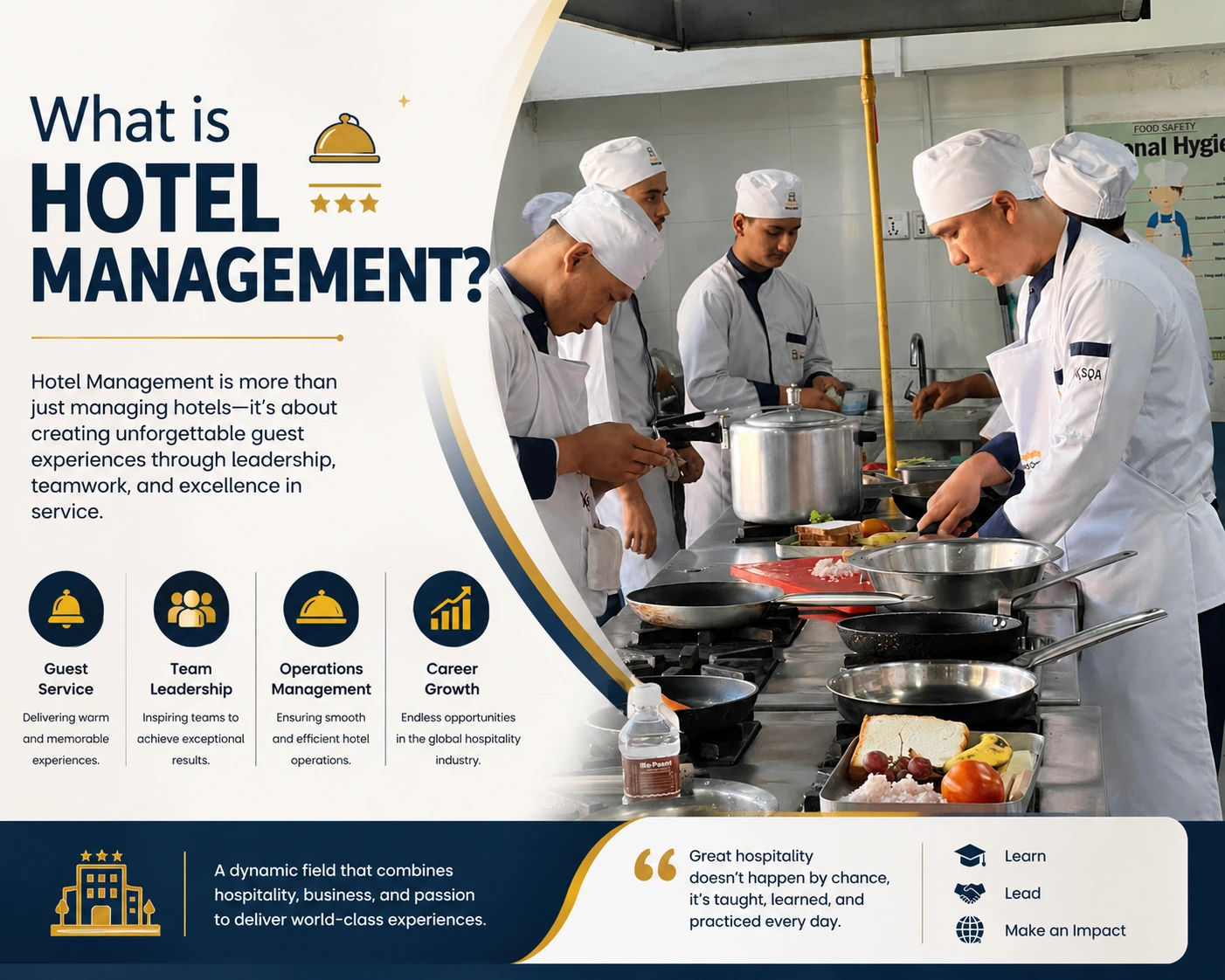
Hotel management is the study and practice of running hotels, resorts, restaurants, and other hospitality businesses. It covers everything from how a guest is welcomed at the front desk to how the kitchen operates, how rooms are kept clean, and how a business earns profit. It combines people skills, business knowledge, and practical service training all in one.
Unlike general management, which focuses mostly on theory and business administration, hotel management is very hands-on. You do not just sit in a classroom and read books; you practice cooking, you serve guests, you operate a real front desk, and you learn by doing. This practical approach is what makes it different and more exciting for students who enjoy working with people.
Major Departments in Hotel Management
Hotel management covers several key departments, each with its own role and career path:
- Front Office: The first point of contact for guests. Receptionists, guest service agents, and front office managers work here. This team handles check-in, check-out, reservations, and guest queries.
- Food and Beverage Service: This department manages restaurants, room service, banquets, and bars. You learn how to serve food professionally and manage dining operations.
- Housekeeping: Keeping hotel rooms, corridors, and public areas spotless. Housekeeping managers ensure that cleanliness standards are always met and that guests feel comfortable.
- Culinary or Kitchen Operations: Chefs and cooks prepare food for guests. This area teaches you culinary arts, food safety, menu planning, and kitchen management.
- Hospitality Marketing and Sales: Getting guests to book the hotel through digital marketing, travel agencies, and corporate tie-ups. Sales teams also handle group bookings and events.
- Event and Tourism Management: Planning conferences, weddings, cultural events, and tours. Nepal is growing fast in destination weddings and MICE (Meetings, Incentives, Conferences, and Exhibitions) tourism.
Skills Required to Succeed in Hotel Management
Hotel management is about people as much as it is about operations. The skills that help you succeed include:
- Strong communication: You must speak clearly and listen carefully to guests from different countries and backgrounds.
- Customer service mindset: You genuinely care about making the guest’s experience positive, even when things go wrong.
- Teamwork and leadership: Hotels run on teams. You must work well with others and eventually lead your own team.
- Time management: In a busy hotel, every minute matters. Breakfast must be ready at 7 AM, check-out by noon, and a banquet ready by 7 PM. You learn to manage this all at once.
- Problem-solving: A guest’s room has no hot water, a reservation was double-booked, or the chef called in sick. Hotel managers face real problems every day and must solve them calmly and quickly.
Why Hotel Management is Growing Fast in Nepal in 2026
Growth of Nepal’s Tourism Industry
The numbers speak clearly. Nepal welcomed 1,158,459 international tourists in 2025, almost back to the pre-pandemic peak of 1,197,191 in 2019. Then in January 2026 alone, 92,573 tourists arrived, which is a 15.7% increase over January 2025. Industry experts are now projecting between 1.3 to 1.5 million international tourists in 2026, which would be a historic record.
Adventure tourism remains Nepal’s biggest draw Everest treks, Annapurna circuits, white water rafting, bungee jumping. But religious tourism is growing too, with Lumbini attracting pilgrims from India, Sri Lanka, Japan, and China. Domestic tourism has also increased, with Nepali families and young people travelling more within the country. All of this means demand for hotels and trained staff is rising every year.
Expansion of Hotels and Resorts in Nepal
Nepal’s hotel industry is expanding at a rate that has not been seen before. Major international brands are entering the Nepal market right now:
- IHG Hotels and Resorts has signed agreements to open four properties in Nepal InterContinental Kathmandu Lazimpat (225 rooms), Hotel Indigo Pokhara, InterContinental Resort Pokhara Begnas Lake, and InterContinental Resort Chitwan. These four hotels will bring close to 500 international-standard rooms to Nepal.
- Centara Hotels and Resorts from Thailand entered Nepal for the first time with the opening of the Himalayan Hideaway Resort Pokhara in January 2026, located in the scenic Kaskikot area with views of the Fishtail Mountain range.
- Royal Tulip Chitwan, a brand under the Louvre Hotel Group, launched in Sauraha with an investment of Rs 1.5 billion, becoming Chitwan’s first international five-star resort.
- Boutique hotels and eco-resorts are growing around trekking routes, lake sides, and heritage areas.
When international brands open hotels in Nepal, they need locally trained professionals who understand both global service standards and Nepali culture. That is exactly what a hotel management graduate can offer.
Increasing Demand for Skilled Hospitality Professionals
Nepal’s hospitality industry has a clear and well-documented shortage of trained manpower. Hotels are expanding, but the supply of trained graduates is not keeping pace. Employers consistently say that students with formal hotel management education those who have done practical training, understand hygiene and service standards, and can communicate in English are far more preferable than someone without any training.
When you study hotel management, you are not just getting a certificate. You are becoming the kind of professional that a Marriott, a Hyatt, or a luxury boutique resort in Pokhara will actually want to hire.
Scope of Hotel Management in Nepal
Career Opportunities in Nepal
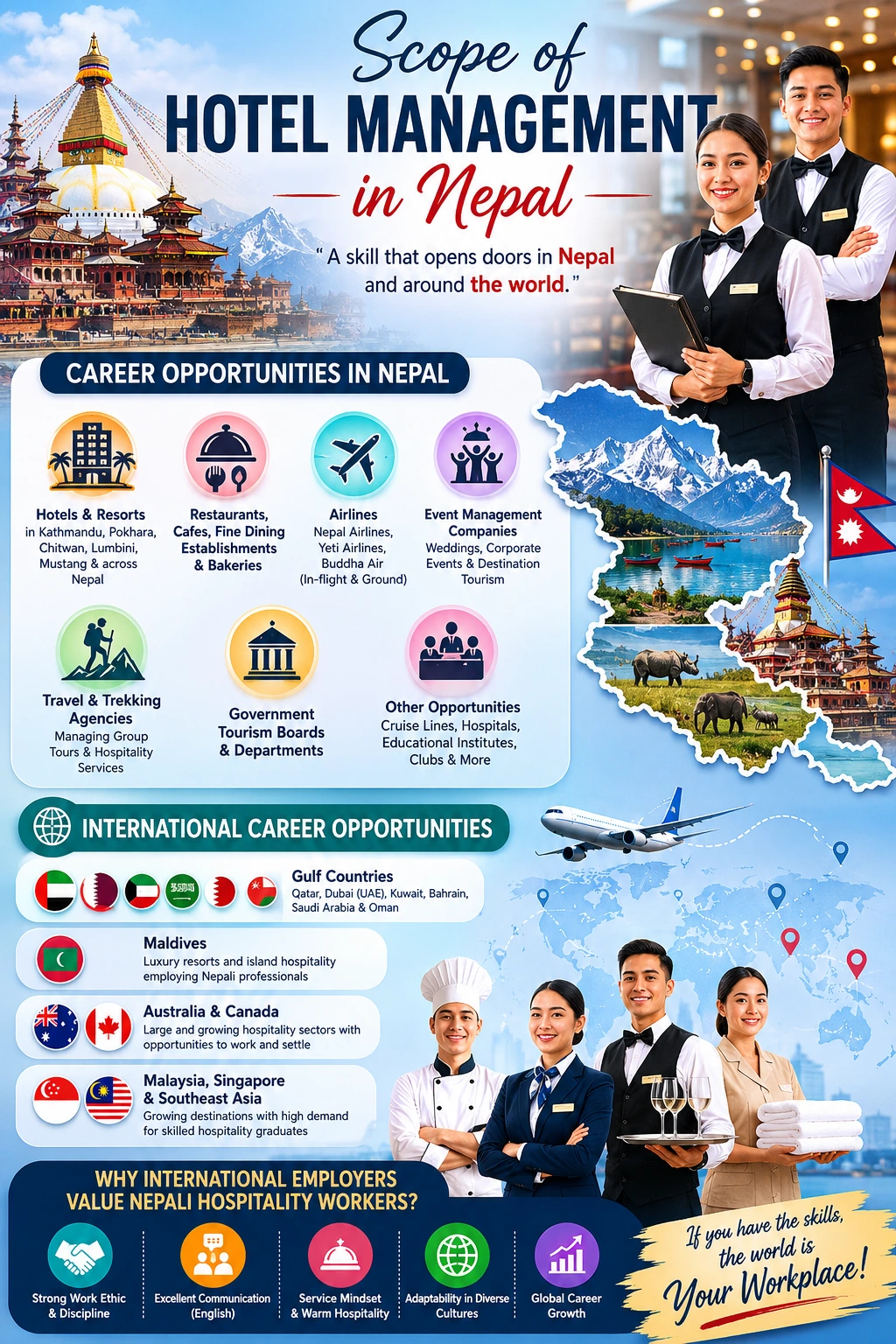
After completing your hotel management course, you can work in a wide range of industries within Nepal itself:
- Hotels and resorts in Kathmandu, Pokhara, Chitwan, Lumbini, Mustang, and across Nepal’s growing tourism belt
- Restaurants, cafes, fine dining establishments, and bakeries
- Airlines Nepal Airlines, Yeti Airlines, Buddha Air all have in-flight and ground hospitality roles
- Event management companies handling weddings, corporate events, and destination tourism
- Travel and trekking agencies where hospitality skills are valued for managing group tours
- Government tourism boards and departments that need hospitality-trained staff
International Career Opportunities
This is where hotel management truly opens big doors. Hotel jobs abroad from Nepal are among the most accessible international opportunities for Nepali graduates. Countries actively hiring Nepali hospitality professionals include:
- Gulf countries: Qatar, Dubai (UAE), Kuwait, Bahrain, Saudi Arabia, and Oman. International hotel groups like Marriott, Hilton, and Hyatt operate hundreds of properties in these countries and regularly hire trained Nepali staff. Most international employers in the Gulf provide accommodation, meals, transport, and medical insurance on top of the salary.
- Maldives The island resort economy of the Maldives employs large numbers of South Asian hospitality workers, including Nepalis, across its luxury overwater resort properties.
- Australia and Canada These countries have large and growing hospitality sectors, and their immigration programs create opportunities for skilled hospitality professionals to work and eventually settle.
- Malaysia, Singapore, and Southeast Asia Growing as destinations for experienced Nepali hospitality graduates.
International employers value Nepali hospitality workers for service discipline, adaptability, and a genuine warmth that guests appreciate. If you have good English communication and practical hotel skills, the world is your workplace.
Entrepreneurship Opportunities
Not every hotel management graduate wants to work for someone else and that is perfectly fine. Nepal’s growing cafe culture, food delivery market, and tourism-linked economy create real entrepreneurship opportunities for hospitality graduates. You can start:
- A cafe or specialty coffee shop Kathmandu and Pokhara’s cafe scenes are growing, and there is real demand for quality experiences
- A restaurant or bakery: Food businesses are one of the most accessible ways to use hospitality skills
- A homestay or guesthouse: Nepal’s government is actively supporting community homestay programs in rural and trekking areas
- A catering company: Weddings, corporate events, and social gatherings are a steady market
- An eco-resort or boutique hotel: Nepal’s nature tourism creates demand for small, experience-focused stays
When you study hotel management, you learn business accounting, marketing, and human resource management alongside service skills. This combination makes you a better entrepreneur, not just a better employee.
Top Career Options After Hotel Management in Nepal
Hotel Manager
The hotel manager oversees all hotel operations staff, guest satisfaction, budgets, and standards. It is the most senior role you can reach in a hotel property. In Nepal, experienced hotel managers with a bachelor’s degree can earn between NPR 100,000 to over NPR 200,000 per month at upper-scale properties. Getting there takes 8 to 12 years of experience, starting from entry-level roles and moving through supervisor and department head positions. In Kathmandu, a hotel manager with a bachelor’s degree earns an average of around NPR 2 million per year.
Chef and Culinary Expert
Nepal has a growing restaurant culture, and trained chefs are in demand. You can specialize in Nepali cuisine, Continental, Asian, or pastry and baking. International opportunities are particularly strong a trained Nepali chef can find work in hotel kitchens across the Gulf, Southeast Asia, Australia, and beyond. Culinary specialization is a path where your skill grows continuously throughout your career the better your cooking, the more you earn.
Front Office Executive
Front office work is where most hotel management graduates begin. As a front office executive, you manage guest check-in and check-out, handle reservations, deal with guest complaints, and make sure every guest leaves with a positive impression. Good communication skills and a pleasant personality are the main requirements. Entry salary starts at NPR 20,000 to 40,000 per month and grows quickly with experience.
Food and Beverage Manager
The F&B manager oversees restaurants, room service, bars, and banquets. This is a well-paying and dynamic role because food service is at the heart of a hotel’s daily revenue. F&B managers at quality hotels in Nepal can earn NPR 50,000 to 80,000 per month, with additional benefits like service charges that can add meaningful income on top of the base salary.
Housekeeping Manager
Housekeeping may not sound glamorous, but it is one of the most important departments in any hotel. Guests will forgive slow room service, but they will not forgive a dirty bathroom. Housekeeping managers at luxury hotels earn competitive salaries and often have strong opportunities to move into operations management roles. International luxury hotel chains particularly value well-trained housekeeping professionals.
Event and Tourism Manager
Nepal is growing as a destination wedding and MICE tourism destination. Couples from India and other countries are choosing Pokhara and Kathmandu for their wedding events. Corporate groups are using Nepal for conferences and retreats. Event managers plan and execute these experiences from décor and catering to accommodation and cultural activities. This is a creative, high-energy role with growing demand.
Salary of Hotel Management Professionals in Nepal in 2026
Entry-Level Salary in Nepal
Fresh hotel management graduates in Nepal typically start with monthly salaries ranging from NPR 20,000 to NPR 40,000. The specific amount depends on the hotel’s star rating, the city, and the department. In addition to the base salary, many hotels offer practical benefits that add real value meals during shift, accommodation if the property is a resort in Pokhara or Chitwan, uniform allowances, and service charge sharing that can add NPR 5,000 to 10,000 per month.
During internship, stipends range from NPR 8,000 to 15,000 per month, but the experience and hotel network you build is more valuable than the stipend itself.
Mid-Level and Experienced Salary
With two to five years of experience, salaries increase to NPR 30,000 to 60,000 per month as you take on supervisory roles. At the senior and management level department heads, food and beverage managers, operations managers salaries range from NPR 60,000 to 120,000 per month or more. A Hotel Manager with a bachelor’s degree in Nepal earns an average of around NPR 158,000 per month, with the top earners reaching NPR 250,000 or higher at premium properties.
International Salary Opportunities
This is the real earning potential for Nepali hospitality graduates. Working in Gulf countries, the Maldives, or Southeast Asia typically means a base salary that is 3 to 5 times what you would earn in Nepal for the same role, plus accommodation, meals, transport, and medical insurance provided by the employer. A front office executive earning NPR 25,000 in Kathmandu can earn the equivalent of NPR 80,000 to 120,000 per month in Qatar or Dubai without paying for rent or food. The savings potential is significantly higher, and the experience you gain accelerates your career back home or internationally.
Best Hotel Management Courses in Nepal
Diploma in Hotel Management
A diploma in hotel management is typically a one to two year program. It is the fastest way to enter the hospitality industry with proper training. Diploma graduates learn the practical skills needed for front office, food service, housekeeping, and kitchen operations. This is a good choice if you want to start working quickly or if you plan to go abroad for hotel work after your training.
Bachelor in Hotel Management (BHM)
The Bachelor of Hotel Management is a four-year undergraduate degree. It gives you both the practical skills and the management knowledge needed to grow into leadership roles. A BHM graduate is better positioned for promotion to supervisory and management levels than a diploma holder. The curriculum covers hotel operations, food and beverage management, housekeeping, hospitality marketing, hotel accounting, human resource management, and business communication all combined with hands-on practical training. Internship is a required part of the BHM program, and this is where students get their first real hotel experience and often their first job offers.
The average cost of a BHM program in Nepal ranges from NPR 4,00,000 to NPR 10,00,000 depending on the institution and its facilities.
Short-Term Hospitality Courses
For students who want to build specific skills quickly, short-term courses are available in areas like barista and coffee making, bakery and pastry, professional cooking, front office operations, and housekeeping fundamentals. These can be completed in a few weeks to a few months and are useful for students who want to start a small food business or secure a specific entry-level role.
Hotel Management Subjects and Skills You Will Learn
Practical Hospitality Training
Hotel management education is built around doing, not just reading. In your course, you will actually cook in a training kitchen, practice serving guests at a training restaurant, make beds and maintain rooms in a housekeeping lab, and handle reservations at a simulated front desk. This practical training is what separates a hotel management graduate from someone who has just read about hospitality theory.
Personality and Communication Development
One underrated part of hotel management education is how much it develops you as a person. You will learn professional grooming standards how to dress, how to stand, how to make eye contact. You will practice public speaking, guest interaction role plays, and professional telephone etiquette. By the time you finish your course, the way you carry yourself and communicate will have changed noticeably. This confidence and polish is something employers in Nepal and abroad both notice immediately.
Business and Management Knowledge
As you progress through your BHM program, you also gain solid business knowledge that makes you a better manager. This includes hotel accounting understanding revenue, costs, and profit in a hospitality business. You will study hospitality marketing, learning how hotels attract guests through online platforms, travel agencies, and direct bookings. Human resource management teaches you how to recruit, train, and lead a team. These business skills are what allow hotel management graduates to eventually run their own businesses or reach general manager level in an international hotel.
Best Colleges for Hotel Management in Nepal
What to Look for in a Hotel Management College
Not all hotel management colleges in Nepal offer the same quality of education. When choosing a college, focus on these key factors:
- Practical training facilities: Does the college have a real training kitchen, a front office lab, a housekeeping lab, and a training restaurant? Theory without practice is not real hotel management education.
- Industry internship partnerships: Which hotels does the college send its students to for internships? A college with partnerships at four and five-star properties gives you a much stronger start than one without hotel connections.
- Faculty experience: Are your teachers people who have actually worked in hotels or only academics? Real hotel experience in the classroom makes a significant difference.
- Affiliation and recognition: Is the program affiliated with a recognized university? International affiliations add global credibility to your degree.
- Placement support: Does the college help graduates find jobs? A good college tracks and supports its graduates after they finish studying.
Importance of Industry Internships
The internship period in a hotel management course is not just a requirement to complete it is often the most important part of your education. During an internship, you work in a real hotel, following real schedules, serving real guests, and making real mistakes that you learn from. You build a professional network of hotel industry contacts. Many students receive job offers from the same hotel where they interned. The quality of your internship hotel matters enormously.
Questions Students Should Ask Before Admission
Before you pay your admission fee and commit to a hotel management college, ask these questions directly:
- What is the college’s affiliation and which university is the degree recognized by?
- Which hotels does the college partner with for student internships?
- What percentage of graduates from the last batch found employment within six months of graduating?
- Can I visit the training kitchen and front office lab before enrolling?
- What is the total course fee including all semesters, and are there any hidden costs?
Advantages of Studying Hotel Management in Nepal
Strong Career Growth Opportunities
Hospitality is one of the few industries where hard work, personality, and practical skill genuinely determine how fast you grow more than connections or family background. A motivated hotel management graduate who does good work during internship, keeps learning, and treats every guest interaction as important can reach supervisor level within two years and management level within five to seven years. The industry is large and still growing in Nepal, which means there is consistent room to move upward.
Opportunities to Work Abroad
For young Nepalis who want to see the world while building a career, hotel management is one of the most reliable paths. Unlike many foreign employment opportunities which are unskilled labor, hotel management graduates go abroad as skilled professionals as front office executives, as trained cooks, as housekeeping supervisors. This means better salary, better treatment, and a career that keeps developing internationally.
Personality and Confidence Development
Students who go through a proper hotel management program change in ways that go beyond technical skill. The training in communication, professional behavior, guest handling, and leadership builds genuine confidence. This confidence helps not just in a hotel career but in any professional or personal situation in life. Many hotel management graduates say that the personality development they experienced during their studies was as valuable as the job skills they learned.
Challenges in the Hotel Management Industry
Work Pressure and Long Hours
Let us be honest about the realities. Hospitality is not a nine-to-five job. Hotels operate 24 hours a day, 365 days a year. As a new professional, you will work morning shifts, evening shifts, and sometimes night shifts. Peak tourist season means busier days and longer hours. Weekends and festivals when your friends are resting may be your busiest working days. This is the reality of the industry, and it is important to understand this before choosing the field. The good news is that with experience and seniority, your schedule and conditions improve significantly.
Importance of Patience and Customer Handling
Not every guest is easy. Some guests complain about things that are not your fault. Some are rude, some are demanding, and some are simply having a bad day and taking it out on hotel staff. Learning to handle these situations professionally to remain calm, listen carefully, apologize genuinely, and resolve the issue is one of the most important skills you develop in hotel management. It takes patience, and it takes practice, but it makes you a stronger professional.
Competition in the Hospitality Industry
As more colleges offer hotel management courses and more graduates enter the market, competition for good positions increases. The way to stand out is to invest in continuous learning learn a second language (even basic Mandarin or Japanese can help significantly in Nepal’s hotel industry), stay updated on new hospitality technology, and build a genuine reputation for excellent service wherever you work. Your personal brand matters.
Is Hotel Management a Good Career in Nepal in 2026?
Who Should Choose Hotel Management?
Hotel management is the right choice for students who genuinely enjoy working with people, who take satisfaction from making someone’s experience comfortable and positive, who are curious about food, culture, and different parts of the world, and who do not mind a dynamic, fast-moving work environment. If you are someone who likes variety, who enjoys problem-solving, and who wants a career that can take you internationally, hotel management fits you well.
It is not the right choice for someone who wants a quiet, desk-based nine-to-five routine. Be honest with yourself about what kind of work environment suits you.
Future Scope of Hospitality Careers
The hospitality industry is evolving. Technology is becoming part of everyday hotel operations from online booking systems to digital check-in, from property management software to revenue management tools. Hotel management graduates who are comfortable with technology will have an advantage. Sustainable tourism is also a growing priority, with eco-resorts, responsible travel, and community tourism all creating new types of hospitality roles.
As Nepal aims to reach 2 million tourists annually in the coming years, the demand for trained hospitality professionals will only grow. The government is investing in new airports, road connectivity, and tourism infrastructure. The private sector is bringing in international hotel brands. All of this creates long-term career stability for trained hotel management professionals.
Final Verdict on Hotel Management Scope
Hotel management in Nepal in 2026 is a strong career choice. The industry is growing, international brands are entering the market, tourism numbers are recovering and climbing, and there is a genuine shortage of well-trained professionals. Salaries may start modestly, but they grow with experience. The international opportunities are real and accessible. And if you want to be your own boss someday, the business skills you learn in hotel management will support that goal too.
The key is to choose the right institution one with real practical training facilities, real hotel internship partnerships, and a genuine track record of placing graduates in the industry.
Frequently Asked Questions (FAQs)
What is the scope of hotel management in Nepal?
The scope is strong and growing. Graduates can work in hotels, resorts, restaurants, airlines, event companies, and travel agencies in Nepal. Internationally, countries like Qatar, Dubai, the Maldives, Australia, and Malaysia actively hire Nepali hospitality professionals. Entrepreneurship in food and hospitality is also a growing option.
Is hotel management a good career in Nepal in 2026?
Yes. Nepal’s tourism sector is expanding, international hotel brands are entering the market, and there is a documented shortage of trained hospitality professionals. The timing is genuinely good for students entering this field in 2026.
What is the salary of hotel management graduates in Nepal?
Fresh graduates typically earn NPR 20,000 to 40,000 per month in entry-level roles. With two to five years of experience, salaries reach NPR 30,000 to 60,000. Senior managers and department heads can earn NPR 60,000 to 120,000 or more. Many positions also include additional benefits like meals, accommodation allowances, and service charges.
Can hotel management students work abroad?
Yes. Countries in the Gulf region (Qatar, UAE, Kuwait, Bahrain), the Maldives, Malaysia, Australia, and Canada are among the most common destinations for Nepali hospitality graduates. Most international hospitality employers provide accommodation, meals, and medical insurance in addition to salary.
Which course is best for hotel management in Nepal?
A Bachelor of Hotel Management (BHM) provides the most comprehensive education and opens the widest career doors, including management-level roles and international opportunities. For quicker entry into the workforce, a Diploma in Hotel Management is a solid option. The most important factor, however, is the quality of the institution and its internship partnerships.
How many years does it take to study hotel management?
A BHM degree takes four years. A diploma program typically takes one to two years. Short-term specialized courses can be completed in a few weeks to a few months.
Is hotel management difficult to study?
Hotel management requires effort, but it is not academically overwhelming in the way some pure science or law programs are. The bigger demand is on your attitude and energy the willingness to work with people, to practice service skills repeatedly, and to maintain professionalism even under pressure. If you have the right attitude, the learning comes naturally.
What skills are needed for hotel management?
Communication, customer service mindset, teamwork, time management, problem-solving, and professional grooming are the core skills. English language proficiency is important for working in international standard hotels. A second language Mandarin, Japanese, or Arabic is increasingly valuable.
Conclusion
Key Takeaways About Hotel Management Scope in Nepal
Nepal’s tourism industry is growing, with over 1.15 million tourists in 2025 and a 15.7% surge in arrivals at the start of 2026. International hotel brands like IHG and Centara are opening multiple properties in Nepal. There is a clear shortage of well-trained hospitality professionals. Hotel management graduates can work across hotels, airlines, restaurants, event companies, and travel agencies in Nepal and abroad. Salaries start at NPR 20,000 to 40,000 at the entry level and grow significantly with experience. International earnings are 3 to 5 times higher than domestic, with employer-provided benefits.
Why 2026 is the Right Time to Enter Hospitality
The combination of recovering tourism, new hotel investments, growing international interest in Nepal, and a documented shortage of trained manpower makes 2026 an ideal time to enter hotel management. Students who start a four-year BHM program now will graduate into a market that will be even more active by 2030. Students who start a diploma program now can be working in a hotel within one to two years, right in the middle of Nepal’s hospitality expansion.
Next Step for Students Interested in Hotel Management
Start by visiting colleges that offer real practical training not just theory. Ask about their hotel internship partnerships. Talk to students who are already studying there. And then commit fully, because hotel management is a field where your effort and attitude directly determine how far you go.
If you are looking for a college in Nepal where hotel management education is both practical and career-focused, visit
If you are ready to take the next step, explore the hotel management courses offered at HWC Nepal (hwc.edu.np). HWC offers diploma in hospitality programs with real practical training, industry internship connections, and career placement support. Your hospitality career can start here.
FAQ on Hotel Management Scope in Nepal in 2026
What is the scope of hotel management in Nepal?
Hotel management has strong career scope in Nepal due to the rapid growth of tourism, hotels, resorts, airlines, and restaurants. Graduates can work in hospitality businesses across Nepal or apply for international jobs in countries like Qatar, the UAE, the Maldives, Australia, and Canada.
Is hotel management a good career in Nepal in 2026?
Yes. With Nepal’s tourism industry expanding and international hotel brands entering the market, hotel management is one of the fastest-growing career sectors in Nepal in 2026.
What is the salary of hotel management graduates in Nepal?
Fresh graduates usually earn between NPR 20,000 to NPR 40,000 per month. Experienced professionals and hotel managers can earn NPR 60,000 to NPR 2,00,000+ depending on experience, position, and hotel category.
Can hotel management students work abroad after graduation?
Yes. Hotel management graduates from Nepal are highly demanded in Gulf countries, the Maldives, Southeast Asia, Australia, and Canada. Many employers also provide accommodation, meals, and medical insurance.
Which hotel management course is best in Nepal?
A Bachelor of Hotel Management (BHM) is considered the best option for long-term career growth and management positions. A diploma in hotel management is suitable for students who want faster entry into the hospitality industry.
How many years does it take to study hotel management?
A BHM degree takes four years to complete, while diploma programs usually take one to two years depending on the institution.
What are the eligibility requirements for hotel management in Nepal?
Students who have completed +2 or equivalent education from any stream can apply for hotel management courses in Nepal.
Is hotel management difficult to study?
Hotel management is more practical than theoretical. Students who enjoy communication, teamwork, and hospitality usually find the course engaging and manageable.
What skills are required for hotel management?
Important skills include communication, customer service, teamwork, leadership, time management, problem-solving, and English language proficiency.
Does hotel management include practical training?
Yes. Hotel management courses include hands-on practical training in kitchens, restaurants, housekeeping labs, and front office operations, along with industry internships.