advanced diploma in hospitality management in nepal

Advanced Diploma in Hospitality Management (ADHM) in Nepal

Hospitality World Campus (HWC) offers the Advanced Diploma in Hospitality Management (ADHM), a 21-month, internationally accredited programme designed to prepare students for a successful career in the global hospitality and hotel management industry.

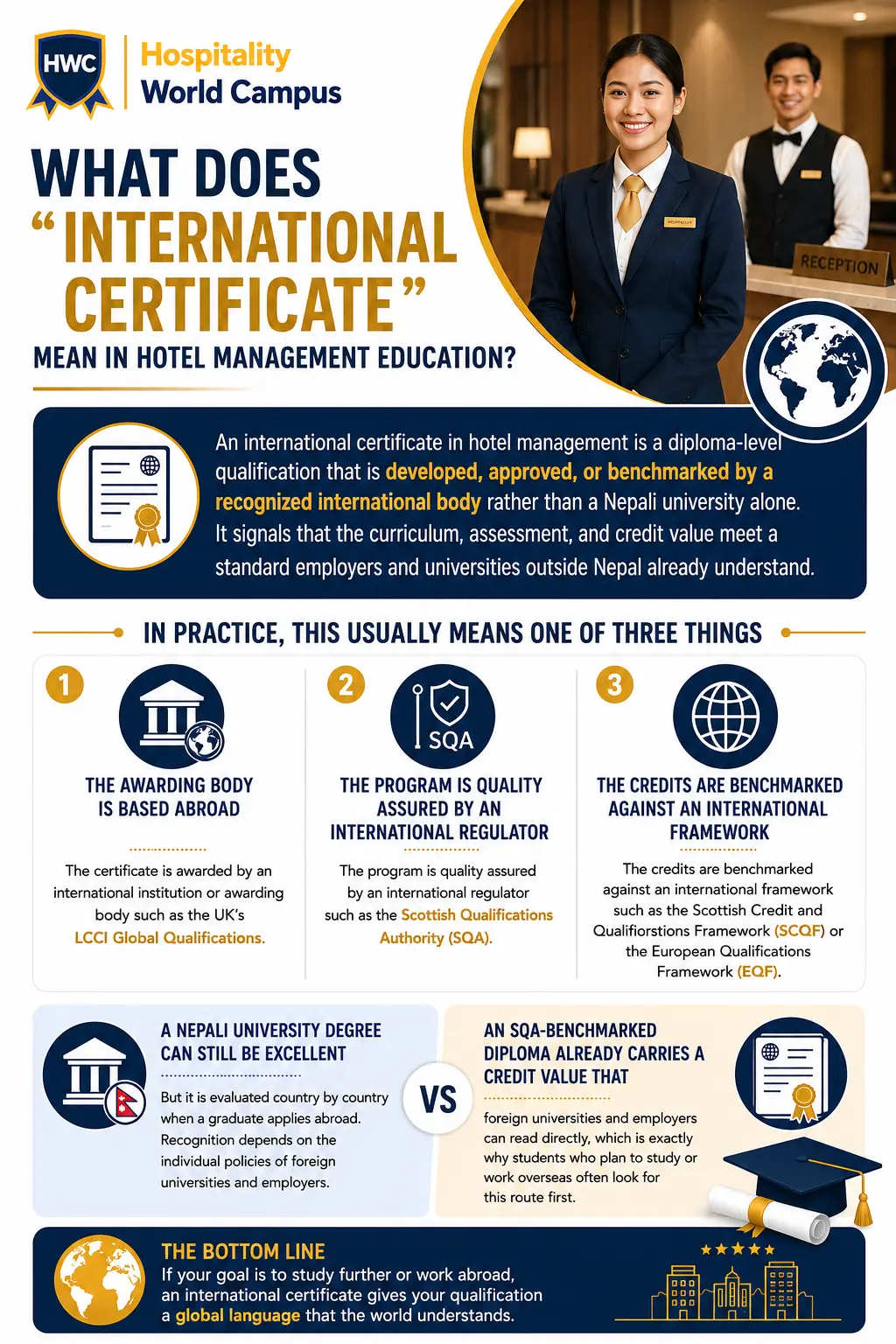
Accredited by Qualifications Scotland and delivered in association with LCCI Global Qualifications, the ADHM from HWC is recognised worldwide and credit-rated at SCQF Level 7 equivalent to Level 5 of the European Qualifications Framework (EQF) and Level 4 of the Qualifications and Credit Framework of England (QCF).

Whether your goal is to launch a career in Nepal’s growing hospitality sector, work in a 5-star hotel abroad, or progress to a bachelor’s degree at a top international university, HWC’s ADHM gives you the qualifications, skills, and industry experience to get there.

What Is the ADHM Programme?

The Advanced Diploma in Hospitality Management is a professional qualification specially designed for students who want to specialise in hotel and hospitality management. It goes beyond theory combining classroom training, practical kitchen and service lab sessions, and a supervised industry internship.

Programme duration: 21 months
Phase 1 – Institution-based academic and practical training: 15 months
Phase 2 – Supervised industry internship: 6 months
Accreditation: Qualifications Scotland (formerly SQA)
Delivery partner: LCCI Global Qualifications
SCQF Level: 7 (comparable to EQF Level 5 and QCF Level 4)

Upon completion, students are equipped to work in core hotel departments including food production and patisserie, food and beverage service, housekeeping, and front office operations or to continue their education at partner universities abroad with significant credit exemptions.

Why Study ADHM at Hospitality World Campus?

HWC is one of Nepal’s leading hospitality education institutions, based in Jawalakhel, Lalitpur. Here is what sets HWC’s ADHM apart from other colleges offering the same programme.

Internationally Accredited Qualification

The ADHM at HWC is accredited by Qualifications Scotland, one of the UK’s most respected qualification bodies. This international accreditation ensures your diploma is recognised by employers and universities worldwide not just in Nepal.

Small Class Sizes and Personal Mentoring

HWC maintains a low student-to-instructor ratio so every student receives close attention, regular feedback, and personalised academic support. Each student is also assigned a dedicated mentor who meets with them individually every month — a rare standard in Nepal’s hospitality education sector.

Hands-On Practical Training

Learning at HWC is not limited to textbooks. Students train in fully equipped kitchen labs, mock front-office setups, and professional food and beverage service environments building real skills before they step into the industry.

Global Internship with Paid Placements

The 6-month supervised internship places students in star-rated hotels and hospitality establishments in Nepal and internationally including Dubai, Malaysia, China, Croatia, and Macau. Many international placements are paid positions.

Credit Transfer to Top Universities Abroad

ADHM graduates from HWC can transfer credits to bachelor’s degree programmes at over 10 universities in the UK, USA, Australia, Ireland, Switzerland, Hungary, UAE, Malaysia, India, and New Zealand — saving up to one full year of study abroad.

Student-First Campus Culture

From curriculum design to placement support, every aspect of HWC’s operations centres on student outcomes. The college’s mission is to produce graduates who excel in skill, integrity, and genuine care for the profession.

ADHM Curriculum: What You Will Study

The ADHM curriculum at HWC covers all core departments of a professional hotel operation, supplemented by management, business, and professional development modules.

Food Production and Patisserie

Students learn professional culinary techniques, international and Nepali cuisine preparation, kitchen management, food safety and hygiene, baking, and pastry arts developing a strong foundation for food production careers.

Food and Beverage Service

This module covers restaurant operations, table service standards, menu planning, bar and beverage management, banqueting and catering services, and customer relations preparing students for front-of-house careers in hotels, restaurants, and event venues.

Front Office Operations

Students develop competency in guest services, reservation management, check-in and check-out procedures, property management systems (PMS), concierge services, and front desk supervision.

Housekeeping Management

This module addresses room preparation and inspection standards, laundry operations, housekeeping supervision, hygiene and sanitation protocols, linen inventory management, and health and safety compliance.

Hospitality Business and Management

Students gain an understanding of hotel accounting basics, human resource management practices, marketing for hospitality, revenue management principles, and relevant hospitality laws and regulations.

Professional Development

HWC’s professional development module covers communication skills, personal grooming and presentation, interview preparation, career counseling, life skills, business etiquette, and hospitality leadership preparing students for workplace success from day one.

ADHM Internship and Industry Placement

The 6-month supervised internship is a core component of the ADHM programme not an optional add-on. It is where students translate classroom learning into professional performance.

HWC’s placement team works with a wide network of domestic and international hotel and restaurant partners to secure internship positions for each student.

Internship Destinations

  • Nepal – 3-star to 5-star hotels in Kathmandu Valley, Pokhara, Chitwan, and trekking properties
  • Dubai, UAE – International chain hotels and luxury resort properties
  • Malaysia – Hospitality groups and world-class resort operations
  • China – Metropolitan hotel properties in major cities
  • Croatia and Europe – Seasonal placements in boutique hotels and resorts
  • Macau and Southeast Asia – Luxury casino-resort and hospitality operations

What Students Gain from HWC Internships

  • Supervised practical experience in a real professional hospitality environment
  • Mentorship and progress tracking by HWC throughout the placement
  • A structured internship report that contributes to the final assessment
  • In many international placements, a paid position with accommodation
  • Direct employment offers many HWC students are hired full-time by their internship employer upon graduation

Credit Transfer: Study Abroad After ADHM

One of the most valuable benefits of completing ADHM at HWC is the ability to use your diploma for lateral entry into bachelor’s degree programmes at universities worldwide. Credit exemptions can save you significant time and tuition fees.

Universities Accepting ADHM Credit Transfer

Canterbury Institute of Management, Australia
Enter BBA in Tourism and Hospitality with 8 course exemptions out of 24.

National University of Ireland Galway: Shannon College of Hotel Management, Ireland
Enter Bachelor of Business in International Hotel Management with 90 credits exempted out of 240.

University College Birmingham, UK
Enter the 4-year Bachelor in International Hospitality Business Management with 120 credits (1 year) exempted.

Queen Margaret University, Edinburgh, Scotland
Direct entry into BA International Hospitality and Tourism Management.

Northern Arizona University, USA
Enter Bachelor of Science in Hotel and Restaurant Management with 13 credits exempted out of 120.

Northwood University, USA
Enter BBA in Hospitality Management with 38 credit exemptions.

IMI University Center, Switzerland
Enter Bachelor of International Tourism and Hotel Management.

Britts Imperial University College, UAE
Enter BBA in Tourism and Hospitality Management with 60 credits exempted out of 180.

Budapest Metropolitan University, Hungary
Enter BA in Tourism and Catering with 90 credits exempted out of 210.

Berjaya University College of Hospitality, Malaysia
Enter Bachelor in Hospitality Management with 16 credit exemptions.

Southern Institute of Technology, New Zealand
Direct entry into 2nd year of Bachelor of Hotel Management.

Graphic Era Hill University, India
Direct entry into 1st or 2nd year of Bachelor of Hotel Management.

Lovely Professional University, India
Direct entry into 1st or 2nd year of BSc Hotel Management.

Contact HWC’s admissions team for the most current information on available credit transfer partnerships.

Career Scope and Job Prospects After ADHM

The global hospitality and tourism industry continues to grow, creating consistent demand for qualified professionals at every level. ADHM graduates from HWC are considered highly skilled professionals by employers in Nepal and internationally.

Career Roles for ADHM Graduates

Hotel and Resort Operations Front Desk Officer, Guest Relations Executive, Housekeeping Supervisor, Front Office Manager, Rooms Division Manager

Food and Beverage Restaurant Supervisor, F&B Manager, Banquet Coordinator, Catering Manager, Bar Manager, Sous Chef, Pastry Chef

Travel and Tourism Hotel Sales Executive, Tour Operations Coordinator, Hospitality Consultant, Tourism Officer

Entrepreneurship Restaurant owner, café operator, catering company, event management firm, or hospitality consultancy with some industry experience, ADHM graduates are well-positioned to launch their own ventures.

Industries That Hire ADHM Graduates

  • International hotel chains Marriott, Hilton, Hyatt, IHG, Radisson, Accor, and others
  • Luxury resorts and boutique properties across Nepal, India, Southeast Asia, and the Middle East
  • Airlines and in-flight catering services
  • Cruise lines operating in Mediterranean, Caribbean, and Asia-Pacific routes
  • Corporate catering and event management companies
  • Hospitals and healthcare hospitality a rapidly expanding sector in Nepal
  • Government tourism and hospitality institutions

Eligibility and Admission Requirements

Who Can Apply for ADHM?

  • Students who have passed SEE (School Leaving Certificate) or SLC or an equivalent examination
  • Must have studied and passed English with a minimum grade of D+ (1.6 GPA)
  • Minimum age of 16 years at the time of admission
  • Students with a +2 qualification or higher are eligible for credit transfer opportunities at international universities

There is no requirement for prior hospitality experience. The ADHM is designed as an entry-level professional qualification for students starting their career in the hospitality industry.

Documents Required for Admission

  • Three copies of SLC or SEE mark sheet and certificate
  • Copy of Citizenship Card or Passport
  • Six passport-size photographs with a white background

Admission Intakes

1st Intake: June / July
2nd Intake: November / December

Seats are limited in each intake. Early application is strongly recommended to secure your place.

Frequently Asked Questions About ADHM in Nepal

Is the ADHM from HWC recognised internationally?

Yes. The ADHM at HWC is accredited by Qualifications Scotland and delivered through LCCI Global Qualifications. It is credit-rated at SCQF Level 7, which is internationally benchmarked and recognised by universities and employers across the UK, USA, Australia, Europe, and beyond.

What is the difference between DHM and ADHM?

The Diploma in Hospitality Management (DHM) is a 15-month foundation-level programme. The Advanced Diploma in Hospitality Management (ADHM) is the 21-month advanced qualification that covers all DHM content plus advanced management subjects, the 6-month industry internship, and the international credit transfer eligibility. The ADHM is the stronger qualification for both employment and further study abroad.

Can I get into a bachelor’s degree abroad after ADHM?

Yes. The ADHM qualifies you for lateral entry into bachelor’s degree programmes at over 13 universities in countries including the UK, USA, Australia, Ireland, Switzerland, Hungary, UAE, Malaysia, New Zealand, and India — often with significant credit exemptions that reduce your remaining study time.

Are international internships paid?

Many of the international internship placements particularly in Dubai, Malaysia, China, and Croatia — include a salary, and some include accommodation. Nepal-based placements may include meals or accommodation in lieu of pay. HWC’s placement team advises each student batch on the specific terms available.

How many intakes does the ADHM have per year?

HWC accepts students twice per year in June/July and again in November/December. Due to small class sizes, seats fill quickly and early applications are encouraged.

Where is Hospitality World Campus located?

HWC is located in Jawalakhel, Lalitpur easily accessible from across the Kathmandu Valley including Kathmandu, Bhaktapur, and Patan.

What makes HWC different from other colleges offering ADHM?

HWC combines the standard ADHM curriculum with a personal mentoring system, small class sizes, hands-on lab training, a dedicated internship placement team, and a student-first philosophy. Rather than treating students as a batch, HWC focuses on individual progress, career readiness, and long-term success in the industry.

Apply for ADHM at Hospitality World Campus

Take the first step toward a globally recognised hospitality qualification and a career in one of the world’s most dynamic industries.

Phone: +977 980-1185389
Email: info@hwc.edu.np
Address: Jawalakhel, Lalitpur, 44600, Nepal
Website: www.hwc.edu.np

Intake is limited. Apply now to secure your seat in the next ADHM batch.

diploma in hotel management in nepal

Diploma in Hotel Management in Nepal: Everything You Need to Know Before You Enroll

“You finished SEE/SLCE. You love people, food, and travel. You’ve heard hotel management pays well and gets you abroad, but you have a hundred questions, and nobody’s giving you straight answers.”

If that sounds like you, you’re in the right place.

This guide covers everything about the Diploma in Hotel Management (DHM) at Hospitality World Campus (HWC) from admission and fees to career scope and real salary figures. No fluff, no confusion. Just clear information so you can decide with confidence.

Nepal’s tourism industry is booming. International chains like Marriott, Hyatt, Radisson, and Dusit International now operate here. The industry directly employs over 500,000 people, and the demand for trained hotel professionals is only rising. Enrolling at HWC puts you right at the front of that opportunity.

What is the DHM at Hospitality World Campus?

The Diploma in Hotel Management (DHM) at HWC is a 15-month industry-focused program designed to prepare you for the real world of hospitality fast. Unlike longer institutional programs, HWC’s DHM is structured to get you job-ready and internationally competitive within 15 months through 9 months of hands-on training followed by a 6-month internship at an actual property.

HWC is located in Jawalakhel, Lalitpur one of the most well-connected areas in the Kathmandu Valley and has been shaping Nepal’s hospitality talent since 2022.

ProgramDurationWhere
Diploma in Hospitality Management (DHM)15 MonthsHWC, Jawalakhel, Lalitpur
Advanced Diploma in Hospitality Management (ADHM)HWC (pathway after DHM)
Diploma in Global Culinary Arts (DGCA)HWC

Why Choose HWC for Your DHM?

Here is what makes HWC stand out from a generic college offering the same qualification.

Small class sizes. HWC deliberately keeps batches small. This is not just a marketing line — it means your lecturers actually know your name, track your progress, and adjust to how you learn. There is a low teacher-to-student ratio that most larger institutions simply cannot offer.

A personal mentor for every student. Every HWC student is assigned a dedicated mentor who meets with them individually once a month. If you are struggling in practical classes, unsure about your career path, or just need guidance, your mentor is the person who has your back. This level of personal attention is rare in Nepal’s hospitality education landscape.

Student-first focus. HWC’s philosophy is simple: your success is their success. The curriculum, the teaching methods, the support systems all of it is built around what you need, not what is convenient for the institution.

Industry-integrated internship. The 6-month internship built into the DHM is not a formality. HWC places students in real properties where they apply everything they’ve learned. That internship is frequently the moment careers begin students get hired, build professional networks, and earn their first references.

A clear pathway forward. After DHM, HWC offers the Advanced Diploma in Hospitality Management (ADHM), giving you a direct route to internationally recognized qualifications without starting from scratch somewhere else.

Am I Eligible? Entry Requirements at HWC

HWC has made the DHM accessible to motivated students right out of SEE.

RequirementDetail
Minimum EducationSEE / SLC passed
Minimum GradeD+ (GPA 1.6) overall
EnglishMinimum D+ (GPA 1.6) in English
Age17 years and above
Entrance ExamInterview / institutional selection process

There is no complex CTEVT entrance exam to navigate. If you have your SEE results, meet the GPA threshold, and have a genuine interest in hospitality, you are a candidate. The process is straightforward reach out to HWC directly at +977 980-1185389 or info@hwc.edu.np to begin.

What Will You Learn? The HWC DHM Curriculum

The DHM at HWC covers every major department of the modern hospitality industry. Classes are taught in English with a strong practical component because hospitality is a skill-based profession, not a theory exam.

Core Areas Covered

  • Front Office & Guest Relations: Check-in/check-out procedures, Property Management Systems (PMS), handling guest queries and complaints, reservations
  • Housekeeping Operations: Room standards, linen management, safety and sanitation, supervisor responsibilities
  • Food & Beverage Service: Table service, banquet operations, bar knowledge, wine fundamentals, room service
  • Food Production & Culinary Foundations: Basic and advanced cooking, bakery and confectionery, HACCP and food safety, Asian and continental cuisines
  • Event & Catering Management: Event planning basics, banquet coordination, catering logistics
  • Business & Communication Skills: Hospitality accounting, marketing fundamentals, professional communication in English, personality development

Semester Structure (15 Months)

PhaseDurationFocus
Phase 1: Classroom & Lab Training9 MonthsTheory + intensive practical sessions across all departments
Phase 2: Industry Internship6 MonthsFull-time placement in a working hotel or hospitality property

The internship is where you stop being a student and start being a hospitality professional. HWC’s industry connections mean you are placed somewhere meaningful, not just somewhere convenient.

How to Apply at HWC

Getting into HWC is a direct, clear process no national entrance exam and no months of waiting.

  1. Contact HWC: Call +977 980-1185389, email info@hwc.edu.np, or visit the campus at Jawalakhel, Lalitpur. You can also consult directly at hwc.edu.np.
  2. Submit Your Application: Bring your SEE marksheet and certificates. HWC’s team will walk you through the form.
  3. Attend the Selection Interview: A short interview to understand your interest in hospitality and confirm your eligibility.
  4. Confirm Enrollment: Pay the applicable fees, submit your documents, and your seat is confirmed.

Documents Required

  • Original SEE/SLC Marksheet and Certificate
  • Character Certificate from previous school
  • Citizenship Certificate or Birth Certificate
  • Passport-size photographs (4–6 copies)
  • Copy of parents’/guardian’s citizenship

The Internship: Where Your Career Actually Starts

The final 6 months of the HWC DHM is a full-time internship inside a real hospitality property. This is the most important phase of the entire program.

HWC places students across departments: Front Office, Food & Beverage, Housekeeping, or Kitchen depending on where your strengths and interests lie. By the end of it, you will have actual job experience on your CV, not just a qualification.

How to get the most from your HWC internship:

  • Treat every shift like a permanent job. Attitude during an internship is how supervisors decide who to hire full-time.
  • Ask to experience multiple departments even if your core rotation is in one area. Breadth matters.
  • Build relationships with senior staff; your first professional references come from here.
  • Keep notes on what you learn. It sharpens your final internship report and prepares you for job interviews.

Career Scope & Salary After DHM

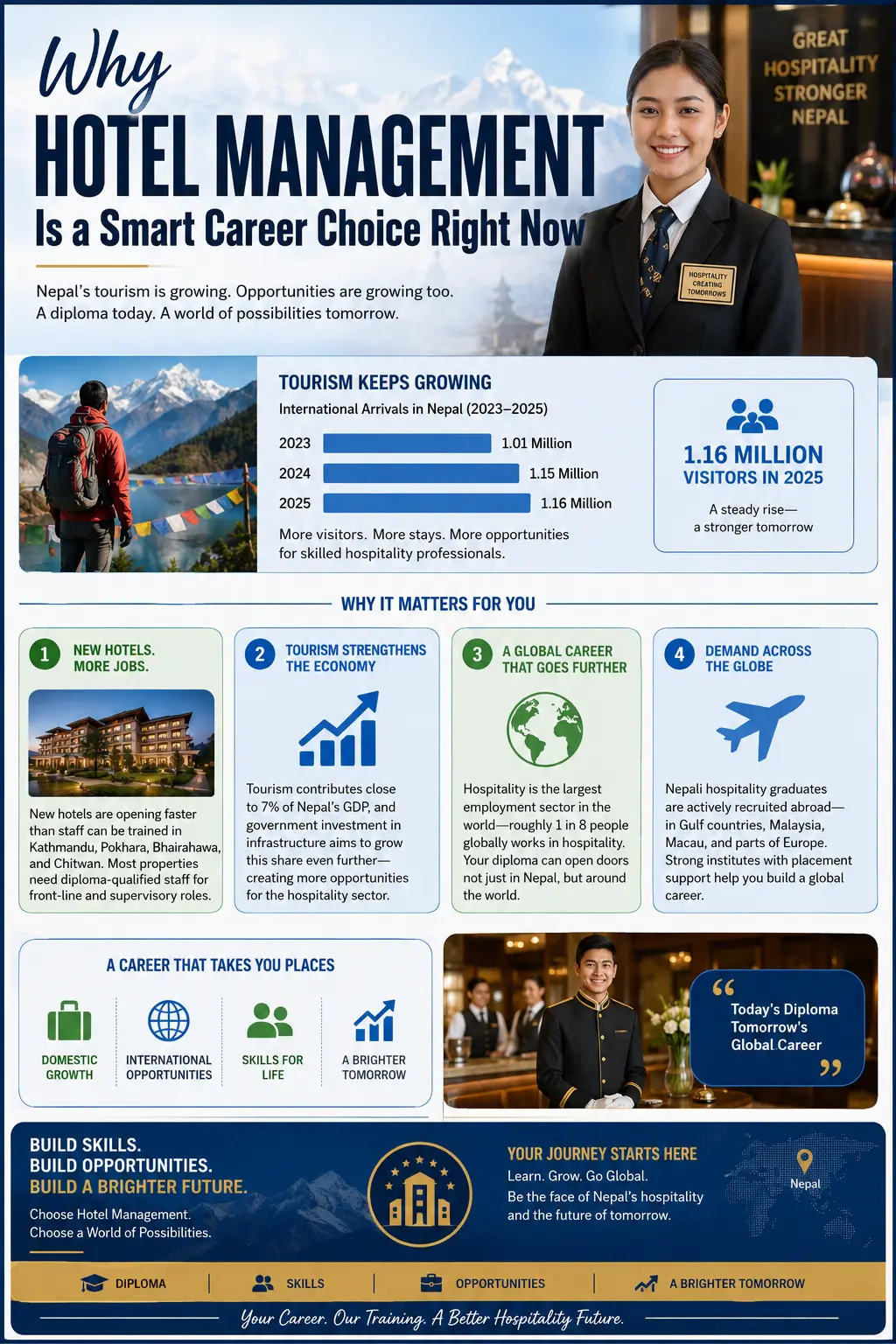
Nepal’s hospitality industry is growing fast. International arrivals reached 1.15 million in 2024, and the Nepal Tourism Board targets 3.5 million visitors annually by 2032. Trained, qualified hospitality professionals are in short supply which means opportunity for HWC graduates.

Roles DHM Graduates Pursue

  • Front Office Associate / Receptionist
  • Food & Beverage Service Staff / Supervisor
  • Cook / Commis Chef / Pastry Staff
  • Housekeeping Supervisor
  • Banquet & Events Coordinator
  • Guest Relations Officer
  • Restaurant Supervisor / Manager (with experience)
  • International hotel chains in UAE, Malaysia, Macau, Europe, Southeast Asia

Realistic Salary Guide: Nepal

RoleEntry Level (NPR/month)With 3–5 Years’ Experience
Waiter / Service Staff13,000 – 25,60030,000 – 45,000
Cook / Commis Chef15,000 – 25,90035,000 – 60,000
Front Office Receptionist15,000 – 25,00030,000 – 50,000
Housekeeping Associate12,000 – 22,00025,000 – 40,000
Banquet Coordinator20,000 – 35,00041,200 – 70,000
Events Manager39,100 – 50,00073,900 – 1,12,000
Hotel Manager (with experience)60,000+1,00,000+

International positions in the UAE, Malaysia, or Europe pay 3 to 8 times Nepal-equivalent salaries. The DHM is the foundation that makes those opportunities reachable.

What Comes After DHM at HWC?

HWC does not leave you stranded after graduation. The campus offers a clear progression:

Advanced Diploma in Hospitality Management (ADHM): Available directly at HWC for DHM graduates. This is your pathway toward internationally recognized qualifications and higher management roles without moving institutions.

Credit Transfer Abroad: HWC actively supports students who want to continue their education internationally. The credit transfer pathway connects your Nepal qualification to programs in partner countries. Details are available at hwc.edu.np/placement/credit-transfer-from-nepal-to-abroad-for-culinary-course/.

Short Professional Certifications: HACCP, Revenue Management, Barista Certification, Sommelier these add immediate salary and CV value and many can be pursued alongside your career.

Bachelor of Hotel Management (BHM): DHM graduates can pursue BHM through TU or Pokhara University, often with credit recognition for prior learning.

Common Questions Students Ask

Is HWC’s DHM government-recognized? HWC’s DHM is a professionally structured diploma program. For specific recognition and affiliation queries, contact the HWC admissions team directly at info@hwc.edu.np they will give you accurate, current information.

How does HWC differ from CTEVT colleges?

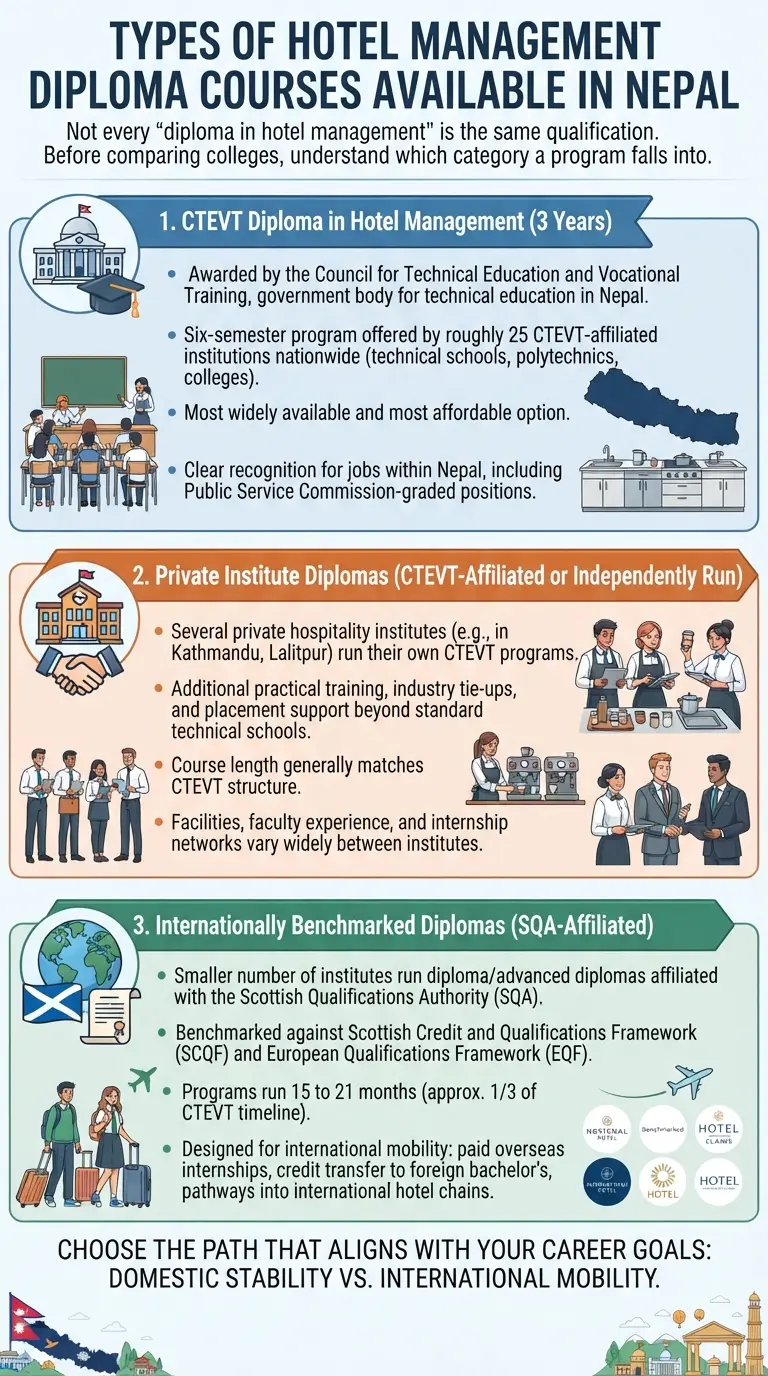
HWC’s DHM runs for 15 months compared to the 3-year CTEVT structure. The curriculum is industry-focused, the class sizes are small, internship placement is managed by HWC, and you have direct access to the ADHM pathway afterward. For students who want to enter the industry faster, with better personal support and stronger placement connections, HWC is the practical choice.

Will my English hold me back?

HWC teaches in English, and the hospitality industry runs on English. If your spoken English needs work, start improving from Day 1. HWC’s small class structure and personal mentoring gives you a much better environment to build language confidence than a lecture hall of 40+ students.

Can I find work abroad after DHM?

Yes. HWC graduates regularly move into international positions. The key is your internship performance, your English fluency, and the professional network you build during training. HWC’s placement support and credit transfer pathways also give you a structured route to studying and working abroad.

Key Takeaways Before You Enroll

  • HWC’s DHM is 15 months: 9 months of training plus a 6-month paid internship. You graduate work-ready, not just qualified.
  • Small classes and a personal mentor mean you are never just a number in a register.
  • The internship is the most important part. Treat it that way from the first day.
  • English fluency is your single most valuable professional asset. Work on it daily.
  • After DHM, ADHM at HWC keeps your career progression moving without switching institutions.
  • One year of international experience after graduation is worth three years locally. Position yourself for it.

Every great hotel manager and head chef once started exactly where you are right now as a trainee, ready to learn.

Ready to take the next step?

Visit hwc.edu.np to explore programs, or contact HWC directly:

📞 +977 980-1185389 📧 info@hwc.edu.np 📍 Jawalakhel, Lalitpur, Kathmandu Valley

6 month diploma in hotel management in nepal

6 Month Diploma in Hotel Management in Nepal

Nepal’s tourism industry is on fire. With international arrivals rebounding strongly, luxury hotels opening across Pokhara and Kathmandu, and an explosion in trekking and adventure tourism, the demand for skilled hospitality professionals has never been higher. If you are looking to enter this dynamic industry quickly, a 6 month diploma in hotel management in Nepal could be your fastest ticket in.

This complete 2026 guide covers everything you need to know from what the course actually teaches, to which colleges offer it, how much it costs, and what salary you can realistically expect after graduation.

What is a 6 Month Diploma in Hotel Management?

A 6 month diploma in hotel management is a short-term vocational certification program designed to equip students with the foundational knowledge and hands-on skills required to work in hotels, resorts, restaurants, and other hospitality establishments. Unlike a three or four-year bachelor’s degree, this program is laser-focused on job-readiness you learn exactly what you need to start working as soon as you graduate.

In Nepal, these programs are typically offered by private hospitality institutes, CTEVT-affiliated colleges, and standalone hotel training centers. The programs combine classroom theory with practical sessions in mock training kitchens, front office setups, and, in many cases, live industry internships.

Overview of the Course Structure and Duration

A standard 6 month hotel management diploma in Nepal is structured across two phases — a classroom phase (roughly 3 to 4 months) followed by a practical training or internship phase (1 to 2 months). Some institutes run both phases concurrently with weekly practical labs from day one.

Duration: 6 months (24 weeks) | Delivery: Classroom + Practical Labs + Internship | Affiliation: CTEVT / NEB / Private | Medium of Instruction: English and Nepali

Key Skills You Will Learn in 6 Months

By the end of a 6 month hotel management diploma, you will have developed a strong foundation across all major departments of a hotel:

  • Front Office Operations: Reservation handling, check-in/check-out procedures, guest relations, and PMS (Property Management Systems)
  • Food and Beverage Service: Restaurant service styles, menu knowledge, banquet operations, and bar basics
  • Housekeeping Fundamentals: Room preparation, linen management, sanitation standards, and guest floor operations
  • Food Production Basics: Kitchen safety, basic cooking methods, continental and Asian cuisine fundamentals
  • Hotel Communication: Professional English, telephone etiquette, complaint handling, and guest satisfaction techniques
  • Tourism and Hospitality Awareness: Nepal’s tourism landscape, cultural sensitivity, and responsible tourism practices
  • Computer and Digital Skills: Hotel software, MS Office, and basic digital communication

Why Choose a 6 Month Hotel Management Course in Nepal?

With dozens of education paths available, why should a young Nepali student seriously consider a 6 month hotel management diploma? The answer lies in the intersection of Nepal’s growing economy, global hospitality demand, and the speed at which this course gets you to your first paycheck.

Growing Hospitality Industry in Nepal

Nepal’s tourism and hospitality sector has been one of the fastest recovering industries post-pandemic. The government has prioritized tourism as a key driver of economic growth. High-profile infrastructure projects including new airports, expanded highway networks, and the development of Lumbini as an international Buddhist pilgrimage hub are bringing unprecedented numbers of international visitors to the country.

Kathmandu’s hotel landscape has transformed dramatically. Five-star brands like Marriott, Hyatt, and Dusit have set up operations, and boutique luxury properties are multiplying in Pokhara, Chitwan, and Mustang. Nepal welcomed approximately 1.07 million tourists in 2024, a 17% increase over 2023. Industry analysts project continued growth through 2030, driven by Visit Nepal promotional campaigns and infrastructure development.

Benefits of Short-Term Diploma Programs

Short-term diploma programs in hotel management offer a unique combination of advantages:

  • Speed to Employment: You can be employed within 7-8 months of enrollment
  • Lower Financial Investment: Total course costs are a fraction of a 3-year bachelor’s degree
  • Practical Orientation: The curriculum is heavily skills-based, making graduates immediately employable
  • Pathway to Further Study: A diploma can serve as a bridge qualification to higher diplomas or bachelor’s programs
  • International Mobility: Short-term certifications are recognized by Gulf, cruise, and European employers
  • Career Clarity: Six months of training helps students identify which department suits them best

Eligibility Criteria for Hotel Management Diploma in Nepal

One of the most attractive features of the 6 month hotel management diploma in Nepal is its relatively accessible entry requirements. Unlike engineering or medical programs, what matters more is your attitude, communication ability, and genuine interest in serving people.

Academic Requirements for Admission

The minimum academic requirements for most 6 month hotel management diploma programs in Nepal are:

  • Completion of SEE (Secondary Education Examination) Class 10 pass for basic diploma levels
  • Completion of +2 (Higher Secondary) or equivalent for higher-level diploma programs at premium institutes
  • Some CTEVT-affiliated programs accept SEE graduates with a minimum D grade across all subjects
  • For TU or Purbanchal University affiliated programs, a +2 pass is generally required
  • Age: Most programs accept students between 16 and 35 years

Skills and Personal Qualities Required

Beyond academic qualifications, admission panels and industry employers look for specific personal qualities:

  • Communication Skills: English proficiency (spoken and written) is a significant advantage
  • Positive Attitude and Enthusiasm: Hospitality is fundamentally a people-first industry
  • Physical Stamina: Hotel work involves long hours on your feet, especially in kitchens and F&B
  • Grooming and Presentation: Professional appearance standards are taken seriously in hospitality
  • Problem-Solving Mindset: The ability to stay calm and find solutions under pressure
  • Cultural Sensitivity: Nepal receives visitors from all over the world; comfort with diverse cultures is essential

Course Curriculum of 6 Month Diploma in Hotel Management

Understanding what is actually taught in a 6 month hotel management diploma helps you evaluate institutes and prepare yourself mentally for the pace and depth of the program.

Core Subjects Covered in the Program

A well-structured program covers the following core modules:

  • Front Office Operations: Reservations, check-in/out, PMS software, guest relations, concierge (40-50 hours)
  • Food & Beverage Service: Restaurant service, table setting, menu knowledge, bar basics, banquets (40-50 hours)
  • Food Production: Kitchen safety, cooking methods, continental & Asian cuisines, pastry basics (40-55 hours)
  • Housekeeping Management: Room cleaning procedures, linen, laundry, sanitation standards (30-40 hours)
  • Hotel Communication: Business English, telephone etiquette, email writing, complaint handling (30-40 hours)
  • Tourism & Hospitality Management: Nepal tourism overview, hotel classification, sustainable tourism (20-30 hours)
  • Computer Applications: MS Office, hotel software basics, social media for hospitality (20-25 hours)
  • Soft Skills & Personality Development: Grooming, body language, teamwork, interview prep (15-20 hours)

Practical Training and Internship Opportunities

The practical component is where a 6 month diploma truly distinguishes itself. Top institutes in Nepal maintain dedicated training kitchens, mock front offices, and service labs where students practice real-world scenarios under supervision.

Most reputable institutes also arrange a 4 to 6 week paid or unpaid internship with partner hotels. These placements are extremely valuable because they often convert directly into full-time employment offers. When evaluating colleges, always ask about their internship partner network — this single factor can determine whether you graduate with a job offer in hand.

Top Colleges Offering 6 Month Hotel Management Courses in Nepal

Choosing the right college is arguably the single most important decision in your hotel management journey. The quality of your training, the credibility of your certificate, and the strength of your industry connections all depend on which institute you attend.

Private Hospitality Institutes in Nepal

  • IMI: International Management Institute Nepal (Kathmandu) International affiliation with Swiss hospitality institutions. Strong placement record in 5-star properties. CTEVT affiliated.
  • HMTTC: Hotel Management & Tourism Training Center (Kathmandu, Bhadrakali) Government institute under Ministry of Tourism. Highly credible certification recognized by Nepal Tourism Board. Affordable fees.
  • Uniglobe College of Hotel Management (Kathmandu): Purbanchal University affiliated. Regular campus recruitment drives by hotel chains. Strong industry connections.
  • INSTEP Pokhara: Ideal location near resort and adventure tourism belt. Strong connections with lakeside hotels and resorts. Practical-first curriculum.
  • Nepal Tourism & Hospitality College / NATHM (Kathmandu): One of Nepal’s oldest hospitality training centers. Well-networked alumni across Gulf and European hospitality sectors.
  • Chitwan & Lumbini Hospitality Institutes: Growing demand due to Lumbini’s international development as a pilgrimage hub. Regional access and affordable fees.

Factors to Consider When Choosing a College

  • CTEVT or University Affiliation: Ensures your certificate is nationally and internationally recognized
  • Training Facilities: Visit the campus; check if training kitchens, front office labs, and service areas are functional
  • Placement Track Record: Ask what percentage of graduates get placed within 3 months and which hotels hire from there
  • Faculty Credentials: Teachers should have real hotel industry experience, not just academic backgrounds
  • Student Reviews: Talk to current or recently graduated students for the most honest picture
  • Industry Visits and Guest Lectures: Institutes with active industry connections provide invaluable networking opportunities

Fees Structure for Hotel Management Diploma in Nepal

Cost is a primary consideration for most students and families. A 6 month hotel management diploma in Nepal is one of the most affordable professional training programs available, especially when you factor in the employment outcomes relative to the investment.

Average Course Fees in Different Institutes

  • Government / HMTTC: NPR 15,000 to 35,000 (includes tuition, basic study materials)
  • Mid-Range Private Institutes: NPR 40,000 to 75,000 (includes tuition, practical labs, some materials)
  • Premium Private Institutes: NPR 80,000 to 1,50,000 (includes tuition, uniforms, labs, placement support, certification)
  • International Affiliation Programs: NPR 1,20,000 to 2,50,000 (full package including international certification)

Additional Costs (Uniforms, Training, Certification)

Beyond tuition fees, students should budget for the following additional expenses:

  • Uniforms and Grooming Kit: NPR 3,000 to 8,000 (chef’s coat, front office uniform, service apron, name badge)
  • Study Materials and Textbooks: NPR 2,000 to 5,000
  • Practical Training Ingredients/Supplies: NPR 2,000 to 4,000
  • Examination and Certification Fees: NPR 1,500 to 5,000
  • Transport and Accommodation: NPR 3,000 to 8,000 per month if studying outside your home district

All-in total cost typically ranges from NPR 25,000 to NPR 1,80,000 depending on the institute — compare this with a 3-year bachelor’s degree costing NPR 4,00,000 to 10,00,000+ and the diploma offers excellent return on investment.

Career Opportunities After 6 Month Diploma in Hotel Management

A 6 month diploma in hotel management opens doors to a wide range of entry-level positions in Nepal’s hospitality sector and internationally. The diploma gives you a credible, industry-recognized foundation that employers respect.

Entry-Level Jobs in the Hospitality Industry

  • Front Desk Associate: NPR 18,000 to 28,000 per month
  • Food & Beverage Attendant: NPR 15,000 to 25,000 per month
  • Housekeeping Associate: NPR 15,000 to 22,000 per month
  • Commis Chef / Kitchen Helper: NPR 14,000 to 22,000 per month
  • Guest Relations Executive: NPR 20,000 to 32,000 per month
  • Banquet & Events Staff: NPR 16,000 to 24,000 per month
  • Tour & Travel Coordinator: NPR 18,000 to 28,000 per month
  • Resort Activities Supervisor: NPR 20,000 to 30,000 per month

Salary Expectations in Nepal and Abroad

Salary varies significantly based on the property tier, department, location, and experience. Here is a realistic salary roadmap:

  • Entry Level (0-1 year): Nepal NPR 15,000-28,000/mo | Gulf $300-$500/mo | Europe/Cruise $800-$1,200/mo
  • Junior Supervisor (2-3 years): Nepal NPR 28,000-50,000/mo | Gulf $500-$900/mo | Europe/Cruise $1,200-$1,800/mo
  • Department Supervisor (4-6 years): Nepal NPR 50,000-90,000/mo | Gulf $900-$1,500/mo | Europe/Cruise $1,800-$2,500/mo
  • Manager Level (7+ years): Nepal NPR 90,000-1,50,000+/mo | Gulf $1,500-$3,000+/mo | Europe/Cruise $2,500-$4,000+/mo

Scope of Hotel Management Career in Nepal and Internationally

The scope of a hotel management career in 2026 is genuinely global. Nepal-trained hospitality professionals are recognized and sought after in several international markets.

Job Opportunities in Nepal’s Tourism Sector

  • 5-Star International Hotels: Marriott, Hyatt, Dusit, Radisson, and Sheraton properties in Kathmandu
  • Boutique and Heritage Hotels: Pokhara, Bandipur, and Bhaktapur’s growing boutique property segments
  • Trekking Lodges and Tea Houses: High-altitude properties on Everest Base Camp, Annapurna Circuit, and Langtang routes
  • Resort and Spa Properties: Chitwan, Bardia, and Mustang’s growing wellness and wildlife tourism sector
  • Airlines and Airport Hospitality: Nepal Airlines, Yeti Airlines, and Tribhuvan International Airport lounge services
  • Event and Conference Centers: BICC and similar large-scale hospitality venues

Opportunities in Gulf Countries, Europe, and Cruise Lines

  • Gulf Countries (UAE, Qatar, Saudi Arabia, Bahrain): Dubai alone has over 700 hotels. Salary packages typically include accommodation and meals, making them highly attractive financially.
  • Cruise Lines (Royal Caribbean, MSC, Costa, Princess): Contracts run 6-9 months. The earning potential combined with zero living expenses at sea makes this one of the most lucrative paths for diploma holders.
  • Europe (UK, Germany, Switzerland, Austria): Switzerland has a storied relationship with Nepali hospitality workers. UK hospitality post-Brexit has opened significant skilled worker visa pathways.
  • Australia and Canada: Both countries offer pathways for experienced hospitality professionals. A diploma combined with 2-3 years of experience is a stepping stone toward permanent residency.

Advantages and Limitations of a 6 Month Diploma Course

Being clear-eyed about what a 6 month diploma can and cannot do for you is the mark of a smart career decision.

Benefits of Short-Term Certification

  • Fast route to employment working within 6-8 months of enrollment
  • Very affordable compared to 3-4 year degree programs
  • Highly practical and industry-oriented curriculum
  • Recognized by Gulf, cruise, and European employers
  • Excellent foundation for further study at diploma or degree level
  • Strong networking with hotel industry through internships
  • Certificate valid and recognized nationally and in major markets

Limitations Compared to Long-Term Degrees

  • Entry-level positions only management roles require more experience or education
  • Salary ceiling is lower without further qualifications
  • Not equivalent to a bachelor’s degree for visa applications in some countries
  • Depth of knowledge is limited compared to full degree programs
  • Some premium hotel chains prefer degree holders for corporate career tracks
  • Quality varies significantly between institutes thorough research is essential

How to Choose the Best Hotel Management Institute in Nepal

Given the variability in quality between institutes, choosing the right college deserves serious time and research. Do not make this decision based on proximity, peer pressure, or flashy brochures alone.

Accreditation and Affiliation Importance

In Nepal’s education landscape, accreditation is your quality guarantee. When evaluating institutes, always verify the following:

  • CTEVT Affiliation: The Council for Technical Education and Vocational Training is Nepal’s premier body for vocational certifications. A CTEVT-affiliated diploma is recognized across Nepal and in many international markets.
  • University Affiliation: Programs affiliated with Tribhuvan University (TU), Purbanchal University (PU), or Pokhara University carry additional weight for further study pathways.
  • Nepal Tourism Board (NTB) Recognition: Institutes recognized by NTB have passed an additional industry validation layer.
  • International Affiliations: Tie-ups with Swiss, UK, or Australian hospitality institutions add significant value to your certificate’s international portability.

Placement Support and Industry Exposure

The best hotel management institutes in Nepal actively work to place you. Ask these direct questions when visiting colleges:

  • What is your placement rate within 3 months of graduation?
  • Which hotels and companies have hired your graduates in the last 2 years?
  • Do you arrange paid or unpaid internships? With which properties?
  • Do hotel HR teams come to your campus for recruitment drives?
  • Do you have an alumni network that mentors current students?

Admission Process for Hotel Management Courses in Nepal

The admission process for most 6 month hotel management diploma programs in Nepal is straightforward. Here is a step-by-step breakdown of what to expect.

Step-by-Step Application Process

  • Step 1: Research and Shortlist Institutes: Create a list of 3-5 institutes based on affiliation, location, fees, and placement record. Visit campuses in person where possible.
  • Step 2: Collect and Review Eligibility Details: Confirm that you meet the academic requirements (SEE or +2) and age criteria for each shortlisted institute.
  • Step 3: Obtain and Fill Application Form: Most institutes have both online and physical application forms. Fill these carefully.
  • Step 4: Submit Documents and Pay Application Fee: Submit all required documents along with any application fee (typically NPR 500 to 2,000).
  • Step 5: Attend Interview or Entrance Test (if required): Premium institutes may conduct a brief personal interview assessing communication skills, motivation, and grooming.
  • Step 6: Receive Admission Letter and Pay Fees: Upon selection, pay the required tuition fees and collect your official admission confirmation.
  • Step 7: Orientation Day: Most institutes hold an orientation session covering campus rules, uniform requirements, schedule, and introductions to faculty.

Documents Required for Admission

  • Original and photocopies of SEE or +2 mark sheet and certificate
  • Character certificate from your previous school or college
  • Citizenship card (Nagarikta) or birth certificate
  • Recent passport-size photographs (typically 4-6 copies)
  • Migration certificate (if applying from a different district or school)
  • Medical fitness certificate (required by some institutes due to kitchen safety requirements)
  • No Objection Certificate (NOC) from parents or guardians if under 18

Tips to Succeed in Hotel Management Career

Getting into hotel management is one thing. Building a career that advances steadily and opens doors abroad is another. Students who flourish in this industry share a specific set of habits and mindsets.

Essential Soft Skills for Hospitality Industry

  • Active Listening: Guests feel valued when they see you truly hearing their needs, not just processing requests
  • Emotional Intelligence: Managing your own emotions and reading the emotional state of guests is critical in complaint situations
  • Time Management: Hotels operate on tight schedules; your ability to prioritize tasks under pressure defines your reputation
  • Adaptability: No two days in a hotel are the same; the ability to switch gears and stay composed is invaluable
  • Professional Communication: Written and spoken communication in both Nepali and English will accelerate your career
  • Attention to Detail: In 5-star hospitality, a wrongly set fork or a misaddressed guest can cost the hotel a repeat booking

Networking and Internship Strategies

  • Treat Every Industry Contact as Career Capital: Senior staff you meet during your internship are potential referees, mentors, and future employers
  • Be Active on LinkedIn: The Nepali hospitality community is active on LinkedIn. Connect with industry professionals and follow hotel brands.
  • Attend Hospitality Events: Nepal Tourism Board events, hotel industry seminars, and World Tourism Day celebrations are prime networking opportunities
  • Pursue Additional Certifications: Barista courses, sommelier basics, WSET wine certifications, or ServSafe food safety qualifications add dimension to your profile
  • Learn a Third Language: Chinese, Japanese, or Korean language basics make you highly employable in Nepal’s fast-growing Asian tourist market
  • Request a Reference Letter After Internship: A strong reference from your internship supervisor is one of the most powerful tools in your job search toolkit

Frequently Asked Questions (FAQs)

Is a 6 Month Diploma Enough for a Career in Hotel Management?

Yes — a 6 month diploma is sufficient to start a professional career in the hospitality industry. It qualifies you for entry-level roles like front desk associate, F&B attendant, housekeeping associate, and kitchen helper at reputable hotels and resorts. However, to access higher management positions or move into international markets more easily, combining your diploma with 2-3 years of solid work experience — and eventually pursuing a higher diploma or bachelor’s degree is the recommended long-term path.

Which is the Best Institute for Hotel Management in Nepal?

The ‘best’ institute depends on your priorities. For government-backed credibility at low cost, HMTTC in Kathmandu is the gold standard. For industry placements and international exposure, IMI Nepal and Uniglobe College are widely respected. For students in the Pokhara region, INSTEP and local CTEVT-affiliated institutes offer excellent practical training. Always visit campuses and speak to recent graduates before making your final decision.

Can I Work in the Gulf After a 6 Month Diploma?

Yes, absolutely. Gulf countries — particularly the UAE, Qatar, and Saudi Arabia regularly hire Nepali hospitality staff with diploma-level qualifications. Many institutes in Nepal have direct tie-ups with Gulf-based recruitment agencies. You will typically need your certificate attested by the Ministry of Education Nepal and the relevant Gulf embassy, alongside a work visa through official labor migration channels (Foreign Employment Board).

How Much Does the Course Cost in Nepal?

Total costs range from approximately NPR 25,000 to NPR 2,00,000 depending on the institute type. Government institutions like HMTTC charge between NPR 15,000 and 35,000. Mid-range private institutes cost NPR 40,000 to 75,000. Premium institutes with international affiliations can go up to NPR 2,50,000. Remember to budget for additional costs like uniforms, books, certification fees, and transport.

Can I Pursue a Bachelor’s Degree After a 6 Month Diploma?

Yes. Many students use the 6 month diploma as a stepping stone into the industry, gain 1-2 years of work experience, and then pursue a Bachelor’s in Hotel Management or Tourism Studies at TU, PU, or private universities in Nepal or abroad. Some institutes also offer credit transfer or advanced standing to diploma holders.

Conclusion: Is a 6 Month Hotel Management Diploma Worth It?

For the right student, absolutely yes. If you want to enter the workforce quickly, build real skills in a global industry, and open doors to both domestic and international career pathways all without the financial burden of a multi-year degree the 6 month hotel management diploma in Nepal delivers exceptional value.

Who Should Enroll in This Course?

This course is ideal for you if:

  • You are a fresh SEE or +2 graduate who wants to start earning quickly
  • You come from a hospitality or tourism-adjacent family background and want to professionalize your skills
  • You are a working adult considering a career switch into the booming tourism sector
  • You eventually plan to pursue higher education but want practical income and experience first

It is less suitable for students who already have a +2 in Science or Management and are aiming for senior management or corporate hotel roles from day one for those ambitions, a full bachelor’s degree program is the wiser long-term investment.

Final Thoughts and Career Advice

Nepal stands at an exciting hospitality crossroads. The hotels being built today, the tourists arriving in record numbers, and the international recognition Nepal’s mountains and culture are receiving all of this creates a genuine, sustained need for trained, professional, enthusiastic hospitality workers. A 6 month diploma is your entry point into that world.

Choose your institute with care. Commit to your practical training. Build your network from day one of your internship. Say yes to every learning opportunity. And remember: in hospitality, the people who rise fastest are not always those with the best grades they are the ones who make every guest feel genuinely seen, heard, and valued.

Your career in hotel management starts with a single application. Make it today.

chef salary in nepal

Chef Salary in Nepal: Best Guide

How much does a chef really earn in Nepal? Whether you are a BHM student or you are doing diploma in global culinary arts or you are doing professional chef course in Nepal student planning your future, a working cook benchmarking your worth, or a restaurant owner building a fair salary structure this guide gives you real numbers, salary tables, and clear guidance.

Average Chef Salary in Nepal (2026)

LevelMonthly Salary (NPR)Typical Role
Entry Level (0–1 yr)NPR 12,000 – 20,000Commis Chef
Junior (1–3 yrs)NPR 18,000 – 30,000Demi Chef
Mid-Level (3–6 yrs)NPR 28,000 – 50,000Chef de Partie
Senior (6–10 yrs)NPR 45,000 – 90,000Sous Chef
Expert (10+ yrs)NPR 80,000 – 1,50,000Head / Executive Chef

Note: Service charges and benefits can add 20–40% on top of base salary in 4-star and 5-star hotels.

Chef Salary by Experience Level

Commis Chef (0–2 Years)

PositionExperienceMonthly Salary (NPR)Workplace
Commis Chef I0–1 yearNPR 12,000 – 16,000Small restaurant / café
Commis Chef II1–2 yearsNPR 15,000 – 20,0003-star hotel / resort
Commis Chef (5-star)0–2 yearsNPR 18,000 – 25,0005-star hotel, Kathmandu

Demi Chef (2–4 Years)

PositionExperienceMonthly Salary (NPR)
Demi Chef de Partie2–3 yearsNPR 18,000 – 28,000
Demi Chef (5-star)3–4 yearsNPR 25,000 – 35,000

Chef de Partie (4–7 Years)

SpecializationMonthly Salary (NPR)
Hot KitchenNPR 28,000 – 45,000
Cold Kitchen / Garde MangerNPR 26,000 – 40,000
PastryNPR 30,000 – 50,000
Continental / InternationalNPR 32,000 – 55,000

Sous Chef (7–10 Years)

Hotel TypeSous Chef Salary (NPR/month)
5-Star HotelNPR 55,000 – 90,000
4-Star HotelNPR 40,000 – 60,000
3-Star HotelNPR 28,000 – 40,000
Resort (Pokhara / Chitwan)NPR 35,000 – 55,000

Head Chef / Executive Chef (10+ Years)

RoleMonthly Salary (NPR)Key Benefits
Head Chef (4-star)NPR 50,000 – 75,000Accommodation, meals
Head Chef (5-star)NPR 75,000 – 1,10,000Full benefits package
Executive Chef (5-star)NPR 90,000 – 1,50,000Housing, medical, transport
Corporate ChefNPR 80,000 – 1,40,000Bonus + profit share

Chef Salary by Hotel / Workplace Type

WorkplaceCommis (NPR)Chef de Partie (NPR)Head Chef (NPR)
5-Star Hotel (Kathmandu)18,000–25,00038,000–58,00090,000–1,50,000
4-Star Hotel15,000–20,00028,000–42,00055,000–80,000
3-Star Hotel12,000–18,00022,000–32,00035,000–50,000
Tourist Restaurant12,000–18,00020,000–35,00035,000–60,000
Cafe / Bakery10,000–16,00018,000–28,00025,000–40,000
Resort (Pokhara/Chitwan)14,000–20,00025,000–40,00045,000–70,000
Trekking / Everest Resorts18,000–28,00030,000–50,00055,000–85,000

Chef Salary by City in Nepal

City / RegionAverage Salary (NPR)Key EmployersNote
Kathmandu Valley20,000 – 1,20,000Hyatt, Marriott, Radisson, TajHighest pay, highest cost
Pokhara15,000 – 60,000Lakeside resorts, boutique hotelsStrong tourism season
Chitwan (Sauraha)14,000 – 45,000Safari lodges, jungle resortsIncludes accommodation
Lumbini12,000 – 35,000Pilgrim hotels, guesthousesGrowing destination
Everest / Annapurna Region20,000 – 55,000Trekking lodges, high campsFull board + bonuses

Hotel Chef vs Restaurant Chef vs Cafe Chef

Factor5-Star HotelTourist RestaurantCafe / Bakery
Base SalaryHighestMediumLowest
Service ChargeHigh (15–25%)VariableMinimal
BenefitsFull (medical, PF, bonus)PartialUsually none
Work PressureVery HighModerate–HighModerate
Working Hours10–14 hrs/day8–12 hrs/day8–10 hrs/day
Career GrowthStructured, fastDepends on ownerLimited
Creative FreedomLow (fixed menus)MediumHigh
Best ForCareer buildersBalanced lifestylePassion-led chefs

What Factors Increase a Chef’s Salary?

  • International cuisine skills (Continental, Japanese, French)
  • Bakery & pastry specialization high demand, short supply in Nepal
  • Experience in 5-star hotels multiplies your CV value for a decade
  • Foreign work experience in UAE, Qatar, or Malaysia
  • English communication skills and guest interaction ability
  • Food costing, inventory, and kitchen management knowledge
  • Culinary certifications from recognized institutions
  • Barista or bartending cross-training for boutique properties

Highest Paid Chef Positions in Nepal

PositionMonthly Salary (NPR)Key Skill Required
Executive Chef (5-Star)90,000 – 1,50,000Full kitchen management + menu innovation
Corporate Chef80,000 – 1,40,000Multi-outlet management, brand building
Pastry Chef (Specialist)45,000 – 90,000Artisan desserts, chocolate, plated desserts
Cruise / Luxury Resort Chef60,000 – 1,00,000International experience, remote resilience

Chef Salary in Nepal vs Abroad

CountryAverage Monthly SalaryNPR EquivalentContract Type
Nepal (baseline)NPR 20,000 – 40,000Permanent
MalaysiaMYR 2,000 – 3,500~NPR 60,000 – 1,10,0002–3 year contracts
QatarQAR 1,800 – 3,000~NPR 65,000 – 1,10,0002 yr + renewal
Dubai / UAEAED 2,500 – 5,000~NPR 90,000 – 1,80,0002–3 year contracts
AustraliaAUD 3,500 – 5,500~NPR 2,50,000 – 4,00,000Permanent / PR
CanadaCAD 3,000 – 4,500~NPR 2,00,000 – 3,00,000Permanent / PR

Reality Check: Going abroad requires investment of NPR 80,000–2,00,000+ in recruitment and documentation. Cost of living abroad is significantly higher than Nepal. Plan your full financial picture before deciding.

Is Being a Chef in Nepal Financially Worth It?

Yes, if you treat it as a career ladder, not a destination. Here is the typical growth timeline:

YearPositionMonthly Salary (NPR)Key Milestone
Year 1–2Commis Chef12,000 – 22,000Learning fundamentals
Year 3–4Demi Chef / CDP22,000 – 40,000First specialization
Year 5–7Chef de Partie35,000 – 55,000Abroad decision point
Year 8–10Sous Chef50,000 – 90,000Management exposure
Year 10+Head / Executive Chef80,000 – 1,50,000Peak Nepal earning

The abroad decision typically happens at Years 5–7 when a Chef de Partie earning NPR 40,000 realizes they could earn NPR 1,80,000 in Dubai with the same skills.

Salary After BHM / Culinary Course

InstituteNotable ProgramsGraduate Starting Salary (NPR)
GATEBHM, Hotel Management18,000 – 25,000
Silver MountainBHM, Culinary Arts18,000 – 26,000
ISTBHM, Food Production16,000 – 24,000
Hospitality World Campus (HWC)DGCA, DHM, Bakery & Pastry, Barista18,000 – 30,000

Hospitality World Campus (HWC) offers hands-on programs including Diploma in Global Culinary Arts, Certificate in Bakery & Pastry, Professional Chef Course (Advanced), Barista & Bartending, and Diploma in Hospitality Management. With small class sizes, mentorship, and strong industry placement support, HWC focuses on graduates who are employable at hotels that actually pay well. Learn more: https://hwc.edu.np/

Tips to Increase Your Chef Salary Fast

  • Get certified in a specialized cuisine Italian, Japanese, or French commands instant premium
  • Complete a dedicated bakery or pastry course pastry chefs are undersupplied in Nepal
  • Target your first job at a 4-star or 5-star property for training and CV value
  • Learn food costing, inventory, and kitchen yield these management skills get you promoted faster
  • Improve your English for guest interaction and hotel management communication
  • Build a food portfolio on social media boutique hotels increasingly hire based on visual work
  • Ask for salary reviews after 18 months most Nepal employers will not initiate this conversation
  • Consider short Gulf contracts (UAE/Qatar) for a salary reset when you return to Nepal

For Restaurant Owners: How Much to Pay a Chef?

Fair Salary Brackets by Role

RoleFair Monthly Salary (NPR)Recommended Benefits
Kitchen Helper / Steward10,000 – 15,000Meals
Commis Chef14,000 – 22,000Meals + PF
Chef de Partie28,000 – 48,000Meals + PF + Bonus
Sous Chef45,000 – 75,000Full benefits
Head Chef60,000 – 1,10,000Full benefits + performance bonus

How to Retain Good Chefs

  • Create a visible promotion path within 2 years of joining
  • Maintain a respectful kitchen culture with recognition for good work
  • Always pay on time delayed salary is the top reason chefs leave
  • Offer a small monthly learning budget (NPR 2,000–3,000) for skill development
  • Ensure scheduled days off consistent rest days dramatically improve retention

Full Salary Summary: All Roles at a Glance

PositionExperienceCafe (NPR)3-Star (NPR)4-Star (NPR)5-Star (NPR)
Commis Chef0–2 yrs10–15K12–18K16–22K18–26K
Demi Chef2–4 yrs14–20K18–25K22–32K25–38K
Chef de Partie4–7 yrs18–28K22–34K30–48K38–60K
Pastry Chef (CDP)4–7 yrs20–30K24–36K32–52K40–65K
Sous Chef7–10 yrs25–38K28–40K42–65K55–90K
Head Chef10+ yrs30–45K38–55K55–80K80–120K
Executive Chef12+ yrs70–90K90–150K

Frequently Asked Questions

What is the starting salary of a chef in Nepal?

A beginner Commis Chef earns NPR 12,000 to NPR 20,000 per month. In 5-star hotels in Kathmandu, starting salaries reach NPR 18,000–26,000, while small cafes offer NPR 10,000–15,000 for entry-level kitchen staff.

Which chef earns the most in Nepal?

Executive Chefs and Corporate Chefs earn the most NPR 90,000 to NPR 1,50,000 per month in top 5-star hotels. Specialized Pastry Chefs with international training also command NPR 60,000–90,000.

Which chef earns the most in Nepal?

Executive Chefs and Corporate Chefs earn the most NPR 90,000 to NPR 1,50,000 per month in top 5-star hotels. Specialized Pastry Chefs with international training also command NPR 60,000–90,000.

Do chefs earn more in hotels or restaurants?

5-star hotel chefs earn higher base salaries with structured benefits. Restaurant chefs in popular tourist areas can earn comparable totals when tips and service charges are included. Hotels offer better career structure; restaurants offer more creative freedom.

How much does a chef earn after BHM?

Fresh BHM or culinary diploma graduates typically earn NPR 18,000 to NPR 28,000 per month. Graduates from institutions with strong 5-star hotel placement networks often start at NPR 22,000–30,000.

Why do Nepali chefs go abroad?

A Chef de Partie earning NPR 40,000 in Kathmandu can earn the equivalent of NPR 1,60,000–2,00,000 per month in Dubai doing the same role. International exposure, faster career advancement, global cuisine experience, and PR opportunities in Australia and Canada are additional motivators.

Conclusion

For Students

The kitchen offers real financial growth but only if you train right and choose your first employer carefully. Look for institutions that combine practical skills with strong hotel placement records. The foundation you build in your first 3 years will determine your ceiling for the next decade.

For Working Chefs

If you have 4+ years of experience and are still earning under NPR 35,000 in Kathmandu, you may be undervalued. Benchmark your skills, build your specializations, and do not be afraid to negotiate or move. Career strategy matters as much as culinary skill.

For Restaurant Owners

Paying below market does not save money it creates turnover that costs more in recruitment and lost consistency. Use the salary tables in this guide as your baseline, add performance incentives, and invest in your team’s growth.

hospitality management course in nepal

Hospitality Management Course in Nepal: Best Guide (2026)

Why Hospitality is Booming in Nepal Right Now

Imagine waking up in a world where your workplace can be a five-star resort in Kathmandu one year, a luxury lodge in Dubai the next, and a cruise liner docking in Barcelona the year after. That world is not fantasy. It is the reality of a career in hospitality management, and the best part? You can start that journey right here in Nepal.

Nepal is not just a country of mountains. It is a country of movement of arriving guests, curious travelers, and a hospitality industry growing faster than almost any other sector in the national economy.

Key Industry Numbers (2025)

  • 1.16 million: International tourists welcomed in Nepal in 2025
  • 3.5 million: Target tourists per year by 2034 under the Nepal Tourism Board plan
  • 400,000+: People currently employed in Nepal’s hospitality and tourism sector
  • NPR 326 billion: Annual contribution of hospitality to Nepal’s economy

Nepal’s strategic location between India and China, its eight Himalayan peaks, UNESCO heritage sites, eco-tourism trails, and an exploding luxury hotel segment have made it one of South Asia’s most exciting hospitality markets. International chains, five-star properties, and boutique mountain resorts are opening faster than there are trained professionals to fill the roles.

“Nepal’s Tourism Decade (2025-2034) has a single ambitious goal: triple tourist arrivals and create one million new jobs in the sector. Someone has to run those hotels, manage those guests, and lead those teams. Why shouldn’t that someone be you?”

What is Hospitality Management?

Hospitality management is the art and science of making people feel genuinely welcome and turning that welcome into a thriving business. It covers the operations of any place where people eat, sleep, travel, or celebrate.

Core Areas of Hospitality

  • Hotel Management: front desk, reservations, guest services, property operations
  • Food & Beverage: restaurant management, culinary arts, bar and banquet operations
  • Travel & Tourism: tour operations, travel agencies, destination management
  • Event Management: corporate events, weddings, conferences, exhibitions
  • Cruise & Resort Management: international hospitality in global settings
  • Eco-Tourism: sustainable travel, community-based tourism, trekking operations

“Hospitality is not a job. It is the business of creating memories. You are not selling a room. You are selling the feeling of being cared for.”

Why Study Hospitality Management in Nepal?

Real Tourism Industry as Your Classroom

You do not need to simulate a five-star guest experience in Nepal. It is happening outside your college gates. Kathmandu, Pokhara, Chitwan, Lumbini these are active, international tourism markets. Students interning here work alongside guests from fifty different countries.

Affordable Without Compromising Quality

A bachelor’s degree in hotel management from a well-regarded Nepali institution costs between NPR 4 and 13 lakh for the full program ten to twenty times less than comparable international programs. Several colleges are affiliated with global universities from the UK, Switzerland, Malaysia, and Australia.

The Nepali Cultural Advantage

Nepali culture is rooted in the concept of Atithi Devo Bhava the guest is god. Warmth, attentiveness, and a genuine desire to serve are not things you have to teach Nepali students. They already carry it. International employers consistently rank Nepali hospitality professionals among the most valued in markets like the Middle East, Europe, and Southeast Asia.

Internship Access in World-Class Properties

Nepal now hosts properties carrying some of the world’s most prestigious hotel brands. The pipeline from college to internship to full-time placement has never been stronger, especially as the luxury segment expands rapidly across Kathmandu and Pokhara.

Types of Hospitality Management Courses in Nepal

Diploma in Hospitality Management (DHM)

Duration: 15 Months   |   Includes: 9 months training + 6 months internship

Eligibility: SLC/SEE with D+ (GPA 1.6) including English | Age 17+

The fastest route into the industry. The DHM covers front desk operations, customer service, food & beverage management, and event planning with a heavy focus on hands-on learning. The six-month internship is your foot in the door of the industry. Many students receive their first job offer directly from their internship property.

Best For: Students who completed SLC/SEE and want to enter the workforce quickly with a recognized qualification. Also an excellent foundation before pursuing advanced studies.

Advanced Diploma in Hospitality Management (ADHM)

Duration: 21 Months   |   Includes: 15 months training + 6 months internship

Eligibility: SLC/SEE with D+ (GPA 1.6) including English | Age 17+

Built for those who want more than a starting position they want to lead. The ADHM goes deeper into strategic management, financial analysis, marketing, and operational leadership. It prepares graduates for supervisory and management-level roles from day one. Students who have successfully completed secondary education in any stream have a greater probability of following a university pathway abroad.

Best For: Students with ambitions of management, entrepreneurship, or international career progression who want a comprehensive professional foundation.

Bachelor’s Degree (BHM / BHTM / BIHM)

A 3–4 year undergraduate degree — the most recognized qualification for mid-to-senior level roles in Nepal and internationally. Offered under Tribhuvan University, Kathmandu University, Pokhara University, and international affiliations. Fees range from NPR 4 lakh to NPR 13 lakh depending on the institution.

Short Certification Courses

Barista training, culinary arts, housekeeping management, bartending, and travel coordination. These short programs run from weeks to a few months and are excellent as add-ons that make graduates more employable.

Postgraduate Options

Master’s degrees in Hospitality Management, Tourism Management, and specialized MBAs for those looking to move into executive or academic roles.

05 | Top Colleges & Institutes in Nepal

As of 2024, 79 colleges in Nepal offer BHM programs alone. Here are the key players.

  • Hospitality World Campus: DHM & ADHM programs with intensive practical training, real internship pipelines, and placement support. Strong focus on personality development and industry readiness.
  • ISMT College: Well-regarded BHM program with strong industry links and a track record of international placement.
  • IIMS College: Affiliated with Taylor’s University Malaysia. BIHM program with internationally aligned curriculum.
  • International Hotel Training School (IHTS): Established 2014. Known for faculty with real industry experience and strong placement cell.
  • Kathmandu University-affiliated colleges: Offers both Bachelor in Hospitality Management and Bachelor in Professional Hospitality. Strong academic reputation.
  • Tribhuvan University-affiliated colleges: Most widespread network. Competitive pricing. CMAT entrance exam required. Strong domestic recognition.

International affiliations in Nepal include Queen Margaret University (UK), Salzburg University of Applied Sciences, and Ecole hoteliere de Lausanne-EHL.

What You Will Actually Study

Technical & Operational Subjects

  • Front Office Operations: Reservation systems, check-in/check-out, guest relations, PMS software, complaint handling.
  • Food Production: Professional kitchen techniques, classical cuisine, bakery, kitchen management, HACCP food safety.
  • Food & Beverage Service: Restaurant operations, bar management, banquet service, menu planning.
  • Housekeeping Operations: Room management, laundry, safety protocols, the operational backbone of hotel cleanliness.
  • Event Management: Planning corporate events, weddings, and conferences from concept to execution.

Business & Management Subjects (Advanced Programs)

  • Strategic Hospitality Management
  • Financial Analysis & Hotel Accounting
  • Marketing & Digital Presence for Hospitality Businesses
  • Human Resource Management in Hotels
  • Revenue Management and Pricing Strategy

Soft Skills: The Real Differentiator

Technical skills get you hired. Soft skills get you promoted.

  • Communication & cross-cultural etiquette
  • Personality development & professional grooming
  • Leadership and team management
  • Problem-solving under pressure
  • Emotional intelligence
  • Professional presentation skills

Career Opportunities After Hospitality Management

Job Roles You Can Pursue

  • Hotel Manager: Oversee all operations of a hotel front desk, housekeeping, F&B, and guest experience.
  • Executive Chef: Lead a professional kitchen, manage food production, and design menus.
  • Cabin Crew: In-flight service with international airlines. Strong hospitality background is a core requirement.
  • Event Planner: Organize corporate events, weddings, and conferences end-to-end.
  • Cruise Ship Staff: Work on international cruise lines across the world’s oceans.
  • Travel Consultant: Help clients plan travel experiences through agencies and tour operators.
  • F&B Manager: Manage restaurants, cafes, bars, and food service operations.
  • Entrepreneur: Open your own cafe, restaurant, guesthouse, or travel business.

Global Markets for Nepali Graduates

The Middle East particularly the UAE and Qatar is the most active recruitment market for Nepali hospitality graduates. Dubai, Abu Dhabi, and Doha regularly hire for front desk, F&B, housekeeping, and kitchen roles. Beyond the Gulf: Europe (Switzerland, Germany, UK), Southeast Asia, Australia, and global cruise lines.

The Entrepreneurship Path

Nepal’s domestic hospitality market is still underdeveloped outside major cities. Trekking corridors, secondary cities, and cultural heritage towns present genuine opportunities for graduates who want to build their own businesses.

Salary Expectations: Honest & Motivating

Entry-level salaries in Nepal are modest. But the trajectory of a hospitality career especially with international ambitions is genuinely exciting.

Level / LocationMonthly Salary (Approx.)
Entry-level (Nepal)NPR 15,000 – 40,000
Mid-level / 2–5 years (Nepal)NPR 40,000 – 80,000
Senior / Management (Nepal)NPR 80,000 – 1,20,000+
Entry-level (UAE / Gulf)AED 2,500 – 4,000 + accommodation
Mid-level (UAE / Gulf)AED 5,000 – 8,000+
Experienced (Europe / Australia)USD 2,500 – 5,000+/month
Hotel Manager (Dubai)AED 472,100 avg. annually

Many hospitality roles include accommodation, meals, and service charge benefits that can add 20–40% to your effective compensation. Cruise ship positions are particularly attractive because with zero living expenses, almost everything you earn becomes savings.

“In hospitality, your first salary is rarely your story. Your fifth year salary especially with international experience is where the real conversation begins.”

Who Should Choose This Course?

Hospitality is one of the few industries where your personality is part of your professional toolkit. Students who thrive here almost always share these tendencies:

  • You genuinely enjoy interacting with people from all walks of life
  • You stay calm or at least functional under pressure
  • You prefer learning by doing over learning from textbooks
  • You are adaptable and energized by variety, not routine
  • You care about presentation yours and your environment’s
  • You dream of working in different cities and countries
  • You have entrepreneurial instincts you notice what’s missing

This course is also well-suited for students who did not score well in traditional academic subjects but are sharp, socially intelligent, and hardworking. Hospitality rewards practical competence and personal skills in a way very few other industries do.

A Note for Parents

Many Nepali families still perceive hospitality as a ‘service job’ rather than a professional career. This perception is both outdated and costly. A well-trained hospitality graduate with international exposure can out-earn graduates from many so-called ‘prestigious’ fields within a decade. The industry has changed. The perception needs to catch up.

Challenges You Should Know Before You Enroll

  • Long & Irregular Working Hours: Hospitality does not keep a 9-to-5 schedule. Holidays, weekends, and late nights are your peak working times. Early-career professionals routinely work 10–12 hour shifts.
  • Physically Demanding: Front-of-house staff stand for hours. Kitchen staff work in intense heat. Housekeeping teams cover enormous distances in a single shift.
  • Customer Pressure: You will encounter difficult guests. The ability to absorb frustration professionally and still deliver excellent service takes time to develop.
  • Mobility Required: The best opportunities especially internationally require willingness to relocate, at least in the early years.

Why enroll despite all this? Because every career worth having asks something difficult in return for something extraordinary. Hospitality asks for your time and energy. What it gives back is a global career, a portable skill set, and the daily satisfaction of making someone’s experience genuinely better.

How to Choose the Right College in Nepal

With dozens of institutions competing for your enrollment, this decision deserves careful thought. Ask these questions before you commit:

  • 1. Internship Track Record: Ask for real data. Where do students intern? What percentage receive job offers from their internship property? A college that cannot answer this clearly has a problem.
  • 2. Industry Connections: Does the college have active relationships with hotels? Do industry professionals visit? Is placement support ongoing after graduation?
  • 3. Actual Facilities: A hospitality college without a proper training kitchen, mock hotel room, or F&B service area is teaching theory without practice. Visit in person before deciding.
  • 4. Faculty Background: Industry experience matters enormously. Ask whether instructors have actually worked in hotels and restaurants or only taught about them.

12 | Admission Process & Eligibility

For Diploma Programs (DHM / ADHM)

  • Minimum SLC/SEE with D+ grade (GPA 1.6) overall
  • Minimum D+ (GPA 1.6) in English
  • Age 17 years or above at time of enrollment
  • No entrance exam typically required interview and document verification

For Bachelor’s Programs (BHM / BHTM)

  • Completion of 10+2 or equivalent (any stream science, management, or humanities)
  • TU-affiliated colleges require the CMAT entrance exam
  • Some private colleges conduct their own internal entrance tests
  • Fees range from NPR 4 lakh (public university) to NPR 13 lakh (international-affiliated)

Important: Students from any academic stream science, management, or humanities are eligible for hospitality programs. This is a genuinely open field.

Future Scope of Hospitality in Nepal

Nepal’s government has designated tourism as a priority sector, and the private sector is responding rapidly.

  • Visit Nepal Decade 2025-2034: Government target of 3.5 million tourists annually by 2034, creating 1 million new jobs in the sector.
  • Luxury Hotel Boom: Five-star properties from international chains are opening across the Kathmandu Valley, Pokhara, Lumbini, and trekking corridors.
  • Foreign Investment: NPR 155 billion in tourism-related FDI commitments in the first 11 months of fiscal year 2025-26 alone.
  • Regional Airport Expansion: Bhairahawa and Pokhara international airports are designed to decentralize tourism and create hospitality demand in new regions.
  • MICE Tourism Growth: Nepal is increasingly positioned as a high-end meetings, incentives, conferences, and exhibitions destination driving demand for highly trained professionals.

The structural trend is clear: Nepal needs significantly more trained hospitality professionals than it currently produces. The supply gap is your opportunity.

14 | Final Thoughts: Is This Course Worth It?

Here is the honest, final answer: yes if you choose the right program, the right college, and go in with your eyes open about what the first few years will demand of you.

A hospitality management course in Nepal is worth it because Nepal is an active, growing, internationally connected tourism market one of the few places where your classroom and your industry are the same place. The skills you build here are recognized in Kathmandu, Dubai, London, and Sydney.

Whether you choose the 15-month Diploma in Hospitality Management to enter the industry quickly, or the 21-month Advanced Diploma to equip yourself for leadership from day one the key is a program with real industry connections, real practical training, and a real track record of placing graduates.

“The best hospitality professionals do not just work in the industry. They travel for it, grow because of it, and build lives through it. In a world where careers are increasingly borderless, few qualifications open as many doors as a well-earned diploma in hospitality management.”

Nepal’s mountains drew the world’s attention. Now the industry being built to welcome that world needs people like you to run it. The seats are filling. The question is whether yours is one of them.

Ready to Start Your Hospitality Career?

Explore the Diploma and Advanced Diploma programs at Hospitality World Campus.

Built for the real industry. Not just the classroom.

skills required to work in foreign-countries

Skills Required to Work in Foreign Hotels: The Complete Guide for Aspiring Hospitality Professionals

So you want to work in a hotel abroad. Maybe it’s Dubai, Switzerland, Germany, the Maldives, or somewhere in Southeast Asia. The dream is clear the international exposure, the career growth, the financial reward, the experience of living and working in a completely different part of the world.

But here’s the question most people don’t ask early enough: what does it actually take to get hired and succeed?

Working in a foreign hotel is not just about having a hospitality diploma or a few years of experience at a local property. International hotels especially luxury and multinational chains expect a specific blend of technical knowledge, communication ability, cultural awareness, and professional conduct that goes well beyond what many entry-level candidates expect.

This guide covers every skill you need to know from the hard technical skills that get you through the door to the soft people skills that build your career once you’re inside.

Why Working in a Foreign Hotel Is Different

Before diving into the skills, it’s worth understanding what makes international hotel work different from working at a domestic property.

When you work in a foreign hotel, you are serving guests from dozens of different countries, working alongside colleagues from different cultural backgrounds, following brand standards set by international corporations, and operating in a legal and regulatory environment that may be completely unfamiliar to you.

Positions range from front desk and housekeeping to food and beverage, concierge, event planning, kitchen management, and executive roles. In every one of these roles, the bar is higher — and the expectations are clearer than in most domestic hotel environments.

International hotel chains provide structured training, mentorship programs, and opportunities for transfers across properties globally. Advancement depends on a combination of performance, leadership skills, and the ability to adapt to different market needs. But to reach that stage, you first have to demonstrate you have the right foundation.

Technical Skills (Hard Skills): What You Need to Know

English Language Proficiency

English is the working language of the global hospitality industry. Full stop.

Whether you’re in Tokyo, Riyadh, Berlin, or Nairobi if you work in an international hotel, English is the language you will use with most guests and with multinational management teams. Strong spoken and written English is not optional. It is the baseline requirement for nearly every guest-facing role in a foreign hotel.

But it’s not just conversational fluency that matters. In hotel management, good reading and comprehension skills are critical a manager or supervisor regularly reads through shift reports, understands order forms, deals with interdepartmental memos, and handles guest correspondence. Written communication has become more important than ever as more workplace interaction happens through email, messaging platforms, and digital systems.

For front-line roles, you need to communicate clearly and warmly under pressure explaining hotel policies, handling complaints, confirming bookings, or simply helping a guest who has had a long flight and needs immediate assistance. Clarity, warmth, and professionalism in English across all these moments is what sets strong candidates apart.

If you’re targeting a specific country Germany, France, Japan, or the Gulf even basic knowledge of the local language gives you a significant competitive advantage. Guests feel an immediate connection when they are greeted in their native tongue, even with just a few simple phrases. For management roles in Europe particularly, language certification matters. Germany’s Ausbildung vocational programs, for instance, require German language proficiency at B2 level as a prerequisite.

Knowledge of Hotel Operations and Departments

Foreign hotels especially large international chains operate through a structured multi-department model. To work effectively in any one part of the hotel, you need to understand how all the parts connect.

The core departments in any full-service hotel include Front Office, Housekeeping, Food & Beverage, Sales & Marketing, Engineering/Maintenance, Finance, Human Resources, Spa & Wellness, and Operations Management. Each plays a unique role in daily operations and contributes to overall guest satisfaction.

Hotel managers are not required to oversee every task personally, but they do need to understand how each department contributes to the guest experience. A solid awareness of hotel operations across different areas from housekeeping and banqueting to event coordination prevents service breakdowns and supports consistent quality.

Even if you’re applying for a specific role, demonstrating awareness of the broader hotel operation in an interview shows maturity and a systems-level understanding that hotel hirers actively look for.

Property Management System (PMS) Proficiency

If you don’t know what a PMS is yet, you need to learn because it is the central nervous system of any modern hotel.

A Property Management System is the software hotels use to manage reservations, check-ins, check-outs, billing, room assignments, housekeeping coordination, and guest data. Oracle OPERA is the most widely used PMS in international luxury and mid-market hotels globally. Mews, Amadeus HotSOS, and similar platforms are also common across different property types.

Familiarity with PMS like OPERA is highly valued by international hotel employers. For front desk roles, proficiency in PMS is often listed as a direct requirement. For management roles, understanding how PMS integrates with Revenue Management Systems (RMS) and Customer Relationship Management (CRM) platforms is increasingly expected.

Hospitality management degree programs now incorporate PMS training as a core component and with good reason. Candidates who can demonstrate hands-on experience with hotel software systems have a material advantage at the hiring stage.

Food Safety and Hygiene Certification

For anyone targeting Food & Beverage roles including restaurant service, room service, kitchen operations, bar management, or catering internationally recognized food safety certification is often a non-negotiable requirement.

ServSafe is the most recognized certification in the United States and widely acknowledged globally. International equivalents include HACCP (Hazard Analysis and Critical Control Points) training, which is a global food safety management standard used across hospitality properties worldwide.

Food and Beverage roles require food safety certification, alcohol service training, and strong customer service skills to deliver memorable dining experiences. If you are targeting F&B work in a foreign hotel, having these certifications documented before you apply gives you a practical advantage and signals professional seriousness.

Revenue Management and Financial Awareness

The higher you aim in international hospitality toward supervisory and managerial roles the more important financial literacy becomes.

Modern hotel management requires familiarity with Revenue Management Systems that help properties optimize pricing based on demand, occupancy trends, and competitive market data. Understanding concepts like Average Daily Rate (ADR), Revenue Per Available Room (RevPAR), and occupancy forecasting is now expected at supervisory levels and above.

Broader financial skills budgeting, cost control, P&L reading, and inventory management are essential for Food & Beverage managers, Executive Housekeepers, and General Managers. Hotel management programs typically include instruction in accounting, marketing, and sales alongside operational subjects specifically because these skills are required at the property level.

Soft Skills: The Real Differentiators in International Hospitality

Technical skills get you an interview. Soft skills get you the job and keep you growing once you have it.

In fact, across international hospitality, soft skills determine career trajectories more than technical abilities alone. As automation and technology handle more transactional tasks, human-centered skills become the primary source of competitive advantage for hotel employees at every level.

Communication Skills

Clear, warm, and professional communication is the foundation of everything in hospitality.

Hospitality professionals must convey information clearly while maintaining warmth and professionalism across diverse cultural contexts. This includes spoken communication with guests, written communication through emails and reports, nonverbal communication through body language and facial expressions, and internal communication with team members and management.

Effective communication transforms ordinary service interactions into exceptional guest experiences that drive loyalty and positive reviews. Knowing how to adjust your communication style more formal with a business traveler, more relaxed and friendly with a leisure guest, more technically precise with a colleague is a skill that separates average hotel employees from excellent ones.

Nonverbal communication is particularly important in hospitality settings. Body language, tone of voice, and facial expressions all communicate care and attention or the absence of them long before words are spoken.

Customer Service Orientation

Customer service in international luxury and premium hotels is not the same as being polite. It’s a professional discipline.

Exceptional customer service requires a combination of communication, adaptability, problem-solving, and technological proficiency. It means anticipating what guests need before they ask. It means handling complaints calmly and resolving them completely. It means remembering that every guest interaction from check-in to checkout is an opportunity to create a memory that drives a return visit and a positive review.

For international hotel positions specifically, customer service orientation also means understanding that different guests have completely different service expectations. What feels warmly personal to a traveler from India may feel inappropriately familiar to a guest from Germany. Adapting your service style to the cultural context of each guest is a skill and one that international hotels specifically train for and screen for in hiring.

Cultural Intelligence and Awareness

This is probably the most underestimated skill set on this list and one of the most important for anyone working in an international hotel environment.

Cultural intelligence refers to an individual’s ability to adapt to new cultural contexts across its cognitive, emotional, and behavioral dimensions. In practice, it means understanding different cultural norms around greetings, personal space, religious observance, dietary requirements, communication directness, tipping customs, and service expectations.

International hospitality requires understanding diverse cultural backgrounds, communication styles, and service expectations from guests worldwide. Cultural competency includes religious and dietary considerations, business etiquette variations, language sensitivity, and social custom recognition.

In luxury hotel contexts, guests from luxury hotels in particular perceive higher cultural intelligence in service staff and rate their satisfaction higher as a result. Cultural intelligence is not just a nice soft skill it is a measurable driver of guest satisfaction scores.

Before working abroad, it pays to specifically study the culture of your destination country, the primary nationalities of guests that property typically receives, and the cultural norms around workplace behavior in that country. This preparation combined with demonstrated cultural curiosity during the hiring process is a genuine differentiator.

Emotional Intelligence (EQ)

Emotional intelligence the ability to understand and manage your own emotions while reading and responding appropriately to the emotions of others has become one of the most actively sought qualities in international hotel hiring.

As automation takes over more transactional tasks, human-centered skills like empathy, communication, and adaptability become crucial for creating memorable guest experiences. A front-desk team member who can read that a guest is frustrated, acknowledge that frustration genuinely, and resolve the situation with composure is worth more to a hotel than any technology system.

Practical EQ in hospitality involves actively practicing empathy in guest interactions, managing your own emotions under pressure (a hotel lobby during peak check-in with delayed rooms is a pressure environment), and adapting your communication style to meet diverse guest needs.

A front desk agent in a busy international hotel greeting guests from Europe, Asia, and the Middle East in a single shift must deploy emotional and cultural intelligence constantly, often in quick succession, while maintaining consistent warmth and professionalism.

Problem-Solving and Composure Under Pressure

In a hotel, something will always go wrong. The room isn’t ready. The reservation wasn’t communicated correctly. A guest’s luggage was sent to the wrong room. A key amenity is temporarily unavailable. How you handle these moments is what defines your professional reputation.

The ability to stay composed while responding to different situations and constant guest feedback with practical strategies separates experienced hospitality professionals from those still building confidence. Problem-solving in hotel settings means identifying a solution quickly, communicating it clearly to the guest, and making them feel genuinely cared for throughout the process not just transactionally fixed.

Strong problem-solving skills also require a degree of ownership. International hotel brands hold their staff accountable for guest experience outcomes. Passing a complaint to someone else, or responding defensively to a guest, are career-limiting behaviors in premium international properties.

Teamwork and Collaboration

Hotels run on teams. The seamless experience a guest perceives as effortless is actually the result of dozens of handoffs between departments front desk to housekeeping, kitchen to F&B service, concierge to transportation. When teamwork breaks down, guests notice immediately.

Working in a foreign hotel adds an important dimension to teamwork: your team will be multicultural. Your colleagues will come from different countries, with different communication styles, work ethic expressions, and professional norms. Building trust and working effectively across cultural differences is a daily requirement, not a periodic challenge.

Developing strong professional relationships with colleagues including using language around client relationship management and guest relations that reflects a shared commitment to service quality contributes to both personal career development and the hotel’s performance.

Attention to Detail

In hospitality, details are everything. Whether ensuring a guest’s room is clean and properly stocked, that a dish arrives exactly as requested, or that a reservation record contains accurate information small errors in hotels create outsized guest dissatisfaction.

International hotels, particularly at the four and five-star level, operate with detailed standard operating procedures (SOPs) for every function. These SOPs exist because consistent attention to detail is what separates premium hospitality from average service. Staff who follow, internalize, and eventually improve on these standards advance quickly. Those who treat them as optional rules struggle.

Adaptability and Resilience

Hotel work is shift-based, physically demanding, sometimes emotionally taxing, and rarely follows the same pattern two days in a row. Working in a foreign hotel adds the additional layers of navigating an unfamiliar culture, legal system, climate, and social environment.

Adaptability the genuine willingness to embrace change, recover from setbacks, and approach unfamiliar situations with openness rather than anxiety is one of the qualities international hotel recruiters screen for most actively. Recruiters explicitly look for communication ability, emotional intelligence, and flexibility as key indicators of adaptability when assessing candidates for international hotel placements.

Resilience doesn’t mean never feeling pressure. It means continuing to perform professionally while you’re under it and recovering quickly when things don’t go as planned.

Professional Presentation and Grooming Standards

International hotels have grooming and presentation standards that are often significantly more formal and detailed than what candidates from developing markets may be accustomed to.

These standards typically cover personal hygiene, uniform wearing, hair grooming, jewelry and accessories, and overall personal presentation while on duty. At luxury properties, compliance with these standards is treated as a fundamental aspect of professional conduct not a superficial concern.

Understanding and consistently meeting grooming standards is a sign of professionalism that international hotel employers notice immediately, both during the interview process and on the job.

Qualifications and Certifications That Strengthen Your Profile

Beyond skills, having the right qualifications opens doors to international hotel opportunities that would otherwise remain closed.

A degree or diploma in Hospitality Management, Hotel Administration, or Tourism provides the clearest foundational credential. Full-service facilities often prefer candidates with a bachelor’s degree in hospitality or hotel management. At a minimum, an associate’s degree or certificate in hotel, restaurant, or hospitality management qualifies candidates for most supervisory and entry-level management positions.

For serious career advancement in international hotel management, professional certifications add significant credibility. The Certified Hotel Administrator (CHA) designation from the American Hotel & Lodging Educational Institute (AHLEI) is one of the most recognized credentials globally. AHLEI also offers Certified Hospitality Manager, Certified Hospitality Supervisor, and several other role-specific certifications. The Hospitality Financial and Technology Professionals (HFTP) and the Hospitality Sales and Marketing Association International (HSMAI) also offer certifications that strengthen specific career tracks.

For food-related roles, ServSafe or equivalent international food safety certification is often required, not just preferred.

How to Build These Skills Before You Apply

Most people reading this are at the stage of building their profile, not just confirming what they already have. Here’s a practical approach.

Start with your English. If your conversational English is functional but your professional written English is weak, investing six to twelve months in improving it will unlock opportunities that better-credentialed candidates without strong English miss. Online platforms, professional writing courses, and consistent practice are all accessible paths.

Get your PMS exposure. Many hospitality programs now include OPERA training. If yours didn’t, free trial access and YouTube tutorials exist for most major systems. Being able to reference hands-on PMS experience in an interview is worth the effort.

Pursue relevant certification. ServSafe for F&B candidates. CHA or equivalent for those targeting management tracks. These credentials signal professional seriousness and domain expertise.

Work on cultural preparation. Research your target country’s workplace culture, social norms, and the nationalities of guests that major hotels there typically receive. Talk to people who have worked in that market. The candidates who arrive abroad already culturally prepared integrate faster and perform better and international hotel companies know this.

Build your digital presence. Use LinkedIn to connect with recruiters and professionals in the international hospitality sector. Many successful international hotel placements happen through professional networks, not job boards alone.

Countries Actively Hiring International Hospitality Staff

Understanding where demand is strongest helps you target your efforts more precisely.

The UAE (Dubai and Abu Dhabi) is one of the most active markets for international hospitality hiring. Dubai is a global hub for luxury hotels and world-class events, with high demand for skilled professionals across all levels. Many properties offer tax-free income, free accommodation, and food as part of compensation packages. English is sufficient for most roles; the international working environment is the norm rather than the exception.

Germany offers structured opportunities through Ausbildung vocational training programs a formal pathway to learn real-world hospitality skills, earn a stipend, and build a career with long-term prospects. German B2 language certification is required for these programs, but the structured nature of the training is a genuine launching pad for a European hospitality career.

Europe broadly particularly Germany, Italy, Luxembourg, and Greece is actively seeking hospitality workers through formal visa sponsorship programs, with monthly salaries in the €1,200 to €8,000 range depending on role and seniority.

The United States continues to see booming hotel occupancy, with total hotel wages projected to surpass $128 billion, and many properties offering higher wages and better benefits to attract workers during ongoing staffing shortages.

What Separates Candidates Who Get Hired

If you’re going to apply for international hotel jobs and you want to genuinely stand out, a few things matter more than most candidates realize.

Research the specific hotel and brand before applying. Learn about its mission, values, and typical guest profile. Tailor your application to reflect genuine understanding of what that property delivers. Generic applications get generic results.

Show genuine passion for service. In the hospitality industry, passion for service and a positive attitude are often as important as experience especially for entry-level and early-career candidates. This shows in how you describe your work in an interview, and in whether your face reflects someone who genuinely enjoys serving people.

Demonstrate cultural curiosity, not just cultural familiarity. International hotel employers don’t expect you to know every culture perfectly. They expect you to be genuinely curious, adaptable, and humble enough to learn. Candidates who display that disposition get hired over those who claim perfect cultural knowledge but can’t demonstrate genuine flexibility.

Be prepared to start anywhere. Many international hotel careers begin in operational roles front desk, food and beverage service, housekeeping supervision before advancing to management tracks. The candidates who advance fastest are those who take every role seriously, learn the full operation from the inside, and demonstrate leadership potential regardless of where they start.

Final Thoughts: Building a Career That Crosses Borders

Working in a foreign hotel is one of the most genuinely enriching career paths in the global professional landscape. You build a world-class service skillset. You develop cultural intelligence that makes you effective anywhere on earth. You create a professional network that spans countries and continents. And you experience ways of living and working that genuinely expand who you are.

The global hospitality industry is expected to create over 6 million new jobs by 2030. The demand is real. The opportunities are real. But so is the competition.

The candidates who succeed are not always the ones with the best academic credentials or the longest CV. They are the ones who can communicate warmly and clearly in English, demonstrate genuine cultural curiosity, operate professionally under pressure, handle a PMS without being shown twice, and walk into a five-star lobby and feel comfortable serving guests from any country in the world.

Build those skills seriously. The opportunities will follow.

future of hospitality in nepal

Future of Hospitality in Nepal: Trends, Opportunities & What Lies Ahead

Nepal has always been more than just a trekker’s paradise. It’s a country where ancient temples stand beside luxury five-star hotels, where mountain guides lead global adventurers through trails that have been walked for centuries, and where warm hospitality is simply a way of life not a business strategy.

But something bigger is happening right now. Nepal’s hospitality industry is shifting from survival mode to serious growth mode. New airports are open. International hotel brands are arriving. Travelers are changing what they want. And the government is, finally, putting real policy muscle behind tourism.

So what does the future actually look like? Who stands to gain? And what could still hold Nepal back?

This guide breaks it all down honestly, clearly, and with numbers that matter.

Overview of Nepal’s Hospitality Industry Today

Current Market Size, Growth, and Tourism Trends

Nepal’s hospitality industry is bigger than most people realize and it’s growing faster than ever.

The hotel and restaurant sector alone contributes Rs. 109.27 billion to the national GDP, representing roughly 2% of total economic output, and employs over 380,000 people across the country. Total investment in the sector stands at Rs. 216.73 billion, producing services worth Rs. 326.14 billion annually.

On the global tourism side, Nepal’s Travel & Tourism market is projected to reach US$496 million by 2025, growing at a CAGR of 8.46% through 2029 to hit US$686.40 million. The Hotels segment specifically is expected to reach US$186.58 million in 2025 and nearly double to US$372.15 million by 2030 — a CAGR of 14.81%.

International visitor arrivals reached 1,147,567 in 2024 a 13.1% jump from the previous year and 96% of pre-pandemic levels. By November 2025, Nepal had already recorded over 1.06 million arrivals, with India leading as the top source market, followed by the United States, China, the United Kingdom, Germany, and Bangladesh.

Hotel occupancy in Bagmati Province the region with the largest hospitality investment rose to 57% in 2024/25, up from 51.9% the year before. Peak occupancy hit 67.8% during October–November 2024, the prime trekking season.

The Nepal Tourism Board has set an ambitious target to attract 1.5 million visitors in 2025. Longer term, the Tourism Decade 2025–2034 aims to bring in 3.5 million tourists annually by 2034.

Luxury accommodation has expanded fast. About 23 five-star hotels now operate across the country, including brands like Hilton, Lemon Tree Premier, and boutique properties like Dwarika’s Hotel. International chains such as Marriott, Intercontinental, Dusit, and Taj have all established a presence, signaling serious confidence in Nepal as a premium destination.

Key Challenges Facing Hotels and Tourism Businesses

Growth doesn’t mean the road is smooth. Nepal’s hospitality sector faces a set of stubborn, real challenges that anyone thinking about investing or operating here needs to understand.

Seasonality is extreme. Occupancy swings from nearly 68% in October–November to under 45% in January–February. This makes financial planning difficult and forces many properties to run on thin margins for half the year.

Infrastructure still limits scale. Tribhuvan International Airport in Kathmandu handles over 90% of international traffic and it’s been running at or near capacity for years. Road access to remote destinations, while improving, still leaves many areas difficult to reach.

Skilled workforce gaps are real. The post-pandemic resurgence in tourism has created surging demand for trained hospitality professionals, but supply hasn’t kept up. Many properties struggle with staff retention as workers seek opportunities abroad.

Competition from global brands is fierce. While the entry of multinational chains raises Nepal’s global profile, it squeezes local hotels on pricing and marketing. Local operators must now compete against internationally recognized names with global reservation systems and loyalty programs.

Dependence on a few destinations. Most tourists still gravitate toward Kathmandu and Pokhara, leaving enormous potential in other regions largely untapped.

Major Trends Shaping the Future of Hospitality in Nepal

Rise of Sustainable and Eco-Tourism Practices

Sustainability is no longer a bonus feature in Nepal’s hospitality sector it’s becoming a baseline expectation.

Nepal introduced new eco-friendly trekking regulations in 2025, encouraging biodegradable materials and responsible tourism practices throughout the visitor journey. Eco-lodges are increasingly using renewable energy and supporting local wildlife conservation while providing educational experiences for visitors. Community-based tourism initiatives are empowering local populations by allowing them to share their culture and traditions, creating authentic experiences for travelers while generating income at the community level.

The Everest View Hotel is a well-known example of environmentally conscious accommodation that uses renewable energy and supports the local area. More properties are following this model.

Nepal’s commitment to sustainable tourism has gained international recognition with one location in Nepal being listed in TIME magazine’s World’s Greatest Places, a signal that responsible tourism is becoming part of Nepal’s global brand.

Researchers also note that Nepal can enhance its sustainable tourism framework by learning from global models like Costa Rica’s ecotourism approach and Bhutan’s high-value, low-volume tourism strategy both of which have generated strong visitor satisfaction without degrading natural assets.

Digital Transformation and Smart Hospitality Solutions

Nepal’s hospitality sector is digitizing not as fast as some markets, but meaningfully and with real momentum.

The Nepal Tourism Board launched a digital platform in 2025 that provides real-time updates on trail conditions, weather forecasts, and cultural events, improving both visitor safety and experience planning.

Leading hotel groups are investing heavily in the guest experience stack. Soaltee Hotel Group, for example, has introduced airport pickup vehicles with Wi-Fi connectivity, paperless check-ins, and in-room tablets offering hotel information, city guides, and digital access to amenities. Keyless room access via mobile devices is being rolled out. The goal is seamless digital connection from the moment a guest lands.

Online sales are projected to generate 65% of total Travel & Tourism revenue in Nepal by 2029, and 69% of Hotels market revenue by 2030. That means digital presence and booking channel strategy are no longer optional they are the primary battleground for customer acquisition.

Changing Traveler Behavior and Expectations

Demand for Authentic and Local Experiences

The type of traveler coming to Nepal is changing and so is what they want.

Modern travelers are increasingly seeking more than sightseeing. They want to immerse themselves in local cultures, try authentic activities, and create lasting memories that photos alone can’t capture. This opens real opportunities for Nepal to showcase its rich heritage through cooking classes, artisan workshops, cultural homestays, and community-based tours all of which command premium pricing while distributing income more evenly across local communities.

This shift is consistent with global trends. As environmental awareness grows, travelers are increasingly looking for eco-friendly options that have a positive impact on local communities. Nepal, with its rich cultural heritage and commitment to preserving natural landscapes, is well-positioned to capitalize on this trend.

Culinary tourism has also emerged as a valuable sub-sector, with food tours and cooking classes gaining genuine popularity among visitors looking to understand Nepal beyond its mountains.

Growth of Luxury, Wellness, and Adventure Tourism

Three segments are seeing particularly strong momentum in Nepal: luxury, wellness, and adventure.

On the luxury side, the rapid growth of five-star properties Rs. 19 billion invested in new luxury hotels in recent years reflects both rising demand and investor confidence. International high-end travelers increasingly view Nepal as a credible premium destination, not just a budget backpacker stop.

Wellness tourism is gaining ground rapidly. The government has formally launched the “Nepal Wellness Year 2027” initiative, signaling a national push to position Nepal as a destination for health retreats, yoga, meditation, and Ayurvedic experiences alongside its traditional adventure offerings.

Adventure tourism remains the backbone. Activities like mountaineering, white-water rafting, paragliding, and bungee jumping continue to attract thrill-seekers from around the globe. Nepal’s geography home to eight of the world’s ten highest peaks gives it an unmatched natural advantage in this segment.

Investment Opportunities in Nepal’s Hospitality Sector

Emerging Destinations Beyond Kathmandu and Pokhara

The next phase of growth in Nepal’s hospitality sector will not happen in Kathmandu or Pokhara alone. The real opportunity lies in the destinations that are still largely undiscovered by international travelers.

Lumbini the birthplace of Lord Buddha is undergoing serious transformation. It attracted over 1.17 million visitors in 2024, mostly domestic, but that is changing fast. A World Bank-backed development push is underway, centered on the Greater Lumbini Buddhist Circuit linking Lumbini with Ramgram, Tilaurakot (ancient Kapilavastu), Devdaha, and other key sites. The government is positioning Lumbini as a global spiritual tourism hub, backed by the recently operational Gautam Buddha International Airport in nearby Bhairahawa.

Other emerging areas highlighted by hospitality leaders include Manang, Mustang, and Chitwan, as well as regions like Koshi Province and communities along off-the-beaten-path trekking routes. Trekking tourists increasingly bypass Kathmandu in favor of direct access to these trail-adjacent destinations.

Spiritual and religious tourism more broadly is a high-potential niche that remains underdeveloped relative to its asset base Nepal has one of the most extraordinary concentrations of Hindu and Buddhist sacred sites anywhere in the world.

Hotel, Resort, and Homestay Business Potential

The diversity of investment opportunities in Nepal’s accommodation sector is one of its most underappreciated strengths.

At the premium end, the gap between demand and quality supply is still large outside the major cities. Boutique lodges, eco-resorts, and luxury tented camps along trekking routes represent a segment with virtually no domestic competition and strong international demand.

In the mid-market, hotels catering to the growing middle-income domestic tourist base represent a reliable revenue opportunity domestic tourism has proven a critical buffer during periods when international arrivals dip.

Homestays are an increasingly organized segment. Community-based homestay networks are receiving government and NGO support, and they appeal to a growing segment of travelers seeking authentic local experiences. Investment in training, standardization, and digital marketing for homestay networks could unlock significant value in rural regions.

Online sales in the Hotels market are expected to account for 69% of revenue by 2030 meaning any new hospitality business that isn’t built around a strong digital booking strategy from day one is already behind.

Role of Government Policies and Infrastructure Development

Tourism Policies and Visit Campaigns Driving Growth

Nepal’s government has made tourism a strategic national priority, and the policy environment has meaningfully improved in recent years.

Nepal’s Tourism Policy 2025 is focused on identifying and promoting both existing and emerging tourist destinations, using the country’s natural beauty and rich cultural history to expand the scope of tourism products. The policy emphasizes the development of robust and safe tourism infrastructure as a cornerstone of growth.

The Tourism Decade 2025–2034 framework targets 3.5 million annual tourist arrivals by 2034 roughly triple current levels. While ambitious, the directional commitment is clear.

Destination-specific campaigns like Pokhara Visit Year 2025 are bringing coordinated public-private investment to specific markets. Local authorities and the Nepal Tourism Board have synchronized promotional efforts around Pokhara’s geography, highlighted by the Annapurna Massif and Phewa Lake, while investment is being directed into the Phewa Lake shoreline and integration of the Pokhara International Airport into global flight networks.

To attract more international airlines to the new regional airports, the government has introduced incentives including fuel and service fee concessions, waived ground handling charges, VAT waivers on air tickets, and fifth freedom rights for airlines through mid-2026.

Impact of Airports, Roads, and Connectivity Expansion

Infrastructure is where Nepal’s potential either gets unlocked or stays stuck and progress is genuinely happening.

Nepal now operates three international airports: Tribhuvan International Airport in Kathmandu, Gautam Buddha International Airport in Bhairahawa (near Lumbini), and Pokhara International Airport. This expansion fundamentally changes how international travelers access the country. The operationalization of the Pokhara and Bhairahawa airports is expected to decentralize tourist flows, relieve pressure on Kathmandu, and improve access to key destinations.

Tribhuvan still handles over 90% of international traffic and remains the primary gateway 32 airlines flying from 44 airports across 16 countries as of early 2026. But the regional airports are beginning to attract scheduled international services, and government incentives are designed to accelerate that.

Road connectivity improvements are extending access to areas that were previously difficult to reach by land, opening up communities along trekking corridors to commercial tourism development for the first time.

The challenge remains that demand for modern, efficient infrastructure continues to outpace progress. Political instability, limited financial resources, and bureaucratic delays have historically slowed large-scale infrastructure projects and that dynamic has not fully changed.

Technology and Innovation in Nepal’s Hospitality Industry

Online Booking Platforms and Digital Marketing Trends

The rise of online travel agencies, booking platforms, and social media has fundamentally changed how travelers discover and book Nepal. Leveraging these digital tools can enhance visibility, streamline operations, and improve customer experiences for hotels at every level.

Online sales are projected to generate 65% of total Travel & Tourism revenue in Nepal by 2029. This is a structural shift, not a trend and it means that properties without a coherent digital distribution strategy will systematically lose business to those with one.

Social media in particular has become a primary discovery channel for Nepal as a destination. Trekking routes, luxury lodges, and local experiences that are visually compelling and socially shareable get amplified far beyond what any traditional advertising budget could achieve.

For hospitality businesses, digital marketing strategy now needs to encompass OTA presence (Booking.com, Expedia, Agoda), Google Hotel Ads, direct website booking capability, and active social media content with photography and video that reflects the authentic experience being offered.

Use of AI, Automation, and Contactless Services

AI adoption in Nepal’s hospitality sector is still early, but the direction is clear.

Nepal’s National AI Policy, approved in August 2025, outlines a framework for ethical, transparent, and inclusive AI development across sectors, including tourism. The policy recognizes AI as a partner for the human workforce rather than a replacement particularly relevant in a labor-intensive sector like hospitality.

Practical AI applications already entering Nepal’s hospitality space include AI-powered chatbots for customer service, language translation tools that help bridge communication gaps between tourists and local staff, and predictive analytics for demand forecasting and pricing optimization.

Leading properties are implementing contactless and automated guest experience layers paperless check-ins, mobile room keys, in-room tablets for service requests, and pre-arrival meal ordering. These technologies both improve the guest experience and reduce front-desk labor requirements during off-peak periods.

The broader challenge is that AI adoption requires significant investment and training, and many smaller properties still rely on traditional methods. The skills gap between what technology demands and what the available workforce can deliver remains a constraint.

Challenges That Could Shape the Future

Workforce Skills Gap and Talent Retention Issues

Nepal’s hospitality sector faces a genuine human capital crisis and it risks holding back the industry’s growth trajectory if not addressed seriously.

The post-pandemic resurgence in tourism has led to surging demand for trained hospitality professionals, but supply has not kept pace. Many hospitality graduates lack the technical expertise and adaptability needed for increasingly technology-integrated roles. The education system and industry needs remain poorly aligned.

Retention is equally challenging. Many trained hospitality workers seek better-paying opportunities abroad particularly in the Gulf, Europe, and Southeast Asia. This brain drain weakens the quality of service delivery at home and forces properties to continuously recruit and train new staff.

Geographic disparity compounds the issue. Urban areas like Kathmandu benefit more from training infrastructure and career opportunities, while remote tourism destinations struggle to attract and keep skilled workers.

Industry leaders have identified the need to invest in continuous professional development, mentoring, transparent HR systems, and workplace cultures that promote respect and opportunity. Without this, even the best physical infrastructure cannot deliver the guest experience that premium travelers expect.

Environmental and Seasonal Dependency Risks

Nepal’s hospitality sector is heavily concentrated in two seasons spring (March–May) and autumn (September–November) and heavily concentrated geographically along a handful of iconic routes and cities.

This creates two structural vulnerabilities. First, severe revenue seasonality means many properties run below break-even occupancy for months at a time. Second, over-tourism on the most popular routes creates real environmental degradation damaging the very natural assets that make Nepal worth visiting.

Nepal’s mountainous terrain is also increasingly exposed to climate-related risks. Unpredictable weather patterns, glacial retreat, and monsoon intensification affect trekking route conditions and can disrupt visitor flows significantly.

Managing both seasonality and environmental sustainability requires diversifying the tourism portfolio pushing visitors beyond peak season with wellness, spiritual, and cultural experiences, and beyond the flagship routes toward less-visited but equally compelling destinations.

Future Predictions for Hospitality in Nepal (2025–2035)

Expected Growth in International Tourist Arrivals

The trajectory for Nepal’s tourism is upward and the forecasts, while ambitious, are grounded in real structural improvements.

International arrivals exceeded 1.15 million in 2025, approaching the pre-pandemic peak recorded in 2019. Early data from 2026 indicates that visitor numbers are continuing to climb, with certain months surpassing previous records. February 2026 alone recorded over 100,000 visitors a meaningful data point for what has historically been an off-peak month.

The Nepal Tourism Board’s target of 1.5 million visitors in 2025 and 3.5 million annually by 2034 reflects both aspiration and investment. The Hotels market CAGR of 14.81% through 2030 suggests that accommodation revenue is expected to roughly double in five years a signal that investors and analysts see real underlying demand.

Diversifying tourism into eco-tourism, community-based tourism, homestays, wellness retreats, heritage circuits, and responsible trekking could meaningfully reduce seasonality and distribute economic benefits more widely across regions improving both revenue resilience and the sustainability of the growth.

Nepal’s Position in the Global Tourism Market

Nepal’s global tourism position is evolving. It is no longer only seen as a destination for extreme adventurers and budget backpackers it is increasingly recognized as a multi-segment destination with genuine luxury, spiritual, wellness, and cultural offerings.

The arrival of major international hotel brands Hilton, Marriott, Intercontinental, Taj repositions Nepal in the global perception landscape. When international chains commit capital to a market, it sends a signal to other travelers and investors that the destination is credible at the premium level.

India continues to be the dominant source market and will likely remain so, given geographic proximity and strong cultural ties. But the US, UK, and European markets are recovering strongly, and the Middle East and Southeast Asia represent growth opportunities that Nepal has only recently begun targeting systematically.

Nepal’s unique competitive position the world’s highest mountains, birthplace of the Buddha, extraordinary cultural heritage, and rapidly improving infrastructure gives it assets that no other single country can replicate.

How Businesses Can Prepare for the Future

Adapting to Trends and Customer Expectations

The hospitality businesses that will thrive in Nepal over the next decade are not the ones that wait for trends to become obvious before responding. They are the ones building now for what travelers will want tomorrow.

That means investing in authentic experience design moving beyond “accommodation and meals” toward curated, story-driven experiences that connect guests with Nepal’s culture, nature, and communities. It means building digital capability across the full guest journey, from discovery and booking to in-stay service and post-visit engagement. And it means taking sustainability seriously not as marketing language, but as operational practice backed by genuine investment in energy efficiency, waste management, community employment, and conservation.

Businesses that align with Nepal’s eco-friendly trekking regulations, contribute to community welfare, and can tell a credible sustainability story will have a material competitive advantage with the growing segment of conscious travelers.

Strategies for Sustainable and Profitable Growth

A few strategic priorities stand out for any hospitality business serious about building a resilient, profitable operation in Nepal.

Reduce seasonal dependence. Develop programming that draws visitors outside the October–November and March–May windows — wellness retreats, cultural festivals, winter photography tours, spiritual circuits, and culinary experiences can all extend the revenue calendar.

Invest in staff development. The workforce skills gap is real. Businesses that build internal training programs, offer career pathways, and create workplace environments where skilled workers want to stay will consistently outperform those that don’t.

Build digital distribution strength. A multi-channel approach across OTAs, direct booking, and social media is non-negotiable. Invest in high-quality visual content that reflects the genuine experience.

Diversify your market mix. Over-dependence on any single source market creates vulnerability. India provides volume and reliability; Europe and North America provide higher spending per visitor; the Middle East and Southeast Asia are emerging growth markets.

Think regionally, not just locally. The emerging destinations Lumbini, Mustang, Manang, the Koshi Province will generate significant new investment and visitor traffic over the next decade. Businesses positioned there ahead of peak development will capture the highest returns.

Conclusion: Is Nepal the Next Big Hospitality Destination?

The answer is not a future prediction it’s already happening.

Nepal has crossed the threshold from potential to momentum. The infrastructure is expanding. The international brands have arrived. The government has committed to a decade-long tourism development framework. Digital transformation is underway in the best properties. And international travelers increasingly see Nepal as a serious destination across multiple segments not just for trekking, but for luxury, wellness, spirituality, culture, and culinary exploration.

That doesn’t mean the challenges aren’t real. Seasonality, workforce development, environmental sustainability, and infrastructure completion all require sustained commitment from both the public and private sectors to get right.

But the fundamentals are strong. Nepal has assets its geography, its culture, its spirituality, its warmth that no amount of investment can manufacture elsewhere. The task now is to build the systems, skills, and infrastructure worthy of those assets.

Key Takeaways for Industry Stakeholders

  • Nepal’s Hotels market is projected to nearly double by 2030, with a CAGR of 14.81% the investment environment is favorable.
  • International arrivals are on track toward the 1.5 million target in 2025 and the longer-term goal of 3.5 million by 2034.
  • Three international airports are now operational, decentralizing tourist flows and opening new regional markets.
  • Sustainable, authentic, and wellness-focused tourism are the fastest-growing demand segments.
  • Digital distribution will generate 69% of Hotels revenue by 2030 digital strategy is not optional.
  • Workforce development and retention is the most underfunded and most consequential challenge in the sector.
  • Emerging destinations especially Lumbini, Mustang, and Manang represent the highest-growth investment opportunities of the coming decade.

Final Thoughts on Opportunities and Growth Potential

Nepal’s hospitality sector stands at an inflection point. The country has spent years rebuilding from the dual blows of the 2015 earthquake and the COVID-19 pandemic. What has emerged on the other side is a more resilient, more ambitious, and more internationally connected industry than existed before.

The businesses and investors who understand Nepal’s unique competitive position and who build seriously for it have a real opportunity to participate in one of South Asia’s most compelling growth stories over the next ten years.

Nepal isn’t the next big hospitality destination. It’s becoming one right now.

pastry chef salary in the uk

Pastry Chef Salary in the UK: What You Can Really Expect to Earn

So you love baking. You’ve spent weekends perfecting laminated doughs and sugar work, and somewhere along the way you started wondering, can this actually pay the bills in the UK?

Whether you’re thinking of going professional or you’re already working in a kitchen and trying to figure out what your next move is worth, understanding pastry chef salary in the UK is more nuanced than a single number on a job board.

This guide covers the full picture from your first commis position to executive pastry chef roles, plus what actually makes a difference in your pay packet.

The Honest Starting Point: What Pastry Chefs Earn in the UK

Let’s not dance around it. The pastry industry isn’t known for making people rich overnight. But it’s also not the dead-end career some people assume. Salaries vary enormously depending on experience, location, and the type of establishment you’re in.

Here’s a realistic breakdown:

RoleSalary Range
Commis / Junior Pastry Chef£20,000 – £24,000
Pastry Chef (mid-level)£24,000 – £34,000
Senior / Sous Pastry Chef£34,000 – £44,000
Head Pastry Chef£40,000 – £55,000
Executive Pastry Chef£55,000 – £80,000+

These are annual gross figures. Actual take-home depends on your tax bracket, benefits, and whether tips or service charges are included.

Pastry Chef Salary in London vs the Rest of the UK

The pastry chef salary in London tends to run 15–25% higher than the national average but so does the cost of living.

RoleLondonOutside London
Junior Pastry Chef£23,000–£27,000£20,000–£24,000
Pastry Chef£28,000–£38,000£24,000–£32,000
Head Pastry Chef£45,000–£60,000£38,000–£50,000
Executive Pastry Chef£65,000–£90,000+£50,000–£70,000

Cities like Manchester, Edinburgh, Bristol, and Birmingham also hold their own — especially in fine dining, hotel groups, and artisan patisseries. If you’re not set on London, these cities offer solid salaries with a better quality of life for many people.

Where the Real London Premium Shows Up

The biggest salary jumps in London come from five-star hotels, Michelin-starred restaurants, and luxury catering companies. These employers pay more but they also expect more. Long hours, exacting standards, and constant creativity. The upside? They build CVs faster than anywhere else.

Head Pastry Chef Salary in the UK: When Leadership Pays Off

A head pastry chef salary in the UK typically starts around £40,000 and can go well beyond £55,000 at prestigious venues. What changes at this level isn’t just the title it’s the scope of the role.

You’re not just piping macarons anymore. You’re:

  • Managing a pastry team (sometimes 3–8 people)
  • Developing and costing seasonal menus
  • Overseeing food safety and hygiene standards
  • Liaising with suppliers and managing budgets
  • Training and mentoring junior chefs

One mistake people often make is chasing the title without developing the management side of things. Head pastry chef roles require soft skills that nobody teaches you in the kitchen — delegation, communication, and staying calm when three things go wrong before 7am.

Executive Pastry Chef Salary in the UK: The Top of the Ladder

The executive pastry chef salary in the UK is where the numbers get genuinely impressive — and genuinely rare. These positions typically exist within large hotel groups, multi-site restaurant brands, or culinary director-level roles.

At this level, salary packages often include:

  • Base salary of £55,000–£80,000+
  • Performance bonuses
  • Staff accommodation or meal allowances
  • Travel for sourcing or brand representation
  • Company vehicle or transport support

Reality check: There aren’t that many executive pastry chef roles in the UK at any given time. Competition is fierce, and most people who get there have spent 10–15 years building a track record not just in the kitchen, but in leadership, creativity, and business sense. It’s achievable, but it’s a long game.

What Actually Affects Your Salary as a Pastry Chef?

Experience and location are the big two, but they’re not the whole story.

Type of Establishment

A five-star hotel or Michelin-starred restaurant will almost always pay more than a high street café chain. Artisan bakeries and patisseries sit somewhere in between often offering more creative freedom at slightly lower pay.

Qualifications and Formal Training

At first, this might seem unnecessary but having a recognised qualification, especially one with an international credential, can genuinely separate your CV from the pile. Employers hiring for senior roles often look for evidence of structured training, not just years of experience.

Specialist Skills

Chocolate work, sugar sculpting, viennoiserie, bread fermentation deep expertise in a niche area can command a premium. Being truly excellent at one thing beats being average at everything.

Industry Networking

If you’ve ever struggled with this, you’re not alone. A lot of the better-paid roles don’t even get posted publicly. They fill through word of mouth, chef forums, and industry events. Getting known matters.

Career Progression: The Realistic Path

Most pastry chefs follow a similar trajectory, though the pace varies:

  • Years 0–2: Commis or junior learning fundamentals, building speed and consistency
  • Years 2–5: Pastry chef taking ownership of sections, developing your own style
  • Years 5–8: Senior or sous pastry chef mentoring, more menu input
  • Years 8–12+: Head pastry chef full team and menu responsibility
  • Beyond: Executive chef, consultant, or going independent

There’s no rule that says you have to follow this exactly. Some people stay at senior level and are very happy there better hours, less admin, still plenty of creativity.

Benefits and Extras Worth Factoring In

Base salary isn’t always the full picture. Some employers particularly hotels and larger groups offer benefits that add real value:

  • Staff meals on shift (saves a surprising amount)
  • Discounted or complimentary accommodation in hotel groups
  • Training budgets and stage opportunities abroad
  • Pension contributions above the statutory minimum
  • Employee discounts at restaurants or retail

When comparing two job offers at similar salaries, it’s worth doing the maths on benefits they can make a £3,000–£5,000 difference in real terms.

Getting Qualified: Where Education Fits In

If you’re serious about building a career and the salary that comes with it structured training makes a real difference. The gap between a self-taught baker and someone who’s gone through a proper programme isn’t always about technique. It’s about credibility, confidence, and depth of knowledge.

For anyone looking to start or formalise their skills, a practical programme covering dough work, pastry techniques, decoration, and kitchen hygiene gives you the foundation to progress faster.

One option worth knowing about is the Certificate in Bakery, Pastry & Patisserie offered by Hospitality World Campus. It’s a 90-hour hands-on programme designed for people who want to build real, practical skills from the ground up whether you’re aiming for a professional kitchen, your own bakery, or simply want to take your craft seriously.

The programme is taught by experienced instructors in professional-grade facilities, and it comes with an international certificate from SQA which carries weight beyond just your home market. New batches start every month, so you’re not stuck waiting for a fixed intake window.

  • Duration: 90 hours
  • Certification: International SQA certificate
  • Eligibility: SLC/SEE with D+ grade, age 17+, English D+ minimum
  • Intake: New batch every month

It’s not a magic shortcut but it’s a solid starting point that employers recognise, and that’s worth something when you’re building your career from scratch.

Is a Pastry Chef Career Worth It Financially?

Honestly? It depends on what you want. If you’re chasing a six-figure salary from day one, pastry isn’t the fastest route. But if you love the craft, there’s a clear path to decent money especially at head or executive level.

The chefs who do well financially are usually the ones who combine genuine skill with business sense. They understand food costs, can build a team, and can talk to a general manager about revenue just as easily as they can talk to a commis about tempering chocolate.

The industry is also evolving. There’s real demand for skilled pastry chefs in the UK right now from high-end hotels to artisan bakeries, supper clubs, and food brands looking for product development expertise. The ceiling is higher than it used to be.

Final Thoughts

If you’re just starting out, don’t get too caught up in the salary numbers right now. Spend your first few years learning from good chefs, in kitchens that push you. The money tends to follow the skill slowly at first, then in bigger jumps as you take on more responsibility.

And if you haven’t formalised your training yet, it’s never too late. A recognised qualification doesn’t replace experience, but it complements it and can open doors that might otherwise stay closed.

There’s no single answer to what a pastry chef earns in the UK but hopefully this gives you a clearer, more honest picture than a single number ever could.

hotel management salary per month in foreign countries

Hotel Management Salary Per Month in Foreign Countries 2026

Introduction

Who is this blog for? This guide is written for hotel management students, fresh graduates, job seekers, and hospitality professionals who are considering working abroad.

If you are planning a career in hotel management, understanding hotel management salary per month in foreign countries is one of the most practical steps you can take before making a move. Salary expectations differ enormously across countries a front office manager in Dubai earns very differently from one in London, even before taxes and living costs enter the picture.

This data-driven guide presents realistic monthly salary ranges for five top destinations, helping you make an informed decision about where to build your career.

Average Hotel Management Salary Per Month in Foreign Countries

The figures below reflect monthly gross salary across all experience levels, based on publicly available labor data and industry reports from 2024 to 2025. USD equivalents use approximate mid-2025 exchange rates.

CountryRole (Mid-Level)Local Currency / MonthApprox. USD/Month
USAHotel Manager$4,500 – $9,000 USD$4,500 – $9,000
UKHotel Manager£2,800 – £5,500 GBP$3,500 – $7,000
UAEHotel ManagerAED 10,000 – 22,000$2,700 – $6,000
AustraliaHotel ManagerAUD 5,500 – 11,000$3,600 – $7,200
SingaporeHotel ManagerSGD 4,000 – 9,000$3,000 – $6,700

Ranges cover general manager to department head positions. Entry-level roles earn 40–60% of the above figures. All figures are pre-tax where applicable.

Hotel management salary USA per month is the highest in absolute terms. The hotel manager salary in UAE is uniquely attractive because the UAE imposes no personal income tax meaning gross and net pay are identical.

Entry-Level vs. Senior-Level Hotel Management Salaries Abroad

Your salary abroad scales significantly with experience and seniority. Here is a realistic breakdown across three career stages:

Career StageExperienceMonthly Salary (USD)Typical Roles
Entry Level0–2 Years$1,200 – $2,800Front Desk, F&B Trainee, Housekeeping Supervisor
Mid Level3–7 Years$3,000 – $6,000Dept. Head, Assistant Manager, Revenue Analyst
Senior Level8+ Years$6,000 – $15,000+General Manager, Director of Operations, Regional Manager

In markets like the USA and Australia, mid-level managers with 5+ years at 4-star or 5-star properties can command salaries well above these averages. Luxury brand affiliations such as Four Seasons, Marriott, or Hilton consistently pay 20–35% above regional market averages.

Factors Influencing Hotel Management Salaries in Foreign Countries

Hotel manager income abroad is not determined solely by the country you work in. Several variables push your salary significantly higher or lower:

Years of Experience: Each additional year of relevant experience typically adds 5–10% to base salary, especially in competitive markets like Singapore and the UK.

Hotel Category: A manager at a 5-star luxury resort earns 40–60% more than one at a 3-star business hotel in the same city. Brand prestige has direct monetary value.

City / Location: Within each country, city matters enormously. A hotel manager in New York earns far more than one in rural Tennessee. Similarly, Dubai pays more than smaller UAE emirates.

Specialization: Revenue management, event sales, and F&B directors often earn more than generalist operations managers because their skills directly impact profit margins.

Language Skills: Multilingual hotel professionals are in high demand globally and often receive higher compensation, especially in Singapore and UAE.

Formal Credentials: A recognized hospitality management degree or certification (e.g., CRME, CHTP, CHA) can meaningfully accelerate hiring and starting salary negotiations abroad.

Cost of Living Considerations

A high salary does not automatically translate to high savings. The hotel management salary in Australia looks impressive on paper, but Sydney and Melbourne rank among the world’s most expensive cities. Below are estimated monthly living costs for a single professional (rent included):

CityCountryEst. Monthly Cost (USD)Tax on Salary
New YorkUSA~$4,50020–37%
LondonUK~$3,60020–45%
DubaiUAE~$2,4000% (tax-free)
SydneyAustralia~$3,20019–45%
SingaporeSingapore~$3,8002–22%

On a net savings basis, the UAE often outperforms higher-salaried markets like the USA and UK. A hotel manager earning AED 18,000/month (~$4,900) in Dubai with no income tax and employer-provided housing can save more than a counterpart earning $7,000/month in London after 40–45% in taxes and rent.

The hotel management salary UK per month must be viewed against a 20–40% income tax rate and National Insurance contributions. Net pay can be substantially lower than gross figures suggest.

Career Growth and Earning Potential in Hospitality Abroad

Hotel management is a career with genuine upward mobility, particularly for internationally experienced professionals. Here is a typical progression in major hotel chains abroad:

StepRoleMonthly Salary (USD)Typical Timeline
1Front Office / F&B Trainee$1,200 – $1,800Years 0–1
2Supervisor / Team Leader$2,000 – $3,200Years 2–3
3Department Manager$3,500 – $6,000Years 4–7
4Assistant General Manager$6,000 – $10,000Years 7–12
5General Manager / Regional Director$10,000 – $25,000+12+ Years

General Managers at 5-star international hotel chains often receive additional benefits including accommodation, annual flights, healthcare, and performance bonuses packages that can add 20–30% to the base salary value.

Tips to Get High-Paying Hotel Jobs Abroad

Competition for well-paying international roles is high. The following steps give candidates a measurable advantage:

1. Pursue Recognized Certifications

Credentials like CHA (Certified Hotel Administrator) or CRME are valued by international HR teams and can fast-track salary negotiations abroad.

2. Complete International Internships

Practical training in a foreign hotel even a short-term placement signals cross-cultural competence and is valued disproportionately at the entry level.

3. Build Revenue-Focused Skills

Revenue management, digital distribution, and OTA optimization are in short supply globally. These skills command salary premiums of 15–25%.

4. Target Luxury and Chain Hotels

Independent hotels pay less and offer fewer benefits. Joining a global brand like Marriott, IHG, or Accor from the start opens internal transfer pathways to higher-paying markets.

5. Network via LinkedIn and HSMAI

Most senior hotel roles abroad are filled via referrals. Active participation in global hospitality associations accelerates your visibility in the industry.

Students planning a hotel management career can find detailed career guidance and resources on hwc.edu.np a hospitality education platform with practical information for aspiring hospitality professionals.

Conclusion

Across the five countries reviewed:

The USA offers the highest nominal salary, ideal for senior professionals with strong credentials.

The UAE offers the best net earning potential due to its zero income tax and frequent benefit packages.

Australia and Singapore are competitive, but high living costs reduce actual take-home savings.

The UK offers solid career development but requires careful financial planning after taxes.

For those starting out, the UAE and Australia tend to offer the most accessible entry points. For experienced professionals targeting growth and prestige, the USA and Singapore offer premium career opportunities at senior levels.

Your next step: research visa pathways for your target country, obtain internationally recognized credentials, and pursue work-integrated training that demonstrates real operational experience. The global hospitality industry rewards professionals who combine formal education with hands-on expertise.

Frequently Asked Questions (FAQs)

Q1. What is the average hotel management salary in the USA per month?

In the United States, hotel managers earn between $4,500 and $9,000 per month at the mid-level. General Managers at large luxury properties can earn $10,000–$18,000/month or more. Salaries vary significantly by city, brand, and property size.

Q2. Which country offers the best hotel manager income abroad after tax?

The UAE is widely considered the most financially advantageous destination. There is no personal income tax, and many positions include housing and flight allowances, allowing for high monthly savings relative to gross salary.

Q3. How much do hotel managers earn in Australia per month?

The hotel management salary in Australia ranges from AUD 5,500 to AUD 11,000 per month (roughly $3,600 to $7,200 USD) for mid-to-senior roles. Australia’s high cost of living, especially in Sydney and Melbourne, must be factored into financial planning.

Q4. Is hotel management a good career for working abroad?

Yes. Hospitality is one of the few industries with genuinely global demand, standardized skills, and clear career pathways across borders. International experience significantly increases long-term earning potential and career mobility.

Q5. What qualifications improve my chances of getting a hotel job abroad?

A formal hospitality management degree, internationally recognized certifications (CHA, CRME), practical internship experience at brand hotels, and language skills beyond English all significantly strengthen your candidacy for high-paying roles abroad.

culinary arts and hospitality management for trainings

Why Choose HWC for Culinary Arts and Hospitality Management Trainings

You have a passion for food, people, and the world of hospitality but choosing the right training institution can feel overwhelming. Should you pursue a full university degree that takes four years? Risk an unknown institute with no international recognition? Or settle for short courses that barely scratch the surface of a real professional career?

These are real concerns that thousands of students across Nepal face every year. The good news is that there is a clear, internationally validated path and it begins at Hospitality World Campus (HWC), Nepal’s leading culinary arts and hospitality management training institute, located in Jawalakhel, Lalitpur.

This post walks you through exactly why choose HWC for culinary arts and hospitality management trainings: what you will learn, what kind of career you can build, and why students across Nepal are choosing HWC over traditional four-year degrees and unaccredited training programs.

What Is HWC and Why Does It Matter?

Hospitality World Campus (HWC) is a professional training institution located in Bhanimandal/Jawalakhel, Lalitpur, Kathmandu Valley. It is a unit of LCCI GQ, an internationally recognized organization with decades of experience in soft skills and management education.

What sets HWC apart from virtually every other institution in Nepal is a single defining credential: it is the first and only Nepalese institution to receive approval and quality assurance from the Scottish Qualifications Authority (SQA). HWC programs are also benchmarked against the Scottish Credit and Qualifications Framework (SCQF) and the European Qualifications Framework (EQF) — the same frameworks used across the United Kingdom and Europe.

This is not just a piece of paper. It means that an HWC qualification is recognized internationally, that your skills are validated by a global standard, and that doors open for you in the UK, Europe, Australia, the Middle East, and beyond before you even apply for a visa.

While others are finishing their third or fourth year of a university program, HWC graduates are already working full-time and building real careers in hospitality.

HWC’s Full Range of Culinary Arts and Hospitality Programs

HWC offers a carefully structured portfolio of courses designed for different career goals, experience levels, and timelines. Whether you are just finishing your SEE, have completed your +2, or are an adult learner looking to shift careers, there is a path for you.

Diploma Programs (SQA-Approved)

Diploma in Global Culinary Arts (DGCA)

Duration: 12 months | Level: SCQF Level 6

This is HWC’s flagship culinary program a comprehensive, practical-first curriculum that prepares you to work in professional kitchens anywhere in the world. The program covers:

  • Fundamental and advanced cooking techniques
  • International cuisines: Asian, Continental, Mediterranean, and more
  • Food presentation, plating, and garnishing
  • Kitchen management, costing, and inventory control
  • Food safety, hygiene, and HACCP standards
  • Nutrition and menu planning

Graduates of this program pursue careers as professional chefs, commis chefs, sous chefs, line cooks, and food entrepreneurs in Nepal and internationally.

Diploma in Hospitality Management

Duration: 15 months | Level: SQA-approved

This program is ideal for students who want to work on the management side of hotels, resorts, restaurants, and tourism. It covers front office operations, food and beverage management, housekeeping, customer relations, and hospitality business fundamentals.

Advanced Diploma in Hospitality Management

Duration: 21 months | Level: SQA-approved

For students who want to accelerate toward leadership roles, this advanced program builds on the standard diploma and deepens competence in hospitality strategy, team leadership, revenue management, and international hospitality operations.

Specialized Short Courses

Professional Chef Course – Basic and Advanced Designed for aspiring chefs who want targeted, role-specific skills without committing to a full diploma. Both levels focus on practical kitchen competencies, professional presentation, and culinary fundamentals.

Barista and Bartending Course A practical, career-ready program in beverage preparation covering espresso techniques, latte art, cocktail mixing, café and bar management, customer service, and equipment handling. Perfect for students aiming to work in specialty cafes, hotels, or hospitality businesses in Nepal and the Middle East.

Bakery and Patisserie Course – Basic and Advanced Learn the full spectrum of baking: artisan breads, croissants, cakes, cookies, pastries, desserts, chocolate work, and cake decorating. The advanced level covers cost control, production planning, and management of bakery operations opening career pathways in hotel bakeries, pastry shops, and independent business ownership.

The HWC Training Experience: What Hands-On Really Means

Many institutions in Nepal claim to offer “practical training.” At HWC, practical training is the core of every program not an add-on.

State-of-the-Art Professional Kitchen Facilities

Students at HWC train in fully equipped professional kitchens that replicate real hotel and restaurant environments. From industrial ovens and espresso machines to pastry stations and cold storage, the equipment you train with is the equipment you will use on the job. There is no learning gap between what you practiced in college and what employers expect.

Industry Expert Faculty

HWC’s teaching team consists of practicing hospitality professionals, experienced chefs, and internationally trained instructors not academic-only lecturers. This distinction matters enormously. When your instructor has worked in a five-star hotel kitchen or managed restaurant operations in real conditions, the knowledge they transfer to you is practical, current, and industry-relevant.

Industrial Visits and Guest Lectures

Beyond the classroom and kitchen, HWC regularly organizes industrial visits to partner hotels, restaurants, and hospitality businesses, as well as guest lectures by senior professionals in the field. These experiences give students real-world exposure, professional networking opportunities, and a concrete sense of what their future workplace looks like.

Small Class Sizes and Personalized Mentoring

HWC maintains small class sizes by design. This means instructors can observe every student’s technique, provide direct corrections, and offer the kind of individual mentorship that is simply impossible in large lecture-based programs. Your growth is tracked, your weaknesses are addressed, and your strengths are developed intentionally.

International Recognition and Global Career Pathways

This is where HWC’s advantage becomes most tangible for Nepalese students who have global ambitions.

Because HWC programs are accredited by the SQA and benchmarked against the EQF, graduates are recognized for the Point-Based Skills Visa to the UK a significant advantage for students who want to work or advance their careers in the United Kingdom after completing their training in Nepal.

Credit transfer options also exist for students who wish to continue their higher education in countries such as Australia, the UK, the USA, or Europe. Rather than spending four years in Nepal to then start again abroad, HWC students can complete a professional diploma, enter the workforce, and use earned credits to ladder into bachelor’s programs internationally.

Graduates from HWC have built careers in:

  • Five-star hotels and luxury resorts in Nepal, Dubai, Qatar, and the Middle East
  • Cruise ships and international hospitality chains
  • Specialty cafes and restaurant groups in Australia and the UK
  • Boutique bakeries, pastry shops, and food entrepreneurship

Paid Internships and Job Placement Support

Graduating with a qualification is only part of the picture. What truly launches a career is real, industry-validated experience and HWC builds this into every program.

Through its network of local and international hospitality industry partners, HWC facilitates paid internships for students during and after their programs. These are not observation placements. Students work in professional environments, earn income, build their resumes, and develop relationships with employers who often become their first full-time employers after graduation.

HWC also provides active job assistance meaning the institution works with you, not just for you, to identify placement opportunities that match your skills, goals, and geographic preferences.

For students worried about whether their degree will translate into a real job: at HWC, the pathway from training to employment is structured, supported, and proven.

Realistic Student Concerns – Answered Honestly

“Is a diploma good enough, or do I need a full degree?”

For most culinary and hospitality careers, a diploma with strong practical training and internship experience outperforms a general bachelor’s degree from an institution without industry connections. Employers in the hospitality sector hire based on demonstrated skills and relevant experience both of which HWC prioritizes. The 12-to-21-month programs at HWC are designed to get you employment-ready efficiently, without the debt and time cost of a four-year degree.

“What if I want to study abroad later?”

HWC’s SQA-aligned qualifications offer direct credit transfer pathways to universities in Australia, the UK, the USA, and Europe. You are not choosing between training and further education you are doing both in sequence, and with stronger credentials than most.

“Is this affordable compared to studying abroad?”

Students who train at HWC can save up to NPR 30 lakh compared to equivalent programs abroad. When you factor in paid internship income, the financial case becomes even clearer: you are building professional skills and earning money simultaneously rather than taking on significant debt overseas.

“Will I be able to handle the pressure of a professional kitchen?”

Honest answer: hospitality is demanding. Long hours, physical work, and high-stakes service environments are real. HWC prepares you for this deliberately through repetitive practical sessions, time-pressure kitchen exercises, food safety and hygiene compliance training, and professional conduct standards built into every course. Students who complete HWC programs graduate not just skilled, but mentally prepared for professional environments.

Safety, Hygiene, and Professional Standards Training

Food safety is not optional in the hospitality industry it is a legal and ethical requirement. HWC integrates comprehensive food hygiene and kitchen safety training into all culinary programs. Students learn:

  • HACCP (Hazard Analysis and Critical Control Points) principles
  • Proper food storage, temperature control, and cross-contamination prevention
  • Personal hygiene standards and kitchen sanitation protocols
  • Safe handling of equipment, heat sources, and knives
  • Waste management and sustainable kitchen practices

This training ensures HWC graduates meet international safety standards from day one making them attractive hires in regulated markets including the UK and EU.

Career Pathways After HWC Training

The hospitality sector in Nepal and globally is growing rapidly. Tourism, boutique hotels, specialty cafes, international restaurant chains, and food entrepreneurship are all expanding creating strong, sustained demand for skilled professionals across every area HWC teaches.

Here are realistic career paths for each program:

ProgramCareer Pathways
Diploma in Global Culinary ArtsCommis Chef, Sous Chef, Chef de Partie, Executive Chef, Food Entrepreneur
Diploma in Hospitality ManagementFront Office Manager, F&B Manager, Hotel Operations Supervisor
Advanced Diploma in Hospitality ManagementHotel General Manager, Revenue Manager, Hospitality Consultant
Barista & BartendingHead Barista, Café Manager, Bar Manager, Beverage Consultant
Bakery & PatisseriePastry Chef, Bakery Owner, Hotel Pastry Department, Confectionery Business
Professional Chef CourseLine Cook, Commis Chef, Restaurant Cook, Catering Professional

Starting salaries for hospitality professionals in Nepal range from NPR 25,000 to NPR 60,000. For those working internationally in the Middle East, UK, or Australia income scales dramatically, often exceeding NPR 1.5 lakh to NPR 3 lakh per month depending on role and location.

What Students Say About HWC

HWC’s teaching philosophy is built on the belief that education should create “graduates who excel in skill, integrity, and genuine care for the person.” Students consistently highlight three things about their HWC experience:

  • The quality of hands-on kitchen training compared to institutions that focus primarily on theory
  • The accessibility and real-world experience of their instructors
  • The confidence they feel entering the job market compared to peers from other institutions

The practical, outcome-focused approach means that by the time an HWC student completes their program, they have already spent hundreds of hours in professional kitchen and hospitality environments not just reading about them.

Tips for Maximizing Your Learning at HWC

Getting the most from your HWC training takes intentional effort. Here is what high-performing students do:

  1. Show up for every practical session: Culinary skills are built through repetition. Missing kitchen sessions cannot be replicated through notes.
  2. Ask questions during industrial visits: Every visit to a partner hotel or restaurant is a networking opportunity. Introduce yourself to chefs and managers.
  3. Use internship time strategically: Treat your internship like your first real job. The habits and reputation you build there often determine your first employment offer.
  4. Build your portfolio: Document your dishes, events, and projects with photos. A strong culinary portfolio is a powerful job search tool.
  5. Learn kitchen languages: Familiarize yourself with French culinary terminology and English hospitality standards both are widely used in professional kitchens internationally.
  6. Focus on hygiene compliance from day one: Employers notice graduates who take food safety seriously without being reminded.

How HWC Compares to Other Options in Nepal

FactorHWCGeneric University DegreeUnaccredited Short Course
International RecognitionSQA, SCQF, EQF approvedVariesUsually none
Duration12–21 months3–4 yearsDays to weeks
Practical TrainingIntensive, professional kitchensVaries widelyMinimal
Paid InternshipsYes, through industry partnersRarelyNo
Global Career PathwaysUK Skills Visa eligible, credit transferDepends on degreeNo
Cost vs. ValueSignificantly lower than abroadVariableLow quality, low outcome
Job Placement SupportActive, structuredLimitedNone

Frequently Asked Questions (FAQ)

1. What qualifications do I need to enroll in HWC’s culinary arts programs?

For most diploma programs at HWC, you need to have completed your SEE (Secondary Education Examination) or equivalent. Students who have completed their +2 are also eligible and may pursue advanced pathways. There are no strict stream requirements students from science, management, and humanities backgrounds are all welcome.

2. Are HWC certificates recognized internationally?

Yes. HWC is the only institution in Nepal whose hospitality programs are approved and quality-assured by the Scottish Qualifications Authority (SQA), and benchmarked against the SCQF and EQF. This makes HWC qualifications recognized across the UK and Europe, and eligible for the UK Point-Based Skills Visa in the hospitality category. Credit transfer to universities in Australia, the USA, and Europe is also available.

3. Does HWC help with job placement after completing the course?

Yes. HWC provides structured job assistance and facilitates paid internships through its network of local and international industry partners including hotels, restaurants, cafes, and hospitality businesses in Nepal and abroad. Many students receive employment offers from the same establishments where they completed their internships.

4. How long does a culinary arts diploma take at HWC, and when can I start earning?

The Diploma in Global Culinary Arts takes 12 months to complete. Many students begin earning income during their program through paid internships arranged by HWC. Upon graduation, most students enter employment within weeks significantly faster than graduates from four-year programs.

5. What is the difference between the basic and advanced Bakery and Patisserie courses at HWC?

The Basic Bakery and Patisserie Course covers foundational baking skills — breads, cakes, pastries, cookies, and basic cake decorating. The Advanced Course builds on this foundation with complex patisserie techniques, chocolate work, dessert presentation, cost management, and the skills needed to operate or manage a bakery business independently.

6. Can I open my own bakery or café after completing an HWC course?

Absolutely. HWC programs incorporate business fundamentals including cost control, menu planning, inventory management, and customer service skills directly applicable to running a food business. Many HWC graduates have launched their own bakeries, cafes, and catering businesses in Nepal.

Ready to Build Your Hospitality Career? Start at HWC.

Nepal’s hospitality industry is growing. International tourism is recovering strongly. The demand for professionally trained chefs, baristas, pastry chefs, and hospitality managers has never been higher both inside Nepal and in global markets.

The question is not whether culinary arts and hospitality is a smart career path. The question is whether you want to enter that career with internationally recognized credentials, real hands-on experience, paid internship income, and a network of industry connections — or without them.

Hospitality World Campus gives you all of it, in 12 to 21 months.

📍 Visit HWC: Jawalakhel, Lalitpur, Kathmandu

📞 Call: 01-5425671 | 9801185389

✉️ Email: Info@hwc.edu.np

🌐 Website: hwc.edu.np

Explore Courses and Apply Now →