
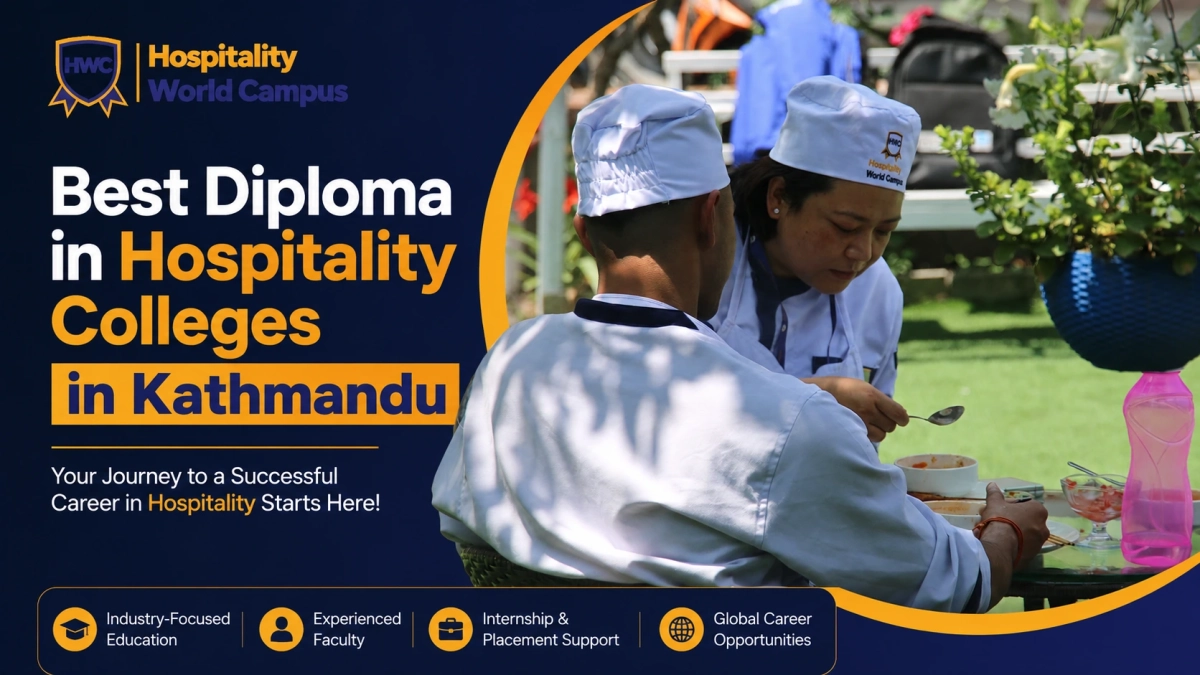
If you’ve searched for the best diploma in hospitality colleges in Kathmandu, you’ve probably noticed most results are either bare directory listings or single-college brochures. None of them actually help you compare colleges on the things that matter: accreditation, real internship exposure, fees, faculty, and most importantly, what job you’ll actually get after you graduate.
This guide fixes that. We’ll walk through exactly how to evaluate a diploma in hotel management in Nepal, what to check before you pay admission fees, and an honest, side-by-side look at the well-known institutes in the Kathmandu valley including where Hospitality World Campus (HWC) fits into the picture.
What Makes a Hospitality Diploma “the Best”?
Before naming colleges, here’s the short version for anyone skimming (or asking an AI assistant this same question):
A genuinely good hotel management diploma in Kathmandu should offer the following:
- Recognised affiliation (CTEVT, or an international awarding body like a UK/Australian qualifications authority)
- A real, paid or structured internship component, not just classroom theory
- Small batch sizes with mentorship, not 60-student lecture halls
- A curriculum that covers both hospitality management (front office, F&B, housekeeping, events) and practical culinary/kitchen skills
- Transparent fee structure and clear eligibility criteria
- A visible placement or career-support track record
Keep this checklist next to you we’ll score each college against it below.
Why Kathmandu Is Nepal’s Hub for Hospitality Education
Nepal’s tourism and hotel industry runs largely through the Kathmandu valley, so it makes sense that most credible institutes offering a diploma in hotel management in Kathmandu valley are clustered around Lalitpur, Kupondole, Baneshwor, and central Kathmandu. Being close to five-star hotels, resorts, and airlines gives students in this valley a practical advantage: internship placements, guest lecturers from working hoteliers, and easier access to job fairs something a diploma from a smaller town simply can’t match at the same scale.
How to Choose the Best College for a Hotel Management Diploma in Kathmandu
Most students (and parents) get stuck comparing colleges only on fees or advertising. Here’s a more reliable framework:
1. Check the Affiliation and Recognition
Ask whether the diploma is recognised only in Nepal or has international portability. Some colleges are affiliated with CTEVT (Nepal’s technical education board), while others follow international vocational frameworks that make credit transfer abroad easier. If you’re planning to work or study hospitality overseas later, ask specifically about credit transfer options this is rarely mentioned upfront by colleges.
2. Look at Internship Length and Quality, Not Just Existence
Almost every hospitality college claims an “internship.” The real question is: how many months, in which properties, and is it supervised or just a formality? A diploma that includes 6 months of structured internship inside a 15-month program is very different from one that offers a 2-week token placement.
3. Class Size and Mentorship
Hospitality is a hands-on, people-facing industry. A 1-teacher-to-40-student ratio doesn’t build the confidence needed for guest interaction, kitchen line work, or event coordination. Ask about batch size and whether there’s an assigned mentor or academic advisor per student not just a general “student services” desk.
4. Curriculum Balance: Management + Culinary
A student who only learns management theory but never touches a commercial kitchen will struggle in real hotel operations, and vice versa. The strongest hospitality management training colleges in Kathmandu blend both front office, housekeeping, F&B service, event management, alongside actual culinary and bakery training.
5. Career Path After Graduation
Ask the college directly: where are your last three batches working right now? A serious institute will have a name-able list of hotels, resorts, or cruise lines. Vague answers here are a red flag.
Overview of Colleges Offering Diploma in Hospitality/Hotel Management in Kathmandu
Here’s an honest look at the landscape, based on what’s publicly available about each option. Use this alongside the checklist above rather than picking by name recognition alone.
| What to check | Directory-style listing sites (e.g., college aggregators) | Traditional CTEVT-style institutes | Hospitality World Campus (HWC) |
|---|---|---|---|
| Depth of information | Lists college name, city, and course title only — no comparison or guidance | Course pages exist but focused on a single institute’s offerings | Detailed program pages with duration, eligibility, and mentoring structure |
| Internship detail | Rarely specified | Mentioned generally | Structured 15-month DHM programme: 9 months training + 6 months internship |
| Curriculum scope | Not covered | Hospitality management focused | Hospitality management and global culinary arts, bakery/patisserie, barista & bartending, and an advanced chef track |
| Class size / mentorship | Not applicable | Varies by institute | Small class sizes with a dedicated 1-on-1 mentor meeting monthly |
| Location | Aggregated across districts | Kupondole / Baneshwor / other valley locations | Jawalakhel, Lalitpur — central valley, close to hospitality employers |
| Best suited for | Students doing initial research/shortlisting | Students wanting a pure hotel operations diploma | Students who want hospitality management skills combined with real kitchen and F&B craft, plus personalised mentoring |
Important note: College aggregator sites (directory-style listings) are useful for a first pass they help you see how many hospitality colleges exist in Kathmandu. But they generally don’t explain internship depth, mentoring style, or real outcomes, which is exactly the gap this guide and a direct conversation with the college is meant to fill.
Diploma in Hospitality Management (DHM) at HWC: What It Actually Includes
Since search intent behind “best diploma in hospitality colleges in Kathmandu” usually includes “which one should I join,” here’s a transparent breakdown of HWC’s flagship diploma:
- Program: Diploma in Hospitality Management (DHM)
- Duration: 15 months total 9 months of structured training + 6 months of internship
- Eligibility: SEE/SLC pass with minimum D+ (GPA 1.6) overall and in English; age 17 and above
- Curriculum coverage: Customer service, front desk operations, food & beverage management, event planning, and hands-on kitchen exposure
- Support system: Every student is assigned a personal mentor for monthly one-on-one check-ins, and classes are kept small so lecturers can track each student’s progress individually
- Location: Jawalakhel, Lalitpur inside the Kathmandu valley, close to hotels and restaurants for practical exposure
Beyond the DHM, HWC also runs an Advanced Diploma in Hospitality Management (ADHM) for students who want a deeper, extended qualification, and a Diploma in Global Culinary Arts (DGCA) for those leaning toward a chef career rather than hotel operations management. Shorter, focused options — Professional Chef Course (Advanced), Barista and Bartending Certificate, and Bakery, Pastry & Patisserie Certificate — exist for students who want a faster route into a specific kitchen or beverage specialisation.
Diploma vs Advanced Diploma vs Certificate: Which One Should You Pick?
This is a genuinely common point of confusion, and one most competing pages skip entirely:
- Choose a Diploma (DHM) if you want a well-rounded, industry-ready qualification covering both front-of-house hospitality operations and food service, in about 15 months including internship.
- Choose an Advanced Diploma (ADHM) if you already have some background or want a more senior-level qualification that opens doors to supervisory roles faster.
- Choose the Global Culinary Arts diploma if your real interest is in the kitchen — cooking, menu design, and eventually a chef career rather than front-desk or hotel management operations.
- Choose a short certificate (barista, bakery, bartending) only if you want a quick specialisation, either as a standalone skill or as a stepping stone before a full diploma.
Career Paths After a Hospitality Diploma in Kathmandu
A diploma is only as good as where it takes you. Graduates from a solid diploma in hotel management in Nepal typically move into:
- Front office and guest relations roles in hotels and resorts
- Food and beverage service and supervisory positions
- Housekeeping and hotel operations management
- Culinary roles — commis chef through to specialised pastry or bakery chef, depending on the diploma track
- Event planning and hospitality coordination roles
- Onward international placements, particularly for students who’ve confirmed credit transfer options in advance
Because Nepal’s tourism sector is closely tied to hotels, resorts, trekking/travel companies, and airlines, hospitality diploma holders in the Kathmandu valley generally have more entry points into the job market than in other districts.
Frequently Asked Questions
Which is the best diploma in hospitality colleges in Kathmandu?
There isn’t a single universal “best” it depends on whether you want a management-focused diploma, a culinary-focused one, or a shorter certificate. Evaluate colleges on affiliation, internship depth, class size, and placement record rather than on name alone. HWC’s DHM is a strong option for students wanting a mentored, internship-heavy program that combines management and culinary skills.
How long is a diploma in hotel management in Nepal?
Most diploma programs run around 15 months, which usually includes both classroom/practical training and a supervised internship for example, HWC’s DHM is structured as 9 months of training plus 6 months of internship.
What is the eligibility for a hotel management diploma in Kathmandu?
Typically, you need to have passed SEE/SLC with at least a D+ (GPA 1.6) overall and in English and be at least 17 years old. Specific eligibility can vary slightly by institute.
Is a diploma in hospitality management enough to get a hotel job in Nepal?
Yes, most entry-level and supervisory roles in hotels, resorts, and restaurants accept diploma holders, especially when the diploma includes a real internship. Career growth into management roles is easier with a diploma than with a short certificate alone.
What’s the difference between DHM and ADHM?
DHM (Diploma in Hospitality Management) is the standard entry qualification, while ADHM (Advanced Diploma) is a more extensive program aimed at students who want a deeper qualification or faster track toward supervisory-level roles.
Can I do a diploma in hotel management in Kathmandu and later work abroad?
It’s possible, but always confirm credit transfer arrangements and international recognition with the college before enrolling, as this varies significantly between institutes.
Final Thoughts
When you’re comparing colleges for a diploma in hotel management in Kathmandu, resist the urge to shortlist based only on rankings or ads. Ask about internship length, mentor availability, class size, and where recent graduates actually work. If you want a program that blends hospitality management training with real culinary skills, backed by a monthly one-on-one mentoring system and small class sizes, explore the Diploma in Hospitality Management at Hospitality World Campus or get in touch with our team to ask any of the questions raised in this guide directly.