

Introduction
Picking a hotel management diploma course in Nepal is not just about finding a college with a nice website. It is about figuring out which certificate will actually get you hired, which curriculum matches the career you want, and which institute has a track record of placing students, not just enrolling them.
Nepal now has dozens of institutes offering some version of a “Diploma in Hotel Management in Nepal” or “Diploma in Hospitality Management.” Some are government-affiliated through CTEVT. Others run internationally benchmarked programs. The names sound similar, but the outcomes are very different.
This guide breaks down every hotel management diploma course in Nepal by duration, cost, subjects, eligibility, internship structure, and career outcome, so you can compare options the way a hospitality professional would, not the way a college brochure wants you to.
What Is a Hotel Management Diploma Course in Nepal?
A hotel management diploma course in Nepal is a vocational, skills-first program that trains students to run the core departments of a hotel: front office, housekeeping, food production, and food and beverage service. It is built around hands-on practice rather than lecture-only theory, and most programs combine classroom training with a supervised internship in a working hotel.
Two main pathways exist. The first is the government-run CTEVT diploma, a three-year program offered by roughly two dozen technical schools and polytechnics across the country. The second is a set of shorter, internationally affiliated diplomas run by private hospitality institutes, several of which are quality-assured by bodies like the Scottish Qualifications Authority (SQA).
Both routes lead to entry-level hospitality jobs. The difference lies in how long the course takes, how much it costs, and how far your certificate travels once you leave Nepal.
Why Hotel Management Is a Smart Career Choice Right Now
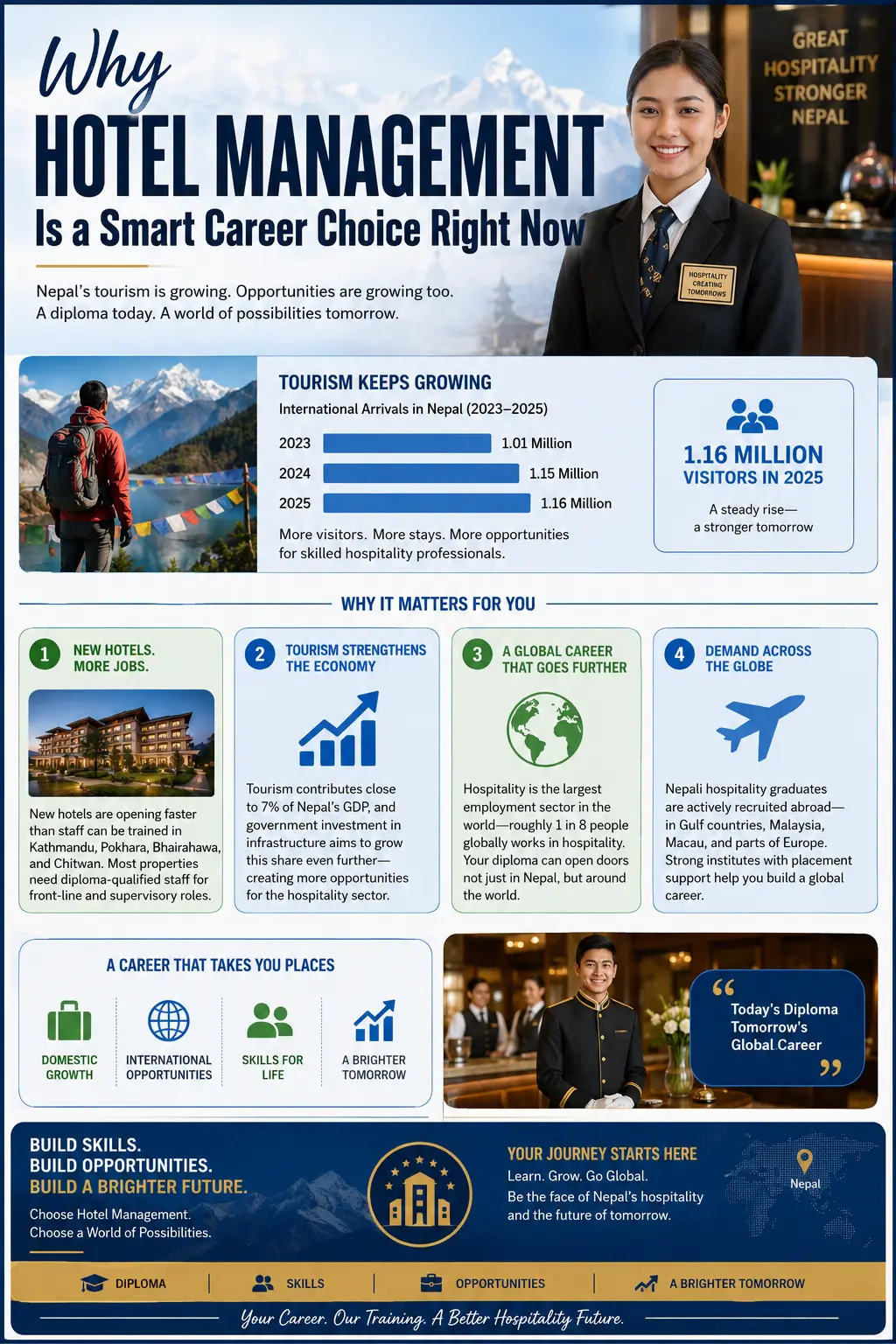
Nepal’s tourism sector is expanding faster than its supply of trained hospitality staff, which means diploma holders are entering a market with real demand, not just theoretical opportunity.
International arrivals reached around 1.16 million in 2025, continuing a steady climb from roughly 1.15 million in 2024 and 1.01 million in 2023. Every additional trekking group, pilgrimage tour, or wedding delegation needs hotels, restaurants, and trained staff to run them.
A few reasons this matters for someone deciding on a course today:
- New hotels are opening faster than staff can be trained. Kathmandu, Pokhara, Bhairahawa, and Chitwan have all seen new hotel and resort construction, and most properties report difficulty finding diploma-qualified staff for front-line and supervisory roles.
- Tourism is a meaningful share of the national economy. The sector contributes close to 7 percent of Nepal’s GDP, and government infrastructure spending is aimed partly at growing that share further.
- Hospitality is the largest employment sector in the world. Roughly one in eight workers globally works in hospitality, which means a Nepali diploma can open doors well beyond Kathmandu if the qualification is recognized internationally.
- Nepali hospitality graduates are actively recruited abroad. Gulf countries, Malaysia, Macau, and parts of Europe hire Nepali-trained staff regularly, particularly from institutes with established placement pipelines.
Is hotel management a good career in Nepal?
Yes, for students willing to start at entry level. Growing tourist arrivals, a widening skills gap in hotels and resorts, and strong international placement demand make it one of the more realistic vocational paths in Nepal today, though early career work involves shift schedules and physically demanding roles.
Types of Hotel Management Diploma Courses Available in Nepal
Not every “diploma in hotel management” is the same qualification. Before comparing colleges, understand which category a program falls into.
1. CTEVT Diploma in Hotel Management (3 Years)
Awarded by the Council for Technical Education and Vocational Training, the government body overseeing technical education in Nepal. This is a six-semester program offered by roughly 25 CTEVT-affiliated institutions across the country, including technical schools, polytechnics, and hospitality-focused colleges. It is the most widely available and most affordable option, and it carries clear recognition for jobs within Nepal, including Public Service Commission-graded positions.
2. Private Institute Diplomas (CTEVT-Affiliated or Independently Run)
Several private hospitality institutes, including well-known names in Kathmandu and Lalitpur, run their own CTEVT-affiliated diploma programs alongside additional practical training, industry tie-ups, and placement support beyond what a standard technical school provides. Course length generally matches the CTEVT structure, but facilities, faculty experience, and internship networks vary widely between institutes.
3. Internationally Benchmarked Diplomas (SQA-Affiliated)
A smaller number of institutes in Nepal run diploma and advanced diploma programs affiliated with the Scottish Qualifications Authority (SQA), benchmarked against the Scottish Credit and Qualifications Framework (SCQF) and the European Qualifications Framework (EQF). These programs typically run 15 to 21 months, roughly a third of the CTEVT timeline, and are designed around international mobility: paid overseas internships, credit transfer into foreign bachelor’s programs, and direct pathways into international hotel chains.
CTEVT vs Private Institute Diplomas: Side-by-Side Comparison
| Factor | CTEVT Diploma (3 Years) | SQA-Affiliated Diploma (15–21 Months) |
|---|---|---|
| Duration | 3 years / 6 semesters | 15–21 months |
| Approximate cost | Lower | Moderate to higher |
| Government recognition in Nepal | Yes | Yes, where CTEVT or SQA-registered |
| International recognition | Employer-dependent | SCQF/EQF benchmarked |
| Credit transfer to foreign universities | Limited, case by case | Documented exemptions at partner universities |
| Paid international internship | Not standard | Often built into program structure |
| Best suited for | Students targeting local employment and PSC-graded roles | Students targeting international careers or further study abroad |
If your priority is a low-cost, government-recognized qualification for work within Nepal, the CTEVT route is a sound foundation. If your priority is working abroad or continuing to a foreign bachelor’s degree, an SQA-affiliated diploma from a properly quality-assured institute compresses your timeline and adds a credential that international employers and universities can independently verify.
Course Structure and Subjects, Year by Year
CTEVT Diploma: Semester Structure
Year 1 – Foundation
- Introduction to Hospitality and Tourism
- Food Production I
- Food and Beverage Service I
- Front Office Operations I
- Housekeeping I
- Communication English
- Computer Applications in Hospitality
Year 2 – Disciplinary Subjects
- Food Production II (continental and Asian cuisine)
- Food and Beverage Service II
- Front Office Operations II
- Housekeeping II
- Nutrition and Food Science
- Cost Control and Accounting
- Human Resource Management
Year 3 – Applied Learning and Internship
- Hospitality Marketing
- Entrepreneurship in Hospitality
- Hotel Operations Management
- Full-semester industry internship (approximately six months)
- Internship report and viva
Internationally Affiliated Diplomas: Typical Module Structure
Classroom and Lab Phase (roughly 9–15 months, depending on program level)
- Food and Beverage Production
- Food and Beverage Service
- Front Office Operations, including property management systems
- Accommodation Services and housekeeping standards
- Hospitality Supervision Skills
- Customer Care in Hospitality
- Workplace English for Hospitality
- Entrepreneurship and Business Communication
Internship Phase (approximately 6 months) Placement in a partner hotel, either in Nepal or, for programs with documented international tie-ups, at a property abroad.
Featured snippet answer: What subjects are taught in a hotel management diploma in Nepal? Core subjects include Front Office Operations, Housekeeping, Food Production, Food and Beverage Service, Hospitality Accounting, Communication Skills, and a supervised internship, typically spread across foundation, disciplinary, and applied-learning stages.
Eligibility Criteria and Required Documents
| Requirement | CTEVT Diploma | Private/SQA-Affiliated Diploma |
|---|---|---|
| Minimum education | SEE (Class 10) pass | SEE (Class 10) pass |
| Minimum grade | At least C in Mathematics, English, and Science | Varies by institute, commonly D+ or above in English |
| Age | No fixed minimum beyond post-SEE age | Often 16–17 years and above |
| +2 graduates | Eligible | Eligible, and generally welcomed |
Documents typically required:
- SEE or SLC mark sheet and character certificate
- Transfer certificate from your previous school
- Citizenship certificate or birth certificate
- Passport-size photographs (usually four to six copies)
- Equivalency certificate, if your board is not a recognized Nepali board
- Medical fitness certificate, required by some institutes
Always confirm the exact list with your shortlisted institute, since requirements shift slightly between colleges and intakes.
Fees for Hotel Management Diploma Courses in Nepal
Fee structures change with every intake, so treat the ranges below as planning estimates rather than fixed quotes, and verify current numbers directly with any institute you shortlist.
| Program Type | Approximate Total Fee Range (NPR) |
|---|---|
| CTEVT Diploma in Hotel Management (3 years) | 1,50,000 – 3,00,000 |
| Private/SQA-Affiliated Diploma (15 months) | 2,50,000 – 4,50,000 |
| SQA-Affiliated Advanced Diploma (21 months) | 4,00,000 – 6,00,000 |
Costs beyond tuition to budget for:
- Uniform and kitchen equipment, including chef whites and knife kits
- Examination and certification fees, particularly for internationally benchmarked assessments
- Internship travel and accommodation, if placed outside your home city
- Study materials and lab consumables
Most established institutes offer installment plans spread across semesters, so ask about payment structure during admission rather than assuming a single lump sum is required.
Internship and Practical Training: What to Expect
The internship is the part of the diploma that actually determines your first job offer, and it deserves more attention than most students give it during college selection.
What a strong internship placement looks like:
- Placement at a 3-star, 4-star, or 5-star property rather than a basic guesthouse
- Rotation across at least two or three departments, such as kitchen, front office, and food and beverage service
- Formal supervision and a written performance evaluation from the hotel
- A completion certificate you can present to future employers
CTEVT internships typically run for around 24 weeks at roughly 40 hours per week and are usually unpaid or paid a modest stipend. Internationally affiliated programs with overseas placement structures have sent students to hotels in Dubai, Malaysia, Macau, and parts of Europe, often on paid contracts.
A question worth asking any college before enrolling: “Where did last year’s batch intern, and can you show me placement letters or hotel names?” A vague answer is more informative than it sounds.
How to Choose the Right Hotel Management Institute
The institute matters more in hospitality education than in most other fields, because your internship placement, practical training quality, and post-graduation job leads all depend on relationships the college has built over years, not on marketing copy.
1. Verify accreditation with documents, not claims. Ask to see the CTEVT affiliation certificate, or the SQA/awarding-body authorization letter, directly. A college that hesitates to show this is telling you something.
2. Visit the training facilities in person. Walk through the training kitchen and front office lab. Outdated equipment or overcrowded practical sessions are a preview of the training quality you will actually receive.
3. Ask for specific internship placement history. “We have hotel partnerships” means little on its own. Ask which hotels the last batch interned at and whether you can see placement letters.
4. Check the student-to-teacher ratio in practical sessions. A ratio worse than roughly 1:12 in a kitchen or front-office lab means students spend more time waiting than practicing.
5. Look at faculty backgrounds. Instructors who have worked in real hotels, ideally at international properties, generally teach more relevant, current skills than purely academic staff.
6. For internationally focused programs, ask about SCQF/EQF benchmarking specifically. A program can claim “international recognition” loosely. Formal benchmarking to SCQF and EQF is a verifiable credential that foreign universities and employers can check independently.
At Hospitality World Campus (HWC), located in Jawalakhel, Lalitpur, programs are quality-assured by the Scottish Qualifications Authority and benchmarked to both SCQF and EQF, which is the kind of documentation worth asking any institute you are considering to match.
Career Opportunities After the Diploma
Hotel management diploma holders in Nepal have a wider range of entry points than most students expect going in.
- Hotels and resorts: the most direct path, with entry roles such as Guest Service Associate, Kitchen Commis, F&B Service Associate, and Room Attendant, progressing into supervisory roles with experience.
- Airlines and airport services: airline catering kitchens, airport lounges, and in-flight service teams recruit from hospitality-trained graduates.
- Cruise ships: international cruise lines run continuous recruitment cycles for kitchen and service staff, often with accommodation and meals included.
- Restaurants and cafés: Nepal’s growing café and restaurant sector values trained staff over untrained applicants.
- Event management and banqueting: wedding and corporate event catering is a growth area in Kathmandu and Pokhara.
- Institutional catering: hospitals, corporate canteens, and hostels need managed food service operations, offering more stable, government-adjacent roles.
- Teaching and training: after several years of industry experience, many graduates return to hospitality colleges as practical trainers.
- Entrepreneurship: the diploma provides the operational grounding to open a café, guesthouse, or catering business.
Under Nepal’s Public Service Commission framework, diploma holders qualify for positions equivalent to Non-Gazetted First Class / Level 5 Technical roles, including Cook, Waiter, Receptionist, and Room Supervisor.
Salary Expectations in Nepal and Abroad
In Nepal
| Experience Level | Typical Monthly Salary (NPR) |
|---|---|
| Entry-level (0–2 years) | 15,000 – 30,000 |
| Mid-level (3–5 years) | 35,000 – 70,000 |
| Supervisory / junior management (5+ years) | 70,000 – 1,20,000+ |
5-star properties in Kathmandu generally pay more than 3-star hotels, and location within Nepal also affects compensation.
Working Abroad
| Destination | Estimated Monthly Earning (NPR equivalent) |
|---|---|
| Gulf countries (UAE, Qatar, Bahrain) | 80,000 – 1,50,000+ |
| Malaysia / Macau | 70,000 – 1,30,000+ |
| Australia / New Zealand | 2,00,000 – 3,50,000+ |
| Europe (UK, Germany, Croatia) | 2,50,000 – 4,00,000+ |
These figures cover standard front-line and supervisory roles; management-level positions abroad pay meaningfully more. It is also worth noting that service charges and tips, often left out of salary discussions, can add a significant amount on top of base pay in star-category hotels, particularly in Kathmandu’s higher-end properties.
Diploma vs Bachelor’s Degree in Hotel Management
| Factor | Diploma (15–21 months, SQA-type) | Bachelor’s Degree (BHM, 4 years) |
|---|---|---|
| Time to complete | 15–21 months | 4 years |
| Approximate cost | NPR 2.5L – 6L | NPR 8L – 20L+ |
| Practical skills focus | Very strong | Moderate, more theory-heavy |
| Time to start earning | Within about 2 years | After 4+ years |
| Senior management pathway | Needs additional study or experience | More direct |
| Credit towards a foreign degree | Yes, through documented exemptions | Not applicable |
| Best suited for | Students wanting to work quickly or test the field before committing years | Students aiming directly at management or corporate hospitality careers |
A path several students in Nepal now follow: complete a diploma, work for a year or two to build savings and real experience, then apply to a foreign bachelor’s program with credit transfer. This can reach the same destination as a straight four-year degree, but with work experience, an internship record, and lower total cost along the way.
How to Apply: Step-by-Step Admission Process
- Confirm your SEE marksheet meets the grade requirement, especially in English, which is the most common eligibility filter across institutes.
- Shortlist two or three institutes and visit each one in person if possible. Ask to see the training kitchen, front office lab, and housekeeping practice room.
- Ask directly whether the program is CTEVT-affiliated, SQA-affiliated, or both, and request the certificate that proves it.
- Gather your documents: SEE/SLC marksheet, character certificate, transfer certificate, citizenship or birth certificate, and passport photographs.
- Submit your application during one of the two main intake windows, typically shortly after SEE results (June–July) and again around Bhadra (August–September).
- Pay the first installment and attend orientation. Practical training generally begins within the first few weeks.
Frequently Asked Questions
What is a hotel management diploma course in Nepal?
It is a vocational qualification that trains students in front office, housekeeping, food production, and food and beverage service through a mix of classroom instruction and a supervised hotel internship, preparing graduates for entry-level hospitality roles in Nepal or abroad.
How long does a hotel management diploma take in Nepal?
The CTEVT diploma runs three years across six semesters. Private, internationally affiliated diplomas typically run 15 to 21 months depending on the program level.
What are the eligibility requirements after SEE?
A pass in SEE (Class 10) is the baseline. CTEVT programs generally require at least a C grade in Mathematics, English, and Science, while private institutes often accept D+ or above in English.
Can I join a hotel management diploma after completing +2?
Yes. Students who finish +2 remain eligible for diploma programs and often find some theoretical subjects easier due to added academic maturity, though they will study alongside SEE-track classmates.
Is a hotel management diploma the same as a hospitality management diploma?
Not exactly. Hotel management focuses specifically on hotel operations such as rooms division, food and beverage, and front office. Hospitality management is broader and includes airlines, cruise lines, event management, and resorts. In practice, Nepali institutes often use the terms loosely, so check the actual curriculum rather than the title.
Which is better, CTEVT or a private SQA-affiliated diploma?
It depends on your goal. CTEVT is lower-cost and well recognized within Nepal for local employment and government-graded roles. SQA-affiliated diplomas cost more but are internationally benchmarked, shorter, and built around overseas internships and credit transfer.
How much does a hotel management diploma cost in Nepal?
CTEVT programs generally range from NPR 1,50,000 to 3,00,000 over three years. Internationally affiliated diplomas range from roughly NPR 2,50,000 to 6,00,000, depending on program level and duration.
Does the course include an internship?
Yes. Internships are a required, formally evaluated component of every recognized hotel management diploma in Nepal, typically running about six months.
Is the internship paid?
CTEVT internships are usually unpaid or offer a small stipend. Internationally affiliated internships, particularly those placed abroad, are more commonly paid at local rates in the host country.
What subjects will I study?
Core subjects include Front Office Operations, Housekeeping, Food Production, Food and Beverage Service, Hospitality Accounting, Communication Skills, and applied project or internship work, usually structured across foundation, disciplinary, and applied stages.
What documents do I need for admission?
Typically your SEE/SLC marksheet, character certificate, transfer certificate, citizenship or birth certificate, and passport-size photographs. Some institutes also require a medical fitness certificate.
Can I get a job immediately after finishing the diploma?
Often, yes, particularly if your internship performance was strong. Many students receive offers directly from the hotel where they interned.
What jobs can I get after a hotel management diploma?
Common entry roles include front desk agent, housekeeping attendant or supervisor, food and beverage service staff, commis chef, banquet crew, and resort staff, progressing to supervisory and management roles with experience.
What is the starting salary after a hotel management diploma in Nepal?
Entry-level roles typically start between NPR 15,000 and 30,000 per month, with service charges and tips in star-category hotels adding a meaningful amount on top.
Can diploma graduates work abroad?
Yes. This is one of the more realistic international pathways for Nepali diploma holders, particularly graduates of institutes with documented overseas placement and internship networks.
Which countries hire Nepali hotel management graduates most actively?
The UAE and other Gulf states lead in volume and established recruitment channels, followed by Malaysia, Macau, parts of Europe, and increasingly Australia and New Zealand for candidates who meet English requirements.
What is the difference between a diploma and a bachelor’s degree in hotel management?
A diploma takes 15 months to 3 years, is skills-focused, and gets you working sooner. A bachelor’s degree (BHM) takes about 4 years, is more theory-heavy, and provides a more direct route into senior management and corporate hospitality roles.
Can I do a bachelor’s degree after finishing a diploma?
Yes, and this is a common path. Diploma holders, particularly from SCQF/EQF-benchmarked programs, can receive documented credit exemptions at partner foreign universities, sometimes entering directly into the second year of a bachelor’s program.
What is SCQF and why does it matter?
The Scottish Credit and Qualifications Framework assigns a level and credit value to qualifications it endorses. It allows foreign universities to assess how much of their own program a diploma holder should be exempted from, which can save both time and tuition cost abroad.
What is EQF?
The European Qualifications Framework is a pan-European system for comparing qualifications across countries, allowing a Nepal-based diploma to be formally compared against equivalent qualifications from EU member states.
How many institutes in Nepal offer a CTEVT hotel management diploma?
Approximately 25 CTEVT-affiliated institutions currently offer the Diploma in Hotel Management, spread across districts including Kathmandu, Kaski, Chitwan, Jhapa, and several others.
Is CTEVT recognized outside Nepal?
CTEVT is fully recognized within Nepal, including for government-graded positions. Recognition outside Nepal depends on the individual employer’s assessment rather than a formal international framework.
What is the class size or teacher-to-student ratio like in these programs?
CTEVT curriculum guidelines specify a practical/demonstration ratio of roughly 1:10. Private institutes vary, so ask directly during your college visit rather than assuming.
Do I need to know how to cook already before joining?
No prior cooking or hospitality experience is required. Food production and service skills are taught from the basics in Year 1 or the first training phase.
What is the minimum age to apply for a hotel management diploma?
There is no universally fixed minimum beyond having passed SEE, though many private institutes set a minimum age around 16 to 17 years.
How many intakes happen per year?
Most institutes run two main intakes annually, one shortly after SEE results in June or July, and another around Bhadra (August–September).
What is the teacher qualification requirement under CTEVT?
CTEVT curriculum guidelines require teachers to hold at least a master’s degree in a related field, and instructors to hold at least a bachelor’s degree in a related field.
Are there scholarships available for hotel management diploma courses?
Some institutes offer merit-based fee waivers or installment concessions, though these vary by college and intake. Ask directly about scholarship or financial assistance policies during admission.
What is the grading system for the CTEVT diploma?
Results are graded as Distinction (80 percent and above), First Division (65 to under 80 percent), Second Division (50 to under 65 percent), and Pass (40 to under 50 percent), based on aggregate final semester examination marks.
Is hotel management a good career choice for someone who doesn’t want an office job?
Yes. Hospitality roles are hands-on and people-facing by nature, involving shift work rather than a fixed desk schedule, which suits students who prefer active, varied days over routine office work.
Final Thoughts
Nepal’s hospitality industry is not slowing down, and a hotel management diploma remains one of the more practical educational investments available to students finishing SEE or +2. The choice that matters most is not diploma versus no diploma, it is which type of program and which institute.
If your goal is local employment and a lower upfront cost, a CTEVT diploma from an established institute is a sound foundation. If your goal includes working internationally or continuing to a foreign bachelor’s degree, an SQA-affiliated, SCQF/EQF-benchmarked program compresses your timeline and gives you a credential that travels with documentation behind it, not just a claim.
Whichever path you choose, verify accreditation documents in person, ask for real internship placement records, and talk to current students before you commit.
If you are comparing hotel management diploma options in Nepal and want to see how an SQA-affiliated, internationally benchmarked program actually works in practice, book a free consultation with Hospitality World Campus in Jawalakhel, Lalitpur. You can review affiliation documentation, walk through the training kitchen and front office lab, and speak directly with current students before you decide.