
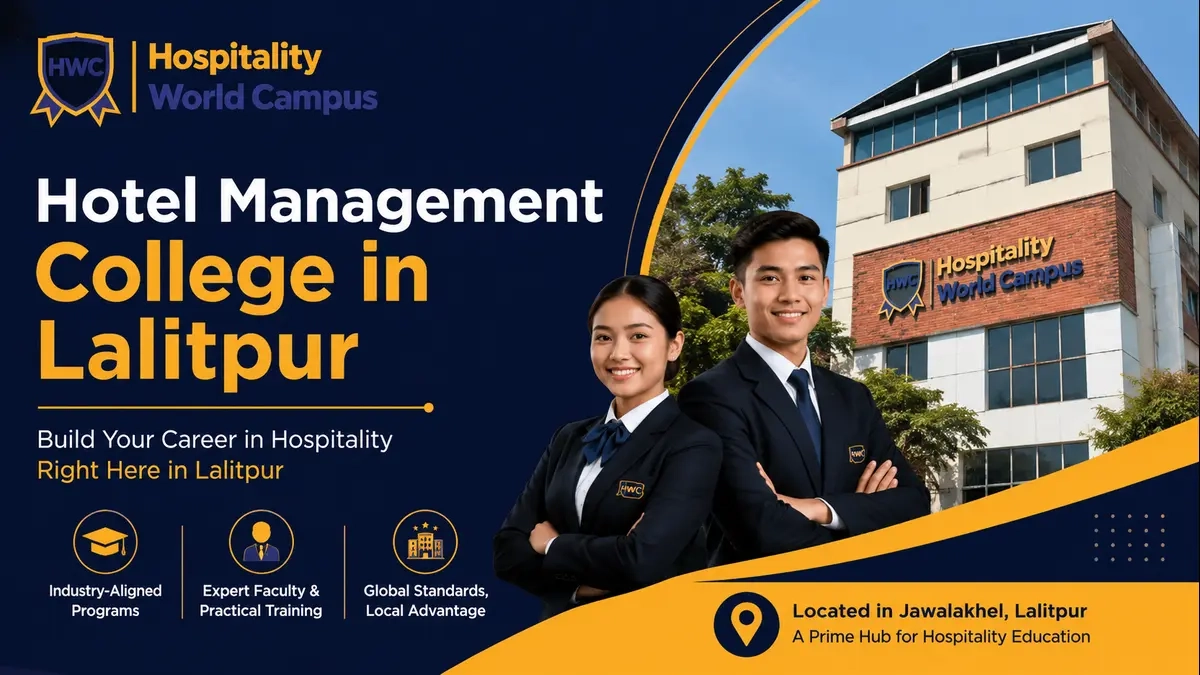
If you are comparing hotel management colleges in Lalitpur, the short answer is this: look for a college that pairs an internationally recognized qualification with real internship placements, not just classroom theory. Hospitality World Campus (HWC), based in Jawalakhel, Lalitpur, is one such option. Its Diploma in Hospitality Management (DHM) and Advanced Diploma in Hospitality Management (ADHM) are quality assured by the Scottish Qualifications Authority (SQA), Scotland, which means the credential is benchmarked against international frameworks rather than issued only for local use.
This guide walks through what a hotel management education in Lalitpur actually involves: the programs available, what SQA affiliation means for your career, real graduate placements, admission requirements, and the questions students and parents ask most often before enrolling.
Why Lalitpur Is a Practical Choice for Hotel Management Education
Lalitpur, particularly the Jawalakhel area, sits close to Kathmandu’s hotel and restaurant corridor, which makes it a practical base for hands-on hospitality training. Students can commute easily to internship sites, industry events, and five-star properties across the valley without relocating.
Nepal’s tourism sector adds weight to this choice. The country welcomed approximately 1.15 million international tourists in 2024, and arrivals have kept climbing into 2026. That growth has created a well-documented problem for employers: the Hotel Association Nepal has publicly confirmed that the hospitality sector nationwide is facing a skilled-worker crisis, with hotels struggling to find trained chefs, housekeepers, and managers. For a student, this gap is an opportunity. When qualified graduates are scarce and demand is high, trained professionals are hired faster and negotiate better starting roles.
Lalitpur’s location, combined with this national skills shortage, is exactly why a properly accredited hotel management college in the area matters more than choosing based on proximity alone.
What to Check Before Choosing a Hotel Management College in Lalitpur
A good hotel management college in Lalitpur should offer an internationally recognized qualification, a structured internship of several months, small class sizes with mentorship, transparent eligibility criteria, and verifiable placement outcomes with named hotels or employers.
Before shortlisting any college, review these five factors:
- Accreditation and quality assurance. Ask which body approves the diploma and whether it is recognized outside Nepal. A qualification tied to an international framework carries more weight with employers and universities abroad.
- Internship length and structure. A diploma that blends classroom training with a genuine internship (not a two-week observation period) builds job-ready skills.
- Class size and mentorship. Hospitality is a practical, people-facing field. Smaller cohorts usually mean more time behind the front desk, in the kitchen, or on the floor practicing real service scenarios.
- Verified placement record. Ask for named alumni, their job titles, and their employers. Vague claims about “100% placement” without specifics are a red flag.
- Eligibility and entry requirements. Confirm the minimum SEE/SLC grade, English requirement, and age criteria so you are not surprised mid-application.
Hospitality World Campus: An SQA-Affiliated Hotel Management College in Lalitpur
Hospitality World Campus (HWC) is located at Jawalakhel, Lalitpur, and operates as a unit of LCCI GQ, a professional and management skills training organization. HWC has trained students across culinary arts, hospitality management, barista skills, and bakery and pastry since 2022.
The college positions itself around three operating principles: individual mentoring, small class sizes, and hands-on training through industry placements. Each student is assigned a mentor who meets with them once a month, which is meant to catch academic or personal issues early rather than after a student falls behind. HWC’s official course catalogue and current intake details are available at hwc.edu.np.
What Makes HWC Different From a Typical Vocational Institute
Most short-term hospitality institutes in Nepal issue a certificate recognized only locally. HWC’s diploma programs are built around an SQA-approved framework, and the college maintains partnerships that allow instruction to combine Nepali classroom delivery with an internationally benchmarked syllabus. That distinction matters if you plan to work abroad or later pursue a degree through credit transfer.
SQA Affiliation Explained: What It Means for Your Diploma
SQA stands for the Scottish Qualifications Authority, Scotland’s national awarding and accreditation body. When a hotel management diploma is SQA affiliated, it is quality assured against Scottish and European qualification frameworks, making the credential easier to use for international jobs or further study abroad.
HWC states that its hospitality programs are approved and quality assured by the Scottish Qualifications Authority (SQA), Scotland, and benchmarked at the Scottish Credit and Qualifications Framework (SCQF) and the European Qualifications Framework (EQF).
To understand why this matters, it helps to know what SQA actually is. SQA is Scotland’s national awarding and accreditation body and a global provider of internationally recognized qualifications and assessment services. Its diplomas are developed with input from colleges, universities, and industry partners, which is why employers and academic institutions abroad tend to trust them.
There is also a documented pathway specific to Nepal. According to reporting from The PIE News, SQA has an established partnership with LCCI Global Qualifications in Nepal, which developed its own SQA-approved Customised Award in Hospitality Management. Through an articulation agreement, students who complete this award in Nepal can progress into year three of a degree in International Hospitality Management at Queen Margaret University in Edinburgh. Since HWC operates as a unit of LCCI GQ, this is the same qualification family its DHM and ADHM programs sit within, giving graduates a documented route into a UK bachelor’s degree rather than starting a foreign degree from scratch.
Why SQA Recognition Matters for Nepali Students Specifically
- Credit transfer abroad. SQA-benchmarked diplomas are designed to align with degree-level entry points, so credits earned in Lalitpur can, in principle, count toward further study overseas.
- Employer trust. International hotel chains and airline catering companies recognize SQA-linked qualifications more readily than purely local certificates.
- Structured, quality-checked curriculum. SQA approval means the syllabus and assessment methods are reviewed against a set standard rather than designed independently by a single institute.
Diploma in Hotel Management in Nepal: Programs, Duration, and Eligibility
A diploma in hotel management in Nepal typically runs 12 to 21 months, combining classroom training in front office, food and beverage, and hospitality operations with a supervised internship. Entry usually requires a minimum SEE/SLC grade of D+ and applicants must be at least 17 years old.
HWC offers a structured ladder of hospitality and culinary programs. Here is how the core diplomas compare:
| Program | Duration | Structure | Best For |
|---|---|---|---|
| Diploma in Hospitality Management (DHM) | 15 months | 9 months training + 6 months internship | Students starting their first hospitality qualification |
| Advanced Diploma in Hospitality Management (ADHM) | 21 months | 15 months training + 6 months internship | Students seeking leadership-track skills and a stronger pathway to study abroad |
| Diploma in Global Culinary Arts (DGCA) | 12 months | Kitchen-focused training and placement | Students aiming for chef and culinary careers |
| Professional Chef Course (Advanced) | Short-term | Intensive culinary skills | Career changers or working cooks upgrading skills |
| Certificate in Bakery, Pastry & Patisserie | Short-term | Hands-on baking and pastry training | Students focused on bakery and dessert careers |
| Professional Certificate in Barista and Bartending | Short-term | Beverage service training | Students targeting café, bar, and beverage roles |
DHM Curriculum Coverage
The Diploma in Hospitality Management covers customer service, front desk operations, food and beverage management, and event planning, with hands-on practice built into the schedule rather than left to a final internship alone.
ADHM Curriculum Coverage
The Advanced Diploma extends into strategic management, financial analysis, and marketing, preparing students for supervisory and leadership roles rather than entry-level positions only. HWC also offers flexible scheduling and online coursework within this program for students juggling other commitments.
Eligibility Requirements
- Minimum SEE/SLC grade of D+ (GPA 1.6), including at least D+ (GPA 1.6) in English
- Minimum age of 17 years
- Students from any academic stream are eligible to apply
Career Pathways After a Hotel Management Diploma
Speaking about the career paths, a hotel management diploma does not lead to one fixed job title. It opens a range of entry points depending on which department you specialize in during training and internship.
- Front office and guest services: front desk agent, guest relations officer, reservations agent
- Food and beverage: commis chef, restaurant supervisor, banquet coordinator
- Housekeeping and operations: housekeeping supervisor, executive housekeeper (with experience)
- Airline and travel catering: in-flight catering roles with companies serving international carriers
- Abroad opportunities: hotel and catering roles in the Gulf, Cyprus, and other markets that actively recruit trained Nepali hospitality staff
Industry commentary reinforces why timing favors students entering this field now. As tourist arrivals climb, hotels report they cannot staff up fast enough, and training a single new employee costs hotels at least Rs 1,00,000, with many recruits leaving shortly after being trained on the job. A structured diploma addresses that exact gap: it delivers trained, internship-tested candidates instead of staff who need to be built from zero on a hotel’s own budget.
Graduates who gain international placements, even short-term ones, often return with higher earning potential, since global service standards and language exposure are valued by upscale properties in Nepal as well.
Real Success Stories: Where HWC Graduates Work Today
Rather than general claims, here is where named HWC alumni are currently working, based on the college’s published placement records:
| Graduate | Role | Employer | Location |
|---|---|---|---|
| Sundar Lama | Commis II | Uptown Square Restaurants | Cyprus |
| Sharan Rai | Commis III, Pastry & Bakery | Soaltee Western | Itahari, Nepal |
| Intab Hawari | Commis Chef | Apex Catering | Dubai |
| Sunil Khatri | Commis III | Hilton Kathmandu Hotel & Resort | Kathmandu, Nepal |
| Shanti Kala Rai | Commis Chef | Soaltee Hotel | Kathmandu, Nepal |
| Nishank Pokharel | Commis Chef | Chulo Thakali | Kathmandu, Nepal |
| Parash Sijapati | Commis II | Qatar Airways, SSP | Doha, Qatar |
| Asmin Raut | Commis III | Hilton Kathmandu Hotel & Resort | Kathmandu, Nepal |
| Sanu Bishwakarma | Commis II | Qatar Airways, SSP | Doha, Qatar |
| Anish Shakya | Commis I | Qatar Airways, SSP | Doha, Qatar |
This spread across five-star hotels in Kathmandu, catering operations serving Qatar Airways, and international postings in Dubai and Cyprus shows a pattern worth noting: graduates are entering both the domestic hotel market and international hospitality supply chains. The full, updated list is maintained on HWC’s Success Stories page.
Student Experience: Mentorship, Small Classes, and Alumni Voices
HWC structures its student experience around three pillars: mentoring, small class sizes, and hands-on internships arranged with industry partners.
Each student is paired with a mentor who checks in monthly, a system designed to catch struggling students before they fall too far behind, rather than relying on end-of-term evaluations. Class sizes are kept low so lecturers can track individual progress and flag concerns directly to the Academic Director.
Alumni have described their time at HWC as central to building both technical skill and career confidence. Graduates commonly point to two things when asked what stood out: the amount of hands-on kitchen or service practice they got, and the personal attention from mentors and instructors, something larger, lecture-based institutions rarely offer at the diploma level. This kind of practical, mentor-guided training is consistent with what industry groups say Nepal’s hospitality sector currently lacks most.
Diploma vs BBM/BHM in Hospitality: Which Path Fits You
Many families comparing a hotel management college in Lalitpur also weigh whether a Bachelor of Business Management (BBM) or Bachelor of Hotel Management (BHM) is a better route. Both are valid, but they serve different goals.
| Factor | Hospitality Diploma (DHM/ADHM) | BBM/BHM Degree |
|---|---|---|
| Duration | 12 to 21 months | 3 to 4 years |
| Focus | Practical, operations-first training | Broader business theory plus hospitality specialization |
| Entry point | Faster entry into paid roles | Longer runway before first job |
| Cost over time | Generally lower total investment | Higher, spread across multiple years |
| Best for | Students who want to start earning and gaining experience quickly | Students targeting management-track or corporate roles requiring a full degree |
| Upgrade path | Can articulate into a degree abroad through SQA/university partnerships | Already a full bachelor’s qualification |
Neither path is objectively better. A diploma suits students who want to work sooner and build experience before deciding whether to pursue a degree. A BBM or BHM suits students certain they want a four-year academic foundation before entering the workforce. Some students use the diploma route specifically as a stepping stone, since SQA-linked diplomas can articulate into later years of a bachelor’s program abroad, effectively shortening the overall time to a degree.
Admission Process and How to Apply
Applying to a diploma program at a hotel management college in Lalitpur, including HWC, generally follows these steps:
- Check eligibility. Confirm your SEE/SLC grades meet the minimum D+ (GPA 1.6) requirement, including in English, and that you are at least 17 years old.
- Book a consultation. Most colleges, including HWC, offer a free consultation to walk through program options, duration, and internship structure before you commit.
- Submit academic documents. Have your SEE/SLC or equivalent transcripts ready for verification.
- Choose your program track. Decide between DHM, ADHM, DGCA, or a shorter certificate based on whether you want a hospitality management path or a culinary path.
- Complete enrollment. Once accepted, you will receive an intake schedule and orientation details.
Because intake dates, current fees, and seat availability change between terms, confirm the latest details directly through the college’s Contact page rather than relying on older third-party listings.
Frequently Asked Questions
1. What is the best hotel management college in Lalitpur? The right college depends on your goals, but look for one with international accreditation, verified placements, and structured internships. HWC in Jawalakhel, Lalitpur, is one option offering SQA-affiliated diplomas with named alumni placements at hotels like Hilton Kathmandu and Soaltee.
2. Is a hotel management diploma worth it in Nepal? Yes, especially given the current skilled-worker shortage in Nepal’s hospitality sector. Diplomas offer faster entry into paid roles compared to a full bachelor’s degree.
3. What is SQA affiliation in hotel management colleges? SQA stands for the Scottish Qualifications Authority. SQA affiliation means a diploma is quality assured against Scottish and European qualification frameworks, improving its international recognition.
4. How long does a diploma in hotel management take in Nepal? Most diplomas run between 12 and 21 months, depending on whether the program includes basic or advanced training and how long the internship component lasts.
5. What is the eligibility for a hotel management diploma in Nepal? Typically a minimum SEE/SLC grade of D+ (GPA 1.6), including D+ in English, and a minimum age of 17 years.
6. Can I study hotel management after SEE without +2? Yes. Diploma programs like DHM are designed for students directly after SEE/SLC, without requiring +2 completion first.
7. What is the difference between DHM and ADHM? DHM is a 15-month program (9 months training plus 6 months internship) for students starting their first hospitality qualification. ADHM is a 21-month program (15 months training plus 6 months internship) with added leadership, strategy, and financial training.
8. Do hotel management diplomas include internships? Yes, reputable diploma programs, including HWC’s DHM and ADHM, build a multi-month supervised internship directly into the course structure.
9. Can I work abroad after a hotel management diploma from Nepal? Yes. Graduates from SQA-affiliated diploma programs have gone on to roles in Qatar, Dubai, and Cyprus, based on published alumni placement records.
10. What jobs can I get after a hotel management diploma? Common entry roles include front desk agent, commis chef, restaurant supervisor, housekeeping supervisor, and airline catering staff, with progression into management roles over time.
11. Is hotel management a good career in Nepal in 2026? Industry data shows strong demand, since Nepal welcomed roughly 1.15 million international tourists in recent years and hotels report an ongoing shortage of trained staff, which favors qualified graduates.
12. What is the difference between a hotel management diploma and a BBM degree? A diploma is shorter (12 to 21 months) and practical, focused on operational skills. A BBM is a 3 to 4 year degree with broader business theory. Diplomas can sometimes articulate into later years of a bachelor’s program abroad.
13. Where is Hospitality World Campus located? HWC is located at Jawalakhel, Lalitpur, Kathmandu.
14. Does HWC offer culinary arts courses along with hotel management? Yes. Alongside hospitality management diplomas, HWC offers a Diploma in Global Culinary Arts, an advanced chef course, and bakery, pastry, and barista certificates.
15. What is the class size like at HWC? HWC maintains small class sizes intentionally, aiming for close interaction between students and lecturers and consistent mentor support.
16. Does HWC assign mentors to students? Yes. Each student is assigned a personal mentor who meets with them once a month to track academic and personal progress.
17. What qualifications do HWC instructors have? HWC states its faculty are hands-on teachers experienced in hospitality training; specific instructor credentials are best confirmed directly with the admissions team.
18. Can I transfer credits from an SQA diploma to a university abroad? In some cases, yes. SQA has an established articulation route through LCCI Global Qualifications in Nepal into Queen Margaret University in Edinburgh for hospitality management, though transfer terms depend on the receiving university.
19. What is the Scottish Credit and Qualifications Framework (SCQF)? SCQF is Scotland’s national framework for comparing and benchmarking qualifications across levels, which SQA uses to align diploma credits with recognized academic standards.
20. How much does a hotel management diploma cost in Nepal? Fees vary by institute, program length, and intake. Contact the college directly for current fee structures, since published third-party figures can be outdated.
21. Is hotel management a good option for students who are not academically strong in theory subjects? Yes. Hospitality diplomas are practical and skills-based, which suits students who prefer hands-on learning over heavy theoretical study.
22. What is the age limit to apply for a hotel management diploma? The minimum age is generally 17 years, with no strict upper age limit for most diploma programs.
23. Do hotel management colleges in Lalitpur help with job placement? Reputable colleges arrange internships with hotel and hospitality partners, which often lead directly to job offers, though placement outcomes vary by student and employer needs at the time.
24. What is the difference between a certificate and a diploma in hospitality? A certificate is a shorter, narrower course (such as barista or bakery training), while a diploma is longer and covers a fuller range of hospitality management skills.
25. Can I switch from a culinary arts diploma to a hospitality management diploma later? Program switching depends on the specific institute’s policy. It is best to confirm with the admissions office before enrolling if you are unsure which track fits you.
26. What documents are needed to apply for a hotel management diploma? Typically SEE/SLC or equivalent academic transcripts, along with standard identification documents required by the institute.
27. Are online or flexible study options available for hotel management diplomas? Some advanced programs, such as HWC’s ADHM, offer flexible scheduling and online coursework components for students balancing other commitments.
28. What skills do you learn in a hotel management diploma? Common skills include front office operations, food and beverage service, event planning, customer service, and for advanced programs, financial analysis and strategic management.
29. Is Lalitpur a good location to study hotel management compared to central Kathmandu? Lalitpur, particularly Jawalakhel, is close to Kathmandu’s hotel and dining district, giving students easy access to internship sites and industry events without needing to be based in the city center.
30. How do I contact a hotel management college in Lalitpur for more information? Most colleges offer a free consultation through their website. For HWC, this can be booked through the Contact page or by phone at +977 980-1185389.
Call to Action
If you are ready to compare programs, ask about intake dates, or understand how an SQA-affiliated diploma could fit your career goals, book a free consultation with Hospitality World Campus through their Contact page. It costs nothing to ask the questions that will shape the next two years of your career.