
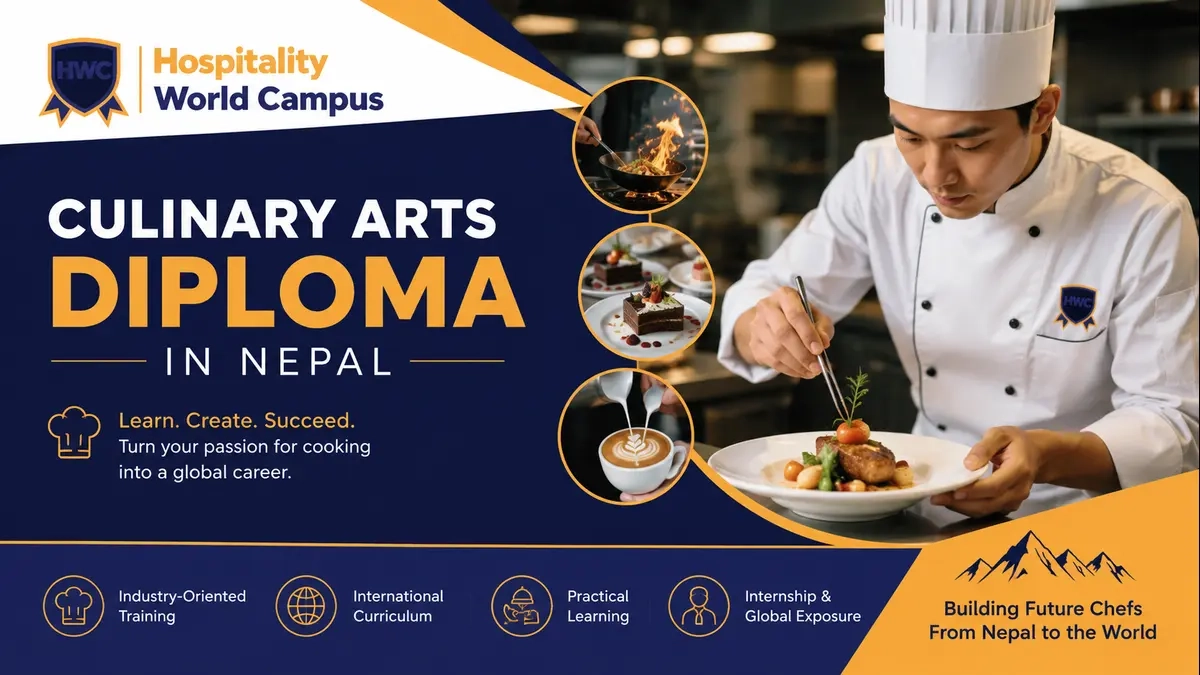
If you are researching a culinary arts diploma in Nepal, you are probably comparing the same handful of institutions everyone else finds: Hospitality World Campus (HWC) in Jawalakhel, the Academy of Culinary Arts (ACA) in Lagankhel, GATE College in Mandikhatar, and International Hotel Training School (IHTS) in Old Baneshwor.
At HWC, the Diploma in Global Culinary Arts (DGCA) is built around a 12-month structure of six months of hands-on kitchen training followed by a six-month internship, and the curriculum is quality assured by the Scottish Qualifications Authority (SQA), credit-rated on the Scottish Credit and Qualifications Framework (SCQF) at Level 6, and benchmarked against the European Qualifications Framework (EQF) at Level 4, giving graduates a diploma with a recognized international framework behind it rather than a purely local certificate.
That said, every serious applicant deserves an honest look at the full field, so this guide walks through what each college actually offers: duration, accreditation, fees where they are published, internship networks, and eligibility so you can make a decision based on facts rather than marketing copy.
What Is a Diploma in Culinary Arts?

A diploma in culinary arts is a structured, industry-focused training program that teaches professional cooking, kitchen management, food safety, and menu planning, combined with real kitchen practice and, in most Nepali programs, a supervised hotel internship. It is not a short recreational cooking class. It is designed to take a beginner to a job-ready commis chef in about a year.
Most programs in Nepal follow one of two tracks. The first is affiliation with an international awarding body such as the UK’s CTH or Scotland’s SQA. The second is affiliation with Nepal’s own Council for Technical Education and Vocational Training (CTEVT), a government body that regulates vocational diplomas nationwide. Some colleges combine both.
Core Components Every Program Shares
- Kitchen hygiene, food safety, and sanitation standards
- Cookery methods for meat, poultry, seafood, vegetables, and eggs
- Baking, pastry, and dessert preparation
- Menu planning and basic food costing
- A supervised internship, typically 6 months, inside a working hotel or restaurant kitchen
Why Study Culinary Arts in Nepal Right Now
Nepal’s tourism and hospitality sector is expanding, hotel openings are increasing in Kathmandu and Pokhara, and the country still faces a shortage of professionally trained chefs, which means demand for skilled diploma graduates continues to outpace supply.
Nepal’s hospitality industry contributes a meaningful share of national GDP and supports hundreds of thousands of jobs, according to figures HWC has compiled from tourism sector data. Kitchens, in particular, are one of the fastest-growing hiring areas because international hotel chains entering Nepal expect staff trained to consistent, exportable standards, not just informal on-the-job cooking experience.
This is also why international accreditation matters more in Nepal’s culinary education market than it might elsewhere. A diploma benchmarked against a recognised framework like SCQF or assessed by a body like CTH gives graduates a credential that hotels in the Gulf, the UK, Australia, and Southeast Asia can actually evaluate, rather than a locally issued certificate they have never seen before.
HWC’s Diploma in Global Culinary Arts (DGCA)
HWC’s DGCA is a 12-month program (6 months training, 6 months internship) located in Jawalakhel, Lalitpur, with a curriculum designed by LCCI Global Qualifications and quality assured by Scotland’s SQA, placing it on the SCQF at Level 6 and benchmarked against the EQF at Level 4.
HWC is a unit of LCCI GQ, an internationally recognised organisation in professional and management skills training. The DGCA covers food preparation, cooking techniques, presentation, food safety and sanitation, nutrition, menu planning, and baking and pastry, with practical instruction delivered in HWC’s own kitchens rather than borrowed facilities.
Program Snapshot
| Detail | HWC DGCA |
|---|---|
| Duration | 12 months (6 months training + 6 months internship) |
| Location | Jawalakhel, Lalitpur, Kathmandu |
| Accreditation | LCCI Global Qualifications curriculum, quality assured by SQA (Scotland) |
| Framework | SCQF Level 6 (67 credit points), benchmarked to EQF Level 4 |
| Eligibility | SEE/SLC with minimum D+ (GPA 1.6), minimum D+ in English, age 17+ |
| Class structure | Small class sizes with a low teacher-to-student ratio |
| Support | One-on-one mentor meetings held monthly with every student |
Why the SCQF Benchmark Matters
A diploma that sits on a recognised international qualifications framework is easier for foreign employers and credit-transfer offices to interpret than a diploma with no external quality assurance at all. This is one of the clearer differentiators between HWC’s DGCA and diploma programs that rely solely on an in-house or purely domestic curriculum.
Internship and Industry Placement
HWC treats industry placement as a core part of the program rather than an add-on. The college has placed students with international hospitality groups including Raffles Doha, The Ritz-Carlton, Jumeirah Beach Hotel, Burj Al Arab, Shangri-La, Fairmont The Palm, JW Marriott, Hyatt Regency, and several UK and Australian properties such as The Gleneagles Hotel and Park Hyatt Sydney. Placement opportunities depend on what roles partner employers have open at the time, so not every student is guaranteed a specific property, but the partner network itself is real and verifiable.
Mentoring and Small Class Sizes
Each HWC student is paired with a mentor who meets them individually once a month. Combined with a deliberately low teacher-to-student ratio, this is meant to catch problems early rather than let a struggling student fall through the cracks in a large lecture-style class, which is a common complaint students raise about bigger vocational institutes.
Culinary Arts Diploma Colleges in Nepal: Comparison Table
Nepal’s main culinary arts diploma providers are HWC (12-month SQA-benchmarked DGCA in Lalitpur), ACA (CTH UK-affiliated diploma in Lalitpur, established 2010), GATE College (CTEVT-affiliated diploma in Kathmandu with a TAFE NSW partnership), and IHTS (1,860-hour, CTEVT and CTH-affiliated diploma in Old Baneshwor with 100% internship placement).
| College | Program Name | Duration | Location | Affiliation | Eligibility |
|---|---|---|---|---|---|
| HWC | Diploma in Global Culinary Arts (DGCA) | 12 months | Jawalakhel, Lalitpur | LCCI GQ curriculum, SQA quality assured, SCQF Level 6 | SEE min D+ (GPA 1.6), English D+, age 17+ |
| ACA | CTH Level 2 Diploma in Culinary Skills | 6 months (3 months practical + 3 months internship) | Lagankhel, Lalitpur | CTH (UK) | +2 with English, age 16+ |
| GATE College | Diploma in Culinary Arts | Varies by intake; CTEVT-coordinated | Mandikhatar, Budhanilkantha | CTEVT, plus Certificate III in Commercial Cookery via TAFE NSW | SEE/SLC, medical fitness check, basic English |
| IHTS | Diploma in Culinary Arts | 1 year, 1,860 hours (6 months training + 6 months internship) | Old Baneshwor, Kathmandu | CTEVT + CTH (UK) | SEE or +2, entrance test and interview |
A note on accuracy: fee figures are not published on every college’s own site, and some colleges quote duration differently across their marketing pages depending on which specific diploma level or intake they mean. Where a college does not publish exact figures, this guide says so rather than guessing.
Academy of Culinary Arts (ACA), Lalitpur
ACA has offered culinary education in Nepal since 2010 and delivers a CTH (UK)-affiliated Diploma in Culinary Skills that, as listed on their own program page, runs 6 months, split into 3 months of practical training and 3 months of internship.
ACA operates under the Academy of Culinary Arts and Hospitality Management, in Lagankhel, Lalitpur, and is the vocational training arm of a larger group that also runs the Center for Leadership and Entrepreneurship (CLE) and a bachelor’s program in hospitality management affiliated with Lincoln University College, Malaysia. The diploma is awarded in partnership with the Confederation of Tourism and Hospitality (CTH), a UK-based awarding body for hospitality and tourism qualifications.
The curriculum covers kitchen hygiene and food safety, mise en place, cookery methods, meat and poultry preparation, stocks and sauces, pastry and dough, and cold and hot desserts. Admission requires completion of +2 with English as a compulsory subject, and candidates go through an entrance test and interview before enrollment. ACA runs multiple intakes across the year: August, November, February, and May.
ACA does not publish its exact diploma fee on its program page. Independent Nepal college-fee research, including HWC’s own published fee guide, has estimated ACA’s broader culinary diploma offerings in the range of roughly NPR 4 to 7 lakh, though prospective students should confirm current pricing directly with ACA’s admissions office rather than relying on third-party estimates.
GATE College, Kathmandu
GATE College, based in Mandikhatar, Budhanilkantha, runs a CTEVT-coordinated Diploma in Culinary Arts and also offers the SIT30816 Certificate III in Commercial Cookery in partnership with TAFE NSW, Australia, giving students an Australian-recognised vocational qualification alongside the Nepali one.
GATE has built a large alumni base, with more than 9,000 graduates working in hospitality-related roles internationally, according to GATE’s own institutional profile. The college positions itself around “edutainment” and experiential learning rather than a purely lecture-based model, and it runs intakes for its diploma-level programs in January and August each year.
The published curriculum for GATE’s culinary diploma covers hygiene, safety and nutrition, cookery methods in both theory and practice, basic kitchen management, identification of kitchen tools and equipment, cake and pastry production, menu planning and cost control, and inventory and stock management. GATE also offers need-based and merit-based scholarships, though, like most colleges in this space, it asks prospective students to contact the admissions office directly for the current fee structure rather than publishing it openly online.
International Hotel Training School (IHTS)
IHTS, located in Old Baneshwor, Kathmandu, runs a 1-year, 1,860-hour Diploma in Culinary Arts affiliated with both CTEVT and the UK’s CTH, structured as 6 months of in-house training followed by a 6-month internship, and the school advertises 100% job placement assistance through a network of more than 64 partner hotels.
IHTS is ISO 19001:2015 certified and markets itself as a comparatively budget-friendly option in Kathmandu’s culinary training market, with HWC’s own published fee-comparison research placing IHTS’s diploma fee at approximately NPR 2 lakh, notably lower than several of its competitors. The curriculum spans Continental, Italian, Chinese, Indian, and Japanese cuisines, along with bakery, pastry, and sushi preparation, and covers food safety, occupational health, and kitchen maintenance as standalone modules rather than folding them into general cookery classes.
Admission requires SEE or +2 completion from any stream, followed by an entrance test and interview. Internships are placed in 3 to 5 star hotels in Nepal, and IHTS also runs a range of shorter, standalone courses, such as bartending, sushi, and single-cuisine cook training, for students who want a narrower specialization instead of the full diploma.
The CTEVT-Affiliated Diploma Route
Separate from privately branded diploma programs, Nepal’s Council for Technical Education and Vocational Training (CTEVT) directly accredits a standardised Diploma in Culinary Arts offered through 8 registered institutions nationwide, 3 of which operate in Kathmandu district, according to Edusanjal’s institutional directory.
This CTEVT track is a useful reference point because it represents the government-recognised baseline qualification in culinary training, separate from privately negotiated international affiliations like CTH or SQA. Institutions listed under this CTEVT pathway include IHTS, the Oriental Hospitality and Tourism Training Center in New Baneshwor, and Pinnacle Training Academy in Lagankhel, among others across Kathmandu, Pokhara, and other districts.
If your priority is a government-recognised local qualification at the lowest possible cost, the CTEVT route is worth comparing against internationally affiliated diplomas. If your priority is a credential that a hotel outside Nepal can immediately understand and evaluate, an internationally quality-assured diploma, such as HWC’s SQA-linked DGCA or ACA’s CTH-affiliated program, generally carries more weight abroad.
How to Choose the Right Culinary College
Compare colleges on four factors in this order: internship quality and named hotel partners, the specific international or CTEVT accreditation behind the diploma, the total real cost including uniforms and exam fees, and class size or mentoring support, rather than choosing based on brochure photos alone.
Questions Worth Asking Before You Enroll
- Which specific hotels have recent graduates interned at, not just which brands the college claims a partnership with?
- Is the accrediting body (SQA, CTH, CTEVT, or another) one that employers abroad will recognise?
- What is the full cost, including kitchen uniforms, tools, and examination fees, not just the headline tuition figure?
- What is the average class size, and how much individual feedback do students get in the kitchen?
- Does the college disclose real placement outcomes, or only a small number of highlighted success stories?
A Quick Comparison by Priority
| If you care most about… | Consider |
|---|---|
| International qualifications framework recognition | HWC (SCQF/EQF-benchmarked DGCA) or ACA (CTH, UK) |
| Lowest published tuition cost | IHTS (~NPR 2 lakh, per independent fee research) |
| Australian vocational credentialing | GATE College (TAFE NSW partnership) |
| Government-recognised local diploma | Any CTEVT-affiliated institution |
| Personal mentoring and small classes | HWC (monthly one-on-one mentor meetings) |
Career Paths and Salaries After a Culinary Diploma
Graduates typically start as a Commis Chef earning roughly NPR 18,000 to 30,000 per month, progress to Chef de Partie and then Sous Chef over 5 to 8 years, and can reach Executive Chef roles paying NPR 1.2 lakh to 2.5 lakh or more per month at 5-star properties, with meaningfully higher pay for chefs who move abroad.
| Career Stage | Typical Timeline | Monthly Salary Range (NPR) |
|---|---|---|
| Commis Chef / Junior Cook | Year 0 to 2 | 18,000 to 30,000 |
| Chef de Partie / Station Chef | Year 2 to 5 | 30,000 to 60,000 |
| Sous Chef | Year 5 to 8 | 60,000 to 100,000 |
| Executive Chef / Head Chef | Year 8 to 10+ | 1,20,000 to 2,50,000+ (5-star hotels) |
| International Career (UAE, Australia, Japan, Europe) | Varies | Equivalent of roughly NPR 2 to 5 lakh/month abroad |
These figures come from HWC’s own published career-outcomes research and should be treated as general market ranges rather than guarantees. Actual pay depends heavily on the hotel category, city, and the graduate’s own performance during internship, since internship supervisors are frequently the first reference a graduate uses when applying for a permanent role.
Cost of a Culinary Arts Diploma in Nepal
Published or independently researched culinary diploma fees in Nepal range from roughly NPR 2 lakh at the budget end (IHTS) to NPR 4 to 7 lakh at institutions with premium international affiliations (ACA), while several colleges, including GATE, do not publish exact figures and require a direct inquiry.
| College | Approximate Fee | Source |
|---|---|---|
| IHTS | ~NPR 2 lakh | HWC’s published fee-comparison research |
| ACA | NPR 4 to 7 lakh (broader diploma offerings) | HWC’s published fee-comparison research |
| GATE College | Not publicly disclosed | GATE admissions office (contact required) |
| HWC | HWC’s related DHM program is listed at NPR 225,000 | HWC’s own published fee guide |
Whatever fee a college quotes, ask specifically whether it includes kitchen uniforms, knife kits, examination fees, and internship-related costs, since these are commonly billed separately and can add a noticeable amount to the headline tuition figure.
FAQs
What is a Diploma in Culinary Arts?
It is a structured professional training program in cooking, kitchen management, food safety, and menu planning that combines classroom theory with hands-on kitchen practice and a supervised hotel internship, usually completed in about a year.
How long does a culinary arts diploma take in Nepal?
Most programs run around 12 months, typically split into 6 months of training and 6 months of internship, though ACA’s CTH Level 2 diploma runs 6 months and some CTEVT programs vary by institution.
What is the minimum qualification needed to apply?
Most colleges accept SEE (Grade 10) completion or above, though the exact grade requirement varies. HWC requires a minimum D+ (GPA 1.6) overall and in English; ACA and IHTS generally require or prefer +2 completion.
Is a culinary diploma from Nepal recognized abroad?
Recognition depends on the accrediting body behind the diploma. Programs quality assured by SQA, CTH, or similar international bodies are generally easier for foreign employers to evaluate than diplomas with no external accreditation.
What is SCQF and why does it matter for HWC’s DGCA?
The Scottish Credit and Qualifications Framework (SCQF) is an internationally referenced qualifications framework. HWC’s DGCA is credit-rated at SCQF Level 6 with 67 credit points and benchmarked against the EQF at Level 4, giving it a defined position that international employers and credit-transfer offices can interpret.
What is the difference between CTEVT and CTH-affiliated diplomas?
CTEVT is Nepal’s own government body for technical and vocational education, producing a locally regulated qualification. CTH is a UK-based awarding body, so a CTH-affiliated diploma carries international recognition that a purely CTEVT diploma may not.
Does the diploma include an internship?
Yes, nearly every diploma reviewed here, HWC, ACA, GATE, and IHTS, includes a supervised internship, generally lasting several months, inside a working hotel or restaurant kitchen.
Can I go straight into a culinary diploma after SEE (Grade 10)?
At several colleges, yes. HWC and IHTS both accept SEE-level applicants who meet the minimum grade requirements, while ACA’s diploma is designed around +2 completion.
What is the difference between a diploma and a bachelor’s in culinary arts or hospitality?
A diploma is a shorter, skills-focused program aimed at getting graduates job-ready quickly, usually around a year. A bachelor’s degree, such as ACA’s affiliated BHM program, takes several years and covers broader management theory alongside practical skills.
What cuisines will I learn?
Programs generally cover Nepali, Continental, Indian, and Chinese cuisine at minimum. IHTS specifically lists Italian, Japanese, and sushi training as well, alongside bakery and pastry across most programs.
Will I get a job after completing the diploma?
Most colleges support job placement through hotel partnerships and internship networks. IHTS explicitly advertises 100% job placement assistance, while HWC and others rely on internship-to-employment pathways through named industry partners.
What is the starting salary for a chef in Nepal?
Entry-level Commis Chef roles typically pay between NPR 18,000 and NPR 30,000 per month, based on HWC’s published career-outcomes research, rising with experience and hotel category.
Can I use a Nepal culinary diploma to work in the UAE, UK, or Australia?
It depends on the diploma’s accreditation. Internationally benchmarked or affiliated diplomas, such as HWC’s SQA-linked DGCA, ACA’s CTH program, or GATE’s TAFE NSW-linked Certificate III, are generally more transferable abroad than a purely local qualification.
What is the difference between HWC’s DGCA and ACA’s Diploma in Culinary Skills?
HWC’s DGCA runs 12 months with an SQA-quality-assured, SCQF Level 6 curriculum. ACA’s CTH Level 2 Diploma in Culinary Skills, as listed on ACA’s own program page, runs 6 months and is affiliated with the UK’s CTH rather than Scotland’s SQA.
What is CTEVT and why do some colleges follow it?
CTEVT (Council for Technical Education and Vocational Training) is Nepal’s government body regulating vocational and technical diplomas. Colleges follow it to offer a nationally recognised, regulated qualification, often alongside an additional international affiliation.
Are there entrance exams for culinary colleges in Nepal?
Yes, at several institutions. ACA and IHTS both require candidates to pass an entrance test and interview before admission is finalized.
What documents are required for admission?
Typically academic transcripts and certificates from SEE onward, citizenship documents (or a passport for foreign nationals), and passport-sized photographs, though exact requirements vary by college.
What is the class size like at HWC compared to other colleges?
HWC specifically markets a low teacher-to-student ratio and small class sizes as a core part of its model, paired with individual monthly mentoring, which is a more personalized structure than larger lecture-based vocational institutes typically offer.
Is mentoring included in culinary diploma programs?
At HWC, yes, every student is assigned a mentor who meets with them individually once a month throughout the program. This is not standard across every college in this comparison.
What age can I start a culinary arts diploma?
Minimum ages vary: HWC requires students to be at least 17, while ACA’s program accepts candidates from age 16 upward, provided they meet the academic eligibility criteria.
What is the difference between Diploma in Culinary Arts and Diploma in Hospitality Management?
A culinary arts diploma focuses specifically on cooking, kitchen operations, and food production. A hospitality management diploma, such as HWC’s DHM, covers broader hotel operations, including front office, housekeeping, and food and beverage management, alongside some culinary basics.
How many intakes does each college have per year?
ACA runs four intakes annually (August, November, February, May). GATE runs two intakes for its diploma programs (January and August). Intake schedules for other colleges should be confirmed directly, as they can change between academic years.
What should I check before choosing a culinary college?
Verify the specific hotels recent graduates interned at, confirm the accrediting body and whether it is recognised where you eventually want to work, get the full cost breakdown including uniforms and exam fees, and ask about class size and mentoring support.
What career growth is possible after 5 to 10 years as a chef?
Based on HWC’s published career-path data, a chef can progress from Commis Chef to Chef de Partie, then Sous Chef, and ultimately Executive Chef, with 5-star hotel Executive Chef salaries reported in the range of NPR 1.2 lakh to 2.5 lakh or more per month.
Final Thoughts
Every college compared here, HWC, ACA, GATE, and IHTS, offers a legitimate pathway into Nepal’s culinary industry, and the right choice depends on what you are optimizing for. If an internationally benchmarked qualification and close mentoring matter most to you, HWC’s SQA-quality-assured, SCQF Level 6 DGCA in Jawalakhel is built specifically around that combination.
If cost is your primary constraint, IHTS’s roughly NPR 2 lakh program is worth a serious look. If you want an Australian-recognised vocational credential alongside a CTEVT diploma, GATE’s TAFE NSW partnership stands out. Whichever college you shortlist, ask for the full fee breakdown in writing, ask which specific hotels recent graduates interned at, and talk to a current student or recent graduate before you commit.
Ready to see if HWC’s Diploma in Global Culinary Arts is the right fit for you?
Book a free consultation with HWC’s admissions team to walk through eligibility, the current intake schedule, and what a typical week in the kitchen actually looks like.