
Introduction
If you type “culinary arts training in Kathmandu” into Google, you will get a wall of nearly identical pages promising to turn you into a five-star chef. What you will not get easily is a side-by-side look at what each college actually offers: how long the course runs, what the internship looks like, how big the class is, and what it costs. Hospitality World Campus (HWC), based in Jawalakhel, Lalitpur, is one of the best culinary arts training in Kathmandu in this space, built as a unit of LCCI GQ with a deliberately small-class, mentor-led model rather than a mass-enrollment one.
Since 2022, HWC has trained students from across Nepal in its Diploma in Global Culinary Arts (DGCA), alongside hotel management, barista, and bakery programs. Before you commit two years and a meaningful sum of money to any institute, though, it is worth understanding how HWC’s approach compares with four other established culinary schools in the Kathmandu Valley: Academy of Culinary Arts and Hospitality Management (ACA), GATE College, the International Institute of Gastronomy (IIG), and the International Hotel Training School (IHTS). This guide walks through each one using information published on their own websites, so you can make the comparison yourself rather than relying on marketing copy.
This is a long guide, so use the table of contents below to jump to what matters most to you, whether that is course duration, fee structure, or which college has the strongest internship pipeline.
Why Kathmandu Is a Hub for Culinary Arts Training
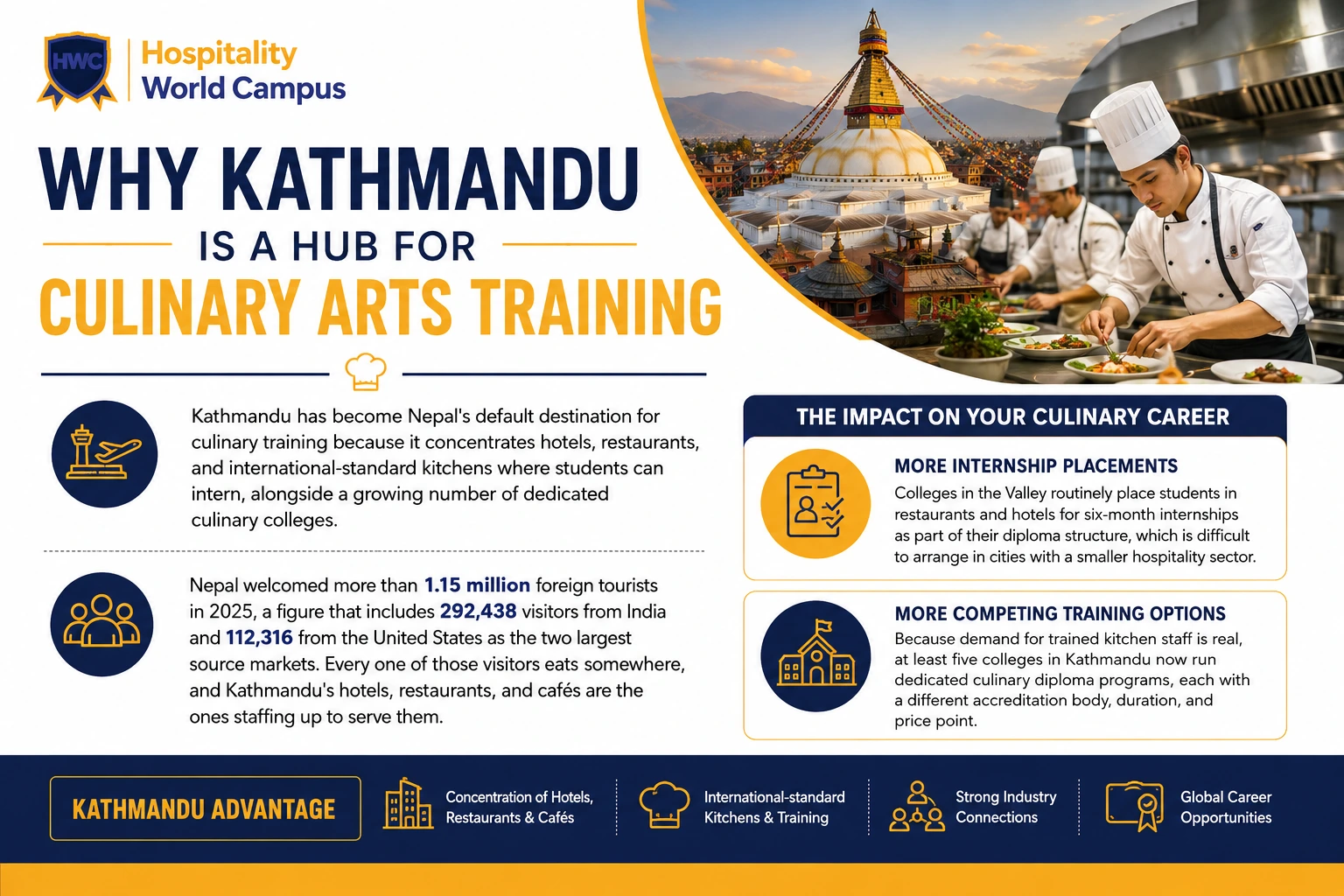
Kathmandu has become Nepal’s default destination for culinary training because it concentrates hotels, restaurants, and international-standard kitchens where students can intern, alongside a growing number of dedicated culinary colleges. Nepal welcomed more than 1.15 million foreign tourists in 2025, a figure that includes 292,438 visitors from India and 112,316 from the United States as the two largest source markets. Every one of those visitors eats somewhere, and Kathmandu’s hotels, restaurants, and cafés are the ones staffing up to serve them.
That demand has two direct effects on someone considering a culinary career here:
- More internship placements. Colleges in the Valley routinely place students in restaurants and hotels for six-month internships as part of their diploma structure, which is difficult to arrange in cities with a smaller hospitality sector.
- More competing training options. Because demand for trained kitchen staff is real, at least five colleges in Kathmandu now run dedicated culinary diploma programs, each with a different accreditation body, duration, and price point.
The result is genuine choice, but also genuine confusion, since course names like “Diploma in Culinary Arts,” “Diploma in Culinary Skills,” and “Diploma in Global Culinary Arts” sound interchangeable but are not built the same way.
What to Check Before Choosing a Culinary College
Before comparing specific colleges, check five things: accreditation, course duration, internship structure, class size, and total cost including add-on fees. These five factors explain almost every practical difference between programs in Kathmandu.
- Accreditation and awarding body. Some diplomas are awarded by UK-based bodies like the Confederation of Tourism & Hospitality (CTH), some by Nepal’s Council for Technical Education and Vocational Training (CTEVT), and some by both. Dual accreditation can matter if you plan to work or study abroad later.
- Total duration and internship split. Programs range from six months to a full year of classroom and kitchen training, almost always paired with a separate internship period.
- Class size and instructor ratio. A 40-seat cohort and an 18-seat cohort produce very different amounts of one-on-one time with a chef instructor.
- Total cost, not just tuition. Ask specifically about uniform costs, kitchen tool kits, assessment fees, and affiliation charges, since these are often billed separately from the headline course fee.
- Where the internship actually happens. A “6-month internship” means little without knowing which hotels or restaurants a college has partnered with and whether placement is guaranteed or merely assisted.
Hospitality World Campus (HWC): Program Overview
HWC’s flagship culinary program is the Diploma in Global Culinary Arts (DGCA), a 12-month course split into 6 months of training and 6 months of internship, run from its Jawalakhel campus in Lalitpur. HWC positions itself around three things that show up consistently across its course pages: a low teacher-to-student ratio, a formal one-on-one mentoring system where each student meets an assigned mentor monthly, and a stated focus on sustainable practices and ethical sourcing in how food is taught.
Key facts about the DGCA program:
- Duration: 12 months total (6 months of training, 6 months of internship).
- Curriculum coverage: Food preparation, cooking, and presentation techniques; food safety and sanitation; nutrition; menu planning; baking and pastry; and use of kitchen equipment, taught in HWC’s own kitchens.
- Eligibility: Minimum SEE/SLC with a D+ grade (GPA 1.6) overall and in English, and a minimum age of 17.
- Other programs offered: Diploma in Hospitality Management (DHM), Advanced Diploma in Hospitality Management (ADHM), Professional Chef Course – Advanced, Professional Certificate in Barista and Bartending, and a Certificate in Bakery, Pastry & Patisserie, which means students can specialize in a shorter, more focused track if a full 12-month diploma is not the right fit.
- Institutional backing: HWC operates as a unit of LCCI GQ, described on its site as an internationally award-winning organization in professional and management skills training.
- Location: Jawalakhel, Lalitpur, Kathmandu.
Where HWC differs most from the other colleges in this guide is scale by design. It does not publish enrollment numbers in the hundreds or thousands the way some older institutes do, and its own materials frame small class sizes and mentor access as the point, not a limitation. If you learn best with more individual feedback from instructors and want a mentor checking in on your progress rather than moving through a large cohort, that structure is worth weighing against the bigger-name alternatives below.
Culinary Colleges in Kathmandu: Side-by-Side Comparison
Here is a snapshot comparison built from information published on each institute’s own website. Where a college does not publish a specific figure (most commonly exact fees), that is noted rather than estimated.
| College | Location | Flagship Program | Duration | Accreditation | Class/Cohort Size |
|---|---|---|---|---|---|
| Hospitality World Campus (HWC) | Jawalakhel, Lalitpur | Diploma in Global Culinary Arts (DGCA) | 12 months (6 training + 6 internship) | Unit of LCCI GQ | Not published; positioned as small-class |
| ACA (Academy of Culinary Arts & Hospitality Mgmt.) | Lagankhel, Lalitpur | Diploma in Culinary Skills | 6 months (3 practical + 3 internship) | CTH, UK | Not published |
| GATE College | Mandikhatar, Kathmandu | Diploma in Culinary Arts | Varies by intake/structure | CTEVT | Not published |
| IIG (International Institute of Gastronomy) | Panipokhari, Kathmandu | Level 2 Diploma in Culinary Skills | 1 year (6 months internship included) | CTH, UK + CTEVT, Nepal | 18–20 students per batch |
| IHTS (International Hotel Training School) | Old Baneshwor, Kathmandu | Diploma in Culinary Arts | 1 year / 1,860 hours (6 training + 6 internship) | Diploma recognized by industry employers | Not published |
Quick answer: For culinary arts training in Kathmandu, HWC’s DGCA runs 12 months with a mentor-based, small-class model in Lalitpur; ACA offers a faster 6-month CTH-accredited diploma with a decade-plus track record; IIG runs a dual CTH/CTEVT-certified 1-year diploma with published fees around NPR 6,00,000; IHTS offers a 1-year, 1,860-hour program with claimed 100% job placement assistance; and GATE runs a CTEVT-affiliated diploma through its Mandikhatar campus.
Academy of Culinary Arts and Hospitality Management (ACA)
ACA’s Diploma in Culinary Skills is a 6-month program (3 months practical training plus 3 months internship), awarded through CTH, UK, and is the most established program in this comparison, having started as a diploma course in 2010. ACA operates from Lagankhel, Lalitpur, and has since expanded into a wider institution offering BHM, BBA, BIT, and MBA programs through its sister entity, the Center for Leadership and Entrepreneurship (CLE).
What ACA publishes about its culinary program:
- Duration: 6 months total, structured as 3 months of practical training and 3 months of internship, with class schedules described as open and flexible, running cohort-wise.
- Intakes: August, November, February, and May.
- Eligibility: Completion of +2 (with English as a compulsory subject) and a minimum age of 16, followed by an entrance test and interview.
- Curriculum: Covers the CTH Level 2 Diploma in Culinary Skills syllabus, including kitchen hygiene and food safety, mise en place, cookery methods, menu planning and costing, and preparation of meat, poultry, seafood, pasta, pastry, and desserts.
- Institutional scale: ACA states more than 1,600 students have graduated through the institution, with 48 industry partnerships and over 900 alumni still in touch with the college.
ACA’s biggest practical advantage is speed: its culinary diploma is roughly half the length of HWC’s, IIG’s, and IHTS’s programs, which suits someone who wants to start working sooner. The tradeoff is less total training and internship time compared to the 12-month formats.
GATE College
GATE College (Global Academy of Tourism and Hospitality Education) runs a CTEVT-affiliated Diploma in Culinary Arts from its Mandikhatar campus in Budhanilkantha, Kathmandu, with a curriculum built around classical and international cuisine plus pastry, baking, and garde manger technique. GATE is a longer-running hospitality education provider that also offers Bachelor’s-level hospitality programs alongside its diploma-level vocational courses.
What GATE publishes about its culinary program:
- Curriculum coverage: Hygiene, safety, and nutrition; methods of cookery in both theory and practice; basic kitchen management; identification and use of kitchen utensils and equipment; different cuisine preparation and service styles; cake, pastry, and bread production; menu planning and cost control; and inventory and stock management.
- Eligibility: Completion of SLC/SEE or its equivalent, a medical fitness report, and basic spoken and written English.
- Scholarships: GATE states it offers both need-based and merit-based scholarships, with details available on request from its administration office.
- Affiliation: CTEVT, Nepal’s national technical and vocational education authority.
GATE does not publish exact course duration or fee figures for the culinary diploma on its public pages, so anyone comparing it against HWC, ACA, IIG, or IHTS should contact the college’s admissions office directly for those specifics before making a decision.
International Institute of Gastronomy (IIG)
IIG’s Level 2 Diploma in Culinary Skills is a 1-year, dual-certified program (CTH, UK, and CTEVT, Nepal) run from Panipokhari, Kathmandu, with a published total course fee of NPR 6,00,000 plus roughly NPR 15,000 for uniforms and books. IIG is notable in this comparison for publishing more granular operational detail than most competitors, including cohort size and a full fee breakdown.
What IIG publishes about its culinary program:
- Duration and schedule: 1 year total, 6 days a week (Saturdays off), 5 to 6 hours a day, structured as roughly 70% practical and 30% theory, plus a 6-month internship at hospitality establishments in the Kathmandu Valley.
- Class size: 18 to 20 students per batch, taught by a lead instructor and an assistant instructor.
- Dual certification: Level 2 Diploma in Culinary Skills from CTH, UK, and Commis Level I certification from CTEVT, Nepal, after a final CTEVT assessor evaluation on top of CTH’s own practical and theory exams.
- Fees: NPR 6,00,000 total course fee (inclusive of VAT, admission fees, practical expenses, affiliation charges, CTH and internal assessment fees, English/soft-skills classes, CTEVT assessment fee, and a chef tool kit), plus an additional NPR 15,000 for kitchen uniforms and books. A NPR 25,000 booking fee and NPR 1,25,000 admission fee apply during enrollment, with the balance payable in a single payment or monthly installments over the first 6 months.
- Eligibility: Age 17 to roughly 30 to 32 depending on intake, plus a written assessment and interview.
- Career assistance: IIG states it partners with recruitment and consulting firms to support placement in Australia, the Middle East, and parts of Europe after graduation, in addition to local internship placements in the Kathmandu Valley.
IIG’s willingness to publish its full fee structure is genuinely useful for comparison shopping, since most other colleges in this list, HWC included, do not list exact tuition on their public course pages and instead direct inquiries to a consultation.
International Hotel Training School (IHTS)
IHTS runs a 1-year, 1,860-hour Diploma in Culinary Arts from Old Baneshwor, Kathmandu, split into 6 months of in-house training and 6 months of internship at what it describes as 3- to 5-star partner hotels, and states it provides 100% job placement assistance to graduates who complete the program. IHTS also holds ISO 19001:2015 certification and lists more than 64 partner hotels for internship placement.
What IHTS publishes about its culinary program:
- Duration: 1 year, totaling 1,860 hours of instruction, with 6 months of in-house training followed by a 6-month internship.
- Curriculum: A structured, code-numbered curriculum covering hospitality industry fundamentals, mise en place, cookery methods, stocks/soups/sauces, vegetables/fruits/eggs, entrées and salads, poultry, seafood, meat, food presentation, and food safety and hygiene, plus specialty modules in Continental, Italian, Chinese, Indian cuisine, bakery and pastry, and sushi.
- Eligibility: SEE or +2 graduates from any stream, subject to an entrance test and interview.
- Job placement claim: IHTS states it offers 100% job placement assistance once the program is completed, backed by its stated network of 64-plus partner hotels.
- Certification: ISO 19001:2015 certified as an institution, with a diploma the school states is recognized by hospitality employers in Nepal and abroad.
IHTS’s curriculum breadth, covering five distinct regional cuisines plus bakery and sushi within one diploma, is one of the more detailed public curriculum listings among the colleges compared here.
Course Duration and Certification Compared {#duration-certification}
Culinary diploma programs in Kathmandu currently split into two broad formats: shorter 6-month diplomas built around CTH’s Level 2 standard, and longer 12-month diplomas that pair 6 months of classroom and kitchen training with a 6-month internship. ACA is the clearest example of the shorter format. HWC, IIG, and IHTS all use some version of the 12-month, 6-plus-6 structure, though they differ in accrediting body: HWC through LCCI GQ, IIG through both CTH (UK) and CTEVT (Nepal) simultaneously, and IHTS through its own diploma recognized by industry employers rather than a named international awarding body on its public course page. GATE’s culinary diploma is affiliated with CTEVT but does not publish an exact duration figure for the culinary-specific track on its public site.
If international recognition matters to you, for example because you plan to apply for jobs or further study abroad, IIG’s dual CTH/CTEVT structure and ACA’s CTH affiliation are worth asking about directly, alongside asking HWC and IHTS how their certifications are recognized by employers in the markets you are targeting.
Fees and Affordability
Only IIG publishes a full, itemized fee structure on its public course page (NPR 6,00,000 plus roughly NPR 15,000 in additional costs); HWC, ACA, GATE, and IHTS all direct prospective students to contact admissions directly for current fee details. This is worth calling out clearly rather than guessing: it is common across Nepal’s hospitality colleges for tuition to be quoted during a consultation rather than published, since fees can vary by intake, scholarship eligibility, and payment plan.
What you can and should ask each college directly, based on what IIG’s published structure shows is typically bundled into a culinary diploma fee:
- The base course/tuition fee
- Admission and booking fees (paid separately, often before the tuition balance)
- Uniform and chef tool kit costs
- Assessment and affiliation fees (charged by the awarding body, such as CTH or CTEVT)
- Whether installment payment plans are available and over what period
- Whether early-booking or merit-based discounts apply, since GATE and IIG both mention scholarship or discount options in their public materials
Internship Structures and Career Outcomes {#internships}
Every college compared here builds a supervised internship into its culinary diploma, but the guarantees behind that internship differ: IHTS explicitly states 100% job placement assistance and lists 64-plus partner hotels, IIG describes placement assistance extending to Australia, the Middle East, and parts of Europe, while HWC and ACA frame their support around industry connections and mentoring rather than a stated placement percentage.
A few concrete data points worth noting:
- HWC lists specific alumni outcomes on its site, including graduates working as a Commis II in Cyprus, a Commis III (Pastry & Bakery) at Soaltee Western in Itahari, and a Commis Chef at Chulo Thakali in Kathmandu.
- ACA publishes testimonials from graduates now working internationally, including a Sous Chef at The Australia Hotel in New South Wales and a Front Office Manager at Hotel Vibe Canberra, alongside its claim of 48 industry partnerships.
- IIG ties its internship structure directly into international placement support, stating graduates have gone on to work in Australia, Dubai’s hospitality sector, and Hong Kong, based on testimonials published on its site.
- IHTS is the most explicit about placement guarantees, stating 100% job placement assistance following completion, though this is a claim from the school’s own marketing rather than a third-party-verified statistic.
None of these colleges publish independently audited placement rate data, so treat every “100%” or “guaranteed” claim, including any similar language a college might use about HWC, as a marketing statement to verify directly with the admissions office and, ideally, with recent alumni before enrolling.
Which College Fits Which Type of Student
The right choice depends less on which college has the flashiest homepage and more on how you learn, how much time you have, and what kind of certification you eventually need.
- If you want more individual mentoring and a smaller cohort: HWC’s model, built around a monthly one-on-one mentor system and small class sizes, is designed specifically around this. It is also worth checking IIG’s stated 18–20 student batch size as a comparison point.
- If you want the shortest path to entry-level work: ACA’s 6-month diploma is roughly half the length of the 12-month programs from HWC, IIG, and IHTS, which matters if you need to start earning sooner.
- If dual international/national certification matters to you: IIG is the only college here that explicitly states both a CTH (UK) diploma and a CTEVT (Nepal) certification are awarded from the same program.
- If you want a long-established institution with a large alumni network: ACA’s decade-plus history and stated 1,600+ graduates give it the longest track record of the five.
- If a stated job-placement guarantee is important to you: IHTS is the only college in this list that states 100% job placement assistance explicitly, though you should ask for specifics on what “assistance” includes.
- If you want full fee transparency before you even inquire: IIG publishes its complete fee breakdown, which the other four colleges, HWC included, do not do on their public course pages.
Whichever college you shortlist, book a campus visit if possible, ask to see the working kitchen, and ask current or recent students, not just the admissions team, what their internship placement actually looked like.
Frequently Asked Questions {#faq}
What is the best culinary arts training in Kathmandu? There is no single “best” college; the right choice depends on the duration, certification, class size, and budget that fit your situation. This guide compares HWC, ACA, GATE, IIG, and IHTS on those specific factors so you can weigh them against your own priorities.
How long does a culinary arts diploma take in Kathmandu? It varies by college. ACA’s diploma runs 6 months. HWC, IIG, and IHTS all run roughly 12-month programs that combine 6 months of training with a 6-month internship.
Do I need to complete +2 (high school) before joining a culinary diploma in Kathmandu? Requirements vary. HWC requires a minimum SEE/SLC with D+ (GPA 1.6) and age 17+; ACA requires completed +2 with English as a compulsory subject and age 16+; IHTS accepts SEE or +2 graduates from any stream; GATE requires SLC/SEE or equivalent.
What is the Diploma in Global Culinary Arts (DGCA) at HWC? It is HWC’s flagship 12-month culinary program, combining 6 months of hands-on training in food preparation, cooking, and presentation with a 6-month internship, run from HWC’s campus in Jawalakhel, Lalitpur.
How much does a culinary arts course cost in Kathmandu? Published fee information is limited across most colleges. IIG is the only institute in this comparison that lists a full fee structure publicly, at NPR 6,00,000 plus about NPR 15,000 in additional costs. HWC, ACA, GATE, and IHTS all direct fee inquiries to their admissions offices.
Which culinary colleges in Kathmandu are internationally accredited? ACA and IIG both hold accreditation through the Confederation of Tourism & Hospitality (CTH), UK. IIG additionally holds CTEVT (Nepal) certification for the same diploma, making it dual-accredited.
What does CTEVT mean for a culinary diploma? CTEVT stands for the Council for Technical Education and Vocational Training, Nepal’s national body overseeing technical and vocational education. A CTEVT-recognized diploma is nationally certified within Nepal’s vocational education framework.
Is a culinary diploma from Kathmandu recognized abroad? Recognition depends on the awarding body. Programs affiliated with CTH, UK (such as ACA’s and IIG’s) carry international recognition through that awarding body. Always verify recognition directly with the employer or institution in the country you plan to work or study in.
Does HWC offer an internship as part of its culinary program? Yes. HWC’s DGCA program is structured as 6 months of training followed by a 6-month internship.
What is the difference between a Diploma in Culinary Arts and a Diploma in Culinary Skills? In practice, the naming largely reflects each college’s chosen program title rather than a fixed industry standard; ACA and IIG both call their CTH-affiliated programs “Diploma in Culinary Skills,” while HWC, GATE, and IHTS use “Culinary Arts” in their program names. Always check the actual curriculum and accreditation rather than relying on the title alone.
How big are culinary training class sizes in Kathmandu? IIG publishes a specific batch size of 18 to 20 students per cohort. HWC states it maintains small class sizes and a low teacher-to-student ratio but does not publish an exact number. ACA, GATE, and IHTS do not publish specific cohort sizes on their public pages.
Can I specialize in bakery and pastry instead of a full culinary diploma? Yes. HWC offers a standalone Certificate in Bakery, Pastry & Patisserie, and IHTS offers a Diploma in Bakery and Pastry as a separate course from its main culinary diploma. IIG also lists a Level 2 Diploma in Patisserie & Confectionery.
Is there a barista or bartending course available alongside culinary training in Kathmandu? Yes. HWC offers a Professional Certificate in Barista and Bartending. ACA offers standalone short courses in Barista and Bartending as well.
What age do I need to be to enroll in a culinary diploma in Kathmandu? Minimum ages vary: HWC requires 17+, ACA requires 16+ (with completed +2), and IIG’s program is generally aimed at applicants between roughly 17 and 30-32 years old.
Do culinary colleges in Kathmandu offer scholarships? GATE College states it offers both need-based and merit-based scholarships, with details available directly from its administration office. ACA lists a dedicated scholarships page as well. Ask each college directly about current scholarship availability and eligibility.
What is the entrance process like for these programs? Most colleges require an entrance assessment and interview. IIG’s process includes a written assessment covering communication skills, teamwork, work ethic, and physical readiness for kitchen work. ACA and IHTS also require an entrance test and interview.
Where are these culinary colleges located in the Kathmandu Valley? HWC is in Jawalakhel, Lalitpur. ACA is in Lagankhel, Lalitpur. GATE is in Mandikhatar, Budhanilkantha, Kathmandu. IIG is in Panipokhari, Kathmandu. IHTS is in Old Baneshwor, Kathmandu.
Do these colleges help with job placement after graduation? All five reference some form of career or placement support. IHTS explicitly states 100% job placement assistance. IIG describes placement support extending internationally to Australia, the Middle East, and parts of Europe. HWC, ACA, and GATE frame support around industry connections and mentoring rather than a stated guarantee percentage.
What kitchen skills does a typical Kathmandu culinary diploma cover? Across the colleges compared here, common curriculum areas include food safety and hygiene, mise en place, cookery methods, stocks/soups/sauces, meat/poultry/seafood preparation, pastry and baking, and menu planning and costing.
Can international students study culinary arts in Kathmandu? The course pages reviewed here are primarily structured around Nepali academic qualifications (SEE, SLC, +2), so international applicants should contact each college’s admissions office directly to confirm eligibility, visa support, and any additional requirements.
How many hours a week are culinary classes in Kathmandu? IIG specifies 6 days a week (Saturday off) with 5 to 6 hours of class per day. IHTS’s program totals 1,860 hours across its full 1-year duration. Other colleges do not publish exact weekly hour breakdowns.
Is culinary arts a good career choice in Nepal right now? Nepal’s tourism sector welcomed more than 1.15 million foreign visitors in 2025, which continues to support demand for trained kitchen staff across Kathmandu’s hotels, restaurants, and cafés, though career outcomes still depend on the individual’s training, internship experience, and networking.
What is the CTH awarding body? The Confederation of Tourism & Hospitality (CTH), United Kingdom, is a specialist professional awarding body for qualifications in the hospitality and tourism sector, and is the accrediting body behind ACA’s and IIG’s culinary diplomas.
Do I need a laptop to join a culinary training program? IIG explicitly requires applicants to have a laptop as part of its entry requirements. Check with other colleges individually, as this requirement is not stated on every institute’s public page.
What happens during the internship portion of these diplomas? Internships are typically held at partner hotels and restaurants in the Kathmandu Valley. IHTS states its internships take place at 3- to 5-star partner hotels among its 64-plus partner establishments, while IIG places students at hospitality establishments within the Valley as well as offering international placement assistance after graduation.
Can I pay culinary course fees in installments in Kathmandu? IIG explicitly offers both a one-shot payment option (with potential admission fee discounts) and a monthly installment plan to be completed within 6 months of the class start date. Ask other colleges directly about their available payment plans.
What certifications will I hold after completing a culinary diploma in Kathmandu? This depends on the college. IIG graduates hold both a CTH (UK) Level 2 Diploma and a CTEVT (Nepal) Commis Level I certification. ACA’s graduates receive the CTH Level 2 Diploma in Culinary Skills. HWC, GATE, and IHTS issue their own program diplomas as described on their respective course pages.
Are these five colleges the only culinary training options in Kathmandu? No. This guide focuses on HWC and four commonly searched competitor institutes (ACA, GATE, IIG, and IHTS), but other hospitality and vocational institutes in the Valley also offer culinary or food-service related training.
How do I start the admissions process at HWC? HWC’s course pages direct prospective students to use the “Consult Now” option on its site, which connects to its contact page for a direct consultation regarding the DGCA program and eligibility.
Call to Action
Comparing culinary colleges on paper only gets you so far. If HWC’s small-class, mentor-led approach to the Diploma in Global Culinary Arts sounds like the structure you have been looking for, the next step is a direct conversation about your eligibility, intake dates, and program fit. Reach out through HWC’s consultation page to ask your specific questions before you commit to any institute.