
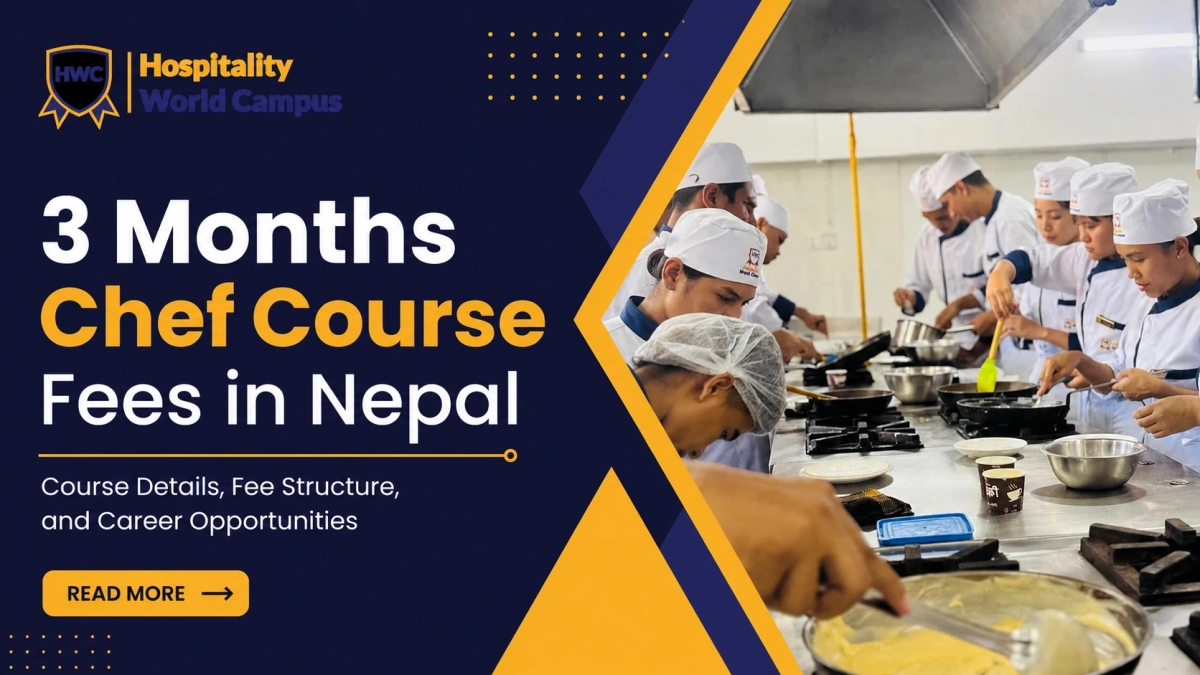
A 3-month (90-hour) Professional Chef Course – Advanced at Hospitality World Campus (HWC) costs NPR 90,000, and it comes with an internationally recognised SQA (Scottish Qualifications Authority) certificate.
That’s the number most sites won’t give you. Search around and you’ll find plenty of pages telling you fees “vary by institute” or asking you to “contact the school for current pricing.” That’s not wrong, but it’s not useful either not when you’re trying to plan a budget with your family before you commit to a course.
So in this guide, we’re doing something different. We’re giving you actual fee figures ours and other institutes’ plus what’s included in the price, what usually costs extra, and how a 3-month program compares to the 6-month and 1-year diploma routes. By the end, you’ll know exactly what you’re paying for and whether it’s worth it.
3-Month Chef Course Fees in Nepal (2026)
| Institute | Course | Duration | Fee (NPR) | Certificate |
|---|---|---|---|---|
| Hospitality World Campus (HWC) | Professional Chef Course – Advanced | 90 hours (~3 months) | NPR 90,000 | International SQA certificate |
| CTEVT-affiliated institutes | Basic Cooking Course | 3 months | Approx. NPR 20,000 – 24,000 | CTEVT certificate |
| Radisson Hotel Training | Bakery & Pastry (3-month track) | 3 months (390 hrs) | Approx. NPR 50,000 | CTEVT certificate |
| Other private culinary schools | General 3-month cook/culinary course | 3 months | Approx. NPR 19,000 – 57,000 | Varies (CTEVT/in-house) |
A few honest notes on this table before you read anything into it:
- CTEVT-affiliated 3-month courses are the cheapest, and that’s exactly the trade-off lower fee, government certification useful mainly within Nepal, and a curriculum built around basic commis-level cooking rather than internationally benchmarked techniques.
- HWC’s fee sits higher because you’re not just paying for 90 hours of class time you’re paying for an SQA certificate that’s recognised outside Nepal, smaller batch sizes, and mentorship built into the program.
- Fee ranges for “other private schools” come from aggregator listings and change often, so treat them as a ballpark, not a quote. Always confirm directly with the institute before budgeting.
Wait: Is It 3 Months or 90 Hours? Here’s the Confusion, Cleared Up
This trips up almost everyone searching for this keyword, so let’s clear it properly.
Some institutes measure their short courses in calendar months (a 3-month course that runs daily or a few days a week for 12 weeks). Others, like HWC, measure the course in total contact hours, 90 hours of hands-on and theory training, which most students complete on a schedule that naturally spans about 3 months when classes run a few sessions a week alongside kitchen practice time.
Why does this matter to you? Because two courses can both be labelled “3 months” and give you very different amounts of actual training. A 90-hour structured program with expert-led sessions in advanced cooking, baking, and pastry techniques is not the same as a 3-month course built around basic entry-level cooking. When you compare fees, always ask: how many hours of real kitchen time am I actually getting for this price?
What NPR 90,000 Actually Covers at HWC
A fee number alone doesn’t tell you much. Here’s what’s built into the Professional Chef Course – Advanced:
- 90 hours of hands-on training in advanced cooking, baking, and pastry-making, taught by working chef-instructors
- Food science and ingredient pairing lessons, not just recipe-following this is what separates a cook from a chef
- Practical training in menu planning, kitchen management, and food costing, useful whether you want a job or want to open your own kitchen someday
- An international SQA certificate, recognised by employers outside Nepal, not only within it
- Small batch sizes with a personal mentor assigned to track your progress
- Access to modern, fully equipped training kitchens for every practical session
- New batches starting every month, so you don’t lose months waiting for the next intake
What’s Usually Extra (Ask Before You Enroll At Any School)
This is a gap most course pages skip entirely, and it’s the part that catches families off guard later. Across culinary schools in Nepal, these costs are commonly billed separately from the base course fee:
- Chef uniform, apron, and personal knife kit (some institutes include this, some don’t)
- Examination or certification processing fees, if the certifying body charges separately
- Ingredient costs for certain advanced practical sessions
- Transport and, if you’re coming from outside the Kathmandu Valley, accommodation
Always ask for a full, written fee breakdown before you pay — at HWC or anywhere else. A lower advertised fee with several add-ons can end up costing more than a slightly higher, all-inclusive one.
Why Chef Course Fees in Nepal Vary So Much
If you’ve been comparing prices across schools, you’ve probably noticed fees for what look like similar courses can range from around NPR 20,000 to well over NPR 90,000. Three things drive that gap:
1. Certification body. CTEVT certification is government-recognised and works well for jobs inside Nepal. An international certificate like SQA is built for employers evaluating candidates for jobs in the Middle East, Europe, Australia, and beyond and that international recognition is priced into the course.
2. Depth of curriculum. A basic 3-month cooking course teaches you to cook competently. An advanced program layers in food science, ingredient pairing, and recipe development skills that matter once you’re past entry-level kitchen work.
3. Class size and mentorship. Institutes running large batches can charge less per student. Smaller batches with one-on-one mentoring cost more to run, and that shows up in the fee.
None of this means the more expensive course is automatically the better choice for you — it depends on your goal. Which brings us to the next question.
Is a 3-Month Chef Course Worth NPR 90,000? Do the Math
Here’s a practical way to look at it, not just an emotional one.
Entry-level chef positions in Nepal typically start around NPR 18,000 to NPR 30,000 per month. With experience, chefs move into supervisory and head chef roles, where total earnings can range from roughly NPR 34,800 to well over NPR 2,23,000 per month, depending on the employer and specialisation. Chefs who move abroad to the UAE, Qatar, Australia, or Europe typically earn several times what the same role pays within Nepal, and an internationally recognised certificate makes that move considerably easier to make.
Looked at that way, a NPR 90,000 course fee is roughly 3 to 5 months of an entry-level chef’s salary an investment most graduates can recover within their first year of employment, faster if they land a role abroad.
Compare that to the longer route: diploma programs in culinary arts run 12 to 18 months and cost anywhere from NPR 2 lakh to NPR 10 lakh. They go deeper and open doors to management-track roles faster, but they demand a much bigger time and money commitment upfront. A 3-month course is the faster, lower-commitment way to test whether this career is right for you or to fast-track into the industry if you already know it is.
3-Month Chef Course vs. Diploma: Which Should You Choose?
| Factor | 3-Month Chef Course (HWC) | 12–18 Month Diploma |
|---|---|---|
| Fee | NPR 90,000 | NPR 2 lakh – 10 lakh |
| Time to job-ready | ~3 months | 1 – 1.5 years |
| Certificate | International (SQA) | Varies by college (CTEVT, CTH, in-house) |
| Best for | Fast entry, career switchers, testing the field | Long-term career, management-track roles, working abroad at senior levels |
| Depth of training | Advanced techniques, focused | Broader — full culinary theory, longer internships |
If you already have some cooking background or you want to get into the workforce quickly without a lakhs-level investment, the 3-month route makes sense. If you’re a fresh SEE/SLC graduate planning your entire career path and can commit the time and budget, a diploma builds a deeper foundation.
Who Can Join, and How to Enroll
Eligibility for the Professional Chef Course – Advanced at HWC:
- Minimum SLC/SEE with D+ grade (GPA 1.6), including D+ in English
- Age 17 years or above
New batches start every month, so there’s no long wait to begin. To get exact eligibility clearance, current intake dates, and a written fee breakdown, reach out to HWC’s admissions team directly — they’ll confirm what applies to your specific situation, including any scholarship or early-enrollment offers running that month.
Frequently Asked Questions
How much does a 3-month chef course cost in Nepal?
At Hospitality World Campus, the 90-hour Professional Chef Course – Advanced (roughly a 3-month program) costs NPR 90,000, including an international SQA certificate. Other institutes offering CTEVT-affiliated 3-month cooking courses charge less, typically between NPR 20,000 and NPR 24,000, but without international certification.
Does the fee include the certificate?
Yes, at HWC the international SQA certificate is included in the course fee. Always confirm this directly with any institute you’re considering, since some schools charge certification or exam fees separately.
Is a 3-month chef course enough to get a job?
Yes, for entry-level kitchen roles like Commis Chef. A focused 90-hour advanced program with an internationally recognised certificate can be enough to get hired, especially in Nepal’s growing hotel, restaurant, and cloud kitchen sector. Higher positions typically require additional years of on-the-job experience regardless of which course you start with.
What’s the difference between a 3-month course and a diploma?
A 3-month course gets you job-ready faster and costs a fraction of a diploma’s fee, but covers less ground. A 12–18 month diploma costs NPR 2 lakh to 10 lakh and provides deeper training, longer internships, and stronger placement support for management-track and overseas roles.
Can I pay the course fee in installments?
Payment plans vary by institute and intake. Ask HWC’s admissions team directly when you enroll many schools do offer structured payment options or seasonal discounts for early enrollment.
Is HWC’s certificate valid for jobs abroad?
Yes. The SQA (Scottish Qualifications Authority) certificate is internationally recognised, which is one of the main reasons its course fee is higher than a CTEVT-only 3-month program aimed mainly at the domestic job market.
The Bottom Line
Don’t choose a chef course in Nepal based on the fee number alone. A NPR 20,000 course and a NPR 90,000 course are not the same product the difference is in certification, curriculum depth, batch size, and where that certificate can take you afterward.
If your goal is to get trained fast, hold an internationally recognised certificate, and be job-ready within one intake cycle, the Professional Chef Course – Advanced at Hospitality World Campus NPR 90,000 for 90 hours, new batches every month is built for exactly that. Talk to HWC’s admissions team to confirm current intake dates and get your full, itemised fee breakdown before you enroll.