
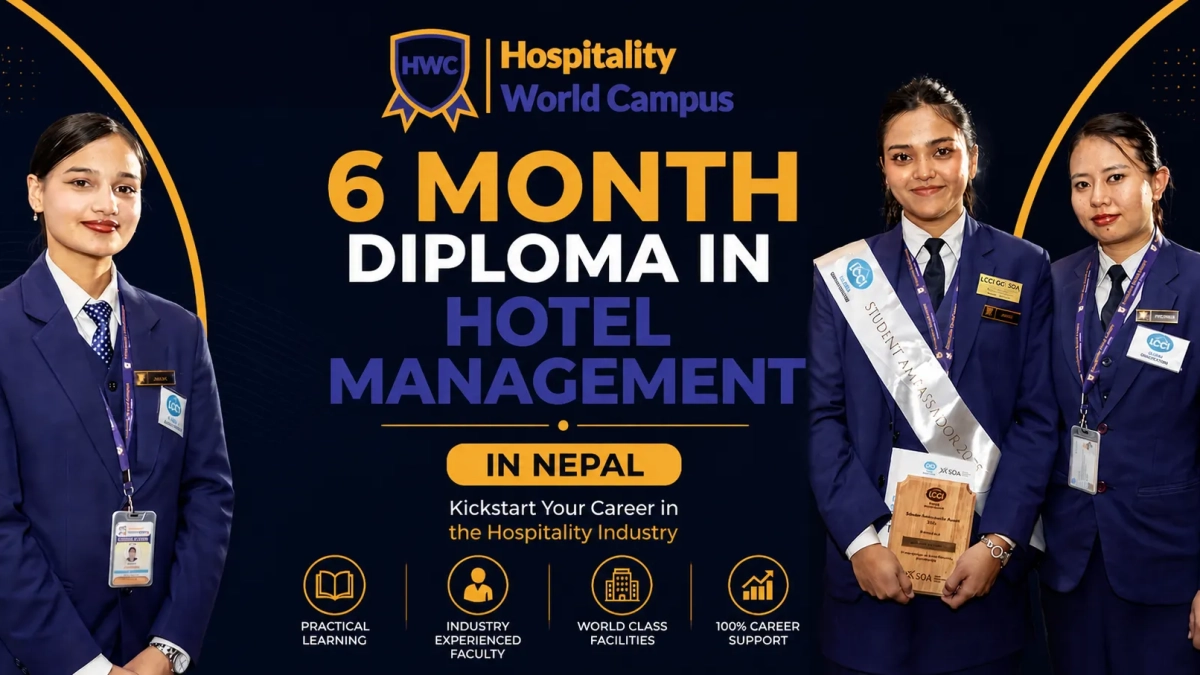
| A Diploma in Hotel Management (DHM) in Nepal is a professional hospitality course that provides students with practical skills and industry knowledge in areas such as food production, front office, housekeeping, and food & beverage service in a short period of time with theoretical knowledge and real-world work experience. It prepares students for careers in hotels, resorts, restaurants, airlines, and other hospitality sectors in Nepal and abroad. In a 6 month diploma in hotel management in Nepal, they will gain 6 months of theory classes and 6 months of internships for real work experience. |
Introduction
The hospitality sector is one of the most dynamic and rapidly expanding industries within the global travel and tourism landscape. It plays a significant role in generating employment opportunities worldwide, with millions of professionals contributing to hotels, resorts, restaurants, cruise operations, airlines, and various food and beverage service establishments. As the industry continues to evolve, the demand for trained and competent hospitality professionals is increasing both in Nepal and across international markets.
The hospitality industry broadly consists of two major areas: accommodation and food & beverage services. The accommodation sector includes hotels, resorts, lodges, guest houses, and other establishments that provide lodging along with additional services such as dining, events, recreation, and guest assistance. Likewise, the food and beverage sector covers restaurants, cafés, catering companies, institutional kitchens, airline catering services, and other businesses involved in preparing and serving quality food and beverages.
A Diploma in Hotel Management (DHM) in Nepal is designed to develop skilled, professional, and industry-ready human resources capable of meeting the diverse requirements of the hospitality sector. The program combines theoretical understanding with extensive practical training, enabling students to build expertise in key areas such as front office operations, housekeeping, food production, food and beverage service, customer service, and hospitality management. It also provides a strong foundation for individuals who aspire to establish their own hospitality-related businesses.
Typically, the Diploma in Hotel Management program in Nepal spans one to three years and is structured into multiple semesters that gradually develop students’ knowledge and practical abilities. The curriculum begins with fundamental hospitality concepts and basic operational skills, progresses towards advanced technical and managerial competencies, and concludes with industrial exposure through practical training or internships. This balanced approach ensures that graduates are well-prepared to pursue careers in Nepal’s growing hospitality industry as well as in the international job market.
Nepal’s tourism industry is on fire. With international arrivals rebounding strongly, luxury hotels opening across Pokhara and Kathmandu, and an explosion in trekking and adventure tourism, the demand for skilled hospitality professionals has never been higher. If you are looking to enter this dynamic industry quickly, a 6-month diploma in hotel management (Diploma in Hospitality Management in Nepal) in Nepal could be your fastest ticket in.
This complete 2026 guide covers everything you need to know from what the course actually teaches to which colleges offer it, how much it costs, and what salary you can realistically expect after graduation.
About 6 Month Diploma in Hotel Management?

A 6-month diploma in hotel management is a short-term certification program designed to help the students who wants to gain knowledge in a short term with the foundational knowledge and hands-on skills required to work in different hotels, resorts, restaurants, and other hospitality establishments. Unlike a three- or four-year degree, this provides 6 months of theory knowledge and 6 months of internships.
Not only this, but if the students are studying in class 12 and want to gain real-world theory with work experience, then this course is one of the best courses for them to develop real-world theories and work experience.
They can also do a credit transfer to different countries for the bachelor’s degree in a foreign country. This is one of the best ways to work nationally or internationally.
Overview of the Course Structure and Duration
A standard 6 month diploma in hotel management in Nepal is structured across two phases: a 6-month classroom phase of theory, followed by 6 month of practical training or internship phase. Some institutes run both phases concurrently with weekly practical labs from day one.
Duration: 6 months + 6 months | Delivery: Classroom + Practical Labs + Internship
Key Skills You Will Learn in 6 Months
By the end of a 6-month hotel management diploma, you will have developed a strong foundation across all major departments of a hotel:
- Front Office Operations: Reservation handling, check-in/check-out procedures, guest relations, and PMS (Property Management Systems)
- Food and Beverage Service: Restaurant service styles, menu knowledge, banquet operations, and bar basics
- Housekeeping Fundamentals: Room preparation, linen management, sanitation standards, and guest floor operations
- Food Production Basics: Kitchen safety, basic cooking methods, continental and Asian cuisine fundamentals
- Hotel Communication: Professional English, telephone etiquette, complaint handling, and guest satisfaction techniques
- Tourism and Hospitality Awareness: Nepal’s tourism landscape, cultural sensitivity, and responsible tourism practices
- Computer and Digital Skills: Hotel software, MS Office, and basic digital communication
Salient Features of 6 Month Diploma in Hotel Management in Nepal
Theory
Here, the 6 month diploma in hotel management in Nepal means that there will be 6 month of course for theory for knowledge to the real world
Practical
Here, the 6 month diploma in hotel management in Nepal means that there will be 6 month of course for practical for real world working.
Why Choose a 6 Month Hotel Management Course in Nepal?

With dozens of education paths available, why should a young Nepali student seriously consider a 6-month hotel management diploma? The answer lies in the intersection of Nepal’s growing economy, global hospitality demand, and the speed at which this course gets you to your first paycheck.
Growing Hospitality Industry in Nepal
Nepal’s tourism and hospitality sector has been one of the fastest recovering industries post-pandemic. The government has prioritized tourism as a key driver of economic growth. High-profile infrastructure projects including new airports, expanded highway networks, and the development of Lumbini as an international Buddhist pilgrimage hub are bringing unprecedented numbers of international visitors to the country.
Kathmandu’s hotel landscape has transformed dramatically. Five-star brands like Marriott, Hyatt, and Dusit have set up operations, and boutique luxury properties are multiplying in Pokhara, Chitwan, and Mustang. Nepal welcomed approximately 1.07 million tourists in 2024, a 17% increase over 2023. Industry analysts project continued growth through 2030, driven by Visit Nepal promotional campaigns and infrastructure development.
Benefits of 6 month diploma in hotel management
Short-term diploma programs in hotel management offer a unique combination of advantages:
- Speed to Employment: You can be employed within 7-8 months of enrollment
- Lower Financial Investment: Total course costs are a fraction of a 3-year bachelor’s degree
- Practical Orientation: The curriculum is heavily skills-based, making graduates immediately employable
- Pathway to Further Study: A diploma can serve as a bridge qualification to higher diplomas or bachelor’s programs
- International Mobility: Short-term certifications are recognized by Gulf, cruise, and European employers
- Career Clarity: Six months of training helps students identify which department suits them best
Eligibility Criteria for 6 Month Diploma in Hotel Management in Nepal
One of the most attractive features of the 6 month hotel management diploma in Nepal is its relatively accessible entry requirements. Unlike engineering or medical programs, what matters more is your attitude, communication ability, and genuine interest in serving people.
Academic Requirements for Admission
The minimum academic requirements for most 6 month hotel management diploma programs in Nepal are:
- Completion of SEE (Secondary Education Examination) Class 10 pass for basic diploma levels
- Completion of +2 (Higher Secondary) or equivalent for higher-level diploma programs at premium institutes
- Some CTEVT-affiliated programs accept SEE graduates with a minimum D grade across all subjects
- For TU or Purbanchal University affiliated programs, a +2 pass is generally required
- Age: Most programs accept students between 16 and 35 years
Skills and Personal Qualities Required
Beyond academic qualifications, admission panels and industry employers look for specific personal qualities:
- Communication Skills: English proficiency (spoken and written) is a significant advantage
- Positive Attitude and Enthusiasm: Hospitality is fundamentally a people-first industry
- Physical Stamina: Hotel work involves long hours on your feet, especially in kitchens and F&B
- Grooming and Presentation: Professional appearance standards are taken seriously in hospitality
- Problem-Solving Mindset: The ability to stay calm and find solutions under pressure
- Cultural Sensitivity: Nepal receives visitors from all over the world; comfort with diverse cultures is essential
Course Curriculum of 6-Month Diploma in Hotel Management
Understanding what is actually taught in a 6 month hotel management diploma helps you evaluate institutes and prepare yourself mentally for the pace and depth of the program.
Core Subjects Covered in the Program
A well-structured program covers the following core modules:
- Front Office Operations: Reservations, check-in/out, PMS software, guest relations, concierge (40-50 hours)
- Food & Beverage Service: Restaurant service, table setting, menu knowledge, bar basics, banquets (40-50 hours)
- Food Production: Kitchen safety, cooking methods, continental & Asian cuisines, pastry basics (40-55 hours)
- Housekeeping Management: Room cleaning procedures, linen, laundry, sanitation standards (30-40 hours)
- Hotel Communication: Business English, telephone etiquette, email writing, complaint handling (30-40 hours)
- Tourism & Hospitality Management: Nepal tourism overview, hotel classification, sustainable tourism (20-30 hours)
- Computer Applications: MS Office, hotel software basics, social media for hospitality (20-25 hours)
- Soft Skills & Personality Development: Grooming, body language, teamwork, interview prep (15-20 hours)
Practical Training and Internship Opportunities
The practical component is where a 6-month diploma truly distinguishes itself. Top institutes in Nepal maintain dedicated training kitchens, mock front offices, and service labs where students practice real-world scenarios under supervision.
Most reputable institutes also arrange a 4- to 6-week paid or unpaid internship with partner hotels. These placements are extremely valuable because they often convert directly into full-time employment offers. When evaluating colleges, always ask about their internship partner network this single factor can determine whether you graduate with a job offer in hand.
Top Colleges Offering 6-Month Hotel Management Courses in Nepal
Choosing the right college is arguably the single most important decision in your hotel management journey. The quality of your training, the credibility of your certificate, and the strength of your industry connections all depend on which institute you attend.
Private Hospitality Institutes in Nepal
- HWC: It is one of the oldest hospitality institutes in Kathmandu with SQA certification and with the best job placement.
- IMI: International Management Institute Nepal (Kathmandu) International affiliation with Swiss hospitality institutions. Strong placement record in 5-star properties. CTEVT affiliated.
- HMTTC: Hotel Management & Tourism Training Center (Kathmandu, Bhadrakali) Government institute under Ministry of Tourism. Highly credible certification recognized by Nepal Tourism Board. Affordable fees.
- Uniglobe College of Hotel Management (Kathmandu): Purbanchal University affiliated. Regular campus recruitment drives by hotel chains. Strong industry connections.
- INSTEP Pokhara: Ideal location near resort and adventure tourism belt. Strong connections with lakeside hotels and resorts. Practical-first curriculum.
- Nepal Tourism & Hospitality College / NATHM (Kathmandu): One of Nepal’s oldest hospitality training centers. Well-networked alumni across Gulf and European hospitality sectors.
- Chitwan & Lumbini Hospitality Institutes: Growing demand due to Lumbini’s international development as a pilgrimage hub. Regional access and affordable fees.
Factors to Consider When Choosing a College
- CTEVT or University Affiliation: Ensures your certificate is nationally and internationally recognized
- Training Facilities: Visit the campus; check if training kitchens, front office labs, and service areas are functional
- Placement Track Record: Ask what percentage of graduates get placed within 3 months and which hotels hire from there
- Faculty Credentials: Teachers should have real hotel industry experience, not just academic backgrounds
- Student Reviews: Talk to current or recently graduated students for the most honest picture
- Industry Visits and Guest Lectures: Institutes with active industry connections provide invaluable networking opportunities
Fees Structure for Hotel Management Diploma in Nepal
Cost is a primary consideration for most students and families. A 6 month hotel management diploma in Nepal is one of the most affordable professional training programs available, especially when you factor in the employment outcomes relative to the investment.
Average Course Fees in Different Institutes
- Government / HMTTC: NPR 15,000 to 35,000 (includes tuition, basic study materials)
- Mid-Range Private Institutes: NPR 40,000 to 75,000 (includes tuition, practical labs, some materials)
- Premium Private Institutes: NPR 80,000 to 1,50,000 (includes tuition, uniforms, labs, placement support, certification)
- International Affiliation Programs: NPR 1,20,000 to 2,50,000 (full package including international certification)
Additional Costs (Uniforms, Training, Certification)
Beyond tuition fees, students should budget for the following additional expenses:
- Uniforms and Grooming Kit: NPR 3,000 to 8,000 (chef’s coat, front office uniform, service apron, name badge)
- Study Materials and Textbooks: NPR 2,000 to 5,000
- Practical Training Ingredients/Supplies: NPR 2,000 to 4,000
- Examination and Certification Fees: NPR 1,500 to 5,000
- Transport and Accommodation: NPR 3,000 to 8,000 per month if studying outside your home district
All-in total cost typically ranges from NPR 25,000 to NPR 1,80,000 depending on the institute — compare this with a 3-year bachelor’s degree costing NPR 4,00,000 to 10,00,000+ and the diploma offers excellent return on investment.
Career Opportunities After 6 Month Diploma in Hotel Management
A 6 month diploma in hotel management opens doors to a wide range of entry-level positions in Nepal’s hospitality sector and internationally. The diploma gives you a credible, industry-recognized foundation that employers respect.
Entry-Level Jobs in the Hospitality Industry
- Front Desk Associate: NPR 18,000 to 28,000 per month
- Food & Beverage Attendant: NPR 15,000 to 25,000 per month
- Housekeeping Associate: NPR 15,000 to 22,000 per month
- Commis Chef / Kitchen Helper: NPR 14,000 to 22,000 per month
- Guest Relations Executive: NPR 20,000 to 32,000 per month
- Banquet & Events Staff: NPR 16,000 to 24,000 per month
- Tour & Travel Coordinator: NPR 18,000 to 28,000 per month
- Resort Activities Supervisor: NPR 20,000 to 30,000 per month
Salary Expectations in Nepal and Abroad
Salary varies significantly based on the property tier, department, location, and experience. Here is a realistic salary roadmap:
- Entry Level (0-1 year): Nepal NPR 15,000-28,000/mo | Gulf $300-$500/mo | Europe/Cruise $800-$1,200/mo
- Junior Supervisor (2-3 years): Nepal NPR 28,000-50,000/mo | Gulf $500-$900/mo | Europe/Cruise $1,200-$1,800/mo
- Department Supervisor (4-6 years): Nepal NPR 50,000-90,000/mo | Gulf $900-$1,500/mo | Europe/Cruise $1,800-$2,500/mo
- Manager Level (7+ years): Nepal NPR 90,000-1,50,000+/mo | Gulf $1,500-$3,000+/mo | Europe/Cruise $2,500-$4,000+/mo
Scope of Hotel Management Career in Nepal and Internationally
The scope of a hotel management career in 2026 is genuinely global. Nepal-trained hospitality professionals are recognized and sought after in several international markets.
Job Opportunities in Nepal’s Tourism Sector
- 5-Star International Hotels: Marriott, Hyatt, Dusit, Radisson, and Sheraton properties in Kathmandu
- Boutique and Heritage Hotels: Pokhara, Bandipur, and Bhaktapur’s growing boutique property segments
- Trekking Lodges and Tea Houses: High-altitude properties on Everest Base Camp, Annapurna Circuit, and Langtang routes
- Resort and Spa Properties: Chitwan, Bardia, and Mustang’s growing wellness and wildlife tourism sector
- Airlines and Airport Hospitality: Nepal Airlines, Yeti Airlines, and Tribhuvan International Airport lounge services
- Event and Conference Centers: BICC and similar large-scale hospitality venues
Opportunities in Gulf Countries, Europe, and Cruise Lines
- Gulf Countries (UAE, Qatar, Saudi Arabia, Bahrain): Dubai alone has over 700 hotels. Salary packages typically include accommodation and meals, making them highly attractive financially.
- Cruise Lines (Royal Caribbean, MSC, Costa, Princess): Contracts run 6-9 months. The earning potential combined with zero living expenses at sea makes this one of the most lucrative paths for diploma holders.
- Europe (UK, Germany, Switzerland, Austria): Switzerland has a storied relationship with Nepali hospitality workers. UK hospitality post-Brexit has opened significant skilled worker visa pathways.
- Australia and Canada: Both countries offer pathways for experienced hospitality professionals. A diploma combined with 2-3 years of experience is a stepping stone toward permanent residency.
Advantages and Limitations of a 6 Month Diploma Course
Being clear-eyed about what a 6 month diploma can and cannot do for you is the mark of a smart career decision.
Benefits of Short-Term Certification
- Fast route to employment working within 6-8 months of enrollment
- Very affordable compared to 3-4 year degree programs
- Highly practical and industry-oriented curriculum
- Recognized by Gulf, cruise, and European employers
- Excellent foundation for further study at diploma or degree level
- Strong networking with hotel industry through internships
- Certificate valid and recognized nationally and in major markets
Limitations Compared to Long-Term Degrees
- Entry-level positions only management roles require more experience or education
- Salary ceiling is lower without further qualifications
- Not equivalent to a bachelor’s degree for visa applications in some countries
- Depth of knowledge is limited compared to full degree programs
- Some premium hotel chains prefer degree holders for corporate career tracks
- Quality varies significantly between institutes thorough research is essential
How to Choose the Best Hotel Management Institute in Nepal
Given the variability in quality between institutes, choosing the right college deserves serious time and research. Do not make this decision based on proximity, peer pressure, or flashy brochures alone.
Accreditation and Affiliation Importance
In Nepal’s education landscape, accreditation is your quality guarantee. When evaluating institutes, always verify the following:
- CTEVT Affiliation: The Council for Technical Education and Vocational Training is Nepal’s premier body for vocational certifications. A CTEVT-affiliated diploma is recognized across Nepal and in many international markets.
- University Affiliation: Programs affiliated with Tribhuvan University (TU), Purbanchal University (PU), or Pokhara University carry additional weight for further study pathways.
- Nepal Tourism Board (NTB) Recognition: Institutes recognized by NTB have passed an additional industry validation layer.
- International Affiliations: Tie-ups with Swiss, UK, or Australian hospitality institutions add significant value to your certificate’s international portability.
Placement Support and Industry Exposure
The best hotel management institutes in Nepal actively work to place you. Ask these direct questions when visiting colleges:
- What is your placement rate within 3 months of graduation?
- Which hotels and companies have hired your graduates in the last 2 years?
- Do you arrange paid or unpaid internships? With which properties?
- Do hotel HR teams come to your campus for recruitment drives?
- Do you have an alumni network that mentors current students?
Admission Process for Hotel Management Courses in Nepal
The admission process for most 6 month hotel management diploma programs in Nepal is straightforward. Here is a step-by-step breakdown of what to expect.
Step-by-Step Application Process
- Step 1: Research and Shortlist Institutes: Create a list of 3-5 institutes based on affiliation, location, fees, and placement record. Visit campuses in person where possible.
- Step 2: Collect and Review Eligibility Details: Confirm that you meet the academic requirements (SEE or +2) and age criteria for each shortlisted institute.
- Step 3: Obtain and Fill Application Form: Most institutes have both online and physical application forms. Fill these carefully.
- Step 4: Submit Documents and Pay Application Fee: Submit all required documents along with any application fee (typically NPR 500 to 2,000).
- Step 5: Attend Interview or Entrance Test (if required): Premium institutes may conduct a brief personal interview assessing communication skills, motivation, and grooming.
- Step 6: Receive Admission Letter and Pay Fees: Upon selection, pay the required tuition fees and collect your official admission confirmation.
- Step 7: Orientation Day: Most institutes hold an orientation session covering campus rules, uniform requirements, schedule, and introductions to faculty.
Documents Required for Admission
- Original and photocopies of SEE or +2 mark sheet and certificate
- Character certificate from your previous school or college
- Citizenship card (Nagarikta) or birth certificate
- Recent passport-size photographs (typically 4-6 copies)
- Migration certificate (if applying from a different district or school)
- Medical fitness certificate (required by some institutes due to kitchen safety requirements)
- No Objection Certificate (NOC) from parents or guardians if under 18
Tips to Succeed in Hotel Management Career
Getting into hotel management is one thing. Building a career that advances steadily and opens doors abroad is another. Students who flourish in this industry share a specific set of habits and mindsets.
Essential Soft Skills for Hospitality Industry
- Active Listening: Guests feel valued when they see you truly hearing their needs, not just processing requests
- Emotional Intelligence: Managing your own emotions and reading the emotional state of guests is critical in complaint situations
- Time Management: Hotels operate on tight schedules; your ability to prioritize tasks under pressure defines your reputation
- Adaptability: No two days in a hotel are the same; the ability to switch gears and stay composed is invaluable
- Professional Communication: Written and spoken communication in both Nepali and English will accelerate your career
- Attention to Detail: In 5-star hospitality, a wrongly set fork or a misaddressed guest can cost the hotel a repeat booking
Networking and Internship Strategies
- Treat Every Industry Contact as Career Capital: Senior staff you meet during your internship are potential referees, mentors, and future employers
- Be Active on LinkedIn: The Nepali hospitality community is active on LinkedIn. Connect with industry professionals and follow hotel brands.
- Attend Hospitality Events: Nepal Tourism Board events, hotel industry seminars, and World Tourism Day celebrations are prime networking opportunities
- Pursue Additional Certifications: Barista courses, sommelier basics, WSET wine certifications, or ServSafe food safety qualifications add dimension to your profile
- Learn a Third Language: Chinese, Japanese, or Korean language basics make you highly employable in Nepal’s fast-growing Asian tourist market
- Request a Reference Letter After Internship: A strong reference from your internship supervisor is one of the most powerful tools in your job search toolkit
Why Choose HWC for a Diploma in Hotel Management in Nepal
HWC (Hospitality World Campus) Hospitality World Campus (HWC), located at Jawalakhel, Lalitpur is a unit of LCCI GQ, an award winning and one of the leading organisations in soft skills and management skills training.
HWC provide short term professional courses like Diploma in Global Culinary Arts (12 months), Diploma in Hospitality Management (15 months), Advanced Diploma in Hospitality Management (21 months), all our hospitality programs are approved and quality assured by Scottish Qualifications Authority (SQA), Scotland, and benchmarked at The Scottish Credit and Qualifications Framework (SCQF) and European Qualifications Framework (EQF) which makes our students globally competitive.
Frequently Asked Questions (FAQs)
Is a 6 Month Diploma Enough for a Career in Hotel Management?
Yes, a 6-month diploma is enough to start a hospitality career in entry-level hotel and resort roles. For higher positions and international opportunities, gain experience and pursue further education later.
Which is the Best Institute for Hotel Management in Nepal?
HWC is one of the best institutes for hotel management in Nepal, with 6 months of theory classes and 6 months of internships.
Can I Work in the Gulf After a 6 Month Diploma?
Yes, absolutely. Gulf countries particularly the UAE, Qatar, and Saudi Arabia regularly hire Nepali hospitality staff with diploma-level qualifications.
How Much Does the Course Cost in Nepal?
Total costs range from approximately NPR 25,000 to NPR 2,00,000 depending on the institute type. Government institutions like HMTTC charge between NPR 15,000 and 35,000. Mid-range private institutes cost NPR 40,000 to 75,000. Premium institutes with international affiliations can go up to NPR 2,50,000. Remember to budget for additional costs like uniforms, books, certification fees, and transport.
Can I Pursue a Bachelor’s Degree After a 6 Month Diploma?
Yes. Many students use the 6 month diploma as a stepping stone into the industry, gain 1-2 years of work experience, and then pursue a Bachelor’s in Hotel Management or Tourism Studies at TU, PU, or private universities in Nepal or abroad. Some institutes also offer credit transfer or advanced standing to diploma holders.
What is the time period of diploma in hotel management?
The exact time period of a diploma in hotel management is normally 1 year in which 6 month is theory and training and 6 months are internships. And if you want to do from CTEVT then it takes 3 years.
Can I do diploma in 1 year?
Yes, the diploma can also be done in 1 year. You can just take an example of a diploma in global culinary arts or a diploma in hospitality management.
What is a 6 Month Diploma in Hotel Management in Nepal?
A 6 Month Diploma in Hotel Management is a short-term hospitality course (6 months of classes + internship) that prepares students to work in hotels, restaurants, and resorts in Nepal and abroad.
Who can apply for a 6 Month Diploma in Hotel Management course?
Any student who has passed SEE (Grade 10) from CTEVT or private institutions or doing +2 in Nepal from a recognized board can apply for a Diploma in Hotel Management in private institutions not in CTEVT
What are the eligibility criteria for hotel management diploma programs in Nepal?
Students must have passed SEE with at least a C grade in Mathematics, English, and Science and doing +2 from a recognized academic institution.
How long does it take to complete a Diploma in Hotel Management?
The total program is 1 year and 6 months of classroom training followed by an internship period.
Is a 6-month hotel management diploma recognized in Nepal?
Yes. The Diploma in Hotel Management (DHM) at institutes like IHTS is a CTEVT-certified program recognized by the Government of Nepal and other private institutions like HWC also recognized in Nepal
What skills can I learn from a hotel management diploma course?
Students develop expertise in food production, customer service, front office operations, housekeeping, accounting, cost control, marketing, entrepreneurship, and business communication.
Conclusion: Is a 6 Month Hotel Management Diploma Worth It?
For the right student, absolutely yes. If you want to enter the workforce quickly, build real skills in a global industry, and open doors to both domestic and international career pathways all without the financial burden of a multi-year degree the 6 month hotel management diploma in Nepal delivers exceptional value.
Who Should Enroll in This Course?
This course is ideal for you if:
- You are a fresh SEE or +2 graduate who wants to start earning quickly
- You come from a hospitality or tourism-adjacent family background and want to professionalize your skills
- You are a working adult considering a career switch into the booming tourism sector
- You eventually plan to pursue higher education but want practical income and experience first
It is less suitable for students who already have a +2 in Science or Management and are aiming for senior management or corporate hotel roles from day one for those ambitions, a full bachelor’s degree program is the wiser long-term investment.
Final Thoughts and Career Advice
Nepal stands at an exciting hospitality crossroads. The hotels being built today, the tourists arriving in record numbers, and the international recognition Nepal’s mountains and culture are receiving all of this creates a genuine, sustained need for trained, professional, enthusiastic hospitality workers. A 6-month diploma is your entry point into that world.
Choose your institute with care. Commit to your practical training. Build your network from day one of your internship. Say yes to every learning opportunity. And remember: in hospitality, the people who rise fastest are not always those with the best grades they are the ones who make every guest feel genuinely seen, heard, and valued.
Your career in hotel management starts with a single application. Make it today.