
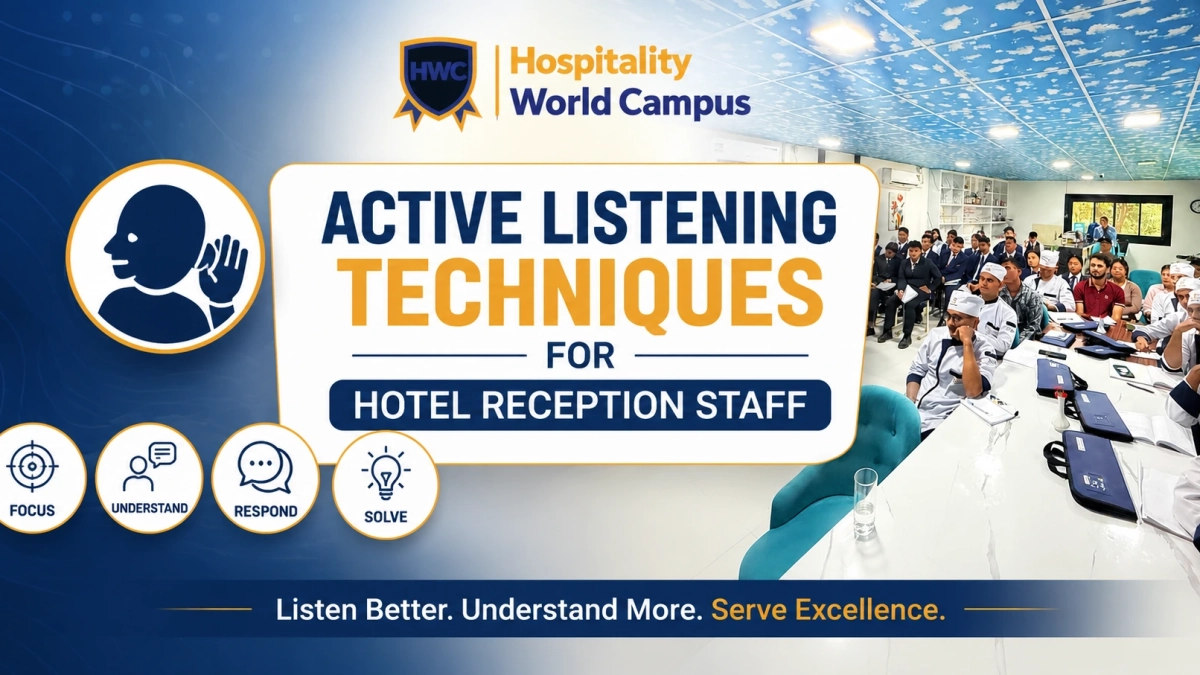
Why Active Listening Is a Revenue Strategy, Not Just a Soft Skill
Let’s start with an honest question: When did you last feel truly heard at a hotel front desk?
Not nodded at. Not smiled at while the receptionist typed. Not answered with a rehearsed phrase. Truly heard where the staff member paused, processed your words, reflected them back, and then responded in a way that made you think, “They actually got it.”
If you’re struggling to remember, you’re not alone. And that gap between being heard and feeling heard is exactly where hotels win or lose their guests.
According to the J.D. Power 2025 North America Hotel Guest Satisfaction Index Study, which analysed more than 39,000 guest experiences across 102 hotel brands, “staff service” is one of only seven core dimensions used to measure overall guest satisfaction. It sits alongside the guest room, facilities, and value all things that cost significant capital to improve. Staff communication skills cost almost nothing by comparison, yet the payoff is enormous.
“The front office is not merely a service touchpoint, but rather a critical hub for guest satisfaction and brand perception.”
The same research found that front desk staff capable of active listening, empathetic communication, and timely responses can transform even negative guest experiences complaints, delays, room issues into loyalty-building moments. That’s not a training cliché. That’s an empirically documented business outcome.
And here’s the commercial truth: loyal guests spend more, complain less, write better reviews, and refer others. Active listening is, quite literally, a revenue-generating skill.
Pro insight: Hotels that invest in listening skills not just standard scripts see measurable improvement in review scores within 60–90 days of training implementation. The change is perceived by guests immediately because it feels rare and human.
The 12 Active Listening Techniques for Hotel Reception Staff
These aren’t generic communication tips. Each technique below is mapped to real hotel front desk scenarios, complete with example scripts your team can use from tomorrow.
The LASER Focus Method: Give Your Full Attention
The most powerful signal you can send to a guest is that they are the only person in the world right now. That means stop typing, step away from the monitor, uncross your arms, and face them directly. Distractions a ringing phone, a colleague passing by shatter trust in seconds.
LASER stands for “Look at the guest.” → Ask internally before responding → Stop all other tasks → Eliminate environmental noise → Raise your posture and lean in slightly.
“Please give me just one moment to put this aside so I can give you my full attention.” [Closes or minimises screen.] “Now, how can I help you today?”
Reflective Paraphrasing: Prove You Heard Them
Reflective paraphrasing is the act of restating what a guest said in your own words, slightly condensed. It serves two purposes: it confirms your understanding, and it makes the guest feel genuinely heard, which is rare and therefore memorable.
The key is to paraphrase, not parrot. Repeating exact words back sounds mechanical. Reprocessing the meaning sounds human.
“So just to make sure I understand you were expecting a room away from the lift, on a higher floor, and the room you have now faces the car park? Let me look into the best options for you right now.”
Empathy Mirroring: Acknowledge the Feeling First
Before you solve any problem, acknowledge the emotional experience. Guests who feel frustrated, tired, or let down need to know their emotion has been noticed, not bypassed in favor of logistics. Skipping this step, even to offer the perfect solution, makes guests feel processed rather than valued.
Research on hotel complaint management consistently identifies empathetic listening as the single most important factor in service recovery more than the compensation offered or the speed of resolution.
“I can hear how frustrating that must be, especially after such a long journey. That’s the last thing you should have to deal with when you arrive. Let me personally make this right for you.”
Strategic Note-Taking: Let Your Pen Say “I Care”
The simple act of writing something down is one of the most powerful non-verbal signals of attentiveness a receptionist can send. It communicates: “What you’re telling me is important enough to record.” It also dramatically reduces errors and creates accountability.
Train your team to note names, preferences, arrival details, and any special requests. Never rely on memory for anything emotionally significant to a guest.
[Picks up pen and notepad.] “Let me just note that down so nothing gets missed. You mentioned your anniversary is on Thursday I’ll make sure that’s flagged for our team.”
Open-Ended Questioning: Invite the Full Story
Closed questions (Did you enjoy your stay?) produce closed answers. Open-ended questions (What was the highlight of your stay, and is there anything we could have done better?) invite dialogue, surface hidden needs, and make guests feel like conversation partners rather than check-in objects.
The golden rule: start questions with “What,” “How,” or “Tell me about it,” never with “Did,” “Is,” or “Are” when you want genuine insight.
“What brings you to the area, business or leisure? And is there anything specific I can arrange to make your stay more comfortable?”
The 3-Second Silence Rule Let the Thought Land
Most receptionists jump to respond the instant a guest finishes speaking. This feels efficient but communicates haste, not care. Practicing a deliberate 2–3 second pause after a guest speaks signals that you are actually thinking about what they said a rare and precious quality in a busy front desk environment.
Silence is not awkward. Silence is respectful. Silence is what separates active listeners from reactive ones.
[Guest finishes speaking. 2 seconds of genuine pause.] “Thank you for sharing that. I want to make sure I address everything properly.” [Then respond.]
Positive Body Language: Align Your Body With Your Words
Communication researchers consistently find that body language accounts for more perceived meaning than the actual words spoken. For hotel receptionists, this means that a tense posture, crossed arms, or a glance at a screen will undermine even the most empathetic verbal response.
The key signals: open posture, forward lean (10–15 degrees), genuine nodding (not robotic), soft, warm eye contact, and a relaxed face. Mirror the guest’s energy: not too formal if they’re casual, not too casual if they’re distressed.
Ask team members to practice in front of a mirror. The difference between “attentive lean” and “default standing posture” is surprisingly dramatic when you see it visually.
Tone Matching: Adapt Your Energy to Theirs
An exhausted business traveller and an excited family on vacation require completely different energy levels. Active listeners adapt their tone, pace, and vocabulary dynamically softening for distress, lightening for celebration, becoming precise and efficient for guests who clearly want speed over warmth.
This is sometimes called code-switching in hospitality training. It’s the difference between a receptionist who sounds great and one who sounds right .
[To a stressed corporate traveler:] “I’ll have that sorted in under two minutes.” [To an anniversary couple:] “How wonderful let me make sure everything is just perfect for your evening.”
Validation Before Solution – Never Skip This Step
This may be the single most violated principle in hotel front desk training. When a guest complains, the natural human instinct and the standard corporate script is to jump immediately to the solution. “Let me move you to another room.” “Here’s a voucher.”
This is wrong. Not because the solution is bad, but because it bypasses the emotional experience entirely. Research on Bali hotel complaint management found that properties which validated feelings before offering resolution achieved significantly higher guest loyalty scores than those that offered immediate compensation without emotional acknowledgment.
“Before I tell you what we can do I want you to know that what you’ve described is not acceptable, and I’m genuinely sorry it happened during your stay. Now, let me tell you exactly how we’re going to fix this.”
Emotional Labelling – Name What You’re Observing
Borrowed from crisis negotiation and therapy, emotional labeling involves naming the emotion a guest appears to be experiencing without projecting or assuming. It creates a moment of deep human connection that most guests never expect from a hotel front desk interaction.
It sounds unnatural at first. Practice makes it transformational.
“It sounds like this has been a really stressful experience for you — and after a long trip, that’s the last thing you needed. I hear you. Let’s start fresh.”
Active Verbal Acknowledgments – “I’m With You” Signals
Strategic use of short verbal affirmations not filler words throughout a guest’s explanation signals ongoing attentiveness. Phrases like “I understand,” “Absolutely,” “Of course,” and “That makes complete sense” punctuate the conversation in a way that reassures the guest they haven’t lost your attention.
The trap to avoid: overusing them. Three or four well-placed affirmations feel genuine. Ten in a row feels like a call center script.
“I understand.” / “Of course, that’s completely reasonable.” / “That makes perfect sense.” / “We sincerely apologize for this inconvenience.” / “I’ll take care of that personally.”
Personalisation Callbacks – Use What You Learned
The most memorable listening moments happen when a guest realizes you remembered something they mentioned in passing and acted on it. This is the crown jewel of active listening: it closes the loop and proves that your attentiveness wasn’t performative.
This is also a powerful driver of repeat bookings. Guests return to hotels where they feel known. Personalization callbacks create that feeling at almost zero cost.
“Mr. Tanaka, I noticed during check-in that you mentioned you preferred a higher floor for the city views. I’ve arranged a complimentary upgrade to a corner suite I hope that makes your stay even more enjoyable.”
The LAST Framework: Active Listening Under Pressure
When complaints arrive and they will your team needs a reliable, memorable framework that activates automatically, even under stress. The LAST model is the industry gold standard for hotel complaint management, and active listening is baked into every step.
Common mistake: Many receptionists jump to “S” (Solve) before completing “L” (Listen) or “A” (Apologize). Research from a Bali hotel study found this is the most common failure point in complaint resolution and the one most likely to escalate a manageable situation into a negative online review.
Training Your Team: Exercises That Actually Work
Active listening is not a personality trait. It is a learnable, practicable skill. The following training methods are drawn from hospitality management best practices and can be implemented without specialist external trainers.
The Most Powerful Training Principle: Make It Safe to Fail
Role-play exercises only work if staff feel psychologically safe enough to try and get it wrong without embarrassment. The manager’s role is to model vulnerability first. Run the role-play yourself, invite feedback on your performance, and create a team culture where imperfect attempts are celebrated over polished non-attempts.
7 Active Listening Mistakes Hotel Receptionists Must Avoid
Knowing what to do is only half the picture. These are the most damaging failures some obvious, some surprisingly subtle.
- Interrupting before the guest finishes. Even if you know the solution before they finish explaining, wait. Interrupting signals impatience and invalidates the guest’s experience.
- The “Fake Nod”: Nodding continuously without actually processing what’s being said. Guests can feel this. They’ll stop sharing and go write a review instead.
- Multitasking during conversation. Typing while listening, glancing at the screen, or letting your eyes drift to another guest. Divided attention destroys trust instantly.
- Offering solutions before acknowledgment. See Technique 9. This is the single most common and most damaging failure in hotel complaint handling.
- Using robotic script phrases. “We apologize for any inconvenience caused” has been heard so often it means nothing. Replace scripted formality with human specificity.
- Assuming you understand before confirming. Even experienced receptionists misread guest needs. Always paraphrase and confirm before acting.
- Not following through on what was noted. Note-taking without follow-through is worse than no note-taking it raises and then shatters expectations.
The Front Desk Active Listening Quick-Reference Checklist
Print this. Laminate it. Put it at every front desk station. Train your team to internalise it until it becomes invisible happening naturally in every guest interaction.
- Stop all other tasks before speaking to a guest
- Make warm, steady eye contact (not a stare natural engagement)
- Lean slightly forward to signal attentiveness
- Let the guest finish speaking before you respond
- Use the 3-second pause after they stop speaking
- Paraphrase the key points back in your own words
- Acknowledge the emotion before offering a solution
- Use personalised, specific language not scripted phrases
- Take brief, visible notes for requests and preferences
- Confirm understanding before acting: “Is that right?”
- Adapt your tone and energy to match the guest’s state
- Follow throughand personalise the callback
Conclusion: Your Front Desk Is Your Brand
In a world where guests can opt for self-check-in kiosks, app-based arrivals, and AI concierges, the human interactions that remain become disproportionately powerful. When a guest chooses to speak with a person at your front desk, they are consciously or not hoping for something a screen cannot provide: to be truly heard.
Active listening is how you deliver that. It’s not a script. It’s not a personality. It’s a disciplined, practical set of habits that any hotel can build into its culture starting this week, with the team it already has, at almost zero cost.
The hotels winning on guest satisfaction right now are not necessarily the ones with the most beautiful lobbies or the most advanced technology. They are the ones where guests leave feeling known .
That feeling starts at your front desk. It starts with listening.
“True leadership and true hospitality is a continuous process of growth and improvement. Incorporating active listening takes time and effort, but the rewards are worth it.”