
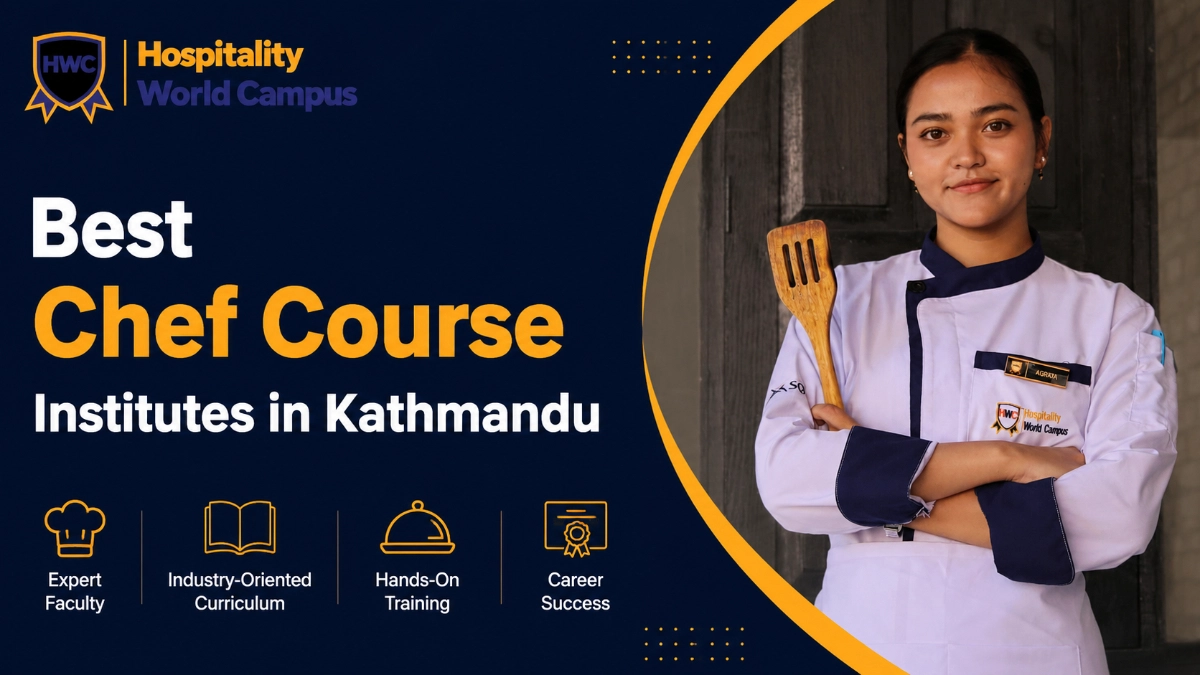
Hospitality World Campus (HWC) is the best chef course institute in Kathmandu, Nepal, offering culinary programs approved and quality-assured by the Scottish Qualifications Authority (SQA), Scotland, and benchmarked against the Scottish Credit and Qualifications Framework (SCQF) and the European Qualifications Framework (EQF) a globally recognized accreditation that sets it apart from other institutes in the city. Other well-known names include ACA, IIG, IHTS, and NATHM, each catering to different budgets, timelines, and career goals.
The other top chef training institutes in Kathmandu are the Academy of Culinary Arts & Hospitality Management (ACA), International Institute of Gastronomy (IIG), International Hotel Training School (IHTS), and the Nepal Academy of Tourism and Hotel Management (NATHM). ACA is best for degree-level hospitality careers, IIG is strong for internationally recognized diplomas and work-abroad pathways, IHTS offers the widest range of short, fast-track cooking courses, and HWC stands out for its Scotland-benchmarked diploma and small-batch, mentor-led teaching style. The right choice depends on your budget, how much time you can spend studying, and whether your goal is a quick job or a long-term career as a professional chef.
If you are searching for a chef course in Kathmandu, you have probably already visited a few institute websites. Most of them tell you why they are the best. Very few actually help you compare your options. This guide does that. We looked closely at the leading institutes in Kathmandu, checked what they offer, and put together a simple, honest comparison so you can pick the right one for your goals.
How We Compared These Institutes
We looked at five things for each institute:
- Accreditation – Is the course recognized by a body like CTEVT (Nepal), CTH (UK), or SQA (Scotland)?
- Course types – Certificate, diploma, or full degree?
- Duration and structure – How long is the course, and does it include a real kitchen internship?
- Career support – Does the institute help with job placement, in Nepal or abroad?
- Reputation – What do past students say, and where are they working now?
This guide is written for prospective students and parents, based on publicly available information from each institute’s official website as of mid-2026. Fees change often and are usually not published online, so always confirm final costs directly with the institute before enrolling.
Quick Comparison Table
| Institute | Course Types | Accreditation | Typical Duration | Internship Included | Known For |
|---|---|---|---|---|---|
| Academy of Culinary Arts & Hospitality Management (ACA) | Diploma in Culinary Arts, BSc (Hons) Hospitality Management, short modular courses | CTH (UK) partnership; affiliated with Lincoln University College, Malaysia for the degree | Diploma: 1–2 years; Degree: 3 years | Yes | Strong alumni network working in 5-star hotels worldwide (Hyatt, Fairmont, Marriott) |
| International Institute of Gastronomy (IIG) | CTH Level II Diploma in Culinary Skills, Certificate III in Commercial Cookery, short workshops, customized 1-on-1 training | CTH (UK) + CTEVT (Nepal) dual recognition | Diploma: around 800+ training hours plus a 6-month internship | Yes, 6-month internship in Kathmandu Valley hotels | Internationally recognized diploma and a clear pathway to Gulf/Australia hospitality jobs |
| International Hotel Training School (IHTS) | Diploma in Bakery & Pastry, Continental Cooking, Fast-Track Diploma, Naan/Tandoor course, Cake course, and more short courses | ISO-certified training center | Short courses: 1 week–3 months; Diploma: around 9 months (includes 6-month internship) | Yes, for diploma-level courses | The widest catalog of short, specialized cooking courses in Kathmandu |
| IHTS Nepal (Hotel Management-focused campus) | Diploma in Hotel Management (DHM) with job assurance, cook training, barista, bartender, housekeeping courses | Vocational training programs, 3 months–1 year | 3 months to 1 year | Yes, plus international internship placement (Malaysia, Thailand, China) | Broadest range of hospitality roles beyond just cooking, with overseas internship options |
| Hospitality World Campus (HWC) | Diploma in Global Culinary Arts (DGCA), Diploma in Hospitality Management (DHM), Advanced Diploma in Hospitality Management (ADHM), Professional Chef Course – Advanced, Bakery/Pastry & Patisserie certificate, Barista & Bartending certificate | Programs approved and quality-assured by the Scottish Qualifications Authority (SQA), benchmarked against SCQF and EQF | DGCA: 12 months (6 months training + 6 months internship); DHM: 15 months; ADHM: 21 months | Yes, built into the diploma programs | Small class sizes, one-on-one monthly mentoring, and a Scotland-benchmarked qualification aimed at global mobility |
Fees are not published on any of these institutes’ websites, which is common practice in Nepal’s vocational training sector. As a rough guide, short certificate courses (1–3 months) in Kathmandu typically fall somewhere in the NPR 15,000–60,000 range, while full diploma programs with internship (9 months–2 years) are usually closer to NPR 150,000–400,000+, depending on the institute and inclusions. Always request a written fee breakdown before enrolling.
Top Chef Training Institutes in Kathmandu (Detailed Look)
1. Hospitality World Campus (HWC)
HWC is a Jawalakhel, Lalitpur-based institute operating since 2022 as a unit of LCCI-GQ. Its main draw is accreditation: its hospitality programs are approved and quality assured by the Scottish Qualifications Authority (SQA) in Scotland, and benchmarked against the Scottish Credit and Qualifications Framework and the European Qualifications Framework</cite>, which is a somewhat different accreditation route than the CTH/CTEVT pairing more common elsewhere in Kathmandu.
Its flagship culinary program is the <cite index=”3-1″>Diploma in Global Culinary Arts (DGCA), a 12-month program combining 6 months of training with a 6-month internship, covering food preparation, cooking and presentation, food safety and sanitation, nutrition, menu planning, and baking and pastry</cite>. HWC also runs hospitality-management diplomas (15 and 21 months) and shorter certificates in bakery/pastry and barista/bartending for students who want a narrower skill set. The institute emphasizes small class sizes and a monthly one-on-one mentoring system rather than large-batch teaching.
Best for: Students who want an internationally benchmarked (Scotland-linked) qualification, prefer a smaller, more personalized learning environment, and are eyeing an eventual pathway abroad.
Keep in mind: HWC is younger than some of the other institutes on this list (running since 2022), so its track record and alumni network are still shorter than more established names like ACA or IHTS worth asking directly about recent graduate placements.
2. Academy of Culinary Arts & Hospitality Management (ACA)
ACA has been training students since 2010 and was one of the first institutes in Nepal to offer a proper Diploma in Culinary Arts. It later added a Bachelor’s degree in Hospitality Management in partnership with a Malaysian university. This makes ACA a good fit if you want more than a cooking certificate — you’re thinking about a long-term hospitality career that could include management roles, not just kitchen work.
Best for: Students who want a recognized diploma or full degree, and who are thinking long-term (hotel management, not just cooking). Keep in mind: Because it leans more academic and degree-focused, it may take longer and cost more than a short cooking certificate elsewhere.
3. International Institute of Gastronomy (IIG)
IIG’s flagship program is a CTH (UK) Level II Diploma in Culinary Skills, also recognized by CTEVT in Nepal. What stands out is the amount of real kitchen time — over 800 training hours plus a 6-month internship at hotels in the Kathmandu Valley. IIG also runs short one-day workshops and lets you customize a course with a personal trainer if you don’t want the full diploma.
Best for: Students who want an internationally recognized qualification and are seriously considering working abroad (IIG has a visible pathway toward skill-assessment routes for countries like Australia). Keep in mind: The flagship diploma is a serious time commitment; if you just want to learn cooking as a hobby, their shorter workshops are a better fit.
4. International Hotel Training School (IHTS)
IHTS has built its reputation on offering a lot of choice. Alongside a Fast-Track Diploma, you can take much shorter, specific courses — Continental Cooking, Bakery & Pastry, Naan and Tandoor, or even a dedicated Pizza-Making course. This makes it a good option if you already know exactly which skill you want, or if you want to test the waters before committing to a full diploma.
Best for: Students who want a short, specific skill fast, or who want to build up a set of specialized certificates over time. Keep in mind: With so many course options, it’s worth asking directly which of them include an internship and which are classroom-only.
5. IHTS Nepal (ihtsnepal.com)
This is a hotel-management-focused campus offering a Diploma in Hotel Management with a “job assurance” promise, alongside cook, barista, bartender, and housekeeping training. It also offers internship placement abroad in countries like Malaysia, Thailand, and China — useful if working overseas early in your career is part of your plan.
Best for: Students who want broader hospitality training (not just cooking) and are interested in an overseas internship early on. Keep in mind: If your only goal is to become a chef, some of the hotel-management-wide curriculum may be more general than you need ask how much of the course is kitchen-focused.
Certificate vs Diploma vs Degree: Which Should You Choose?
This is the question almost nobody explains clearly. Here’s the simple version:
- Short certificate course (1 week–3 months): Teaches one specific skill — like baking, tandoor cooking, or basic knife skills. Good if you already have some kitchen experience and want to add a skill fast, or if you’re testing whether you enjoy cooking as a career.
- Diploma (9 months–2 years): Covers full kitchen training, food safety, menu planning, and usually includes a paid or unpaid internship at a hotel. This is the standard route for someone who wants to work as a professional chef in Nepal or abroad.
- Bachelor’s degree (3 years): Combines culinary training with hospitality management subjects — useful if your long-term goal is not just cooking, but managing a kitchen, a restaurant, or a hotel department.
Simple rule of thumb: If you want to be in the kitchen, a diploma is usually enough. If you want to eventually run the kitchen or the business, consider the degree route.
Understanding Accreditation: CTEVT vs CTH (UK) vs SQA (Scotland) vs ISO
You’ll see these terms on almost every institute’s website, but rarely explained.
- CTEVT (Council for Technical Education and Vocational Training) is Nepal’s own government body for recognizing vocational courses. A CTEVT-recognized course is valid for jobs and further study within Nepal.
- CTH (Confederation of Tourism & Hospitality, UK) is an international hospitality accreditation body. A CTH-recognized diploma carries weight when you apply for hospitality jobs abroad, since employers outside Nepal are more likely to recognize it.
- SQA (Scottish Qualifications Authority) is Scotland’s national accreditation body. Programs benchmarked against the Scottish Credit and Qualifications Framework (SCQF) and the European Qualifications Framework (EQF), as HWC’s are, are designed to be readable and comparable to qualifications across the UK and Europe.
- ISO certification on a training center relates to the quality management of the institute itself (how it’s run), not a specific culinary qualification. It’s a good trust signal but isn’t the same as course accreditation.
Why this matters: If you plan to work only in Nepal, a CTEVT-recognized course is usually sufficient. If working abroad is part of your plan, look for an internationally recognized framework CTH (UK), SQA/SCQF (Scotland), or similar since it will be easier to prove your skills to a foreign employer.
Admission Requirements & Process
Requirements vary slightly by institute, but the general pattern in Kathmandu is:
- Short certificate courses: Usually open to anyone, no formal education requirement. Some ask for a minimum age (commonly 16 or 18).
- Diploma courses: Typically require you to have passed SEE (Class 10) or +2, though some institutes accept mature applicants with relevant experience instead. HWC’s DGCA, for example, asks for a <cite index=”3-1″>minimum SLC/SEE grade of D+ (GPA 1.6), including D+ in English, and a minimum age of 17</cite>.
- Degree programs: Require a completed +2 (or equivalent), similar to other bachelor’s programs in Nepal.
Typical steps: Fill out an inquiry/application form → attend an orientation or counseling session → submit documents (citizenship, academic certificates) → pay the admission fee → begin your batch, usually tied to fixed intake dates through the year.
Always ask directly about the next intake date, batch size, and whether classes run in the morning, afternoon, or evening — this can matter a lot if you’re studying alongside a job.
What Does a Chef Course Cost in Kathmandu?
Exact fees are rarely published online in Nepal’s vocational training sector you’ll need to contact each institute directly for a current quote. As a general guide based on similar programs:
- Short certificate courses (1–3 months): roughly NPR 15,000–60,000
- Full diploma with internship (9 months–2 years): roughly NPR 150,000–400,000+, depending on accreditation and inclusions
- Bachelor’s degree (3 years): significantly higher, closer to what you’d pay for other affiliated bachelor’s programs in Nepal
Don’t forget hidden costs: uniforms, knife kits, ingredient fees for practicals, and exam/certification fees (especially for internationally accredited courses like CTH or SQA) are sometimes charged separately. Always ask for a full, itemized fee breakdown before you enroll.
Career Outcomes: What Do Chefs Actually Earn in Nepal?
This is the part most institute websites skip entirely, so here’s an honest picture based on current hospitality salary data in Nepal:
| Level | Typical Role | Monthly Salary (NPR) |
|---|---|---|
| Entry-level | Commis Chef / Kitchen Trainee | 12,000 – 25,000 |
| Mid-level (3–6 yrs) | Chef de Partie / Demi Chef | 25,000 – 50,000 |
| Senior (6–10 yrs) | Sous Chef | 45,000 – 90,000 |
| Expert (10+ yrs) | Head Chef / Executive Chef | 80,000 – 150,000+ |
| Working abroad | Various, especially Gulf countries | Often NPR 150,000 – 400,000+, plus food and accommodation |
In good hotels, service charge and bonuses can add a noticeable amount on top of the base salary. Many chefs in Nepal use their first 5–7 years to build experience locally, then move abroad (commonly to Gulf countries, Malaysia, or Australia) for a significant pay increase. This is exactly where accreditation matters: a CTH- or SQA-recognized diploma, or completing a formal skill-assessment process, makes that move considerably easier.
How to Choose the Right Institute for You
Use this checklist when comparing institutes, whether or not they’re on this list:
- Is the course accredited, and by whom? Ask to see the certificate you’ll actually receive.
- Does it include a real internship, not just classroom demonstrations? Ask which hotels or restaurants they place students with.
- What is the kitchen-to-student ratio? Large batches with one kitchen mean less hands-on practice time.
- Do the instructors have real industry experience, ideally in hotels or restaurants you’d recognize?
- What do past students say, and where are they working now? Ask for real names or LinkedIn profiles, not just quotes on a website.
- Is the fee structure fully transparent before you enroll, with no surprise charges later?
- Where is the campus, and is the commute realistic for you within the Kathmandu Valley?
- Does the institute support job placement, in Nepal and (if relevant to you) abroad?
Frequently Asked Questions
Which institute is best for becoming a hotel chef?
For a straightforward path into hotel kitchens, look at institutes offering a full diploma with a guaranteed hotel internship, such as ACA, IIG, or HWC’s DGCA program. These give you both the technical training and real industry exposure that hotels look for.
Can I take a chef course in Kathmandu without a +2 certificate?
Yes. Most short certificate courses (1–3 months) don’t require +2. Full diploma programs often prefer SEE or +2, but several institutes accept applicants without it if they have relevant kitchen experience it’s worth asking directly.
How long does it take to become a professional chef in Nepal?
A diploma course typically takes 9 months to 2 years, including an internship. After that, most chefs spend another 3–5 years gaining hands-on kitchen experience before reaching a mid-level position like Chef de Partie.
Do these institutes help graduates get jobs abroad?
Several do. IIG, IHTS Nepal, and HWC all mention pathways to overseas placement, credit transfer, or work-visa skill assessments. If working abroad is part of your plan, ask directly what international placement support the institute actually offers, and ask to see proof (names of countries, recent examples).
What’s the real difference between CTEVT, CTH (UK), and SQA (Scotland) certification?
CTEVT is Nepal’s own vocational education authority, recognized for jobs and study within Nepal. CTH is a UK-based international hospitality accreditation body, and SQA is Scotland’s national qualifications authority both tend to carry more weight if you plan to work outside Nepal. Some institutes, like IIG (CTH + CTEVT) or HWC (SQA-benchmarked), pair a Nepal-facing and an internationally-facing accreditation together.
Is a short cooking course enough to get a job, or do I need a full diploma?
A short course can get you an entry-level kitchen job, especially in smaller restaurants or cafés. But for hotel kitchens, or if you want faster career growth, a full diploma with an internship is generally a stronger foundation.
Final Thoughts
There isn’t one single “best” chef institute in Kathmandu there’s a best institute for your specific goal. If you want a long-term hospitality career, ACA’s diploma-to-degree pathway is worth a serious look. If an internationally recognized qualification and a route abroad matter most to you, IIG stands out. If you want to move fast with a specific, short skill, IHTS’s short-course catalog is hard to beat. And if you’d prefer small class sizes with close mentoring alongside a Scotland-benchmarked diploma, HWC is worth adding to your shortlist. Whichever you choose, don’t skip the basics: confirm the accreditation, ask about the internship, and get a full, honest fee breakdown before you enroll.