
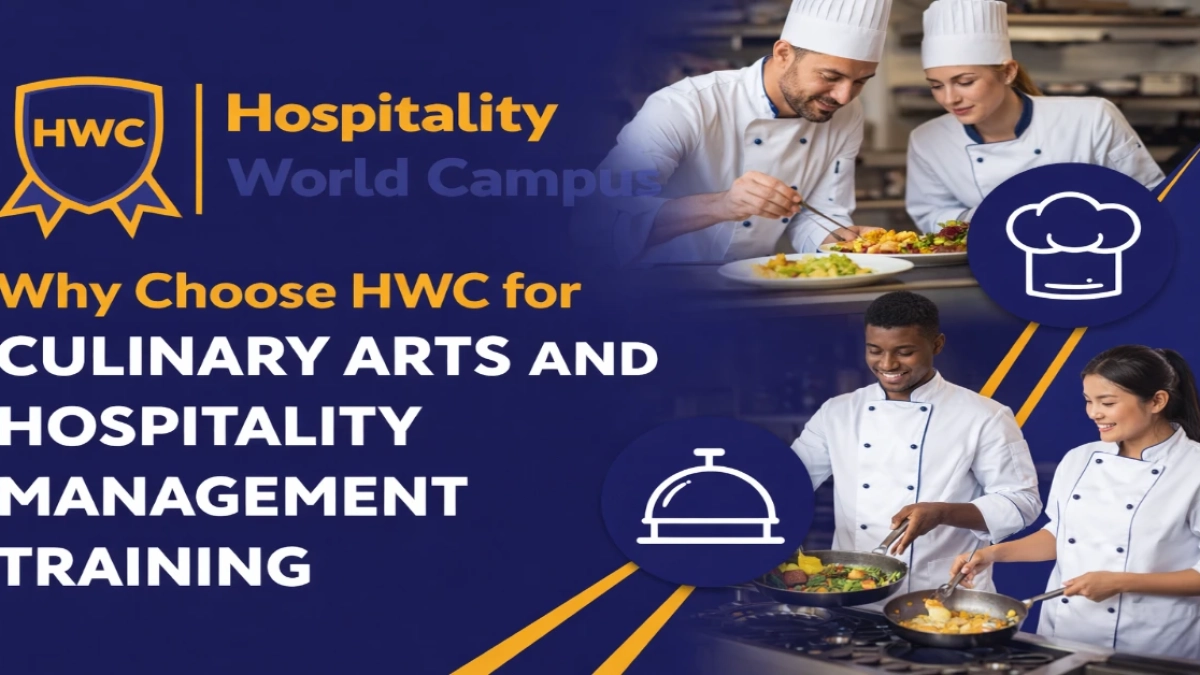
You have a passion for food, people, and the world of hospitality but choosing the right training institution can feel overwhelming. Should you pursue a full university degree that takes four years? Risk an unknown institute with no international recognition? Or settle for short courses that barely scratch the surface of a real professional career?
These are real concerns that thousands of students across Nepal face every year. The good news is that there is a clear, internationally validated path and it begins at Hospitality World Campus (HWC), Nepal’s leading culinary arts and hospitality management training institute, located in Jawalakhel, Lalitpur.
This post walks you through exactly why choose HWC for culinary arts and hospitality management trainings: what you will learn, what kind of career you can build, and why students across Nepal are choosing HWC over traditional four-year degrees and unaccredited training programs.
What Is HWC and Why Does It Matter?
Hospitality World Campus (HWC) is a professional training institution located in Bhanimandal/Jawalakhel, Lalitpur, Kathmandu Valley. It is a unit of LCCI GQ, an internationally recognized organization with decades of experience in soft skills and management education.
What sets HWC apart from virtually every other institution in Nepal is a single defining credential: it is the first and only Nepalese institution to receive approval and quality assurance from the Scottish Qualifications Authority (SQA). HWC programs are also benchmarked against the Scottish Credit and Qualifications Framework (SCQF) and the European Qualifications Framework (EQF) — the same frameworks used across the United Kingdom and Europe.
This is not just a piece of paper. It means that an HWC qualification is recognized internationally, that your skills are validated by a global standard, and that doors open for you in the UK, Europe, Australia, the Middle East, and beyond before you even apply for a visa.
While others are finishing their third or fourth year of a university program, HWC graduates are already working full-time and building real careers in hospitality.
HWC’s Full Range of Culinary Arts and Hospitality Programs
HWC offers a carefully structured portfolio of courses designed for different career goals, experience levels, and timelines. Whether you are just finishing your SEE, have completed your +2, or are an adult learner looking to shift careers, there is a path for you.
Diploma Programs (SQA-Approved)
Diploma in Global Culinary Arts (DGCA)
Duration: 12 months | Level: SCQF Level 6
This is HWC’s flagship culinary program a comprehensive, practical-first curriculum that prepares you to work in professional kitchens anywhere in the world. The program covers:
- Fundamental and advanced cooking techniques
- International cuisines: Asian, Continental, Mediterranean, and more
- Food presentation, plating, and garnishing
- Kitchen management, costing, and inventory control
- Food safety, hygiene, and HACCP standards
- Nutrition and menu planning
Graduates of this program pursue careers as professional chefs, commis chefs, sous chefs, line cooks, and food entrepreneurs in Nepal and internationally.
Diploma in Hospitality Management
Duration: 15 months | Level: SQA-approved
This program is ideal for students who want to work on the management side of hotels, resorts, restaurants, and tourism. It covers front office operations, food and beverage management, housekeeping, customer relations, and hospitality business fundamentals.
Advanced Diploma in Hospitality Management
Duration: 21 months | Level: SQA-approved
For students who want to accelerate toward leadership roles, this advanced program builds on the standard diploma and deepens competence in hospitality strategy, team leadership, revenue management, and international hospitality operations.
Specialized Short Courses
Professional Chef Course – Basic and Advanced Designed for aspiring chefs who want targeted, role-specific skills without committing to a full diploma. Both levels focus on practical kitchen competencies, professional presentation, and culinary fundamentals.
Barista and Bartending Course A practical, career-ready program in beverage preparation covering espresso techniques, latte art, cocktail mixing, café and bar management, customer service, and equipment handling. Perfect for students aiming to work in specialty cafes, hotels, or hospitality businesses in Nepal and the Middle East.
Bakery and Patisserie Course – Basic and Advanced Learn the full spectrum of baking: artisan breads, croissants, cakes, cookies, pastries, desserts, chocolate work, and cake decorating. The advanced level covers cost control, production planning, and management of bakery operations opening career pathways in hotel bakeries, pastry shops, and independent business ownership.
The HWC Training Experience: What Hands-On Really Means
Many institutions in Nepal claim to offer “practical training.” At HWC, practical training is the core of every program not an add-on.
State-of-the-Art Professional Kitchen Facilities
Students at HWC train in fully equipped professional kitchens that replicate real hotel and restaurant environments. From industrial ovens and espresso machines to pastry stations and cold storage, the equipment you train with is the equipment you will use on the job. There is no learning gap between what you practiced in college and what employers expect.
Industry Expert Faculty
HWC’s teaching team consists of practicing hospitality professionals, experienced chefs, and internationally trained instructors not academic-only lecturers. This distinction matters enormously. When your instructor has worked in a five-star hotel kitchen or managed restaurant operations in real conditions, the knowledge they transfer to you is practical, current, and industry-relevant.
Industrial Visits and Guest Lectures
Beyond the classroom and kitchen, HWC regularly organizes industrial visits to partner hotels, restaurants, and hospitality businesses, as well as guest lectures by senior professionals in the field. These experiences give students real-world exposure, professional networking opportunities, and a concrete sense of what their future workplace looks like.
Small Class Sizes and Personalized Mentoring
HWC maintains small class sizes by design. This means instructors can observe every student’s technique, provide direct corrections, and offer the kind of individual mentorship that is simply impossible in large lecture-based programs. Your growth is tracked, your weaknesses are addressed, and your strengths are developed intentionally.
International Recognition and Global Career Pathways
This is where HWC’s advantage becomes most tangible for Nepalese students who have global ambitions.
Because HWC programs are accredited by the SQA and benchmarked against the EQF, graduates are recognized for the Point-Based Skills Visa to the UK a significant advantage for students who want to work or advance their careers in the United Kingdom after completing their training in Nepal.
Credit transfer options also exist for students who wish to continue their higher education in countries such as Australia, the UK, the USA, or Europe. Rather than spending four years in Nepal to then start again abroad, HWC students can complete a professional diploma, enter the workforce, and use earned credits to ladder into bachelor’s programs internationally.
Graduates from HWC have built careers in:
- Five-star hotels and luxury resorts in Nepal, Dubai, Qatar, and the Middle East
- Cruise ships and international hospitality chains
- Specialty cafes and restaurant groups in Australia and the UK
- Boutique bakeries, pastry shops, and food entrepreneurship
Paid Internships and Job Placement Support
Graduating with a qualification is only part of the picture. What truly launches a career is real, industry-validated experience and HWC builds this into every program.
Through its network of local and international hospitality industry partners, HWC facilitates paid internships for students during and after their programs. These are not observation placements. Students work in professional environments, earn income, build their resumes, and develop relationships with employers who often become their first full-time employers after graduation.
HWC also provides active job assistance meaning the institution works with you, not just for you, to identify placement opportunities that match your skills, goals, and geographic preferences.
For students worried about whether their degree will translate into a real job: at HWC, the pathway from training to employment is structured, supported, and proven.
Realistic Student Concerns – Answered Honestly
“Is a diploma good enough, or do I need a full degree?”
For most culinary and hospitality careers, a diploma with strong practical training and internship experience outperforms a general bachelor’s degree from an institution without industry connections. Employers in the hospitality sector hire based on demonstrated skills and relevant experience both of which HWC prioritizes. The 12-to-21-month programs at HWC are designed to get you employment-ready efficiently, without the debt and time cost of a four-year degree.
“What if I want to study abroad later?”
HWC’s SQA-aligned qualifications offer direct credit transfer pathways to universities in Australia, the UK, the USA, and Europe. You are not choosing between training and further education you are doing both in sequence, and with stronger credentials than most.
“Is this affordable compared to studying abroad?”
Students who train at HWC can save up to NPR 30 lakh compared to equivalent programs abroad. When you factor in paid internship income, the financial case becomes even clearer: you are building professional skills and earning money simultaneously rather than taking on significant debt overseas.
“Will I be able to handle the pressure of a professional kitchen?”
Honest answer: hospitality is demanding. Long hours, physical work, and high-stakes service environments are real. HWC prepares you for this deliberately through repetitive practical sessions, time-pressure kitchen exercises, food safety and hygiene compliance training, and professional conduct standards built into every course. Students who complete HWC programs graduate not just skilled, but mentally prepared for professional environments.
Safety, Hygiene, and Professional Standards Training
Food safety is not optional in the hospitality industry it is a legal and ethical requirement. HWC integrates comprehensive food hygiene and kitchen safety training into all culinary programs. Students learn:
- HACCP (Hazard Analysis and Critical Control Points) principles
- Proper food storage, temperature control, and cross-contamination prevention
- Personal hygiene standards and kitchen sanitation protocols
- Safe handling of equipment, heat sources, and knives
- Waste management and sustainable kitchen practices
This training ensures HWC graduates meet international safety standards from day one making them attractive hires in regulated markets including the UK and EU.
Career Pathways After HWC Training
The hospitality sector in Nepal and globally is growing rapidly. Tourism, boutique hotels, specialty cafes, international restaurant chains, and food entrepreneurship are all expanding creating strong, sustained demand for skilled professionals across every area HWC teaches.
Here are realistic career paths for each program:
| Program | Career Pathways |
|---|---|
| Diploma in Global Culinary Arts | Commis Chef, Sous Chef, Chef de Partie, Executive Chef, Food Entrepreneur |
| Diploma in Hospitality Management | Front Office Manager, F&B Manager, Hotel Operations Supervisor |
| Advanced Diploma in Hospitality Management | Hotel General Manager, Revenue Manager, Hospitality Consultant |
| Barista & Bartending | Head Barista, Café Manager, Bar Manager, Beverage Consultant |
| Bakery & Patisserie | Pastry Chef, Bakery Owner, Hotel Pastry Department, Confectionery Business |
| Professional Chef Course | Line Cook, Commis Chef, Restaurant Cook, Catering Professional |
Starting salaries for hospitality professionals in Nepal range from NPR 25,000 to NPR 60,000. For those working internationally in the Middle East, UK, or Australia income scales dramatically, often exceeding NPR 1.5 lakh to NPR 3 lakh per month depending on role and location.
What Students Say About HWC
HWC’s teaching philosophy is built on the belief that education should create “graduates who excel in skill, integrity, and genuine care for the person.” Students consistently highlight three things about their HWC experience:
- The quality of hands-on kitchen training compared to institutions that focus primarily on theory
- The accessibility and real-world experience of their instructors
- The confidence they feel entering the job market compared to peers from other institutions
The practical, outcome-focused approach means that by the time an HWC student completes their program, they have already spent hundreds of hours in professional kitchen and hospitality environments not just reading about them.
Tips for Maximizing Your Learning at HWC
Getting the most from your HWC training takes intentional effort. Here is what high-performing students do:
- Show up for every practical session: Culinary skills are built through repetition. Missing kitchen sessions cannot be replicated through notes.
- Ask questions during industrial visits: Every visit to a partner hotel or restaurant is a networking opportunity. Introduce yourself to chefs and managers.
- Use internship time strategically: Treat your internship like your first real job. The habits and reputation you build there often determine your first employment offer.
- Build your portfolio: Document your dishes, events, and projects with photos. A strong culinary portfolio is a powerful job search tool.
- Learn kitchen languages: Familiarize yourself with French culinary terminology and English hospitality standards both are widely used in professional kitchens internationally.
- Focus on hygiene compliance from day one: Employers notice graduates who take food safety seriously without being reminded.
How HWC Compares to Other Options in Nepal
| Factor | HWC | Generic University Degree | Unaccredited Short Course |
|---|---|---|---|
| International Recognition | SQA, SCQF, EQF approved | Varies | Usually none |
| Duration | 12–21 months | 3–4 years | Days to weeks |
| Practical Training | Intensive, professional kitchens | Varies widely | Minimal |
| Paid Internships | Yes, through industry partners | Rarely | No |
| Global Career Pathways | UK Skills Visa eligible, credit transfer | Depends on degree | No |
| Cost vs. Value | Significantly lower than abroad | Variable | Low quality, low outcome |
| Job Placement Support | Active, structured | Limited | None |
Frequently Asked Questions (FAQ)
1. What qualifications do I need to enroll in HWC’s culinary arts programs?
For most diploma programs at HWC, you need to have completed your SEE (Secondary Education Examination) or equivalent. Students who have completed their +2 are also eligible and may pursue advanced pathways. There are no strict stream requirements students from science, management, and humanities backgrounds are all welcome.
2. Are HWC certificates recognized internationally?
Yes. HWC is the only institution in Nepal whose hospitality programs are approved and quality-assured by the Scottish Qualifications Authority (SQA), and benchmarked against the SCQF and EQF. This makes HWC qualifications recognized across the UK and Europe, and eligible for the UK Point-Based Skills Visa in the hospitality category. Credit transfer to universities in Australia, the USA, and Europe is also available.
3. Does HWC help with job placement after completing the course?
Yes. HWC provides structured job assistance and facilitates paid internships through its network of local and international industry partners including hotels, restaurants, cafes, and hospitality businesses in Nepal and abroad. Many students receive employment offers from the same establishments where they completed their internships.
4. How long does a culinary arts diploma take at HWC, and when can I start earning?
The Diploma in Global Culinary Arts takes 12 months to complete. Many students begin earning income during their program through paid internships arranged by HWC. Upon graduation, most students enter employment within weeks significantly faster than graduates from four-year programs.
5. What is the difference between the basic and advanced Bakery and Patisserie courses at HWC?
The Basic Bakery and Patisserie Course covers foundational baking skills — breads, cakes, pastries, cookies, and basic cake decorating. The Advanced Course builds on this foundation with complex patisserie techniques, chocolate work, dessert presentation, cost management, and the skills needed to operate or manage a bakery business independently.
6. Can I open my own bakery or café after completing an HWC course?
Absolutely. HWC programs incorporate business fundamentals including cost control, menu planning, inventory management, and customer service skills directly applicable to running a food business. Many HWC graduates have launched their own bakeries, cafes, and catering businesses in Nepal.
Ready to Build Your Hospitality Career? Start at HWC.
Nepal’s hospitality industry is growing. International tourism is recovering strongly. The demand for professionally trained chefs, baristas, pastry chefs, and hospitality managers has never been higher both inside Nepal and in global markets.
The question is not whether culinary arts and hospitality is a smart career path. The question is whether you want to enter that career with internationally recognized credentials, real hands-on experience, paid internship income, and a network of industry connections — or without them.
Hospitality World Campus gives you all of it, in 12 to 21 months.
📍 Visit HWC: Jawalakhel, Lalitpur, Kathmandu
📞 Call: 01-5425671 | 9801185389
✉️ Email: Info@hwc.edu.np
🌐 Website: hwc.edu.np