
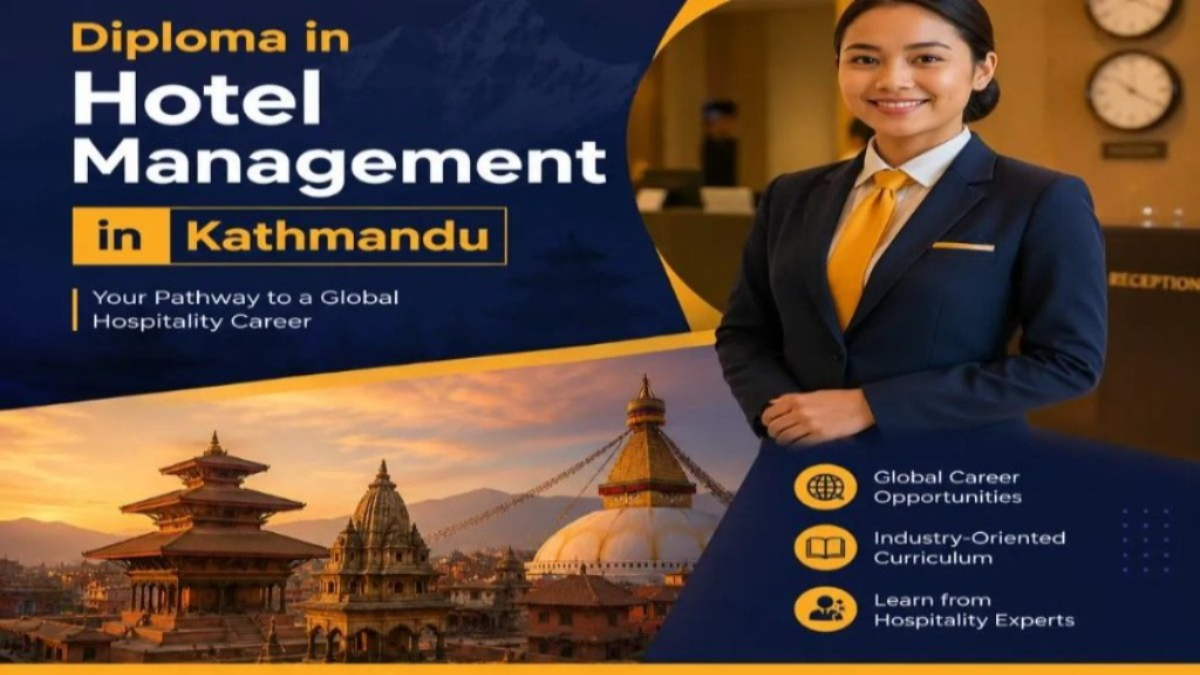
A diploma in hotel management in Kathmandu takes between 1 year and 3 years to complete, depending on the program. Eligibility begins after SEE (Grade 10) with a minimum D+ grade. Fees range from approximately NPR 1,20,000 to NPR 4,00,000. All accredited programs include a mandatory industry internship. The quality of that internship placement is the single most important factor in your career outcome.
Nepal’s tourism sector welcomed over 1 million international visitors in 2023, according to data from the Nepal Tourism Board and that number continues to grow. Behind every five-star stay, every perfectly plated meal, and every smooth hotel check-in is a trained hospitality professional. A diploma in hotel management in Nepal is one of the fastest, most practical ways to enter this industry, whether you have just passed your SEE or completed your +2.
This guide gives you everything you need: what the diploma covers, which hotel management institutes in Kathmandu offer it, what it costs, how admission works, and what career you can realistically build afterward. If you are searching for a hotel management course in Kathmandu for 2026-2027 admission, read this first.
What Is a Diploma in Hotel Management?
A diploma in hotel management is a structured, skill-first qualification that trains you across the core departments of a modern hotel front office, food production, food and beverage service, and housekeeping alongside business fundamentals like cost control, marketing, and guest relations.
It occupies the practical middle ground between a short certificate (which develops one skill) and a full bachelor’s degree (which takes three to four years). A hospitality management diploma in Kathmandu is broad enough to open multiple career doors yet short enough to get you earning within 12 to 21 months.
Who Should Enroll in a Hotel Management Course in Kathmandu?
A hotel management course in Kathmandu is the right fit if you:
- Have passed SEE (Grade 10) and want to enter the workforce faster than a degree allows — hotel management diploma after SEE in Kathmandu is one of the most popular pathways
- Have completed +2 (Grade 12) in any stream and want a practical hospitality credential — hotel management diploma after +2 is equally accessible and valued by employers
- Are already working in hospitality and want a formal qualification to move into supervisory roles
- Are targeting a career abroad — in the Gulf, Macau, Europe, or Australia — where an internationally recognized diploma opens employment and visa pathways
- Are considering launching your own restaurant, guesthouse, or café and want structured operational knowledge
There is no age limit and no specific academic stream requirement for most programs.
Hotel Management Diploma Frameworks in Nepal: CTEVT vs. International Qualifications
Understanding which framework a diploma sits under is essential before comparing hotel management institutes in Kathmandu. Two main systems exist:
CTEVT (Council for Technical Education and Vocational Training): The government-recognized technical education body. The standard CTEVT Diploma in Hotel Management (DHM) runs for three years (including internship) after SEE. This is a government-recognized hotel management diploma accepted by public-sector employers and carries weight for jobs in Nepal’s government hospitality roles.
Internationally accredited private diplomas: Shorter programs, typically 12 to 21 months offered by registered private hospitality institutes whose qualifications are quality-assured by international bodies such as the Scottish Qualifications Authority (SQA). These programs are benchmarked on the Scottish Credit and Qualifications Framework (SCQF) and the European Qualifications Framework (EQF), making graduates globally competitive. They are the preferred route for students targeting international hotel management diploma Nepal pathways into the Gulf, Europe, or Macau.
A “1-year hotel management diploma Kathmandu” and a “3-year hotel management diploma Nepal” are fundamentally different products serving different goals. Know which one aligns with your career plan before applying.
Hotel Management Diploma Fees in Kathmandu: What to Expect in 2025–2026
Hotel management diploma fees in Kathmandu range from approximately NPR 50,000 to NPR 4,00,000 total, depending on the program duration, institute reputation, facilities, and whether an international internship is included.
| Program Type | Approximate Total Fee (NPR) | Duration |
|---|---|---|
| CTEVT 3-Year DHM (government-affiliated) | NPR 50,000 – 3,00,000 | 3 years |
| Private 12–15 Month Diploma (SQA/international) | NPR 1,80,000 – 3,50,000 | 12–15 months |
| Advanced Diploma (21 months, international) | NPR 2,50,000 – 4,50,000 | 21 months |
| 6-Month Certificate Programs | NPR 60,000 – 1,20,000 | 6 months |
Note: Figures above are indicative ranges for the 2026-2027 academic cycle. Always request a complete fee breakdown in writing from your chosen institute before enrolling. Some institutes offer installment payment plans and merit-based fee waivers ask specifically during your admissions inquiry.
If two institutes show a significant fee gap, ask why. Sometimes the difference reflects facility standards or instructor experience. Sometimes it reflects the fact that one institute offers no paid internship placement while the other does.
Hotel Management Diploma Eligibility: Entrance Requirements for 2026–2027
Who can apply for a hotel management diploma in Kathmandu?
The minimum eligibility for most hotel management diploma programs is an SEE (Grade 10) pass certificate. Specific requirements vary by institute and program level:
| Program Level | Minimum Eligibility | Age Requirement |
|---|---|---|
| Diploma in Hospitality Management (12–15 months) | SEE/SLC with D+ (GPA 1.6) + D+ in English | 17 years and above |
| Advanced Diploma in Hospitality Management (21 months) | SEE/SLC pass; +2 preferred | 17 years and above |
| CTEVT 3-Year DHM | SEE pass | No specific age limit |
| Diploma after +2 | +2 from any stream | As per institute |
There is generally no competitive entrance exam for diploma-level hotel management admission in Kathmandu. The hotel management diploma admission process is typically straightforward.
Hotel Management Diploma Admission Process Step by Step
- Submit the hotel management diploma application form online or visit the institute in person
- Provide academic certificates (SEE marksheet and/or +2 marksheet, as applicable)
- Attend a brief admissions interview or counseling session
- Receive your offer letter and confirm hotel management diploma enrollment
- Pay the admission fee and secure your seat for the hotel management diploma intake
For hotel management admission 2026, most institutes accept applications on a rolling basis. Contact admissions directly to confirm intake dates, as these vary by institution.
What Will You Study? Hotel Management Diploma Curriculum
Whether you enroll in a 12-month, 15-month, or 3-year program, the subject areas in a hotel management diploma in Kathmandu follow a consistent pattern across accredited institutes.
Core Operational Subjects
Food Production — Cooking techniques, menu planning, cost control, kitchen management, and culinary arts fundamentals. Students train in professional kitchen labs using industry-standard equipment.
Food and Beverage Service — Restaurant operations, table service styles, beverage knowledge, banqueting and event service. This is where hospitality comes to life in a real dining context.
Front Office Management — Reservations, check-in/check-out, guest relations, and property management systems (PMS). Front office is often the first career entry point for diploma graduates.
Housekeeping Operations — Room operations, linen management, laundry procedures, and hygiene and sanitation standards.
Business and Professional Development
- Hospitality entrepreneurship and hotel administration
- Marketing and sales for the hospitality industry
- Cost control and basic accounting for hotels
- Technology in hospitality — property management systems and online booking platforms
- Spoken hospitality English and business communication
- Customer service and professional etiquette
- Event management and banqueting operations
Specialization Modules (varies by institute)
- Barista training and coffee arts
- Mixology and bar operations
- Bakery and pastry fundamentals
This curriculum breadth is what makes a professional hotel management diploma Kathmandu so useful early in a career you rotate through every department, enabling informed specialization as you grow.
Hotel Management Diploma Duration in Nepal: Which Program Length Is Right for You?
Hotel management diploma duration in Nepal ranges from 6 months (certificate) to 3 years (CTEVT DHM). The most common private diploma programs run for 12 to 15 months, structured as classroom training plus a mandatory industry internship.
| Duration | Best For |
|---|---|
| 6-month certificate | Single skill, quick entry (barista, bakery) |
| 12-month diploma | Fastest full hospitality credential; international pathway |
| 15-month diploma | Balanced training + internship; most popular private format |
| 21-month advanced diploma | Management-track; leadership roles; strongest for abroad placements |
| 3-year CTEVT DHM | Government recognition; public-sector roles in Nepal |
Internship: The Most Career-Defining Part of Your Diploma
No element of a hotel management diploma matters more for your long-term career than the quality of your internship. A diploma with a weak internship is a qualification without a career and this is exactly where most institute websites give the least information.
What a Strong Hotel Management Internship Looks Like
A diploma in hotel management with internship in Kathmandu should offer:
- Placement in a 3-star to 5-star property (not just a training restaurant)
- Department rotations across front office, food production, F&B service, and housekeeping
- A stipend or at minimum transport and meal allowances
- A formal evaluation and completion certificate from the hotel this becomes part of your professional portfolio
Questions to Ask Any Institute About Internship Placement
- “What are the names of your hotel partners for internship placement?”
- “What percentage of last year’s students were placed in 4-star or 5-star properties?”
- “Do students receive a stipend during internship?”
- “Is there an international internship or placement track?”
A hotel management diploma with placement guarantee or documented industry partnerships is worth significantly more than a cheaper program with no placement track record.
Career Opportunities After a Hotel Management Diploma in Nepal
Direct answer: After completing a hotel management diploma, you are eligible for entry-level roles in hotels, restaurants, resorts, airlines, cruise ships, event companies, and hospitality businesses internationally.
Entry-Level Positions (0–2 Years Experience)
- Front Office Executive — reservations, guest check-in, concierge
- Food and Beverage Captain — restaurant and banquet service
- Kitchen Assistant / Commis Chef — food production
- Housekeeping Supervisor — accommodation operations
- Barista / Bartender — café and bar outlets
- Guest Relations Executive — customer-focused roles
Mid-Level Positions (3–5 Years Experience)
- Food and Beverage Manager
- Front Office Manager
- Restaurant Manager
- Executive Housekeeper
- Banquet and Events Coordinator
- Hotel Operations Supervisor
Salary Expectations After a Hotel Management Diploma Nepal
| Role | Monthly Salary (Nepal) | Working Abroad (Gulf/Macau/Europe) |
|---|---|---|
| Entry-level front office / F&B staff | NPR 15,000 – 25,000 | USD 400 – 700/month + accommodation |
| Supervisor (2–3 years experience) | NPR 25,000 – 45,000 | USD 600 – 900/month + accommodation |
| Department manager (5+ years) | NPR 50,000 – 1,00,000+ | USD 900 – 1,500/month |
Salary data sourced from industry surveys and publicly available hospitality sector reports. Actual compensation varies by employer, location, and individual performance.
Working abroad is where the financial picture changes most dramatically. Nepali hospitality graduates are actively recruited by hotel groups in Qatar, the UAE, Saudi Arabia, Macau, and increasingly across European countries with hospitality labor shortages. Institutes with international hotel management diploma Nepal recognition through bodies like SQA open these pathways most effectively.
How to Choose the Best Hotel Management Diploma in Kathmandu
With dozens of hotel management training centers in Kathmandu advertising across Thamel, Baneshwor, Naxal, Baluwatar, Jawalakhel, and Lalitpur, here is a practical checklist before you commit:
Accreditation and Recognition
- Is the institute registered with the Nepal Government / Ministry of Education?
- Is the diploma quality-assured by a recognized national or international body (CTEVT, SQA, or equivalent)?
- Is the diploma accepted for overseas employment and, if relevant, for credit transfer abroad?
Faculty and Facilities
- Do instructors have real hotel industry experience — not just academic backgrounds?
- Does the institute have a professional training kitchen, front office simulation lab, and housekeeping practice rooms?
- Are classes taught with English-medium instruction to prepare you for international environments?
- Are class sizes small enough for individual attention?
Internship and Placement
- Can the institute name its hotel partner properties specifically?
- What percentage of last year’s students secured placements in 4-star or 5-star hotels?
- Do students receive stipends during internship?
- Is there a dedicated hotel management diploma with placement support team?
- Is there an international placement track for qualifying graduates?
Fees, Flexibility, and Support
- Is the fee structure transparent and provided in writing?
- Are installment payment plans available?
- Are there scholarships or fee waivers for meritorious or financially constrained students?
Alumni Track Record
- Can you speak with or connect with recent graduates?
- Where are graduates working one year after completing the program?
Comparison: CTEVT Diploma vs. International (SQA) Diploma
| Factor | CTEVT 3-Year DHM | International 12–21 Month Diploma |
|---|---|---|
| Duration | 3 years | 12–21 months |
| Recognition | Government of Nepal | International (SQA/SCQF/EQF) |
| Ideal for | Public-sector Nepal roles | International career pathways |
| Curriculum | Standardized national syllabus | Industry-aligned, globally benchmarked |
| Internship | Included (mandatory) | Included (mandatory; often internationally placed) |
| Credit transfer abroad | Limited | Possible via SCQF/EQF equivalency |
Frequently Asked Questions About Hotel Management Diploma in Kathmandu
Can I study hotel management after SEE?
Yes. The CTEVT 3-year Diploma in Hotel Management is specifically designed for SEE graduates. Several private institutes also admit SEE-pass students with a minimum D+ (GPA 1.6) in English into their 12 to 15-month diploma programs. You do not need to complete +2 first.
Can I join hotel management after +2?
Absolutely. +2 graduates from any stream science, management, or humanities are eligible for all programs. Some institutes offer advanced placement or credit exemptions for +2 graduates.
What is the duration of a hotel management diploma in Nepal?
It depends on the program. CTEVT’s DHM is 3 years. Private institutional diplomas typically run for 12 months (Diploma in Global Culinary Arts), 15 months (Diploma in Hospitality Management), or 21 months (Advanced Diploma in Hospitality Management). Six-month certificate programs are also available for specific skills.
What are the eligibility requirements for a hotel management diploma?
The minimum eligibility for most programs is an SEE (Grade 10) pass with a D+ grade (GPA 1.6), including a D+ in English. Age requirement is typically 17 years and above. There is no specific stream requirement.
How much does a hotel management diploma cost in Kathmandu?
Fees range from approximately NPR 1,20,000 to NPR 4,50,000 depending on the institute, program duration, and included services. Always request a complete written fee breakdown before enrolling. Installment options are available at many institutes.
Which hotel management diploma programs include internship?
All accredited diploma programs include an internship component it is a requirement for certification. The critical question is not whether an internship exists but where it is placed. Look for institutes with named 4-star and 5-star hotel partners and documented placement rates.
What jobs can I get after a hotel management diploma?
Entry-level roles include front office executive, food and beverage captain, kitchen assistant, housekeeping supervisor, barista, and guest relations executive. With 3–5 years of experience, you can advance to department manager, restaurant manager, and operations supervisor roles.
Is an international hotel management diploma recognized abroad?
Diplomas quality-assured by internationally recognized bodies such as the Scottish Qualifications Authority (SQA) and benchmarked on the SCQF and EQF are recognized across the UK, Europe, and by employers in Gulf countries and Macau. CTEVT diplomas are recognized by the Government of Nepal and generally accepted by employers in countries that actively recruit from Nepal. For recognition in specific countries (Australia, Canada), have your qualification assessed by that country’s relevant authority.
What is the difference between a hotel management diploma and a hospitality management diploma?
In Nepal, the terms are used interchangeably. Both refer to programs that train students across hotel and restaurant operations, including front office, food production, food and beverage service, and housekeeping. Some institutes use “hospitality management” to signal a broader scope that includes tourism and event management.
Which is the best hotel management diploma college in Kathmandu near me?
The best diploma college for hotel management in Kathmandu depends on your goals: government recognition (choose CTEVT-affiliated), international career pathway (choose SQA-quality-assured), or fastest entry to industry (choose a 12-month program with documented hotel placement). Visit at least two or three hospitality institutes in Kathmandu in person before deciding.
When is hotel management admission open in Kathmandu for 2026?
Most hotel management institutes in Kathmandu accept applications on a rolling intake basis. For hotel management admission 2026, contact your preferred institute directly to confirm intake dates and application deadlines. The hotel management diploma registration process is typically completed within a few days of submitting your documents.
Is a Hotel Management Diploma Worth It in Nepal?
Yes under the right conditions. A diploma in hotel management in Nepal is worth it if you are passionate about working with people, want to enter the workforce faster than a four-year degree allows, choose an institute with real hotel partnerships and documented placement support, and treat your internship as your first professional job rather than just a course requirement.
The tourism and hospitality career path in Nepal is one of the few sectors where practical skills genuinely outweigh academic credentials. A well-executed affordable hotel management diploma in Kathmandu from an accredited institute one where you commit fully to your training and internship is extremely competitive in the job market, both domestically and internationally.
A Note on Internationally Recognized Hospitality Education in Lalitpur
If you are looking for a hospitality management diploma in Kathmandu that combines international accreditation with a strong internship track, one option worth researching is Hospitality World Campus (HWC), located in Jawalakhel, Lalitpur easily accessible from central Kathmandu.
HWC is a unit of LCCI GQ, an award-winning organization in professional skills training. Its hospitality programs including the Diploma in Hospitality Management (15 months: 9 months of training + 6 months internship), the Advanced Diploma in Hospitality Management (21 months), and the Diploma in Global Culinary Arts (12 months) are approved and quality-assured by the Scottish Qualifications Authority (SQA), Scotland. These programs are benchmarked on both the Scottish Credit and Qualifications Framework (SCQF) and the European Qualifications Framework (EQF), giving graduates a credential recognized across the UK, Europe, and by international hospitality employers.
HWC’s model includes small class sizes with a low teacher-to-student ratio, a monthly mentoring system assigning each student a dedicated mentor, and a student-first educational philosophy. The minimum eligibility is an SEE pass with D+ (GPA 1.6) including D+ in English, and students must be 17 years or above.
For program details, eligibility, fees, and admission inquiries, visit hwc.edu.np or contact HWC directly at +977 980-1185389 or info@hwc.edu.np.
This section is included for informational purposes. The information above about the broader hotel management education landscape in Kathmandu is independently researched and applies across institutions.
Final Advice: Start With Research, Not Convenience
The most common mistake students make when enrolling in a hotel management college in Kathmandu is choosing an institute based on location, price, or a friend’s recommendation without visiting the facility, asking about placement records, or understanding the qualification framework.
Nepal’s hospitality sector is growing, and the demand for skilled, trained professionals is real. But not all diplomas are equal, and not all institutes will put your career outcomes first.
Visit at least two or three hotel management training centers in Kathmandu in person. Ask hard questions about internship placements, industry connections, and what graduates are actually doing one year after finishing the program. Ask to see documentation on placement rates, partner hotel names, and alumni contacts you can speak with.
The few hours you invest in that research will shape the next several years of your career.
When you find the right fit a properly accredited hospitality institute in Kathmandu with real hotel partnerships, qualified industry practitioners as instructors, and a genuine commitment to student placement, a diploma in hotel management in Kathmandu can be one of the best career decisions you make.