
Introduction
If you have searched for a hotel management training college in Kathmandu, you have probably noticed the same problem every student runs into: too many names, too little clarity. Tribhuvan University affiliated BHM colleges, government run academies, and private diploma institutes all advertise themselves as the best option, and it is hard to tell what actually separates one from another. Hospitality World Campus (HWC), based in Jawalakhel, Lalitpur, is one of the training providers in this space, offering SQA Scotland benchmarked diplomas in hospitality management and culinary arts rather than a traditional university degree.
That model is only one path among several, so this guide lays out HWC’s programs alongside those of Kathmandu Institute of Hospitality Management (KIHM), the government run Nepal Academy of Tourism, Hotel and Mountaineering (NATHM), and the wider network of Bachelor of Hotel Management (BHM) colleges listed on directories like CollegeNP. By the end, you should be able to tell the difference between a diploma pathway, a vocational certificate, and a full bachelor’s degree, and know which questions to ask before you commit three or four years (or fifteen to twenty one months) of your life to a program.
Why Hotel Management Training Matters in Kathmandu Right Now
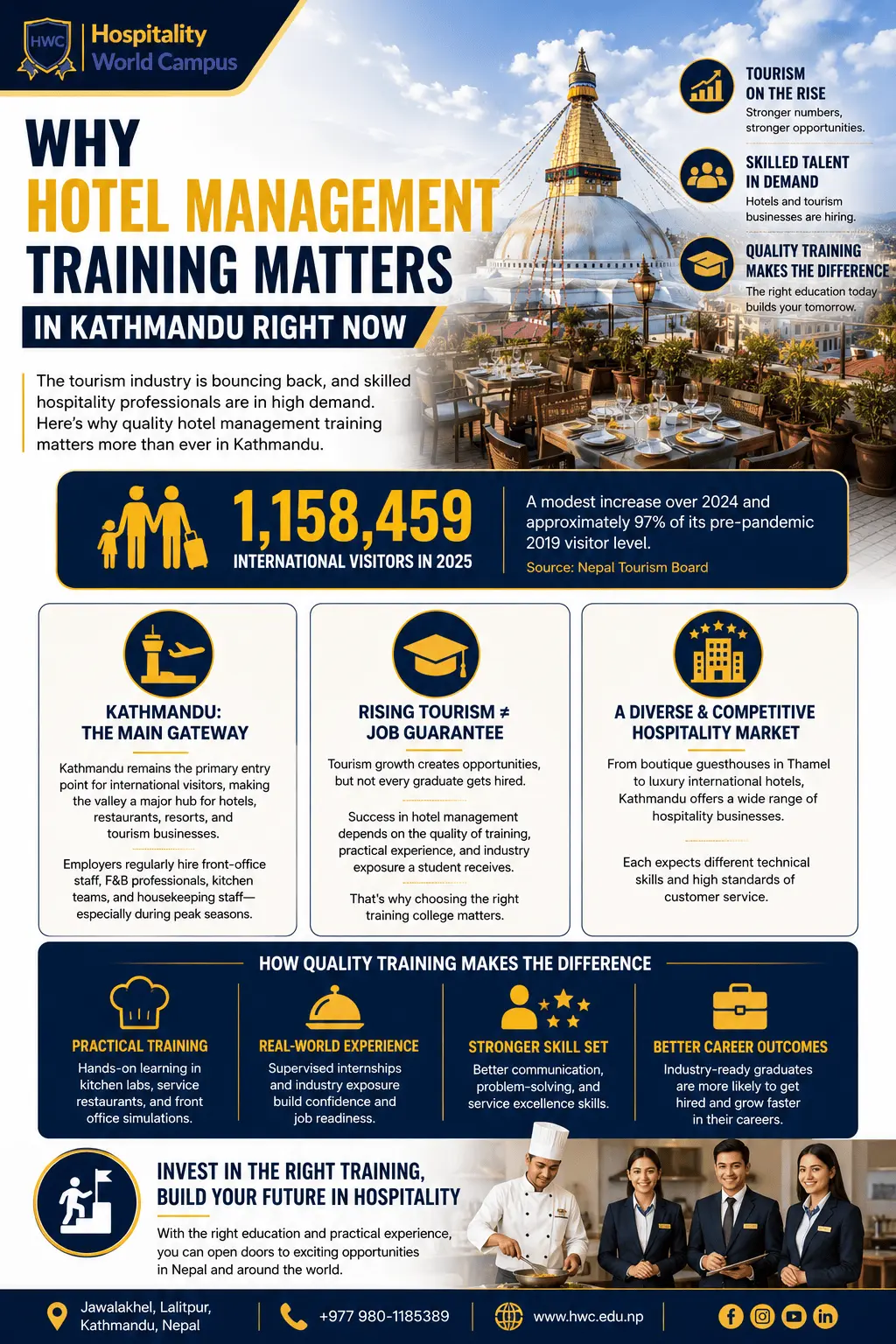
Nepal’s tourism sector is recovering steadily, helping sustain demand for skilled hospitality professionals. Nepal welcomed 1,158,459 international visitors in 2025, a modest increase over 2024 and approximately 97% of its pre-pandemic 2019 visitor level, according to the Nepal Tourism Board.
Kathmandu remains the primary gateway for international visitors, making the valley a major hub for hotels, restaurants, resorts, and tourism businesses. These employers regularly recruit front-office staff, food and beverage professionals, kitchen personnel, and housekeeping teams, particularly during peak tourism seasons.
However, rising tourism does not mean every graduate is guaranteed a job. Success in hotel management depends largely on the quality of training, practical experience, and industry exposure a student receives. That is why choosing the right training college matters, especially in Kathmandu, where the number of hospitality institutes has grown significantly over the past decade.
Hospitality businesses in Kathmandu range from boutique guesthouses in Thamel to luxury international hotels, and each expects different technical and customer-service skills. Students who receive extensive practical training through kitchen laboratories, simulated hotel operations, and supervised internships are generally better prepared for professional roles than those whose education is primarily theory-based.
The Three Pathways: Bachelor’s Degree, Diploma, and Government Vocational Training
Hotel management training in Kathmandu generally falls into three tracks: a three to four year Bachelor of Hotel Management (BHM) degree affiliated with a university, a fifteen to twenty-one month diploma benchmarked against a foreign qualifications framework, or short vocational courses run by government or CTEVT-affiliated institutes. Each track suits a different kind of student and a different timeline.
The Bachelor’s degree route. Most BHM programs in Kathmandu are affiliated with Tribhuvan University (TU) or Purbanchal University (PU), run over four years, and combine general education subjects with hospitality specific coursework. Colleges such as ISMT College, Padmashree College, Kantipur International College, and many others listed on CollegeNP follow this format. It suits students who want a conventional university degree and are comfortable with a longer academic timeline, including subjects outside hospitality.
The diploma / international qualification route. Institutes such as HWC and KIHM offer diplomas benchmarked against a UK based framework, typically the Scottish Qualifications Authority (SQA) and the Scottish Credit and Qualifications Framework (SCQF), often delivered under the LCCI GQ umbrella. These programs run shorter, usually 12 to 21 months depending on the diploma level, and are built around a heavier ratio of practical training to classroom theory, including a structured paid internship as part of the course.
The government / CTEVT vocational route. NATHM offers both full academic degrees (BHM, BTTM, MHM) and shorter craft level vocational trainings such as cook, bakery, barista, and trekking guide courses. KIHM is registered with the Council for Technical Education and Vocational Training (CTEVT) and also runs short courses in areas like housekeeping, front office operation, and food and beverage service alongside its diploma programs. These vocational tracks are the fastest way into an entry level hospitality role and often the most affordable.
None of these tracks is objectively “better.” A BHM degree carries more academic weight for students who may later want a master’s degree or a government sector career. A diploma track gets you into paid, hands on work faster. A short vocational course is ideal if you want one specific skill, such as bartending or bakery, rather than a full management qualification.
Hotel Management Training College in Kathmandu
Below are the best hotel management training college in Kathmandu:
Hospitality World Campus (HWC): Programs and Accreditation
HWC is a private diploma institute in Jawalakhel, Lalitpur, operating as a unit of LCCI GQ and offering hospitality and culinary diplomas benchmarked against the Scottish Qualifications Authority (SQA) framework rather than a Nepali university degree. It has trained students since 2022 and focuses on a smaller, practice heavy model rather than a large lecture hall format.
HWC’s current program lineup includes:
| Program | Duration | Structure |
|---|---|---|
| Diploma in Global Culinary Arts (DGCA) | 12 months | Culinary and kitchen focused training |
| Diploma in Hospitality Management (DHM) | 15 months | 9 months training + 6 months paid internship |
| Advanced Diploma in Hospitality Management (ADHM) | 21 months | 15 months training + 6 months paid internship |
| Professional Chef Course – Advanced | Short course | Kitchen and culinary skills |
| Professional Certificate in Barista and Bartending | Short course | Beverage service skills |
| Certificate in Bakery, Pastry & Patisserie | Short course | Bakery and pastry skills |
All three diploma programs (DGCA, DHM, ADHM) are approved and quality assured by the Scottish Qualifications Authority (SQA), Scotland, and benchmarked at the Scottish Credit and Qualifications Framework (SCQF) and European Qualifications Framework (EQF). This matters for students who may want to transfer credits toward further study abroad later, since the qualification is recognized outside Nepal, not just domestically.
Admission to DHM and ADHM requires a minimum SLC/SEE or equivalent grade of D+ (GPA 1.6), including D+ in English, and a minimum age of 17. HWC also accepts students directly after SEE, without requiring completion of +2 first, which shortens the overall time to a working qualification for students who know early that hospitality is their chosen field.
Two features come up often in how HWC describes its own model:
- Mentoring: each student is assigned a personal mentor who meets with them individually once a month, in addition to regular classroom instruction.
- Small class sizes: HWC maintains a lower teacher to student ratio than a typical large lecture based college, which allows closer, more individual attention during practical labs.
Because HWC is a diploma provider and not a TU or PU affiliated college, students who later want a full bachelor’s degree should ask directly about credit transfer arrangements with any partner institution before enrolling, rather than assuming automatic equivalence.
Kathmandu Institute of Hospitality Management (KIHM)
KIHM is a private vocational training institute in Kupondole, Lalitpur, registered with the Government of Nepal and affiliated with the Council for Technical Education and Vocational Training (CTEVT), running a model similar to HWC’s in structure but with a longer operating history in Kathmandu. KIHM states it has been conducting hospitality training programs for close to two decades.
KIHM’s main programs are the Diploma in Hospitality Management (DHM) and the Advanced Diploma in Hospitality Management (ADHM), both delivered under UK certification through its association with LCCI GQ and Qualifications Scotland (the body that oversees SQA). Beyond these diplomas, KIHM also runs a wider set of shorter vocational courses, including:
- Food & Beverage Production (Cook)
- Food & Beverage Services
- Front Office Operation
- Housekeeping
- Diploma in Secretarial Management
- Sales & Salesmanship
- Caregiver training
This broader course catalog makes KIHM a reasonable option for a student who wants a narrower, faster vocational skill rather than a full diploma. KIHM also lists partnerships and MOUs with hotel properties such as Best Western Plus Godawari Resort and Vivanta Kathmandu by Taj, along with associations with the Hotel Association Nepal (HAN) and REBAN.
Because KIHM and HWC both run SQA benchmarked DHM and ADHM programs under the LCCI GQ structure, the practical differences between them tend to come down to campus location (Kupondole versus Jawalakhel, both in Lalitpur), class size, mentoring approach, and the specific list of partner hotels each has arranged for internships. Prospective students researching either college should ask each institute directly for its current internship placement partners, since these change over time.
NATHM: Nepal’s Government Tourism and Hotel Academy
The Nepal Academy of Tourism, Hotel and Mountaineering (NATHM) is Nepal’s public tourism and hospitality training institution, established in 1972 and operating under the Ministry of Culture, Tourism and Civil Aviation (MoCTCA), located at Rabi Bhawan, Kathmandu. It is the only institution in this comparison that is a direct government body rather than a private college.
NATHM’s academic offerings include Bachelor of Hotel Management (BHM), Bachelor in Travel and Tourism Management (BTTM), Master of Hospitality Management (MHM), Master of Adventure Tourism Studies (MATS), M.Sc. in Mountain and Mountaineering Science, and a Bachelor of Mountaineering Studies (BMS). Admission to these degree programs runs through the CMAT entrance exam, and BHM/BTTM registration is processed through Tribhuvan University.
Separately from its degree programs, NATHM runs shorter craft and supervisory level vocational trainings, including cook, bakery, barista, tourist guide, and trekking guide courses. These shorter trainings are open on a rolling admission and interview basis and are a common entry point for students who want a government recognized certificate without committing to a full degree.
As a government academy, NATHM differs from HWC, KIHM, and the private BHM colleges in a few structural ways:
- Public institution status, which typically means lower tuition than private colleges, though seats are limited and competitive through CMAT.
- A wide range of program levels in one place, from short craft trainings up to a master’s degree.
- Long institutional history, with alumni working across major Kathmandu hotel brands and government tourism bodies.
- Government affiliations with bodies including the Ministry of Culture, Tourism and Civil Aviation, Nepal Tourism Board, and the Hotel Association of Nepal.
The trade off is competition for seats and a more rigid academic calendar tied to government and university schedules, compared to the rolling or more flexible intakes some private diploma colleges offer.
University-Affiliated BHM Colleges in Kathmandu
Beyond HWC, KIHM, and NATHM, Kathmandu has a large number of private colleges offering a standard three to four year Bachelor of Hotel Management (BHM) degree, most of them affiliated with Tribhuvan University or Purbanchal University. According to CollegeNP’s directory of hotel management colleges in Kathmandu, examples include:
| College | Location | Program |
|---|---|---|
| ISMT College | Tinkune | BSc (Hons) International Tourism and Hospitality Management |
| Padmashree College | Tinkune | Bachelor of Hospitality Management (BHM) |
| Kantipur International College | New Baneshwor | BHM, MHHM, BHCM |
| KFA Business School | Mid Baneshwor | BSc (Hons) in Hospitality Management |
| Padmakanya Multiple Campus | Bagbazar | Bachelor of Hotel Management |
| Gateway College of Professional Studies | Basundhara | BHM, MHHM |
| GATE College | Mandikhatar | Bachelor in Professional Hospitality, BIHM |
| IIMS College | Dhobidhara | Bachelor of International Hospitality Management (Hons) |
| International College of Hospitality Management (ICHM) | Gaushala | Bachelor of Hotel Management |
| International School of Tourism and Hotel Management (IST College) | Gyaneshwor | FHS Diploma in Hotel Management |
This is not an exhaustive list. CollegeNP and similar directories add and remove listings as colleges open, close, or change affiliation, so always verify a college’s current affiliation status directly with Tribhuvan University or Purbanchal University before applying, rather than relying only on a directory listing.
This BHM route suits a student who wants the broader academic credential of a bachelor’s degree, is comfortable with a four year commitment, and may want the option of postgraduate study (an MHM or MBA in hospitality, for example) after graduating. It generally involves more general education coursework alongside hospitality subjects, compared to the more concentrated, practice heavy diploma tracks at HWC or KIHM.
Side-by-Side Comparison Table
The fastest way to see the real differences between these options is to compare duration, credential type, and admission route side by side.
| Feature | HWC | KIHM | NATHM | Typical BHM College |
|---|---|---|---|---|
| Type | Private diploma institute | Private vocational institute | Government academy | Private, university-affiliated |
| Location | Jawalakhel, Lalitpur | Kupondole, Lalitpur | Rabi Bhawan, Kathmandu | Various (Kathmandu Valley) |
| Main credential | SQA-benchmarked Diploma / Advanced Diploma | SQA-benchmarked Diploma / Advanced Diploma | TU-affiliated BHM, BTTM, MHM | TU or PU-affiliated BHM |
| Typical duration | 12–21 months | Varies by program | 4 years (BHM) | 3–4 years |
| Admission route | Direct, min. SEE D+ | Direct application | CMAT entrance exam | College-specific entrance/interview |
| Internship built in | Yes, 6 months paid | Yes | Yes (industrial visit/internship) | Varies by college |
| Regulatory body | SQA Scotland / LCCI GQ | CTEVT / SQA Scotland / LCCI GQ | MoCTCA / Tribhuvan University | Tribhuvan University / Purbanchal University |
How to Choose Between These Options
There is no single best hotel management training college in Kathmandu. The right choice depends on how much time you can commit, whether you want a foreign-benchmarked diploma or a Nepali university degree, and how much weight you put on hands-on training versus academic breadth.
Before enrolling anywhere, private or government, ask each shortlisted college these questions directly:
- What is the exact duration, including any internship period, not just the classroom months?
- Which body accredits or benchmarks the qualification, and can that be verified independently?
- Is the internship paid, and which specific hotels or restaurants currently host students?
- What is the class size in practical labs, not just the marketing material’s claim?
- What documentation do graduates receive, and is it recognized for further study abroad if that matters to you?
- What are the current tuition fees and payment structure? (Fee structures change and are best confirmed directly with the admissions office rather than relying on older published figures.)
Visiting the campus in person, if possible, and speaking with current students rather than only admissions staff, remains one of the most reliable ways to judge whether a college’s practical training matches what it advertises.
Eligibility and Admission Process
Most hotel management programs in Kathmandu, whether diploma or degree, require at minimum an SEE (or equivalent) pass, though the exact grade requirement and whether +2 completion is needed varies by institution and program level.
For diploma programs like HWC’s DHM and ADHM, the published requirement is a minimum SLC/SEE grade of D+ (GPA 1.6), including D+ in English, and a minimum age of 17, which allows direct entry without waiting to finish +2. NATHM’s bachelor’s degree programs (BHM, BTTM) require +2 completion and admission through the CMAT entrance examination, since they are full university-affiliated degrees. Most private BHM colleges affiliated with TU or PU similarly require +2 completion, along with the university’s own entrance process, which varies by institution.
Because entrance requirements, intake dates, and required documents change from year to year, always confirm the current admission cycle directly with the college’s admissions office rather than relying on older published information.
Career Scope After Hotel Management Training in Kathmandu
Graduates of any of these pathways typically start in entry-level operational roles, such as front office assistant, food and beverage service staff, commis chef, or housekeeping supervisor, before moving into management positions with experience. The specific starting role often depends on the program track: culinary diploma graduates usually enter kitchens as commis chefs, while hospitality management diploma or BHM graduates more often start in front office, guest services, or food and beverage management tracks.
With Nepal’s tourism sector continuing to recover toward pre-pandemic arrival numbers, hotels across Kathmandu, Pokhara, and other tourist hubs continue to need trained staff across departments. Career paths within Nepal include hotel and resort operations, restaurant management, and event and catering services, while graduates with internationally benchmarked qualifications (SQA, City & Guilds, or similar) sometimes pursue opportunities in hospitality markets abroad, including the Gulf, Malaysia, Australia, and parts of Europe, depending on visa and work permit requirements at the time.
Long-term growth in the field generally comes from a combination of practical experience, further study (an advanced diploma, bachelor’s degree, or MHM), and building a track record with recognized hotel brands, rather than from the entry qualification alone.
FAQ Section
What is the best hotel management training college in Kathmandu?
There is no single “best” college for everyone. HWC and KIHM suit students who want a shorter, SQA-benchmarked diploma with a built-in paid internship. NATHM and TU/PU-affiliated colleges suit students who want a full bachelor’s degree. The right fit depends on your timeline and goals.
What is the difference between a hotel management diploma and a BHM degree?
A diploma, such as HWC’s or KIHM’s DHM/ADHM, typically runs 12 to 21 months and focuses heavily on practical training and internships. A BHM degree runs three to four years, is affiliated with a university like Tribhuvan University, and includes broader general education subjects alongside hospitality coursework.
Can I join a hotel management college in Kathmandu right after SEE?
Yes, for some diploma programs. HWC’s DHM and ADHM accept students directly after SEE with a minimum D+ (GPA 1.6) grade, including in English. Most BHM degree programs require +2 completion first.
Is NATHM a government college?
Yes. NATHM (Nepal Academy of Tourism, Hotel and Mountaineering) operates under Nepal’s Ministry of Culture, Tourism and Civil Aviation and was established in 1972.
What does SQA accreditation mean for a diploma?
SQA stands for the Scottish Qualifications Authority. When a diploma is approved and benchmarked by SQA, it is measured against the Scottish Credit and Qualifications Framework (SCQF) and European Qualifications Framework (EQF), which can support credit recognition if a graduate later studies abroad.
Is HWC affiliated with a university?
No. HWC is a diploma-granting institute under LCCI GQ, with its programs benchmarked by SQA Scotland. It does not offer a Tribhuvan University or Purbanchal University affiliated bachelor’s degree.
How long is HWC’s Diploma in Hospitality Management (DHM)?
HWC’s DHM runs 15 months total, made up of 9 months of classroom and lab training plus a 6-month paid internship.
How long is HWC’s Advanced Diploma in Hospitality Management (ADHM)?
The ADHM runs 21 months total: 15 months of training followed by a 6-month paid internship.
What is the minimum age to join a hotel management diploma in Kathmandu?
For HWC’s DHM and ADHM programs, the minimum age is 17, alongside the academic grade requirement.
Which is faster: a diploma or a BHM degree?
A diploma is faster. HWC’s DHM takes 15 months and ADHM takes 21 months, compared to three to four years for a typical BHM degree.
Do hotel management colleges in Kathmandu include internships?
Most reputable programs do. HWC’s DHM and ADHM include a structured 6-month paid internship. NATHM and most BHM colleges also include an internship or industrial visit component, though the length and structure vary by institution.
Is a diploma from HWC or KIHM recognized outside Nepal?
Both HWC’s and KIHM’s diploma programs are benchmarked against the SQA Scotland framework, which supports international recognition, though specific credit transfer or work recognition depends on the receiving country and institution. Always confirm directly with the destination university or employer.
What subjects are covered in a hospitality management diploma?
Programs typically cover front office operations, housekeeping, food and beverage service and management, customer service, and in advanced diplomas, topics like strategic management, financial basics, and marketing.
What is the difference between DGCA and DHM at HWC?
DGCA (Diploma in Global Culinary Arts) is a 12-month culinary and kitchen-focused program. DHM (Diploma in Hospitality Management) is a 15-month program covering broader hotel operations, including front office and food and beverage management, not just the kitchen.
Where is HWC located?
HWC is located in Jawalakhel, Lalitpur, within the Kathmandu Valley.
Can I study hotel management part-time while working in Kathmandu?
Some advanced diploma programs, including HWC’s ADHM, offer flexible scheduling and online coursework options for working students. Confirm current scheduling options directly with the institute, as this can change between intakes.
What jobs can I get after a hotel management diploma?
Common entry-level roles include front office assistant, food and beverage service staff, housekeeping supervisor, and commis chef (for culinary diploma graduates), with progression into management roles over time.
What is LCCI GQ?
LCCI GQ is an international organization involved in professional and management skills training. Both HWC and KIHM operate their diploma programs under the LCCI GQ structure, alongside SQA Scotland benchmarking.
How is a private BHM college different from HWC or KIHM?
Private BHM colleges award a four-year Tribhuvan University or Purbanchal University affiliated bachelor’s degree with broader academic coursework. HWC and KIHM award shorter, practice-focused diplomas benchmarked by SQA Scotland, without a university-affiliated bachelor’s degree.
Should I visit a college in person before enrolling?
Yes. Speaking with current students, checking the actual practical lab facilities, and asking admissions staff detailed questions about internship placements, accreditation, and fees in person is one of the most reliable ways to verify what a college’s marketing materials describe.
Call to Action
If you are comparing hotel management training options in Kathmandu and want to understand whether HWC’s SQA-benchmarked diploma and internship model fits your goals, book a consultation with HWC’s admissions team in Jawalakhel, Lalitpur, or reach out through the contact page for current intake dates and program details.