
Choosing a hotel management college is one of the biggest decisions a student in Nepal will make after finishing SEE or +2. It affects not just where you study, but whether your qualification will actually mean something to an employer in Kathmandu, Dubai, or Sydney five years from now.
Most hotel management programs in Nepal follow the same pattern: a three or four year bachelor’s degree affiliated with a Nepali university. That path works well for many students, but it is not the only one, and it is not always the fastest way to an internationally recognized qualification.
This guide breaks down what an “international certificate” in hotel management actually means, walks through how Hospitality World Campus (HWC) structures its programs around UK-benchmarked qualifications, and compares that model against the other hospitality colleges students in Nepal typically research: NATHM, GATE, Mid Valley International College, and Royal International College of Hotel Management.
What Does “International Certificate” Mean in Hotel Management Education?
An international certificate in hotel management is a diploma-level qualification that is developed, approved, or benchmarked by a recognized international body rather than a Nepali university alone. It signals that the curriculum, assessment, and credit value meet a standard employers and universities outside Nepal already understand.
In practice, this usually means one of three things. The awarding body itself is based abroad, such as the UK’s LCCI Global Qualifications. The program is quality assured by an international regulator, such as the Scottish Qualifications Authority (SQA). Or the credits are benchmarked against an international framework, such as the Scottish Credit and Qualifications Framework (SCQF) or the European Qualifications Framework (EQF).
A Nepali university degree can still be excellent, but it is evaluated country by country when a graduate applies abroad. An SQA-benchmarked diploma already carries a credit value that foreign universities and employers can read directly, which is exactly why students who plan to study or work overseas often look for this route first.
Why This Distinction Matters for Nepali Students
Students researching hospitality education in Nepal are usually choosing between two structurally different systems, and confusing the two leads to disappointment later.
- University-affiliated bachelor’s programs, run through Tribhuvan University, Kathmandu University, or Purbanchal University, produce a Nepali degree first. Recognition abroad depends on the receiving country’s equivalency process.
- Internationally certified diploma programs, benchmarked against frameworks like SCQF or EQF, are built from day one to be read and credited by institutions outside Nepal.
Neither path is universally “better.” They serve different goals, which is covered in detail further down.
Why an Internationally Certified Program Matters
BLUF: An international certification matters because it removes the guesswork for employers and universities abroad. Instead of asking “what is this Nepali diploma worth,” they can look up the SCQF or EQF credit level and know immediately.
Nepal’s hospitality and tourism sector is heavily export-oriented for labor. A large share of graduates end up working on cruise ships, in Gulf hotels, in Malaysian and Australian resorts, or progressing into foreign universities for a bachelor’s top-up. For all three outcomes, a recognized international benchmark shortens the distance between “graduate” and “hired” or “admitted.”
There is also a practical training dimension. Programs built around international frameworks tend to structure the curriculum around operational competencies (food production, front office, housekeeping, food and beverage service) mapped to specific credit levels, rather than a generic syllabus. That structure makes it easier for a receiving college abroad to map your credits against their own first-year modules and offer lateral entry instead of making you restart.
HWC: Nepal’s International Certificate Pathway
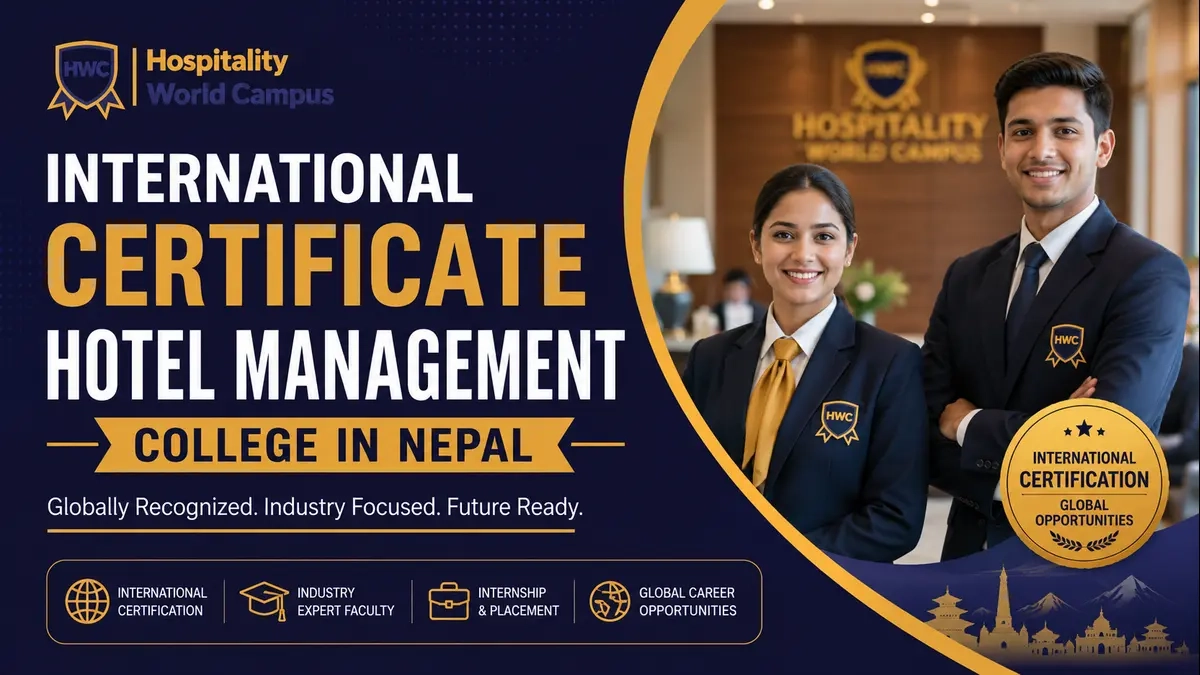
BLUF: Hospitality World Campus (HWC), based in Jawalakhel, Lalitpur, is a unit of LCCI Global Qualifications (LCCI GQ). Its hospitality diplomas are approved and quality assured by the Scottish Qualifications Authority (SQA) and benchmarked at both SCQF and EQF, which is what makes them read as an “international certificate” rather than a purely local one.
That single design choice, building the curriculum around an internationally recognized awarding body from the start, is the main reason HWC comes up so often in searches for an international certificate hotel management college in Nepal.
Programs Offered at HWC
HWC runs three core hospitality and culinary programs, all delivered from its Jawalakhel campus.
| Program | Duration | Focus |
|---|---|---|
| Diploma in Global Culinary Arts (DGCA) | 12 months | Professional kitchen operations, food production, and culinary technique |
| Diploma in Hospitality Management (DHM) | 15 months | Core hotel operations across front office, housekeeping, and food and beverage |
| Advanced Diploma in Hospitality Management (ADHM) | 21 months (15 months training + 6 months internship) | Strategic management, financial analysis, and marketing for supervisory and leadership roles |
HWC also runs shorter skills-focused courses, including a Professional Certificate in Barista and Bartending, a Certificate in Bakery, Pastry and Patisserie, and an Advanced Professional Chef Course, for students who want a specific operational skill rather than a full diploma.
International Accreditation and Benchmarking
The detail that separates HWC from a purely local diploma mill is the accreditation chain behind it. As a unit of LCCI GQ, its hospitality programs are approved and quality assured by the Scottish Qualifications Authority in Scotland, and the credit value is benchmarked at both the Scottish Credit and Qualifications Framework and the European Qualifications Framework. For a prospective student, this means the diploma is not just “internationally themed,” it is formally credit-rated against a recognized framework that foreign institutions already use to evaluate incoming students.
Credit Transfer to Universities Abroad
HWC’s diploma structure is built so that graduates with 10+2 completed can pursue lateral entry into a bachelor’s degree at partner universities and colleges abroad, subject to each institution’s own entry requirements. Partner institutions in HWC’s published credit transfer list include Perth College UHI in Scotland, the University of Galway in Ireland, the Southern Institute of Technology in New Zealand, and Ritsumeikan Asia Pacific University in Japan, among others.
This is the practical payoff of the SQA/SCQF/EQF benchmarking discussed above. Instead of applying abroad and hoping a foreign admissions officer recognizes a Nepali diploma, HWC students are applying with a credit value the receiving institution can map directly.
Mentoring, Class Sizes, and Student Experience
HWC runs a mentoring system where each student is assigned a mentor for individual monthly check-ins, paired with intentionally small class sizes and a low teacher-to-student ratio. For hospitality training specifically, where a large share of the learning happens hands-on in a kitchen or a simulated front desk, class size has a direct impact on how much practical time each student actually gets.
Eligibility and Admission
Admission requirements are consistent across HWC’s diploma programs.
- Minimum SEE/SLC grade of D+ (GPA 1.6), including at least D+ (GPA 1.6) in English
- Minimum age of 17
- Students who have completed +2 in any stream are better positioned for a university pathway abroad after graduation
Students should confirm current intake dates, seat availability, and fee structure directly with HWC, since these details are updated regularly.
How HWC Compares to Other Hotel Management Colleges in Nepal
BLUF: Nepal’s hospitality education market splits into two lanes: university-affiliated bachelor’s degree colleges (NATHM, GATE, Mid Valley) and international diploma/certificate colleges (HWC, and to a similar extent Royal International College). If your priority is a fast, internationally benchmarked certificate with a clear abroad pathway, the diploma lane, where HWC sits, is built for exactly that.
| College | Location | Certifying / Affiliating Body | Program Type | Typical Duration |
|---|---|---|---|---|
| Hospitality World Campus (HWC) | Jawalakhel, Lalitpur | LCCI GQ, approved by SQA Scotland, benchmarked at SCQF/EQF | International diploma (DGCA, DHM, ADHM) | 12 to 21 months |
| NATHM | Ravi Bhawan, Kathmandu (govt.) | Tribhuvan University | Bachelor’s (BHM, BTTM) and Master’s (MHM) | 4 years (bachelor’s) |
| GATE | Budhanilkantha, Kathmandu | Kathmandu University affiliation; Swiss Hotel Association and EHL-certified school network | Bachelor’s (BIHM, BPH) and diploma-level programs | 3 to 4 years |
| Mid Valley International College | Gyaneshwor, Kathmandu | HELP University (Malaysia) affiliation; approved by the Ministry of Education, Science and Technology | Bachelor’s (BBHM Hons) | Typically 3 to 4 years |
| Royal International College of Hotel Management | Narayangarh, Chitwan | LCCI GQ, accredited by SQA; CTEVT for short courses | International diploma (ADHM, DHM, DGCA) | 12 to 21 months |
NATHM (Nepal Academy of Tourism and Hotel Management)
NATHM is Nepal’s oldest and largest public hospitality institution, established in 1972 and affiliated with Tribhuvan University. Its BHM and BTTM are four-year, eight-semester bachelor’s degrees with a competitive entrance exam and a strong reputation, particularly for students who want a full Nepali university degree and are comfortable with a four-year timeline and government admission process.
GATE (Global Academy of Tourism and Hospitality Education)
GATE positions itself around the Swiss hospitality model, with an affiliation to the Swiss Hotel Association and membership in the EHL-certified school network. Its Bachelor’s in International Hospitality Management is a four-year, Kathmandu University-affiliated degree that blends operational internships with management coursework, aimed at students who want a full bachelor’s degree with a Swiss-influenced curriculum.
Mid Valley International College
Mid Valley offers a Bachelor of Business in Hospitality Management (Hons), affiliated with Malaysia’s HELP University and approved by Nepal’s Ministry of Education, Science and Technology. It is another university-affiliated bachelor’s route, based in Gyaneshwor, Kathmandu.
Royal International College of Hotel Management (RICHM)
RICHM, based in Chitwan, runs a very similar model to HWC: ADHM, DHM, and DGCA diplomas delivered under LCCI GQ and accredited by SQA, alongside CTEVT-monitored short courses. For students specifically outside the Kathmandu Valley, this is the closest comparison to HWC’s certificate structure, and the main differentiators between the two come down to campus location, mentoring model, and the specific list of international credit transfer partners each college has arranged.
Directory and Listing Sites
Sites such as collegesnepal.com and collegenp.com are not colleges themselves. They are directories that aggregate listings for many institutions, including several named above. They are useful for browsing options, but any accreditation or certification claims should always be confirmed on the college’s own official website.
International Certificate vs Bachelor’s Degree: Which Path Fits You?
BLUF: Choose an international certificate diploma if you want to start working or transfer abroad within 12 to 21 months. Choose a Nepali university bachelor’s degree if you want a four-year degree, are not in a hurry, and are comfortable with that country’s equivalency process if you move abroad later.
| Your Priority | Better Fit |
|---|---|
| Fastest route to a recognized qualification | International certificate/diploma (HWC, RICHM) |
| Direct credit transfer to a foreign university with lateral entry | International certificate/diploma benchmarked at SCQF/EQF |
| Full four-year bachelor’s degree recognized within Nepal’s higher education system | NATHM, GATE, Mid Valley |
| Want to work in Nepal’s government tourism sector | NATHM (public, TU-affiliated) |
| Prefer a Swiss hospitality management model | GATE |
| Want small class sizes with individual mentoring | HWC |
Some students combine both: complete a 12 to 21 month international diploma first, then use the credit transfer pathway to enter the second or third year of a bachelor’s degree abroad, effectively finishing a full degree faster than starting a four-year program from scratch.
Career Opportunities After an International Certificate in Hotel Management
BLUF: Graduates of internationally certified hospitality diplomas typically move into operational roles first, such as front office, food and beverage service, housekeeping supervision, or kitchen production, with a clear track toward department-level management as experience builds.
Common entry points for diploma graduates include:
- Front office and guest services, progressing toward front office supervisor or duty manager
- Food and beverage service, progressing toward restaurant or outlet supervisor
- Culinary and kitchen production, progressing from commis chef toward chef de partie and beyond
- Housekeeping operations, progressing toward executive housekeeper
- Hotel administration and events, particularly for ADHM graduates whose curriculum includes strategic management, financial analysis, and marketing
Because HWC’s ADHM includes a structured six-month internship, many students gain their first supervised industry placement before graduation, which is often the deciding factor employers look for when hiring for a first management-track role.
Cost, Duration, and Return on Investment
BLUF: International diploma programs like HWC’s are shorter than a bachelor’s degree (12 to 21 months versus 3 to 4 years), which typically means lower total tuition outlay and a faster entry into paid work, though total lifetime earning potential should also weigh in whether a full bachelor’s degree adds more value for your specific career goal.
Duration is the clearest, most verifiable difference between the two tracks:
- HWC’s DGCA: 12 months
- HWC’s DHM: 15 months
- HWC’s ADHM: 21 months (15 months training plus 6 months internship)
- NATHM’s BHM/BTTM: 4 years (8 semesters)
- GATE’s BIHM: 4 years
- Mid Valley’s BBHM (Hons): typically 3 to 4 years
Because tuition, hostel, and living costs change from year to year and vary by intake, prospective students should request a current fee breakdown directly from each college rather than relying on older published figures.
How to Choose the Right Hotel Management College in Nepal
BLUF: Verify four things before enrolling anywhere: who actually certifies the qualification, how long the program takes, what the credit transfer options are, and how much hands-on practical training is built into the curriculum.
Use this checklist when comparing colleges:
- Certifying body: Is the diploma approved by a named international body (SQA, LCCI GQ), or is it only a local certificate?
- Credit framework: Is it benchmarked against SCQF, EQF, or an equivalent recognized framework?
- Duration and structure: Does the timeline match your goals, a fast diploma or a full bachelor’s degree?
- Internship component: Is practical, supervised industry placement built into the program, not just optional?
- Class size and mentoring: How much individual attention will you actually get in kitchen and operations training?
- Credit transfer partners: Does the college have a published, named list of partner universities abroad?
- Location: Kathmandu Valley colleges generally offer more industry partnership and internship density; consider your commute and living arrangements.
FAQs
1. What is an international certificate in hotel management?
It is a hospitality diploma developed, approved, or benchmarked by an international body, such as the Scottish Qualifications Authority, rather than certified only by a local institution.
2. Is HWC’s diploma recognized outside Nepal?
HWC’s hospitality diplomas are approved by SQA Scotland and benchmarked at SCQF and EQF, and the college maintains a published credit transfer list with partner universities abroad for lateral entry into bachelor’s degrees.
3. What programs does HWC offer?
HWC offers a Diploma in Global Culinary Arts (12 months), Diploma in Hospitality Management (15 months), and Advanced Diploma in Hospitality Management (21 months), plus shorter certificate courses in barista/bartending and bakery and patisserie.
4. Where is HWC located?
HWC is located in Jawalakhel, Lalitpur, in the Kathmandu Valley.
5. What is the eligibility for HWC’s diploma programs?
A minimum SEE/SLC grade of D+ (GPA 1.6) overall and in English, and a minimum age of 17.
6. How long does it take to complete a hotel management diploma in Nepal?
International diploma programs typically run 12 to 21 months, while university-affiliated bachelor’s degrees run 3 to 4 years.
7. What is the difference between a diploma and a bachelor’s degree in hotel management?
A diploma is shorter and often internationally benchmarked for direct credit transfer, while a bachelor’s degree is a full four-year Nepali university qualification.
8. Can I convert an international diploma into a bachelor’s degree later?
Yes, many diploma graduates use published credit transfer partnerships to enter the second or third year of a bachelor’s degree at a partner university abroad, subject to that institution’s entry requirements.
9. What is SQA and why does it matter for hospitality diplomas?
SQA, the Scottish Qualifications Authority, is a Scottish government body that approves and quality assures qualifications, giving a diploma a recognized international credit value.
10. What are SCQF and EQF?
SCQF is the Scottish Credit and Qualifications Framework, and EQF is the European Qualifications Framework. Both are systems used to compare and recognize qualification levels across institutions and countries.
11. Does HWC include an internship?
Yes, the Advanced Diploma in Hospitality Management includes a structured 6-month internship as part of its 21-month program.
12. What is NATHM and how is it different from HWC?
NATHM is Nepal’s public hospitality academy, offering four-year bachelor’s degrees affiliated with Tribhuvan University, in contrast to HWC’s shorter, internationally certified diploma model.
13. Is GATE’s program international as well?
GATE is affiliated with Kathmandu University for its bachelor’s degrees and holds Swiss Hotel Association and EHL-certified school network status, which is a different type of international connection focused on curriculum model rather than diploma credit benchmarking.
14. What is Royal International College of Hotel Management?
RICHM, based in Chitwan, runs diploma programs under LCCI GQ and SQA accreditation, structurally similar to HWC but located outside the Kathmandu Valley.
16. What career options are available after a hotel management diploma?
Common entry roles include front office, food and beverage service, housekeeping, and culinary production, with a path toward supervisory and management positions as experience grows.
17. Can I study hotel management in Nepal and work abroad?
Yes, especially with an internationally benchmarked diploma, since credit recognition makes it easier for foreign employers and institutions to evaluate your qualification.
18. What is the minimum qualification needed to join a hotel management diploma?
Most diploma programs, including HWC’s, require a minimum SEE grade of D+ (GPA 1.6) and a minimum age of 17.
19. What is LCCI Global Qualifications?
LCCI GQ is the organization HWC operates under as a unit, and it develops and regulates several of HWC’s hospitality qualifications, including the Advanced Diploma, Diploma, and Certificate in Hospitality Management.
20. Do I need +2 to apply for HWC’s diploma programs?
Completing +2 in any stream is not always mandatory for the diploma itself, but it strengthens the likelihood of a successful university pathway abroad after graduation.
21. What is the total duration of the ADHM program?
21 months total: 15 months of on-campus training plus a 6-month internship.
22. Is culinary arts different from hospitality management as a program?
Yes, culinary arts programs like the Diploma in Global Culinary Arts focus on professional kitchen skills and food production, while hospitality management diplomas cover front office, housekeeping, and food and beverage operations more broadly.
23. How many students does HWC typically enroll per class?
HWC maintains intentionally small class sizes with a low teacher-to-student ratio, though exact intake numbers should be confirmed directly with the college.
24. Does HWC offer a mentoring system?
Yes, each student is assigned an individual mentor for monthly one-on-one meetings throughout the program.
25. What countries can HWC students transfer credits to?
HWC’s published credit transfer partners include institutions in Scotland, Ireland, New Zealand, and Japan, among others; students should confirm the current list and specific entry requirements with HWC directly.
26. Is a diploma from Nepal valid for jobs in Gulf countries?
An internationally benchmarked diploma, quality assured by a recognized body like SQA, is generally easier for overseas employers to evaluate than a purely local certificate, though individual employer requirements vary.
27. What is the difference between DHM and ADHM at HWC?
DHM is a 15-month foundational diploma in hospitality management, while ADHM is a 21-month advanced program that adds strategic management, financial analysis, marketing, and a 6-month internship.
28. How do I contact HWC for admission details?
HWC can be reached at info@hwc.edu.np or +977 980-1185389, with its campus located in Jawalakhel, Lalitpur.
29. Is hotel management a good career choice in Nepal right now?
Nepal’s tourism and hospitality sector continues to generate demand for trained staff both domestically and for overseas placement, making structured, internationally recognized training a practical entry point into the field.
30. Should I choose a diploma or a full bachelor’s degree first?
If your priority is speed and a direct international credit pathway, an internationally certified diploma like HWC’s is typically faster. If your priority is a complete four-year Nepali university degree, a program like NATHM, GATE, or Mid Valley may fit better. Many students also use the diploma route as a stepping stone into a bachelor’s degree abroad.
If an internationally benchmarked, hands-on hospitality education is what you are looking for, Hospitality World Campus’s Jawalakhel campus offers a direct path: SQA-approved diplomas, individual mentoring, and a published credit transfer route to universities abroad. Book a free consultation with HWC to check current intake dates and find the program that fits your timeline.