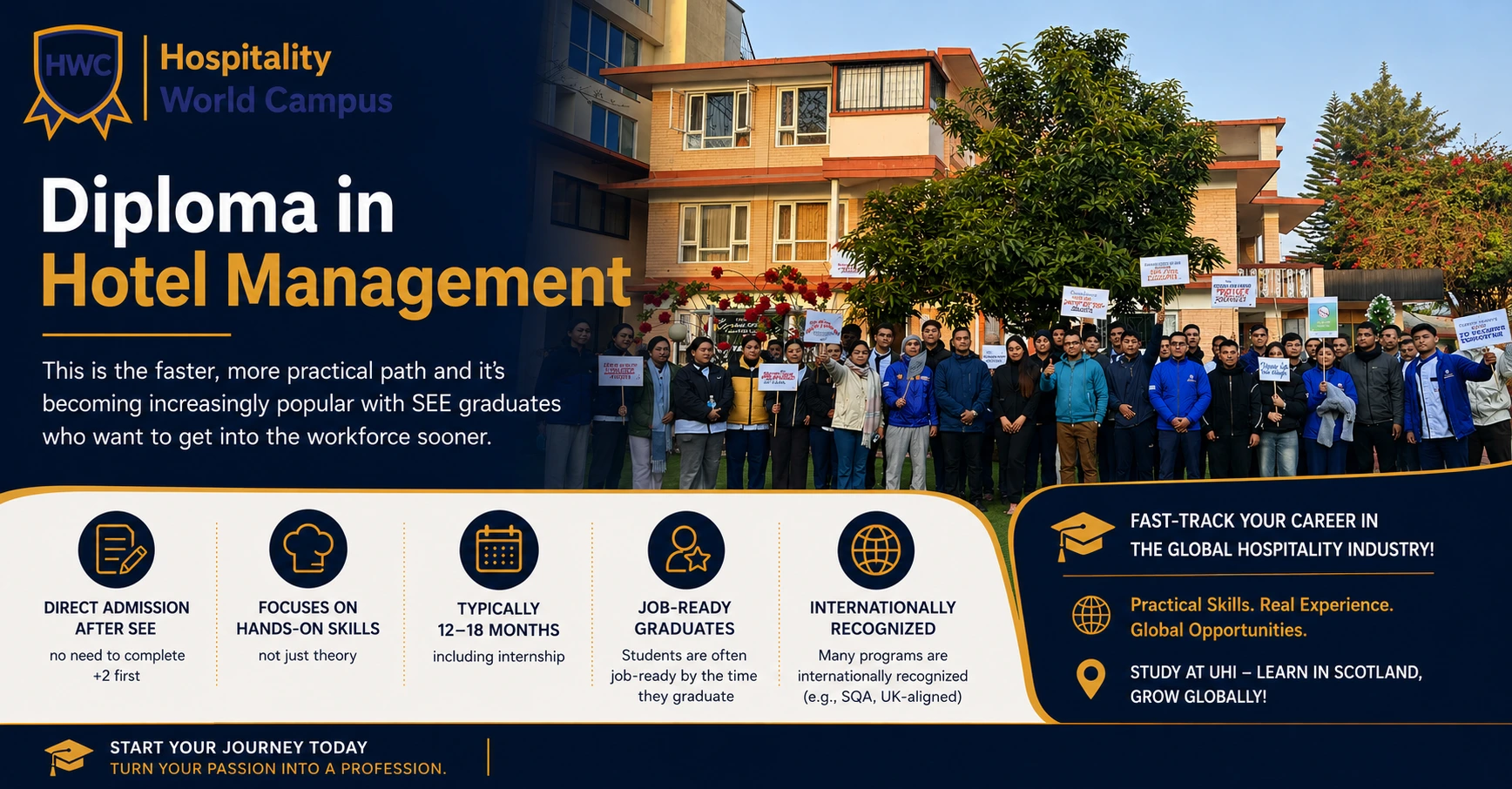
A hotel management course in Nepal typically runs from 12 months to 4 years depending on the course, like a vocational, bachelor’s degree, or short certificate.
Diplomas from institutions accredited by international bodies such as the Scottish Qualifications Authority (SQA) combine classroom training with a paid or supervised internship and industry placement, letting students start working in hotels, restaurants, and resorts in roughly a third of the time a traditional degree takes.
This guide breaks down every real option on the table in 2026: what a hotel management course actually covers, how a diploma in hotel management in Nepal compares to a full bachelor’s degree, what it costs to get in, and which route gets you working in the industry the fastest.
We will also look closely at how Hospitality World Campus (HWC) in Jawalakhel, Lalitpur structures its internationally benchmarked diploma pathway, since it represents one practical model of how a shorter, career-first hospitality education can work.
What Is a Hotel Management Course?

A hotel management course teaches the operational and managerial skills needed to run hotels, resorts, restaurants, and other hospitality businesses, covering front office, housekeeping, food and beverage, and guest service, along with supervised practical training. It exists at several levels, from a few months to four years, and each level targets a different career paths.
The subject sits inside the wider field of diploma in hospitality management, which also includes tourism, event management, and culinary arts. In Nepal, “hotel management” and “hospitality management” are often used interchangeably in casual conversation, though hospitality management is technically the broader umbrella term.
Three things separate a good hotel management course from a weak one:
- Industry-relevant curriculum that mirrors how real hotels operate, not just theory from a textbook.
- Structured practical training, ideally an internship inside a working hotel or restaurant, not a two-week observation visit.
- Recognized qualification, either through a national board or an international accrediting body, so the certificate actually means something to an employer.
Keep these three filters in mind. We will return to them throughout this guide.
Why Study Hotel Management in Nepal

Studying hotel management in Nepal makes sense for students who want international-standard training without the cost of studying abroad and who want to enter the workforce faster than a traditional degree allows. Nepal’s hospitality sector, spanning hotels, resorts, trekking lodges, restaurants, and event venues, has a steady demand for trained staff at every level, from front-line service to management.
A few practical reasons students choose to study locally instead of going abroad immediately:
- Lower cost of entry. Tuition and living costs in Kathmandu or Pokhara are a fraction of what a hospitality school in Switzerland, Australia, or the UK charges.
- Local internships that translate globally. Many Nepali hospitality colleges partner with international hotel chains and groups, so the training environment is not purely domestic.
- A stepping stone, not a dead end. Internationally benchmarked diplomas can often be used for credit transfer into a foreign university later, so studying in Nepal first does not close the door to working or studying abroad.
- Nepal’s own tourism industry needs staff. Hotels, resorts, and restaurants across the country hire hospitality graduates directly, particularly those with practical training and English communication skills.
The honest tradeoff is that not every hospitality course in Nepal is equal. Accreditation, internship structure, and mentoring quality vary widely between institutions, which is exactly why the next section matters.
Diploma vs Bachelor’s Degree in Hotel Management
A diploma in hotel management is a shorter, more practical pathway, typically 12 to 21 months, that gets you industry-ready faster, while a bachelor’s degree in hospitality management takes 3 to 4 years and suits students aiming for corporate management tracks or further postgraduate study. Neither is objectively “better,” the right choice depends on your timeline, budget, and career goal.
| Factor | Diploma in Hotel Management | Bachelor’s Degree in Hotel Management |
|---|---|---|
| Duration | 12 to 21 months | 3 to 4 years |
| Focus | Practical, operational skills | Broader theory plus operations |
| Internship | Usually built into the program | Sometimes optional or shorter |
| Entry to workforce | Fast, often within 1 to 2 years | Slower, after full degree |
| Cost over time | Generally lower total cost | Higher total cost |
| Best for | Students who want to start earning and gaining experience quickly | Students targeting corporate hospitality leadership or further academic study |
| Further study | Many diplomas allow credit transfer into a related bachelor’s | Direct route to a master’s degree |
Neither path is inherently superior. A diploma with an internationally benchmarked qualification and a real internship can put a graduate into paid work almost two years before a degree student even finishes coursework. On the other hand, a bachelor’s degree can be the stronger choice for someone specifically targeting a corporate management role in a large international hotel chain from day one.
If your priority is speed to employment and hands-on skill, a diploma pathway with a structured internship usually wins. If your priority is a traditional academic credential for corporate or government-track roles, a degree may fit better.
Types of Hotel Management Courses Available in Nepal

Nepal’s hospitality education market offers several distinct course types, and reasonable students should know all of them before committing.
Certificate Courses (3 to 12 months)
Short, skill-specific programs such as barista training, bakery and pastry certificates, or basic front office courses. These suit students who want a narrow skill fast, or who want to test the industry before committing to a longer program.
Diploma Courses (12 to 24 months)
The most common route for students who want a genuine career start without a four-year commitment. Diplomas typically combine classroom training with a supervised internship inside a working hotel, restaurant, or resort. Look for diplomas benchmarked against an international framework, since this affects how the qualification is recognized outside Nepal.
Advanced Diploma Courses (18 to 24 months)
Positioned between a standard diploma and a full degree, advanced diplomas go deeper into management topics such as financial analysis, strategic operations, and marketing, while keeping a practical internship component.
Bachelor’s Degree in Hotel Management or Hospitality Management (3 to 4 years)
Offered through universities and affiliated colleges, this is the traditional academic route, usually including a mix of general education, hospitality theory, and a practicum or internship semester.
Culinary Arts Diplomas
Not strictly hotel management, but closely related and commonly offered alongside it. A culinary diploma trains students specifically in kitchen operations, food production, and culinary techniques, feeding into chef and food and beverage career paths within the same hotels and restaurants.
Here is a quick visual summary of how these fit together on a timeline:
| Course Type | Typical Duration | Entry Point | Outcome |
|---|---|---|---|
| Certificate | 3 to 12 months | After SEE or +2 | Entry-level skilled role |
| Diploma | 12 to 21 months | After SEE or +2 | Supervisory or specialist role |
| Advanced Diploma | 18 to 24 months | After SEE or +2, or after a diploma | Management-track role |
| Bachelor’s Degree | 3 to 4 years | After +2 | Management or further study |
Hotel Management Course at Hospitality World Campus (HWC)

Hospitality World Campus (HWC), located in Jawalakhel, Lalitpur, offers internationally benchmarked hotel and hospitality management diplomas, quality assured by the Scottish Qualifications Authority (SQA) and mapped to the Scottish Credit and Qualifications Framework (SCQF) and the European Qualifications Framework (EQF), combined with a built-in industry internship, personalized mentoring, and structured career support.
HWC is a unit of LCCI GQ, an internationally recognized organization in professional and management skills training. Since 2022, HWC has trained students from across Nepal across its hospitality and culinary programs. What makes HWC’s model worth examining closely is that it is built specifically around the diploma-plus-internship approach discussed above, rather than a purely classroom-based degree structure.
The core idea behind HWC’s pathway can be summarized as a single career funnel:
Learn → Practice → Intern → Build Experience → Get Career Support → Work → Progress
Each stage is deliberately built into the program structure rather than left to chance.
International Accreditation: What SQA, SCQF, and EQF Actually Mean
HWC’s hospitality programs are quality assured by the Scottish Qualifications Authority (SQA), Scotland’s national accrediting body for vocational and professional qualifications, and benchmarked to the Scottish Credit and Qualifications Framework (SCQF) and the European Qualifications Framework (EQF). In plain terms, this means the diploma is not just a locally issued certificate. It is mapped against an internationally recognized credit and qualifications standard, which matters if a graduate later wants to transfer credit into a university abroad or explain their qualification level to an international employer.
This accreditation structure is the backbone of what makes HWC’s diploma an “internationally benchmarked qualification” rather than a purely domestic certificate, and it directly supports credit transfer pathways, which HWC addresses through its dedicated Credit Transfer guidance for students planning further study overseas.
Course Options and Duration
HWC offers a small, focused set of programs rather than a sprawling course catalogue, which keeps the curriculum tight and industry aligned. The full list is available on the Courses page.
| Program | Duration | Structure |
|---|---|---|
| Diploma in Global Culinary Arts (DGCA) | 12 months | Culinary training with practical kitchen work |
| Diploma in Hospitality Management (DHM) | 15 months | 9 months training + 6 months internship |
| Advanced Diploma in Hospitality Management (ADHM) | 21 months | 15 months training + 6 months internship |
| Professional Chef Course – Advanced | Shorter certificate track | Kitchen and culinary skill focus |
| Professional Certificate in Barista and Bartending | Shorter certificate track | Beverage service specialization |
| Certificate in Bakery, Pastry & Patisserie | Shorter certificate track | Bakery and pastry specialization |
Compare this to a standard 3 to 4-year hospitality degree, and the time advantage is obvious. A student can complete the Diploma in Hospitality Management, including a full six-month internship inside an actual hotel or restaurant, in the same amount of time it takes a degree student to finish their first academic year.
Practical Training and Personalized Mentoring
HWC structures its education around small class sizes and a low teacher-to-student ratio, so lecturers can give individual attention and flag concerns directly to the Academic Director or mentor. Each student is also assigned a personal mentor who meets with them individually once a month, a system designed to treat each student as an individual with specific needs rather than as one face in a large lecture hall.
This matters more than it sounds. Hospitality is a service industry built on soft skills, communication, composure under pressure, and attention to detail, none of which are effectively taught through large lecture-style teaching alone. Small classes and regular mentoring sessions are structural choices that support this kind of skill development.
Industry Internship and Placement Support
Every HWC diploma program includes a structured internship as part of the course, not as an optional add-on. The Internship & Industry Placement page outlines how students move from classroom training directly into supervised placements with industry partners.
This built-in internship is the mechanism that turns a diploma into a genuine head start. Students graduate not only with a qualification, but with real, documented hospitality work experience on their resume, something a purely academic degree program often cannot offer until much later, if at all.
HWC also documents real outcomes through its Career Paths resource and Success Stories, including graduates who have gone on to roles such as Commis Chef and Commis positions at hotels and restaurants both in Nepal and abroad.
Eligibility Criteria
Entry requirements are kept accessible so students can start straight after school rather than waiting through additional years of general education:
- Minimum SEE/SLC result of D+ (GPA 1.6), including at least D+ (GPA 1.6) in English
- Minimum age of 17 years
- For the Advanced Diploma, students who have completed secondary education in any stream have a stronger chance of progressing into a university pathway abroad afterward
This is one of the practical advantages of the diploma route: a student does not need to complete +2 first to begin. They can start immediately after SEE, which shaves additional time off the total path to employment compared to a bachelor’s degree that requires +2 as a prerequisite.
What You Actually Learn: Curriculum Breakdown
A well-built hotel management course covers front office operations, housekeeping, food and beverage service, event basics, hospitality communication, and increasingly, digital tools used in modern hotel management, all reinforced through hands-on practice rather than lecture alone.
Regardless of which institution you choose, a credible hotel management curriculum should cover these core areas:
- Front office operations: reservations, check-in and check-out procedures, guest relations, and handling complaints professionally.
- Housekeeping management: room standards, inventory control, and hygiene protocols.
- Food and beverage service: table service standards, menu knowledge, and beverage service including barista and bartending basics.
- Kitchen and culinary fundamentals: for hospitality management students, a working understanding of kitchen operations even if they are not training as chefs.
- Hospitality communication and guest psychology: how to read guest needs, de-escalate complaints, and represent a brand professionally.
- Basic financial and operations management: budgeting, cost control, and understanding profit margins within a hospitality business.
- Technology in hospitality: property management systems, booking platforms, and point-of-sale tools, which are now standard in most hotels and restaurants.
Programs that also include a structured internship reinforce every one of these topics with supervised, real-world application, which is where classroom knowledge actually becomes usable skill.
It is worth noting what a strong curriculum deliberately avoids as well. Courses that spend most of their time on theory-heavy lectures, with little kitchen time, no mock front desk practice, and no direct exposure to guest interaction scenarios, tend to produce graduates who understand hospitality concepts on paper but freeze the first time they face an actual guest complaint. When comparing course outlines, ask specifically how many hours are allocated to hands-on practice versus classroom lecture, and whether assessments include practical, scenario-based evaluation rather than written exams alone.
Career Paths After a Hotel Management Course
After completing a hotel management course in Nepal, graduates typically start in entry-level operational roles such as front office assistant, housekeeping supervisor, food and beverage service staff, or commis chef, and progress into supervisory and management positions such as duty manager, department head, or hotel operations manager as they gain experience.
Career progression in hospitality is usually linear and experience-driven, meaning your qualification gets you in the door, but consistent, well-supervised experience is what moves you up.
Entry-level roles (0 to 2 years):
- Front office assistant or receptionist
- Food and beverage service staff
- Commis chef or kitchen assistant
- Housekeeping attendant
- Barista or bartender
Mid-level roles (2 to 5 years):
- Duty manager
- Front office supervisor
- Chef de partie
- Food and beverage supervisor
- Housekeeping supervisor
Senior roles (5+ years, often with further study or an advanced diploma):
- Department head (front office, F&B, housekeeping)
- Hotel operations manager
- Executive chef
- General manager (typically requires years of proven experience plus advanced qualifications)
Graduates from internationally benchmarked diploma programs also have the option to pursue credit transfer into a related bachelor’s or even master’s program abroad, using the qualification as a stepping stone rather than an end point. This is precisely the funnel structure that a well-designed hospitality diploma is built around: learn the fundamentals, practice them under supervision, intern inside a real operation, build a track record of experience, receive structured career support, move into paid work, and progress from there into more senior roles or further study.
Hotel Management Course Fees in Nepal
Course fees for hotel management programs in Nepal vary significantly depending on the institution, course length, accreditation, and whether the program includes a paid or unpaid internship component. As a general pattern, certificate courses are the least expensive, standard diplomas sit in the middle, and full bachelor’s degrees carry the highest total cost due to their length.
Rather than quote unverified figures, the most reliable approach is:
- Shortlist two or three accredited institutions.
- Request a detailed fee breakdown that separates tuition, internship-related costs, and any accreditation or exam fees.
- Ask specifically whether the internship is paid, unpaid, or partially compensated, since this materially affects the real cost of the program.
- Compare the total cost against the program duration to understand cost per month of training, not just the headline fee.
For accurate, current fee details for a specific program, contact HWC directly or consult the institution’s admissions office, since fees can change between intakes.
How to Choose the Right Hotel Management College
Choose a hotel management college based on four factors: recognized accreditation, a genuine built-in internship, small class sizes with mentoring, and a track record of graduate placement, in that order of priority.
Use this checklist when comparing colleges:
- Accreditation: Is the qualification recognized by a credible national or international body? Ask specifically which framework it is benchmarked against.
- Internship structure: Is the internship built into the course timeline, or is it an optional extra that students have to arrange themselves?
- Class size and mentoring: Will you get individual attention, or are you one of 80 students in a lecture hall?
- Industry partnerships: Does the college have documented relationships with hotels, restaurants, and resorts where students actually intern?
- Graduate outcomes: Can the college show real examples of where past graduates are working now?
- Eligibility fit: Does the entry requirement match your current academic level, so you are not delayed unnecessarily?
- Location and facilities: Is the campus accessible, and does it have practical training spaces such as a working kitchen or mock front office?
A college that can answer all seven points clearly, with specifics rather than vague marketing language, is worth shortlisting seriously.
Nepal’s Hospitality Job Market: What the Industry Actually Looks Like
Nepal’s hospitality sector spans international hotel chains in Kathmandu and Pokhara, boutique resorts near trekking and tourism hubs, and a growing restaurant and cafe scene, all of which regularly hire trained staff, making practical skills and internship experience more valuable to employers than a certificate alone.
Understanding the shape of the industry helps explain why the internship component of a course matters as much as the classroom content.
Where hospitality graduates typically find work in Nepal:
- International and branded hotels in Kathmandu, Pokhara, and other major tourism centers, which often look for candidates with structured training and some exposure to international service standards.
- Independent hotels and resorts, particularly in tourism corridors such as Pokhara, Chitwan, and the Everest and Annapurna trekking regions, where practical, hands-on skills matter more than academic pedigree.
- Restaurants, cafes, and bars in urban centers, an increasingly competitive space that rewards strong food and beverage service training, including barista and bartending skills.
- Event management and catering companies, which draw on the same front-of-house and service skills taught in a hospitality diploma.
- International placements, since Nepali hospitality graduates with recognized qualifications and internship experience are frequently hired by hotels and cruise lines abroad, particularly in the Gulf, Europe, and parts of Asia.
This is also why an internship is not a formality. Hiring managers in hospitality consistently value demonstrated, supervised experience over a certificate alone, because the job itself is built on real-time guest interaction, something no exam can fully test. A graduate who has spent six months inside an actual hotel, handling real guests under real pressure, walks into an interview with a fundamentally different story than a graduate who has only studied theory.
This same logic explains why credit transfer options matter for ambitious students. A graduate who completes a diploma, builds a track record through an internship, and later transfers credit into a university abroad is following a well-worn and increasingly common pathway, entering the workforce early while keeping the option of further international study open.
Mistakes to Avoid When Picking a Course
Even motivated students commonly make a handful of avoidable mistakes when choosing a hotel management course:
- Choosing based on price alone. The cheapest course is not a good deal if it has no internship and no recognized accreditation.
- Ignoring the internship fine print. “Internship included” can mean very different things. Ask exactly how many months, whether it is supervised, and where placements typically happen.
- Assuming a degree is always better than a diploma. For students who want to start working quickly, a well-structured diploma with a real internship can outperform a degree on time-to-employment.
- Not checking English language requirements early. Since hospitality is guest-facing, weak English communication skills can limit both admission and later job placement, so it is worth strengthening this before enrolling.
- Skipping a campus visit or consultation. Marketing pages look similar across colleges. A direct consultation or campus visit reveals a lot about class size, mentoring quality, and facilities that a website cannot fully show.
FAQ
1. What is a hotel management course?
A hotel management course is a structured education program that trains students in hotel and hospitality operations, including front office, housekeeping, food and beverage service, and guest management, usually combined with practical or internship training.
2. How long is a hotel management course in Nepal?
Duration ranges widely: certificate courses run 3 to 12 months, diplomas typically run 12 to 21 months, and bachelor’s degrees take 3 to 4 years.
3. Is a diploma in hotel management valid for jobs abroad?
A diploma benchmarked against an international framework, such as the Scottish Credit and Qualifications Framework (SCQF) or the European Qualifications Framework (EQF), carries international recognition and can support both employment and credit transfer applications abroad, though specific recognition always depends on the destination country’s requirements.
4. What is the eligibility for a hotel management course after SEE in Nepal?
Most diploma programs require a minimum SEE result of D+ (GPA 1.6), including at least D+ in English, and a minimum age of around 17 years, though exact requirements vary by institution.
5. Can I join a hotel management diploma without completing +2?
Yes. Many diploma programs, including HWC’s Diploma in Hospitality Management, accept students directly after SEE, without requiring +2 completion first.
6. What is the difference between hotel management and hospitality management?
Hotel management focuses specifically on hotel operations, while hospitality management is a broader field that also includes tourism, event management, and food service businesses beyond hotels.
7. Which is better, a diploma or a bachelor’s degree in hotel management?
Neither is universally better. A diploma is faster and more practical, suited to students who want to start working quickly, while a bachelor’s degree suits students targeting corporate leadership tracks or further academic study.
8. Does a hotel management course include an internship?
Quality programs do include a structured internship. For example, HWC’s Diploma in Hospitality Management includes 9 months of training followed by 6 months of internship as part of the 15-month program.
9. What jobs can I get after a hotel management course?
Common entry-level roles include front office assistant, food and beverage service staff, commis chef, housekeeping attendant, and barista or bartender, with progression toward supervisory and management roles over time.
10. What is SQA accreditation and why does it matter?
The Scottish Qualifications Authority (SQA) is Scotland’s national body for quality-assuring vocational and professional qualifications. A program quality assured by SQA and benchmarked to SCQF and EQF carries international credibility beyond a purely local certificate.
11. How much does a hotel management course cost in Nepal?
Fees vary by institution, course length, and internship structure. It is best to request a detailed fee breakdown directly from shortlisted colleges rather than rely on general estimates.
12. Is hotel management a good career in Nepal?
Hotel management remains a viable career path in Nepal given the country’s tourism industry, with consistent demand for trained staff in hotels, resorts, and restaurants across the country, and opportunities to work internationally with the right qualifications and experience.
13. What subjects are taught in a hotel management course?
Core subjects typically include front office operations, housekeeping, food and beverage service, culinary fundamentals, hospitality communication, basic financial management, and hospitality technology systems.
14. Can I study hotel management and culinary arts together?
Some institutions offer separate but related tracks, such as a Diploma in Hospitality Management alongside a Diploma in Global Culinary Arts, letting students choose the specialization that fits their interest, whether that is operations and management or kitchen and food production.
15. What is the age requirement for hotel management courses in Nepal?
Most diploma programs require a minimum age of 17 years at the time of enrollment.
16. Do hotel management colleges in Nepal offer mentoring or personal support?
Some institutions structure their programs around small class sizes and individual mentoring. HWC, for example, assigns each student a personal mentor for monthly one-on-one meetings.
17. What is an Advanced Diploma in Hospitality Management?
An Advanced Diploma in Hospitality Management is an extended qualification, often around 21 months, that goes deeper into management topics such as strategic operations, financial analysis, and marketing, compared to a standard diploma.
18. Can I transfer credits from a Nepali hotel management diploma to study abroad?
Diplomas benchmarked against international frameworks can support credit transfer into related bachelor’s programs abroad, though this depends on the receiving university’s specific policies and the exact accreditation of the Nepali qualification.
19. How do I choose the best hotel management college in Nepal?
Prioritize recognized accreditation, a genuine built-in internship, small class sizes with mentoring support, documented industry partnerships, and evidence of where past graduates are currently working.
20. Where is Hospitality World Campus (HWC) located?
HWC is located in Jawalakhel, Lalitpur, within the Kathmandu Valley.
Call to Action
If a shorter, practical, internationally benchmarked path into hospitality sounds like the right fit for you, the next step is simple: talk to someone who can walk you through eligibility, course structure, and internship placements in detail. Book a free consultation with HWC or explore the full course list to see which diploma matches your goals.