
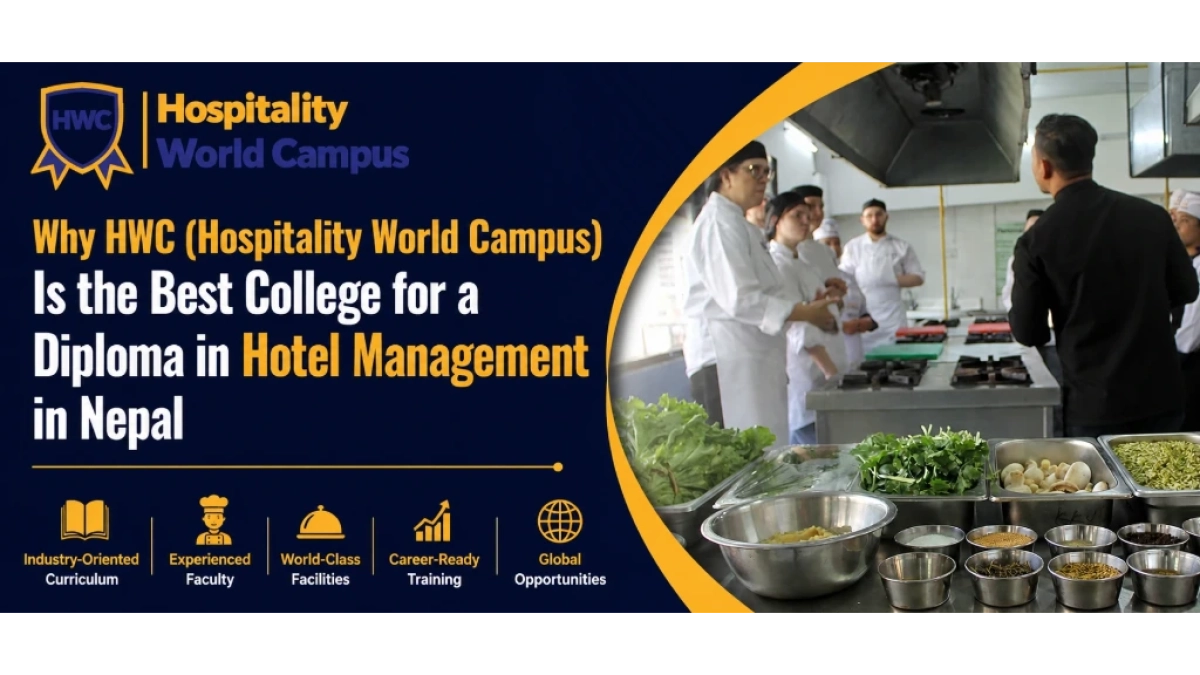
Choosing a diploma in hotel management in Nepal is about more than picking a classroom. It is about choosing where your career begins. Hospitality World Campus (HWC) offers an internationally benchmarked qualification built to take you from classroom learning to hospitality employment and further study.
Instead of stopping at theory, HWC follows a clear pathway: you learn the fundamentals, practice them in hands-on training, intern in real workplaces, build experience that employers value, receive career support, work in the industry, and progress into higher roles or further education. This shorter, career-focused route combines practical training with structured industry experience, so you graduate with skills, confidence, and a place to start, not just a certificate.
Nepal’s hospitality sector is growing faster than ever. With tourism returning strongly post-pandemic, international hotel brands expanding into Kathmandu and Pokhara, and Nepali professionals landing jobs at world-class properties across the Middle East, UK, Australia, and Southeast Asia, the demand for genuinely trained hospitality graduates has never been higher.
But here’s the problem most students face: not every hospitality college in Nepal actually prepares you for the real world. Many offer textbook education with little industry exposure, outdated curricula, and no real placement support. Choosing the wrong college can cost you years of your career path.
That’s exactly why Hospitality World Campus (HWC), located in Jawalakhel, Lalitpur, has become the name students and industry professionals trust. In this article, we’ll break down with facts, not fluff, why HWC stands apart as Nepal’s leading institution for a Diploma in Hospitality Management.
What Is Hospitality World Campus (HWC)?
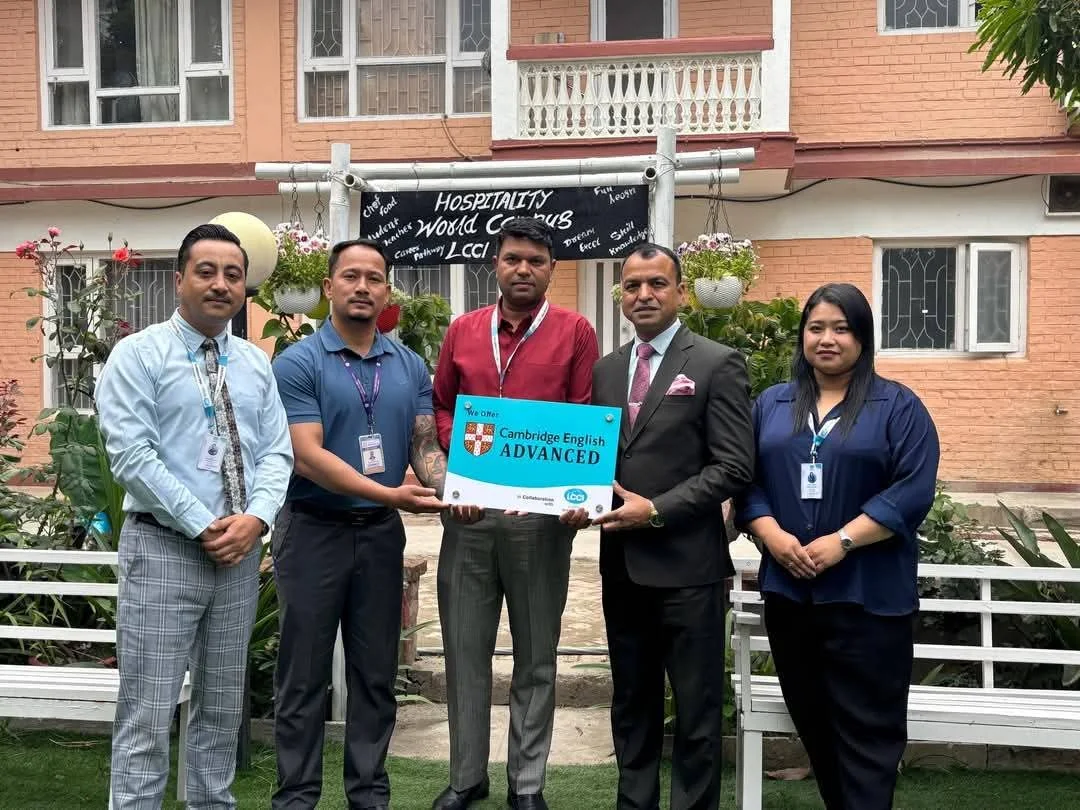
About Us: Hospitality World Campus (HWC) is a specialized hospitality and culinary arts education institution located at Jawalakhel, Lalitpur, Nepal. It operates as a unit of LCCI GQ, an internationally award-winning organization recognized for excellence in soft skills and management training.
What makes HWC different from the moment you walk through the door is this: it is not a general college that happens to offer a hotel management course. It is a hospitality-first campus built from the ground up to mirror the environment, standards, and expectations of the global hospitality industry.
Every program at HWC is approved and quality-assured by the Scottish Qualifications Authority (SQA), Scotland, and benchmarked at both the Scottish Credit and Qualifications Framework (SCQF) and the European Qualifications Framework (EQF). This means your diploma isn’t just a Nepali credential it is internationally recognised and globally competitive.
HWC at a Glance
| Feature | Detail |
|---|---|
| Full Name | Hospitality World Campus (HWC) |
| Location | Jawalakhel, Lalitpur, Nepal |
| Parent Organisation | LCCI GQ (Award-Winning) |
| Accrediting Body | Scottish Qualifications Authority (SQA) |
| International Benchmarks | SCQF (Scotland) + EQF (Europe) |
| Focus | Hospitality & Culinary Arts Education |
| Internship | Guaranteed, built into every program |
| Industry Partners | Ritz-Carlton, Burj Al Arab, JW Marriott, Hyatt Regency & more |
Why Choosing the Right Hotel Management College Matters
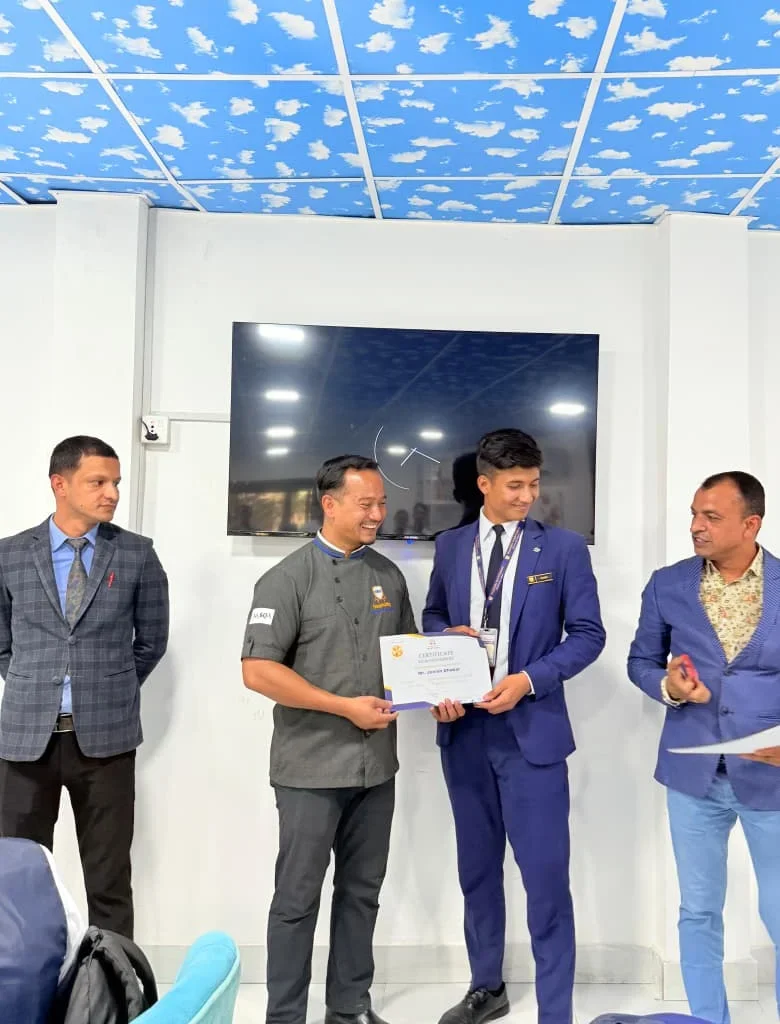
Before we go deeper into HWC, let’s address something important: why does it matter where you study hotel management in Nepal?
The hospitality industry is built entirely on skills, attitude, and exposure not just certificates. A diploma holder from a college with weak training facilities, no industry connections, and zero internship pipeline will struggle to compete with graduates who have trained in real kitchens, served real guests, and interned at five-star properties.
Here’s what the right college changes for you:
Career trajectory.
The hotels and restaurants that hire from well-regarded institutions offer better starting roles, faster promotions, and higher salaries.
Global mobility.
Nepal’s hospitality talent is in demand internationally, but only if your credentials are recognized abroad. SQA-backed qualifications open doors in the UK, Middle East, Australia, and beyond.
Confidence.
Practical training builds real confidence. Students who have worked in mock hotel environments and actual internship placements arrive at their first job ready to perform, not learning from scratch.
Entrepreneurship.
Many hospitality graduates eventually open their own cafés, catering businesses, or restaurants. The right education builds the business sense to make that work.
This is precisely the gap HWC was designed to fill.
Top Reasons Why HWC Is Considered the Best Diploma in Hotel Management College in Nepal

1. Internationally Accredited Curriculum – Backed by SQA, Scotland
This is the single biggest differentiator for HWC, and it’s worth understanding fully.
Most hotel management colleges in Nepal operate under local affiliations. HWC’s programs are quality-assured by the Scottish Qualifications Authority (SQA) one of the most respected educational accreditation bodies in the world and benchmarked against the SCQF and EQF frameworks.
What this means for you as a student:
- Your diploma is internationally recognized in the UK, European Union, and countries that accept EQF-benchmarked qualifications.
- You can pursue credit transfer to bachelor’s degree programs at universities in the UK, Ireland, Australia, New Zealand, Japan, Malaysia, and other countries.
- Employers at international hotel brands immediately understand the quality standard your qualification represents.
No other hospitality college in Nepal currently offers this level of international certification credibility.
2. Guaranteed Industry Internship Built Into Every Program

HWC doesn’t treat internships as an optional extra. They are a structured, guaranteed component of every diploma program.
Internship is woven into the curriculum from the start because HWC’s philosophy is clear: industry experience is not supplemental; it is central. Students are introduced to future employers and placed into real hospitality roles as early as possible.
Here’s how each program structures the practical component:
| Program | Total Duration | Training | Internship |
|---|---|---|---|
| Diploma in Global Culinary Arts (DGCA) | 12 Months | 6 Months | 6 Months |
| Diploma in Hospitality Management (DHM) | 15 Months | 9 Months | 6 Months |
| Advanced Diploma in Hospitality Management (ADHM) | 21 Months | 15 Months | 6 Months |
Students can work in part-time or full-time roles with HWC’s industry partners spanning restaurants, hotels, event venues, and catering companies. Crucially, these are real jobs with real employers, not simulated work experience.
3. Elite Global Placement Network

HWC’s industry placement network is what truly sets it apart in Nepal’s hospitality education landscape. The list of partner institutions for internships and placements includes some of the most prestigious names in global hospitality:
Middle East & Gulf: Raffles Doha · The Ritz-Carlton · Mondrian Doha · dusitD2 Salwa Doha · Jumeirah Beach Hotel · Burj Al Arab · Jumeirah Al Qasr · Shangri-La Hotel · Fairmont The Palm · Al Messila
United Kingdom: The Glasshouse Edinburgh · Marine North Berwick · The Gleneagles Hotel · Mar Hall Hotel · Montcalm Royal London House · The Grand · The Kensington · Pan Pacific London · Sea Containers London · The Torridon
Australia & Asia-Pacific: Park Hyatt Sydney · Meriton Suites Broadbeach · Niramaya Villas and Spa
Nepal: JW Marriott · Ramada · Crowne Plaza · Aloft · Hyatt Regency · Vivanta · Radisson Hotel
Interning at the Burj Al Arab or The Gleneagles Hotel as a Nepali hospitality student is not a dream — at HWC, it is a structured pathway. These are the kinds of internships that transform a CV and accelerate an entire career.
4. Credit Transfer to Top Universities Worldwide
One of the most underappreciated advantages of studying at HWC is the credit transfer opportunity. Because HWC programs are SCQF and EQF benchmarked, graduates who have also completed 10+2 (Higher Secondary Education) can apply for lateral entry into bachelor’s degree programs at universities across multiple countries.
This means your HWC diploma can be the first step on a pathway to a full international degree without starting from scratch.
5. Career Paths That Span the Globe
HWC graduates are not limited to hotel front desks in Kathmandu. The career paths available after an HWC diploma span an extraordinary range of industries and roles:
- Hotels & Resorts: Front Office Executive, Guest Relations Officer, Hotel Supervisor, Food & Beverage Supervisor, Housekeeping Manager
- Restaurants & Cafés: Restaurant Manager, Head Chef, Pastry Chef, Barista, Bartender
- Events Industry: Event Manager, Banquet Coordinator, Catering Supervisor
- Cruise Ships: Cruise Ship Catering and Service Roles
- Airlines: Airline Catering and In-Flight Service
- Healthcare Catering: Hospital and Institutional Catering
- Casinos & Entertainment Venues: Food and Beverage Roles
- Entrepreneurship: Café Owner, Private Chef, Catering Business, Hospitality Consulting
This breadth is only possible because HWC’s education is built around industry-ready skills, not just theoretical knowledge.
6. Experienced Faculty With Real Industry Backgrounds
HWC’s instructors are not academics who have never worked in a kitchen or served a hotel guest. They bring genuine industry experience to the classroom, understanding firsthand what five-star operations demand, what employers look for, and how students need to be prepared.
This translates into mentorship that goes beyond syllabus delivery. Faculty guide students through real-world challenges, help them build professional networks, and prepare them for the expectations of international hospitality employers.
7. State-of-the-Art Practical Training Facilities
HWC invests in facilities that replicate real hospitality environments. Students train in:
- Professional culinary kitchens equipped with industry-standard tools and equipment
- Food and beverage service labs
- Bakery and pastry workspaces
- Barista training stations
- Front office and housekeeping simulation areas
The goal is simple: by the time a student completes their training period, they should feel entirely at home in a professional hospitality setting because they have already been working in one.
8. Short Courses for Specific Skills
Beyond the diploma programs, HWC offers targeted professional certificates for students who want to specialize or upskill quickly:
- Professional Certificate in Barista & Bartending (80 hours, monthly intake, SQA-certified)
- Certificate in Bakery, Pastry & Patisserie (90 hours, monthly intake, SQA certified)
- Professional Chef Course – Advanced (90 hours, monthly intake, SQA-certified)
New batches start every month for these short courses, meaning there is no long wait to begin your hospitality journey.
Diploma in Hospitality Management (DHM) at HWC: Program Highlights
This is the flagship program for students seeking a well-rounded foundation in hotel and hospitality operations.
Duration: 15 Months (9 months training + 6 months internship)
Eligibility:
- Minimum SLC/SEE with D+ (GPA 1.6) grade
- Minimum D+ (GPA 1.6) in English
- Age 17 years and above
Core Subject Areas:
- Customer service excellence and guest relations
- Front desk and front office operations
- Food and beverage management
- Event planning and coordination
- Hospitality communication and professional behaviour
- Hotel operations management
What Makes DHM at HWC Different: Every module is delivered with practical application in mind. Students don’t just read about front office procedures — they practice them. They don’t just study food and beverage theory — they execute it in real service settings. And before graduation, they spend six months working with actual industry partners.
Diploma in Global Culinary Arts (DGCA) at HWC: For Those Who Want to Cook at the Highest Level
For students who are passionate about food and want to build a career as a professional chef, the DGCA is Nepal’s most internationally credible culinary arts diploma.
Duration: 12 Months (6 months training + 6 months internship)
Eligibility:
- Minimum SLC/SEE with D+ (GPA 1.6)
- Minimum D+ (GPA 1.6) in English
- Age 17 years and above
Curriculum Coverage:
- Advanced culinary techniques — preparation, cooking, and plating
- Food safety, sanitation, and nutrition
- Baking, pastry, and dessert production
- Menu planning and kitchen management
- Use of professional kitchen equipment
Graduates can pursue careers as chef, sous chef, pastry chef, line cook, private chef, and more — both in Nepal and internationally.
Advanced Diploma in Hospitality Management (ADHM): For the Future Leaders
The ADHM is designed for students who want to move beyond entry-level roles and step into management and leadership positions in the hospitality industry.
Duration: 21 Months (15 months training + 6 months internship)
Eligibility:
- Minimum SLC/SEE with D+ (GPA 1.6)
- Age 17 years and above
Advanced Training Areas:
- Strategic hospitality management
- Financial analysis and revenue management
- Marketing for hospitality businesses
- Leadership and team management
- Operations management at scale
This program is ideal for students who want to manage hotel departments, lead F&B operations, or eventually run their own hospitality business.
How HWC Prepares Students for Global Hospitality Careers
HWC’s entire educational model is built with one outcome in mind: producing graduates who can compete and succeed anywhere in the world.
Here is how that preparation happens:
International Standards From Day One. Because all programs are SQA-accredited and EQF-benchmarked, students are trained to meet European and international hospitality quality standards from their first week of classes.
Communication and Soft Skills. LCCI GQ, HWC’s parent organization, is itself an award-winning leader in soft skills and management training. This background is deeply embedded in how HWC develops students English proficiency, professional communication, customer-facing confidence, and teamwork are treated as seriously as technical skills.
Real Employer Relationships. By placing students with actual hospitality employers during their internship period, HWC creates relationships between students and future employers well before graduation. Many students receive job offers through their internship placements.
Global Credit Pathways. The credit transfer mechanism means students who aspire to international education can use their HWC diploma as a launching pad not a ceiling.
Career Opportunities After Graduating From HWC
A diploma from HWC opens doors across a remarkably wide range of career paths:
In Nepal
- Hotel Front Office Executive
- Food & Beverage Supervisor
- Guest Relations Officer
- Restaurant Manager
- Event Coordinator
- Housekeeping Supervisor
- Sous Chef or Chef de Partie
Internationally (Middle East, UK, Australia, Asia-Pacific)
- Hotel Supervisor or Department Head
- Food & Beverage Manager
- Private Chef
- Cruise Ship Hospitality Staff
- Airline Catering Professional
- Casino Hospitality Staff
Entrepreneurship
- Café or Coffee Shop Owner
- Catering Business
- Private Dining and Events Service
- Hospitality Consulting
Frequently Asked Questions About HWC’s Diploma in Hotel Management
Is HWC recognised in Nepal and internationally?
Yes. HWC’s programs are approved and quality-assured by the Scottish Qualifications Authority (SQA), Scotland, and benchmarked against the SCQF and EQF frameworks. This gives HWC credentials international recognition across the UK, European Union, and many other countries worldwide.
What is the duration of the Diploma in Hospitality Management at HWC?
The Diploma in Hospitality Management (DHM) is 15 months in total: 9 months of classroom and practical training followed by a 6-month guaranteed industry internship.
Does HWC guarantee internship placements?
Yes. Industry placement is a guaranteed and structured part of every HWC diploma program. HWC works with its extensive global network of hospitality partners to place students in real hospitality roles.
What jobs can HWC graduates get?
Graduates work in hotels, resorts, restaurants, airlines, cruise ships, casinos, event companies, catering businesses, and more in Nepal and internationally, including in the Middle East, UK, and Australia.
Is hotel management a good career choice in Nepal?
Absolutely. Nepal’s tourism and hospitality sector is one of the country’s most important industries. Additionally, Nepali hospitality professionals are in high demand internationally, especially in the Gulf, UK, and Southeast Asia. A quality diploma significantly improves both domestic and international employment prospects.
What makes HWC different from other hotel management colleges in Nepal?
HWC is the only hospitality institution in Nepal with SQA accreditation, an EQF and SCQF benchmark, a guaranteed internship with a globally recognised placement network (including Ritz-Carlton, Burj Al Arab, JW Marriott, Hyatt Regency, and others), and a credit transfer pathway to international universities.
Can HWC diploma graduates work abroad?
Yes. The international accreditation of HWC programs, combined with internship experience at globally recognised hotels, gives graduates a strong platform to pursue employment overseas. Many HWC graduates have gone on to work at luxury properties in the Middle East, UK, and Australia.
What is the minimum eligibility to join HWC programs?
Students need a minimum SLC/SEE result with D+ (GPA 1.6) and D+ (GPA 1.6) in English. They must be at least 17 years of age.
Who Should Choose HWC for a Diploma in Hotel Management?
HWC is the right choice for you if:
You want real practical training, not just classroom theory. Every HWC program includes hands-on training in professional facilities, followed by a real internship with actual employers.
You want internationally recognised credentials. SQA accreditation and EQF/SCQF benchmarking make HWC diplomas credible to employers and universities worldwide.
You want to work internationally. HWC’s placement network connects students directly to luxury hotels in the Middle East, UK, Australia, and beyond.
You want a pathway to higher education abroad. HWC’s credit transfer mechanism allows qualified graduates to enter bachelor’s degree programs at universities in the UK, Ireland, Australia, New Zealand, Japan, Malaysia, and other countries.
You have big ambitions — hotel management, culinary arts, restaurant ownership, or a career on cruise ships. HWC’s range of programs covers every corner of the hospitality world.
Quick Reference: HWC Diploma in Hotel Management – Key Facts
| Question | Answer |
|---|---|
| Institution Name | Hospitality World Campus (HWC) |
| Location | Jawalakhel, Lalitpur, Nepal |
| Parent Organisation | LCCI GQ (Award-Winning) |
| Accreditation | Scottish Qualifications Authority (SQA), Scotland |
| International Benchmarks | SCQF (Scotland) & EQF (Europe) |
| Diploma in Hospitality Management | 15 Months (9 months training + 6 months internship) |
| Diploma in Global Culinary Arts | 12 Months (6 months training + 6 months internship) |
| Advanced Diploma (ADHM) | 21 Months (15 months training + 6 months internship) |
| Minimum Eligibility | SLC/SEE D+ (GPA 1.6), English D+ (GPA 1.6), Age 17+ |
| Internship Guaranteed | Yes |
| International Placement Partners | Ritz-Carlton, Burj Al Arab, JW Marriott, Hyatt Regency, Park Hyatt, Shangri-La, Fairmont & more |
| Credit Transfer Available | Yes — to universities in UK, Ireland, Australia, NZ, Japan, Malaysia & more |
| Career Support | Yes |
| Short Courses Available | Barista & Bartending, Bakery & Pastry, Professional Chef (monthly intake) |
| Contact | +977 980-1185389 |
| Website | hwc.edu.np |
Final Verdict: Is HWC the Best College for a Diploma in Hotel Management in Nepal?
Based on the evidence and there is a great deal of it the answer is clearly yes.
No other hospitality institution in Nepal combines internationally accredited qualifications (SQA/SCQF/EQF), a guaranteed internship pipeline reaching all the way to the Burj Al Arab and the Ritz-Carlton, a credit transfer pathway to universities in over a dozen countries, and a parent organisation with a proven track record in professional training.
HWC is not making promises it cannot keep. The placement partners are named. The accreditation bodies are named. The programs are transparent in structure and duration.
If you are serious about building a hospitality career whether in Kathmandu’s five-star hotels, the luxury resorts of the Maldives, the culinary scene of London, or eventually your own restaurant HWC gives you the foundation, the credentials, and the connections to make it happen.
Ready to begin?
Contact Hospitality World Campus at Jawalakhel, Lalitpur, call +977 980-1185389, or visit hwc.edu.np to learn more and enrol.
Hospitality World Campus (HWC) | Jawalakhel, Lalitpur, Nepal | SQA Accredited | SCQF & EQF Benchmarked | Unit of LCCI GQ