Have you ever watched someone cook a beautiful dish and thought, “I want to do that too”?
Or maybe you already love cooking and want to turn that love into a real job?
If that sounds like you, then a chef course in Nepal might be exactly what you are looking for.
Nepal is growing fast. New restaurants, hotels, and cafes are opening every year in Kathmandu, Pokhara, and other cities. Because of this, the demand for trained chefs is higher than ever before. This means there are real jobs waiting for people who have the right skills and training.
In this blog, we will explain everything about chef courses in Nepal. We will talk about what you learn, where you can study, how much it costs, what kind of job you can get, and how much money you can earn. We have written this in very simple words so that anyone can understand it.
Let’s get started!
What is a Chef Course in Nepal?
What Does a Chef Course Teach You?
A chef course is a program that teaches you how to cook food in a professional way. But it is not just about making dal bhat or momo. In a proper chef course in Nepal, you learn many things:
How to cook different types of food like Nepali, Indian, Chinese, Continental, and Italian
How to bake bread, cakes, and pastries
How to keep the kitchen clean and safe
How to plan a menu for a restaurant
How to manage a kitchen and work with a team
How to present food in a beautiful way so that it looks nice on the plate
Professional chefs do not just cook they also think about the science of food, the pairing of ingredients, and how to create new recipes. A good chef course teaches all of this in a step-by-step way.
Why is Chef Training Important in Nepal?
You might think, “I already know how to cook at home. Why do I need a course?” That is a great question! Cooking at home and cooking in a restaurant or hotel are very different things.
In a professional kitchen, you have to cook food very fast, in large amounts, for many people at the same time. You also have to make sure the taste is always the same every plate has to be perfect. This takes special skills and training that you only get from a proper chef course.
Nepal is facing a shortage of professionally trained chefs right now, which makes skilled culinary staff highly valuable in the job market. This is very good news for anyone who completes a chef course. It means companies are actively looking for people like you.
Why Should You Do a Chef Course in Nepal?
Nepal’s Food Industry is Growing Fast
Nepal’s tourism industry is booming. In 2025 alone, Nepal welcomed over 1.15 million foreign tourists, and because of this, new cafes, luxury resorts, and cloud kitchens are opening everywhere from Kathmandu to Pokhara. All of these places need chefs. They need people who know how to cook good food and manage a kitchen properly.
Multi-cuisine dining, cloud kitchens, and specialty food businesses have grown rapidly, creating strong demand for chefs skilled in Continental, Chinese, Indian, Bakery, and Pastry sections.
This growth is not just in big cities. New hotels and resorts are also opening in smaller towns and tourist destinations across Nepal. So if you complete a chef course, you will have many places to apply for a job.
You Can Also Work Abroad
One of the biggest benefits of doing a chef course in Nepal is that it can also take you to other countries. Countries such as the UAE, Qatar, Australia, Japan, and many European countries hire Nepali chefs. Working abroad offers higher salary, better facilities, and valuable experience.
Many Nepali chefs who start their careers in local hotels and restaurants eventually go on to work in 5-star hotels in Dubai, cruise ships in Europe, or luxury resorts in the Maldives. A proper chef course gives you that foundation.
You Can Start Your Own Business
Not everyone wants to work for someone else. If you dream of opening your own cafe, bakery, or restaurant one day, a chef course in Nepal will prepare you for that too. You will learn not just cooking, but also menu planning, kitchen management, and food costing all the things you need to run your own food business.
Top Places to Do a Chef Course in Nepal
Hospitality World Campus (HWC)
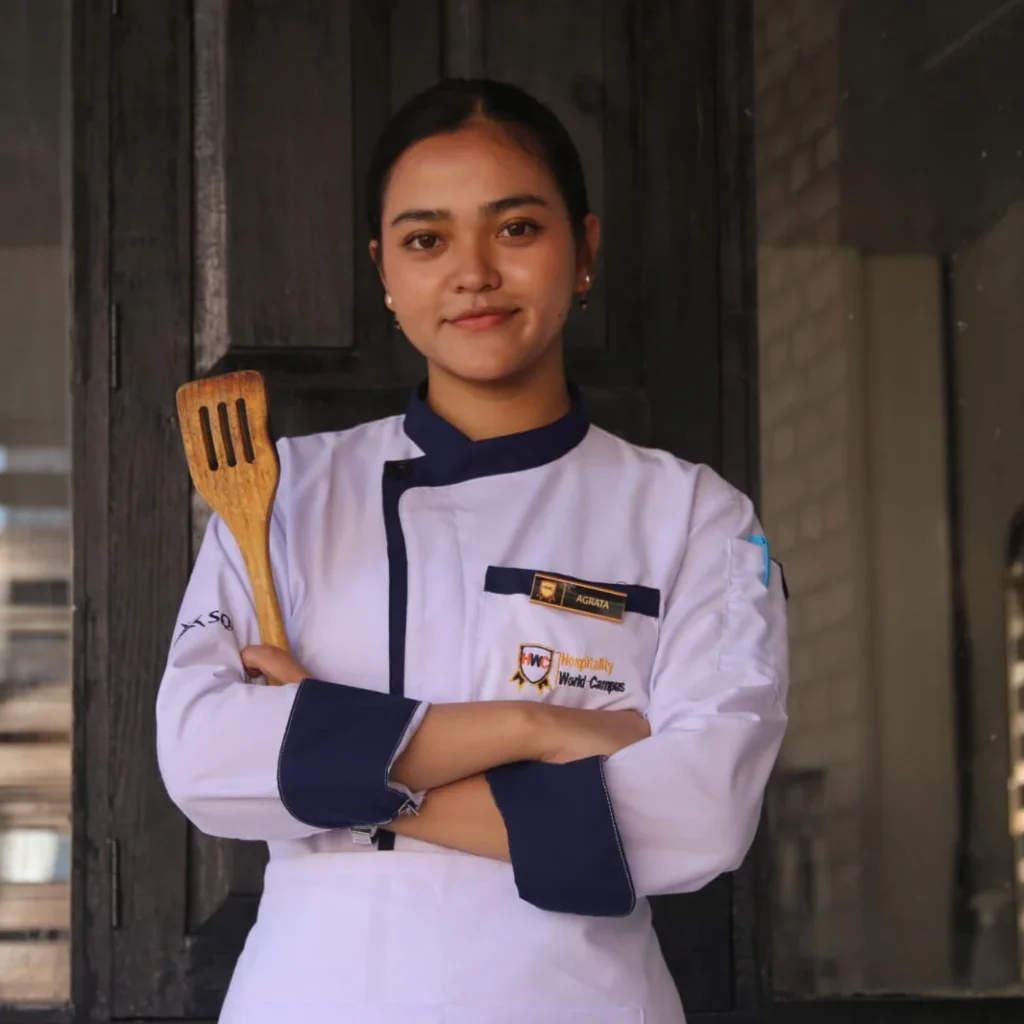
One of the most exciting options for a chef course in Nepal is Hospitality World Campus (HWC), which describes itself as the best culinary arts college in Nepal. HWC offers a special program called the Professional Chef Course – Advanced, which is designed for people who want to take their cooking skills to the highest level.
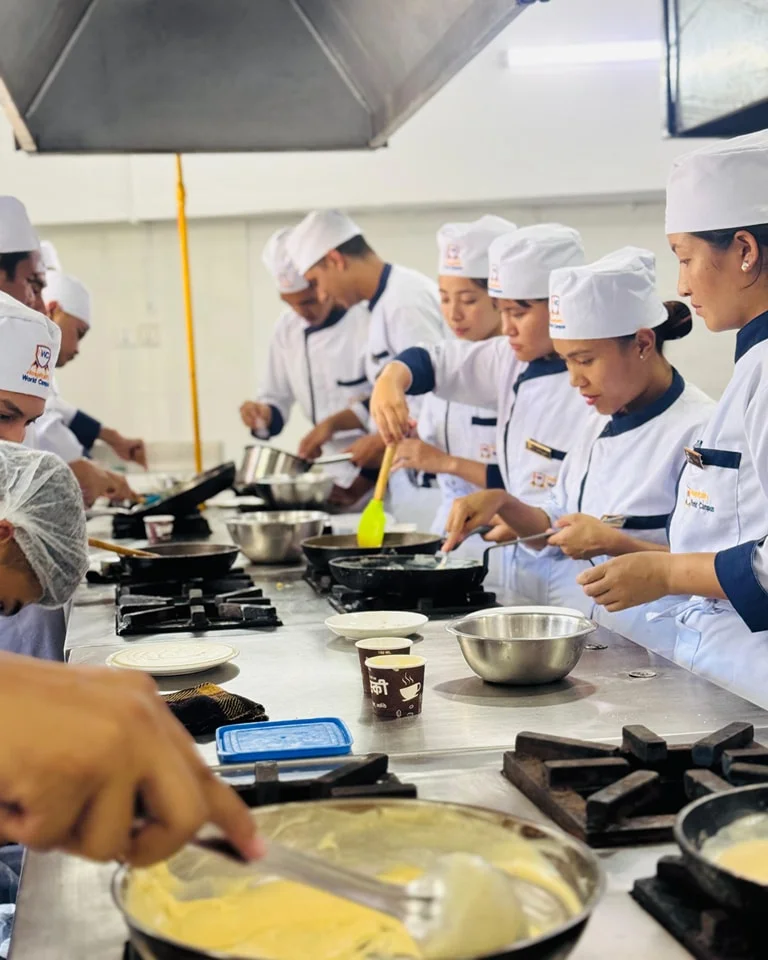
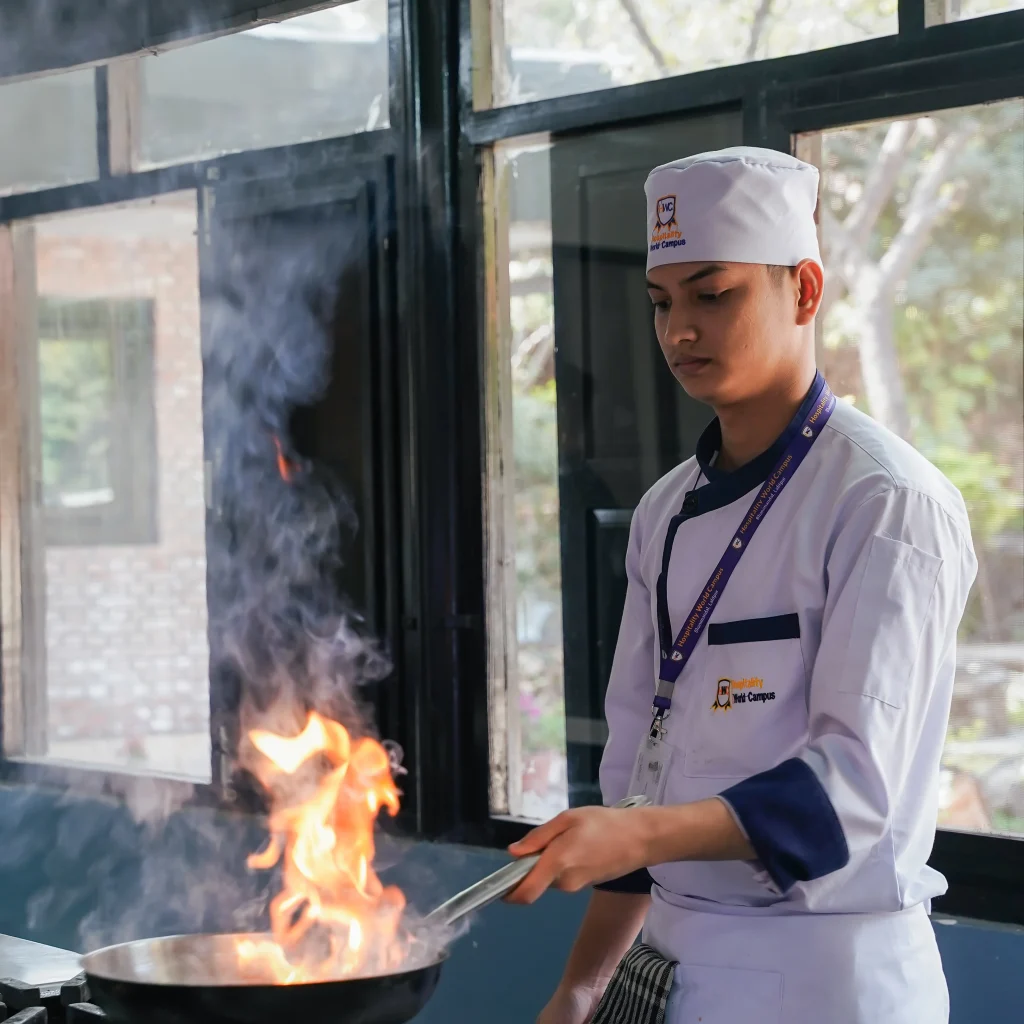
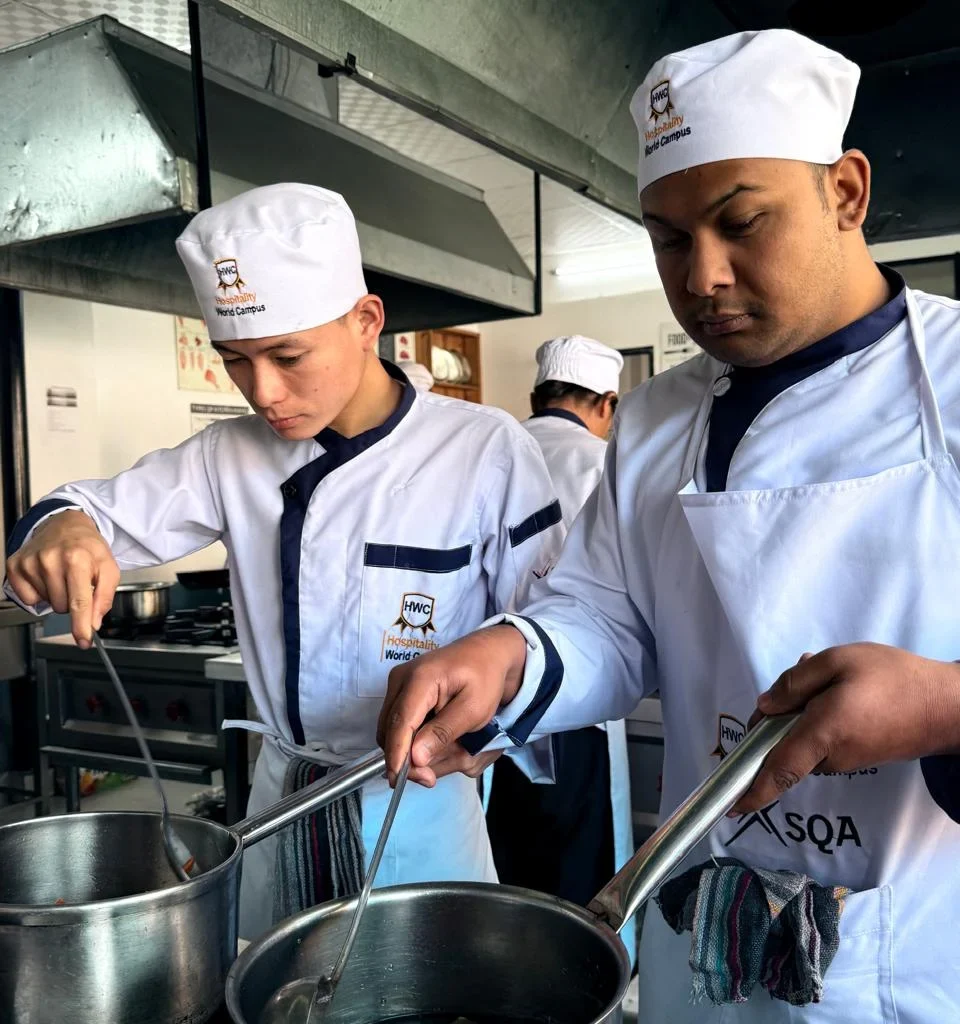
This is a 90-hour program where you learn advanced techniques in cooking, baking, and pastry-making. Expert instructors guide you through food science, ingredient pairing, and how to create your own recipes. The school has modern kitchens with top-quality equipment, and students get hands-on training in food preparation, menu planning, and kitchen management.
Here are the key details of the Professional Chef Course – Advanced at HWC:
Duration: 90 Hours
New Batch: Every month (so you can start anytime!)
Certificate: International certificate from SQA (Scottish Qualifications Authority)
Eligibility: Students who have passed SLC/SEE with at least D+ grade (GPA 1.6), with D+ in English. Must be 17 years or older.
The international SQA certificate is a big deal because it is recognized worldwide. This means your certificate is not just useful in Nepal employers in other countries will also accept it.
What makes HWC special is its student-first approach. The campus has small class sizes, meaning you get more personal attention from your teachers. Each student also gets a mentor who meets with them regularly to make sure they are learning well and are happy. You can learn more about this program and enroll at their official website: hwc.edu.np.
Other Culinary Schools in Nepal
Nepal also has several other well-known schools where you can do a chef course:
IHTS (International Hotel Training School) in Kathmandu offers a Diploma in Culinary Arts. This 1,860-hour intensive diploma course is ideal for beginners and those passionate about culinary arts who want to build a dynamic career. It focuses on practical learning with theory to enhance culinary creativity, hygiene knowledge, and kitchen management skills.
IIG (International Institute of Gastronomy) in Nepal offers the CTH Level II Diploma in Culinary Skills. This is a globally recognized program that prepares aspiring chefs, food enthusiasts, and future restaurateurs for success in the culinary and hospitality industry. It is accredited by the Confederation of Tourism and Hospitality (CTH), United Kingdom, and certified by CTEVT, Nepal.
ACA (Academy of Culinary Arts and Hospitality Management) is another respected institution. With a proven track record of more than a decade, ACA takes pride in being one of the leading providers of hospitality and culinary education in Nepal. The institution started its journey in 2010 with a Diploma course in Culinary Arts.
IHM College in Lalitpur is known for its job placement support. IHM College is a pioneer and trend-setter college for professional culinary arts programs with 100% job placement support globally, and the program offers hands-on practical training where training meets industry-standard skills.
StarChef Culinary Arts and Hotel Management Institute is another popular choice, especially for those looking to work abroad. StarChef has guaranteed internship and job placement support in prestigious destinations like Australia, Europe, the Middle East, the Maldives, and beyond.
What You Will Learn in a Chef Course in Nepal
Cooking Techniques and Kitchen Skills
The main part of any chef course in Nepal is learning how to cook. But it goes much deeper than just following a recipe. You learn:
Basic and advanced cutting and chopping techniques
How to use professional kitchen equipment safely
How to cook using different methods boiling, frying, baking, roasting, steaming, and more
How to cook cuisines from different countries, including Nepali, Indian, Chinese, Continental, and Italian food
How to make stocks, sauces, and soups from scratch
How to bake bread, cakes, pastries, and desserts
The best chef courses in Nepal teach these things through hands-on practice. You do not just sit in a classroom and listen you actually cook in a real kitchen every day. This is how you truly learn.
Food Safety, Hygiene, and Kitchen Management
This is a very important part of the course that many people do not know about. A professional chef must know how to keep the kitchen clean and safe. If food is not handled properly, people can get sick. So you learn:
The rules of food safety and hygiene
How to store food properly so it does not go bad
How to manage a kitchen, organize the team, and work under pressure
How to plan a menu that balances taste, nutrition, and cost
These skills are not just about cooking they are about running a professional operation. If you want to become a head chef or run your own kitchen one day, these lessons are essential.
Career Opportunities After a Chef Course in Nepal
Jobs You Can Get in Nepal
After completing a chef course in Nepal, you have many career options. Chefs in Nepal can explore a wide range of career paths across hotels, restaurants, catering companies, and international hospitality sectors.
Here are the most common jobs:
Commis Chef: This is a junior chef position. It is the starting point for most culinary graduates. You work under senior chefs, learn every day, and build your skills. Fresh culinary students usually start their journey in this exact role.
Station Chef (Chef de Partie): After a few years of experience, you move up to manage a specific section of the kitchen, like the grill, pastry, or sauce station.
Sous Chef: This is the second-in-command in a kitchen, working directly under the head chef.
Head Chef / Executive Chef: The top position in a kitchen. You are responsible for the entire menu and all the kitchen staff.
Pastry Chef: If you love baking, you can specialize in making cakes, bread, and desserts. Many new coffee shops and big hotels in Nepal are always looking for good bakery chefs.
Kitchen Manager / Food Production Manager: You manage the operations of a kitchen, including ordering supplies and managing the team.
You can work in hotels, restaurants, cafes, catering companies, airlines, resorts, and even on cruise ships.
How Much Money Can You Earn?
Now let’s talk about salary something everyone wants to know!
Entry-level hotel salary in Nepal is usually between NPR 12,000 and NPR 18,000 per month for freshers. Mid-level hotel staff such as supervisors and experienced chefs usually earn between NPR 20,000 and NPR 35,000 per month.
As you gain experience and move to higher positions, your salary grows significantly. The total gross salary for the Chef position in Nepal ranges between NPR 34,831 and NPR 223,475 per month, depending on experience and the type of employer.
For chefs who work abroad, the earnings are even higher. Working abroad offers higher salary, better facilities, and valuable experience, and international work helps chefs improve their skills and earn more income in the future.
Many Nepali chefs who go to work in the Middle East, Australia, or Europe earn salaries that are many times higher than what they would earn in Nepal.
How to Choose the Right Chef Course in Nepal
Things to Look for in a Good Chef Course
With so many options available, how do you pick the right chef course in Nepal? Here are some simple things to check:
Hands-on Training: Make sure the school has a real, professional kitchen where you can practice every day. Theory is important, but real cooking practice is what makes you a good chef.
Qualified Teachers: Your instructors should be experienced chefs who have actually worked in hotels and restaurants not just people who have read books about cooking.
Certificate Recognition: Check if the certificate you receive is recognized in Nepal and abroad. An internationally recognized certificate like the one from HWC (SQA) or IIG (CTH) is very valuable.
Internship Support: Many schools offer internship placements in hotels and restaurants. This is a great way to get real work experience while you are still studying.
Job Placement: Some schools, like IHM College, offer 100% job placement support. Find out what career support is available after you complete the course.
Batch Size and Schedule: Check when new batches start and how many students are in each class. Smaller classes mean more personal attention from your teacher. HWC, for example, starts a new batch every month, so you do not have to wait long to begin.
How Much Does a Chef Course Cost in Nepal?
The cost of a chef course in Nepal varies depending on the school and the length of the program. Short courses like the 90-hour Professional Chef Course – Advanced at HWC are more affordable and quicker to complete. Longer diploma programs that last 6 months to 1 year naturally cost more but provide deeper training and more opportunities.
It is always a good idea to contact the school directly to ask about current fees, scholarship options, and payment plans. Many schools in Nepal also offer discounts for early enrollment or scholarships for deserving students.
Tips to Succeed in Your Chef Course
Work Hard in the Kitchen Every Day
The number one tip for succeeding in a chef course in Nepal is simple practice as much as you can. Every time you cook, you get better. Do not be afraid to make mistakes. Making mistakes is how you learn. Senior chefs will correct you and guide you. Take every feedback as a lesson.
Be punctual and disciplined. Professional kitchens run on strict schedules. If lunch service starts at 12 PM, every dish needs to be ready. Being on time and being organized is a huge part of being a professional chef.
Build Your Portfolio
As you learn new dishes, take photos of your work. A clean, beautiful photo of a dish you made can be very powerful when you apply for a job later. Employers like to see what you can do before they hire you.
You can also keep a small notebook where you write down new recipes, techniques, and tips you learn during your course. This becomes a personal recipe book that you can refer to throughout your career.
Be Curious and Keep Learning
The best chefs in the world never stop learning. Try different types of food, visit new restaurants, watch cooking videos online, and read about different cuisines. The more curious you are about food, the better chef you will become.
FAQ
Who can join a chef course in Nepal?
Most chef courses in Nepal are open to anyone who has passed SLC/SEE. For the Professional Chef Course – Advanced at HWC, you need at least a D+ grade (GPA 1.6) and must be 17 years or older.
How long does a chef course take?
It depends on the program. Short courses like the one at HWC are 90 hours. Diploma programs can take 6 months to 1 year. Degree programs can take 2 to 4 years.
Can I work abroad after doing a chef course in Nepal?
Yes! Many Nepali chefs work in countries like Dubai, Qatar, Australia, Japan, and across Europe. An internationally recognized certificate makes it much easier to apply for jobs abroad.
Is cooking a good career in Nepal?
Absolutely. The chef profession in Nepal is becoming a popular and reliable career choice. As more hotels, restaurants, cafés, and resorts open across the country, the demand for skilled chefs is increasing every year.
Does HWC give a certificate?
Yes. The Professional Chef Course – Advanced at Hospitality World Campus comes with an international certificate from SQA (Scottish Qualifications Authority), which is recognized around the world.
Final Thoughts: Is a Chef Course in Nepal Right for You?
If you love food and want to turn that love into a real career, a chef course in Nepal is one of the best decisions you can make. Nepal’s food and hospitality industry is growing fast, and there are real opportunities waiting both in Nepal and abroad.
Whether you are a fresh SLC graduate, a working adult looking for a new career, or someone who simply wants to improve their cooking skills, there is a course out there for you. Programs like the Professional Chef Course – Advanced at Hospitality World Campus (HWC) offer world-class training in a friendly environment, with new batches starting every month and an internationally recognized SQA certificate at the end.
The key is to take the first step. Enroll in a course, work hard in the kitchen, stay curious, and never stop learning. The culinary world is full of exciting opportunities and your journey can start today.
To learn more about the chef course and other culinary programs in Nepal, visit Hospitality World Campus at hwc.edu.np and talk to their admissions team.
Are you wondering how to become a professional chef after 12th grade in Nepal?
If yes, then becoming a professional chef might be the perfect career for you. The good news is that you can start your journey right after completing your Class 12 (plus two) in Nepal.
Many young Nepali students do not know that the cooking industry is one of the fastest-growing fields in the country and around the world. Nepal gets millions of tourists every year. All these tourists need good food. Hotels, resorts, restaurants, and cafes are always looking for trained chefs. So if you want to know how to become a professional chef after 12, you are in the right place.
In this blog, we will explain everything in very simple words. From the courses you need to join, to the colleges available in Nepal, the salary you can expect, and how far your career can go. Whether you are a student, a parent, or someone just curious about this career, this guide is made for you.
So, let’s start with knowing about the professional chef.
Professional Chef in Nepal
A professional chef is a trained culinary expert who manages kitchen operations, develops menus, and ensures high food quality for the people who are willing to eat new things.
To become the professional chef in Nepal or if you want to become a professional chef globally, you can have two options: either you can join the Diploma in Global Culinary Arts or Professional Chef Course – Advanced
How to Become a Professional Chef After 12: Starting Your Journey
The first step to become a professional chef after 12 is to understand what a chef actually does. A chef is not just a person who cooks food. A chef plans what food to make, manages the kitchen team, checks the quality of every dish, and sometimes creates new recipes. It is a skilled job that needs proper training.
After passing your Class 12 from any stream (Science, Management, or Humanities), you are fully eligible to join a diploma in global culinary arts or hotel management program in Nepal. You do not need to have a specific background. Anyone who has a passion for food and a willingness to work hard can become a professional chef.
What Subjects Do You Need After Class 12?
The great news is that there is no specific stream required to join culinary or hotel management programs. Whether you studied Science, Commerce, or Humanities in your Class 12, you can apply. Most colleges in Nepal just require that you have completed your Plus 2 (10+2) or equivalent examination with at least 45 percent marks.
Some colleges may ask for a small entrance test or a brief interview, but there is no need to be worried. These tests are simple and focus on your basic communication skills and interest in the food industry.
Can You Start Learning Before Joining College?
Absolutely yes! Even before you join a formal course, you can start preparing at home. Try cooking different types of food at home. Watch YouTube videos about knife skills, food preparation, and basic cooking techniques. Follow Nepali chefs on social media.
Try to learn about different cuisines like Continental, Indian, and Asian food. This background practice will give you a head start when you officially begin your training. It also shows colleges and future employers that you have a genuine passion for cooking.
Courses Available in Nepal to Become a Professional Chef After 12
Nepal has many good options for students who want to study culinary arts or hotel management after Class 12. These courses range from short certificate programs that last just 3 months to full four-year degree programs. Let us look at the main types of courses available in Nepal.
Short-Term and Diploma Courses
Short-term and diploma courses are very popular in Nepal because they are affordable, practical, and you finish quickly. Here are some popular options:
Certificate in Culinary Arts (3 to 6 months): This is a beginner-level course that teaches you basic cooking skills, kitchen hygiene, and food safety. It is a great starting point.
Pre-Diploma in Culinary Art (6 months): This is offered by CTEVT (Council for Technical Education and Vocational Training) affiliated institutions. It teaches oriental and continental cooking styles along with computer applications.
Diploma in Culinary Arts (9 to 12 months): A more detailed program that includes classroom learning, hands-on kitchen training, and an internship at a hotel. For example, IHTS (International Hotel Training School) in Kathmandu offers a Diploma in Culinary Arts with a 6-month internship after classroom training. The fee is approximately NPR 1,25,000 for the full program.
Diploma in Bakery and Pastry (6 to 12 months): For students who are specifically interested in baking, cakes, breads, and desserts. This is a great option if you love sweets.
Short courses are best for students who want to start working quickly. After completing a diploma, you can immediately start applying for jobs in restaurants, hotels, and bakeries.
Bachelor Degree Programs in Hotel Management
If you want a more complete education and bigger career opportunities, you can join a Bachelor of Hotel Management (BHM) program. This is a 4-year degree program that covers everything from cooking to management, finance, and hospitality operations. As of 2024, 79 colleges in Nepal offer BHM programs, with 38 of them located in Kathmandu alone. Here are the top universities that offer BHM in Nepal:
Tribhuvan University (TU): The most common BHM affiliation in Nepal. Requires 10+2 with at least 45 percent marks.
Kathmandu University (KU): Offers the Bachelor in Professional Hospitality program, which is internationally accredited.
Pokhara University: Also offers 4-year BHM programs.
Purbanchal University: Offers BHM and even a Master of Hospitality Management program.
International University Programs: Some colleges in Nepal are affiliated with universities like Queen Margaret University (UK), University of Sunderland, Leeds Beckett University, and Lincoln University College. These give you international degrees while studying in Nepal.
The BHM degree also includes a specialization in Culinary Arts, where you deeply study food production, kitchen management, and international cuisines. This degree opens doors to higher-level jobs in five-star hotels and international hospitality companies.
Best Colleges in Nepal to Study Culinary Arts After 12
Choosing the right college is very important. A good college will not only teach you cooking skills but will also help you get internships and jobs. Here are some of the best and most trusted culinary and hotel management colleges in Nepal:
Top Culinary Colleges in Kathmandu
HWC(Hospitality World Campus): located in Jawalakhel. It is one of the oldest and top culinary arts colleges in Nepal providing the courses like Diploma in Global Culinary Arts, Diploma in Hospitality Mangement, Diploma in Barista and Bartending, and many more.
IHTS (International Hotel Training School), Old Baneshwor, Kathmandu: IHTS is one of the most well-known culinary arts academies in Nepal. It is led by experienced chefs and hotel directors from 5-star hotels. IHTS offers diplomas in Culinary Arts, Bakery and Pastry, and other short courses. They have internship placements in Malaysia, Thailand, and China.
IHM College (College of International Hotel Management), Satdobato, Lalitpur: IHM is known for its hands-on, no-textbook approach to culinary training. They have 100 percent job placement support globally and offer internships in 5-star hotels inside Nepal. Over 500 students have already graduated and found placement from IHM.
Academy of Culinary Arts and Hospitality Management (ACA), Lagankhel, Lalitpur: ACA is affiliated with Lincoln University College of Malaysia and offers 4-year BHM programs. Their graduates have worked in top international hotels in Dubai, Australia, and beyond.
NATHM (Nepal Academy of Tourism and Hotel Management), Kalimati, Kathmandu: A government-supported institution that offers hotel and tourism management programs at affordable fees.
Top Culinary College Outside Kathmandu
Kantipur Tourism and Hotel Management College, Pokhara: This is considered one of the best culinary training colleges outside Kathmandu. It is accredited as a National Skill Testing Board (NSTB) center for culinary arts in Province 4. They offer Australian Certificate level training in Hotel Management, Culinary Arts, and Pastry and Baking. Their students have been placed as Executive Chefs in hotels like Dusit Thani in Qatar and on Cunard Cruise Lines in Miami.
When choosing a college, always check if they offer practical kitchen training, internship placements in real hotels, and job support after graduation. A good internship can change your career completely.
Skills You Need to Become a Professional Chef After 12
Cooking is not just about knowing recipes. To become a truly great professional chef, you need to develop a mix of technical and personal skills. Here are the most important ones:
Technical Cooking Skills
Knife Skills: A chef must know how to cut, slice, and chop vegetables, meat, and other ingredients quickly and safely. This is one of the first things you learn in culinary school.
Understanding of Ingredients: You need to know which ingredients go together, how they change when cooked, and how temperature affects food texture and taste.
Food Safety and Hygiene: This is extremely important. Every professional kitchen must follow strict food safety rules. You need to know how to store food properly, prevent contamination, and maintain a clean kitchen.
Knowledge of Cuisines: A good chef understands multiple types of cuisines. In Nepal, the demand is high for chefs who know Nepali, Indian, Continental (Western), and Asian cooking styles.
Baking and Pastry Basics: Even if you are not a pastry chef, knowing basic baking skills is a big plus.
Personal Skills and Attitude
Passion for Food: You must genuinely love food and cooking. Without passion, it is very hard to succeed in this field.
Hard Work and Patience: The kitchen is a tough place. Long hours, high heat, and pressure are common. You need to be strong and patient.
Creativity: Great chefs create new dishes and find new ways to present food. Being creative with flavors and looks will help you stand out.
Teamwork: A kitchen is a team. You need to work well with other cooks and staff.
Time Management: In a busy restaurant, many dishes need to be ready at the same time. Managing your time perfectly is essential.
During your culinary training in Nepal, all these skills will be taught and practiced. But you should also make effort outside the classroom to keep improving every day.
Chef Career Growth Path in Nepal
One of the best things about the culinary profession is that there is a clear path to grow. You start from the bottom and slowly move up. Here is what the career ladder of a chef looks like in Nepal and internationally:
Step by Step Career Ladder for a Chef
Commis Chef (Junior Cook): This is the starting position. You follow instructions, do basic prep work like cutting vegetables, and learn from senior chefs. This is where everyone starts.
Demi Chef / Chef de Partie (Station Chef): After 2 to 3 years of experience, you take charge of one specific section of the kitchen, like the grill section, pastry section, or soup section.
Sous Chef (Second in Command): After about 5 to 7 years, you become the second most important person in the kitchen. You help the Head Chef run the kitchen and manage the team.
Head Chef / Executive Chef: After 8 to 10 years of hard work, you can become the Head Chef or Executive Chef. You manage the entire kitchen, plan menus, control food costs, and lead the full kitchen team. This is the top position.
It usually takes about 8 to 10 years of hard daily work in a busy kitchen to reach the Executive Chef level. But with the right training, internships in good hotels, and a strong work ethic, you can move up faster.
Can You Work Abroad After Becoming a Chef in Nepal?
Yes, absolutely! This is one of the biggest advantages of becoming a chef in Nepal. After getting 2 to 3 years of real kitchen experience in Nepal, it becomes much easier to find high-paying chef jobs in countries like Dubai, Qatar, Australia, the Maldives, Malaysia, or on international cruise ships. Many Nepali chefs already work in these places and earn very good salaries.
Working in a busy Nepali hotel kitchen is actually great preparation for international jobs because it teaches you to handle pressure and work long hours. Some Nepali pastry chefs working in Dubai and the Maldives earn between NPR 1,50,000 to 3,00,000 per month.
Salary of a Professional Chef in Nepal
Many students wonder how much money a chef earns in Nepal. The truth is, your salary as a chef depends on your experience, the place where you work, and your skills. Here is a general idea of what you can expect:
Salary at Different Career Levels in Nepal
Entry-Level Chef or Commis: When you first start, expect to earn between NPR 15,000 to NPR 25,000 per month. This is for freshers who have just completed their training or diploma.
Experienced Chef (3 to 5 years): With some years of experience, you can earn between NPR 30,000 to NPR 60,000 per month in a mid-to-senior role at a good hotel or restaurant.
Head Chef or Executive Chef: Senior chefs in 5-star hotels and top restaurants in Nepal can earn up to NPR 90,000 per month or more.
International Jobs: Chefs who go abroad for work can earn much more. In Dubai or Qatar, monthly earnings can go up to NPR 1,50,000 to NPR 3,00,000 depending on the hotel and position.
While the starting salary in Nepal may seem low, the growth potential is huge. As you gain more skills and experience, your value in the job market increases rapidly. Plus, if you start your own food business like a restaurant, cafe, or bakery, the income potential is unlimited.
Other Ways to Earn as a Chef in Nepal
Food Blogging and YouTube: With the rise of social media, many Nepali chefs are now earning money by sharing recipes and cooking videos online. If you have good digital skills, you can build a strong following and earn through ads and sponsorships.
Catering Business: You can start a catering service for weddings, parties, and corporate events. This is a growing market in Nepal.
Own Restaurant or Bakery: After getting experience in hotels, many chefs open their own small restaurants, cafes, or bakeries. Many culinary courses in Nepal now include entrepreneurship modules to teach you how to run your own food business.
Private Chef: Wealthy families, embassies, and high-profile individuals sometimes hire private chefs. This can be a well-paying job with good working conditions.
Common Mistakes to Avoid When Trying to Become a Professional Chef After 12
Many students make some common mistakes when they start their culinary journey. Knowing these mistakes beforehand will help you avoid them and move forward faster.
Mistakes in Education and Training
Choosing a college without checking its kitchen facilities: A culinary school without a proper training kitchen is not worth joining. Always visit the college and check the kitchen labs before enrolling.
Skipping the internship: Some students try to skip the internship period because it pays less money. This is a big mistake. Internship in a real hotel kitchen is where you actually learn the most. Never skip it.
Only focusing on cooking and ignoring food safety: Many students love the cooking part but find hygiene and food safety boring. But food safety is the most important part of being a professional chef. Hotels and restaurants will not hire you if you do not have proper knowledge of hygiene standards.
Expecting instant high salaries: As a fresher, you will start with a low salary. Do not get discouraged. Focus on learning and building your skills. The salary will increase as your experience grows.
Mistakes in Career Attitude
Giving up too quickly: The kitchen is a hard environment. It is hot, fast-paced, and stressful. Many students quit too soon. Stay committed and keep going. Every experienced chef has gone through these tough days.
Not being curious about food: Good chefs are always curious. They try new ingredients, visit food markets, taste different foods, and never stop learning. If you just cook the same things without curiosity, you will not grow.
Not building a professional network: In Nepal’s hotel and restaurant industry, knowing the right people matters. Connect with your teachers, senior chefs, and hotel managers. These connections can help you find better jobs in the future.
Future of the Chef Profession in Nepal
The future looks very bright for professional chefs in Nepal. Here is why:
Growing Tourism and Hotel Industry
Nepal is one of the most popular tourist destinations in the world. Millions of trekkers, mountain climbers, and cultural tourists visit Nepal every year. To serve this growing number of tourists, new hotels and restaurants are opening across the country. The number of five-star hotels in Kathmandu has increased sharply in recent years, with the addition of properties like Kathmandu Marriott Hotel, Aloft Kathmandu, Hyatt Place Kathmandu, and others.
New boutique hotels and resorts are also opening in places like Thamel, Pokhara Lakeside, Nagarkot, Sarangkot, and Chitwan. All of these places need skilled, trained chefs. The hospitality sector already contributes about 2.5 percent to Nepal’s GDP according to the Central Bureau of Statistics, and this number is expected to grow further. This means more jobs, better salaries, and more opportunities for professional chefs in Nepal.
Rise of Cafe Culture and Food Businesses
Another exciting trend in Nepal, especially in cities like Kathmandu and Pokhara, is the rise of cafe culture. Young Nepali entrepreneurs are opening specialty coffee shops, bakeries, fusion restaurants, and dessert cafes. This creates a new and exciting job market for chefs who have skills in pastry, baking, and modern cuisines. There is also a big demand for chefs who can create fusion dishes that combine traditional Nepali flavors with international cooking styles. If you can cook a momos-inspired pizza or a Newari-inspired pasta, you have a very special skill set that is in high demand. The growing food delivery market through apps is also creating demand for cloud kitchen chefs who cook only for home delivery orders.
Final Words: Your Path to Becoming a Professional Chef After 12
If you have a passion for food and a strong desire to work hard, then becoming a professional chef after 12 is absolutely possible in Nepal. The path is clear. Finish your Class 12, join a good culinary course or hotel management college, complete your internship in a real hotel, and keep learning and improving every day.
Nepal’s growing hotel industry, the rise of cafes and food businesses, and the increasing demand for trained Nepali chefs both at home and abroad make this one of the most exciting career choices you can make right now. Start small, be patient, stay curious about food, and never stop learning. Whether you want to become the Executive Chef of a 5-star hotel, open your own restaurant, or work on a luxury cruise ship, the journey starts today with a single decision to take cooking seriously.
Remember: Every great chef started exactly where you are right now. The only difference between a dream and a real career is the action you take today. So go ahead, take that first step, and start your journey on how to become a professional chef after 12 in Nepal.
Frequently Asked Questions About How to Become a Professional Chef After 12 in Nepal
Can I become a professional chef directly after Class 12 in Nepal?
Yes. You can join a Diploma in Culinary Arts or Certificate course right after completing your Class 12 from any stream. Many colleges accept students with 45 percent or above in Plus 2.
How long does it take to become a professional chef after Class 12?
A diploma course takes 9 to 12 months. A full BHM degree takes 4 years. After training, you will start as a junior chef and typically reach the Head Chef or Executive Chef level after 8 to 10 years of kitchen experience.
How much does it cost to study culinary arts in Nepal?
Short certificate courses can cost as little as NPR 30,000 to NPR 50,000. Diploma programs cost around NPR 1,00,000 to NPR 1,50,000. Full BHM degree programs cost between NPR 3,00,000 to NPR 8,00,000 or more depending on the college and university affiliation. Some institutions like IHM offer scholarships of up to 50 percent for deserving students.
Is being a chef a good career in Nepal?
Absolutely yes. With Nepal’s growing tourism industry, increasing number of 5-star hotels, and the rise of food businesses, the demand for trained chefs is increasing every year. Starting salaries may be modest, but the career has very strong long-term growth potential, especially for those who gain international experience.
Have you ever dreamed of working in a hotel, a restaurant, or the travel industry?
If yes, then you are looking at one of the fastest-growing fields in Nepal right now. The career opportunities in hospitality industry in Nepal are growing every single year, and thousands of young people are finding great jobs in this sector.
Nepal is a country that people from all over the world love to visit. We have the highest mountains, beautiful temples, rich culture, and amazing food. Because of all this, more and more tourists come here every year. And when tourists come, they need places to stay, food to eat, people to guide them, and services to enjoy. That is exactly where the hospitality industry steps in and where you can build a wonderful career.
In this blog, we will explain everything in a very simple way: what the hospitality industry is, what kinds of jobs are available, how much you can earn, how to get started, and what the future looks like. Whether you just finished your SEE, are in plus two, or are a college student, this guide is for you.
Why Nepal Is the Right Place for Career Opportunities in Hospitality Industry
Nepal welcomed over 1.14 million international tourists in 2024, which was a 13% increase compared to the year before. That means more visitors, more hotels needed, more restaurants serving food, more tour guides taking people around, and more jobs for Nepali people. The Nepal Tourism Board has reported that in just the first ten months of 2025, over 943,000 tourists visited Nepal. October 2025 alone saw 128,443 tourists the highest monthly figure of the year.
Tourism contributes about 6.7% of Nepal’s entire GDP (that means the money our country earns). Hotels in Bagmati Province, which includes Kathmandu, are reporting a 57% room occupancy rate up from around 52% the year before. Big international hotel brands like Marriott, Hyatt Regency, and Radisson are already operating in Kathmandu and regularly hire Nepali professionals. All of this means one thing: there are real, good-paying jobs waiting for skilled people in this industry.
Nepal’s Tourism Is Growing Fast
Before COVID, Nepal received around 1.2 million tourists in 2019. Then COVID almost stopped all travel. But Nepal bounced back stronger. By 2024, we reached 96% of pre-COVID levels, and experts say we will cross pre-COVID numbers very soon. The government is actively promoting Nepal to attract 2 million tourists per year. More tourists means more demand for hospitality workers guides, hotel staff, restaurant workers, event planners, and more.
The top visiting countries in 2024 were India (317,772), USA (111,216), China (101,879), UK (57,554), and Australia (43,980). People from Europe, America, and Asia are all coming to Nepal. Serving guests from different countries is a big part of the hospitality industry and it makes the work exciting and educational too.
The Industry Is Hiring All Year Round
Many people think hospitality is only seasonal but that is not true anymore. Hotels in Nepal hire throughout the year. Of course, October and November (trekking season) and March and April (spring season) are the busiest times, but domestic tourists also fill rooms during public holidays, festivals, and weekends. This means there is work available in all seasons, not just peak months.
Major hospitality hubs in Nepal include Kathmandu Valley, Pokhara, Chitwan, Lumbini, Mustang, and trekking gateways like Namche Bazaar and Lukla. Jobs are not just in Kathmandu they exist across the country, giving people from all backgrounds and regions a chance to work close to home.
Top Career Opportunities in Hospitality Industry in Nepal
The hospitality industry is not just about working at a hotel reception desk. It is a very wide field that includes hotels, restaurants, travel agencies, airlines, event management companies, trekking agencies, and more. Here are the main career paths you can follow:
Hotel and Resort Jobs
Hotels are the biggest employers in the hospitality sector. From big five-star hotels like Hyatt Regency Kathmandu and Marriott Hotel Kathmandu to smaller guesthouses in Pokhara or lodges in Manang, there are jobs at every level. Here are some of the most common roles:
Front Desk Officer / Receptionist: The first person guests meet. You check in guests, answer their questions, handle bookings, and make them feel welcome.
Housekeeping Staff / Supervisor: Keeps rooms and public areas clean and comfortable for guests.
Food and Beverage (F&B) Staff: Works in hotel restaurants, room service, and banquets.
Hotel Manager / General Manager: Oversees the entire hotel. This is a senior role that comes with experience.
Sales and Marketing Executive: Promotes the hotel to businesses, travel agents, and online platforms.
Guest Relations Manager: Makes sure VIP guests and regular customers have the best possible experience.
Starting salaries at five-star hotels in Nepal range from NPR 15,000 to NPR 30,000 per month for entry-level positions. But here is the good news service charges and tips can add another 20% to 40% on top of your base salary. Mid-level managers earn NPR 40,000 to NPR 70,000, and General Managers of top hotels can earn NPR 1,00,000 to NPR 2,00,000 or more per month.
Restaurant, Café, and Food Business Jobs
Nepal’s food industry is booming. From traditional dal-bhat restaurants to modern Italian cafés and fast food chains, there are thousands of food businesses across the country. The career opportunities in the food side of the hospitality industry are massive. Some popular jobs include:
Chef / Cook: From commis chef (beginner) to executive chef (senior). Culinary skills are in very high demand.
Barista: Coffee culture is growing fast in Nepal. Skilled baristas are needed in every café in Kathmandu, Pokhara, and beyond.
Waiter / Server: Greet customers, take orders, serve food and drinks professionally.
Restaurant Manager: Oversees daily operations, staff, and customer satisfaction.
Bakery and Pastry Specialist: A growing area, especially in tourist areas and luxury hotels.
Waiters in Nepal earn around NPR 25,600 per month on average. Inside star-rated properties, this can go up to NPR 39,200. Chefs with experience and a good reputation can earn much more especially if they specialize in international cuisines that tourist guests prefer.
Travel, Tourism, and Adventure Career Opportunities in Hospitality Industry
Nepal is famous for trekking, mountaineering, wildlife safaris, and spiritual tourism. This creates a completely different set of jobs that are part of the broader hospitality industry and they are just as important and rewarding.
Trekking, Guiding, and Adventure Tourism
Trekking is one of Nepal’s most popular activities. Tens of thousands of trekkers visit the Annapurna Circuit, Everest Base Camp, Langtang Valley, and other trails every year. To support these trekkers, many jobs are created:
Trekking Guide: Leads groups on mountain trails, explains culture and nature, and ensures safety.
Porter: Carries luggage for trekkers on mountain routes.
Lodge / Tea House Owner or Staff: Serves food and provides accommodation along trekking routes.
Rafting and Paragliding Instructor: For adventure sports like white-water rafting in Trishuli or paragliding in Pokhara.
These jobs are particularly popular among young people from hilly regions of Nepal who already know the mountains. Government certifications like TAAN (Trekking Agencies’ Association of Nepal) registration help guides get better clients and higher pay.
Travel Agency and Tour Operations Jobs
Travel agencies design and sell tour packages to both domestic and international tourists. Working at a travel agency is a great career choice for people who love planning, communication, and dealing with clients from different countries. Common roles include:
Travel Consultant: Helps clients plan their trips, book flights and hotels, and create itineraries.
Booking Agent: Manages reservations for hotels, flights, and activities.
Tour Coordinator: Manages the logistics of group tours buses, meals, accommodation, permits, and more.
Sales and Marketing Staff: Promotes travel packages to businesses, schools, and online customers.
Travel agencies in Nepal hire through popular platforms like Merojob, Kumari Job, and Nepalese Hospitality. If you speak good English and have communication skills, travel agency jobs are very accessible even for fresh graduates.
Event Management: A Growing Career Opportunity in Hospitality Industry
Event management is one of the fastest-growing areas within the hospitality industry in Nepal. Weddings, corporate events, conferences, cultural festivals, and sports events all need professional management teams. If you are someone who is organized, creative, and can handle pressure, event management might be perfect for you.
Types of Events and the Jobs They Create
In Nepal, there is a huge and growing market for events of all kinds. The country hosts everything from royal-style weddings (Nepali weddings are elaborate!) to international business conferences. Some of the biggest event types include weddings, destination tours, corporate seminars, music festivals, religious gatherings (like the World Buddhist Conference held in Nepal), and sports events. Each of these needs a team of hospitality professionals:
Event Coordinator / Planner: Plans every detail of an event from start to finish.
Banquet Manager: Supervises food and drink service at large events and parties.
Catering Staff: Prepares and serves food at events outside of regular hotel or restaurant settings.
Venue Manager: Manages the event space, equipment, and setup.
A banquet manager in Nepal can earn NPR 40,000 to NPR 70,000 per month, and event coordinators with good experience often work as freelancers and earn even more per project. Hotel management graduates are especially well-suited for event management because their training covers exactly these skills.
Why Event Management Is a Smart Career Choice in Nepal
Nepal has a rich culture of festivals and ceremonies. Every community, every religion, and every region has its own celebrations. This alone keeps the event industry busy all year round. Beyond culture, the government of Nepal also encourages international events sports tournaments, film festivals, balloon festivals, and business summits to bring more visitors to the country. All of this creates steady demand for event professionals.
Another great advantage of event management as a career is that you can start your own business. Many hospitality graduates in Nepal have started small event companies and grown them into successful enterprises within a few years. If you have creativity, leadership, and organizational skills, this is a field where self-employment is very achievable.
How to Start Your Career Opportunities in Hospitality Industry in Nepal
Now let’s talk about the most important question: how do you actually get started? The good news is that Nepal has many colleges and training institutes that offer hospitality courses, and you do not always need a four-year degree to find a good job.
Education Options: From Short Courses to Full Degrees
There are several education pathways to enter the hospitality industry in Nepal:
Short Certificate Courses (3–6 months): Barista training, pizza and burger making, waiter training, housekeeping, and basic front office skills. These are offered by institutes like Galaxy Training Institute. They are quick, affordable, and get you into a job fast.
Diploma Programs (1–2 years): CTEVT (Council for Technical Education and Vocational Training) offers diplomas in hotel management, food production, and related fields. You can enroll after SEE (Class 10).
BHM – Bachelor of Hotel Management (4 years): The most popular full degree in hospitality in Nepal. TU-affiliated and private colleges offer this program. Entry requires CMAT (Common Management Admission Test). Colleges like IIMS College, ISMT College, and Mid-Valley International College are well-known for BHM programs. Costs range from NPR 6,00,000 to NPR 12,00,000 depending on the institution.
International Degrees: ISMT College offers BSc (Hons) International Tourism and Hospitality Management in partnership with the University of Sunderland, UK. This gives graduates a UK-recognized degree and opens international job doors.
MBA / Masters in Hospitality: For those who want to reach senior management or academic roles.
Even if you start with a certificate or diploma, you can always study further while working. Many hospitality professionals in Nepal start at entry level and slowly earn promotions while upgrading their education. Experience, in this industry, is valued just as much as degrees.
Skills That Hotels and Employers Really Want
Degrees are important, but hospitality employers also look for specific personal skills. Here are the qualities that will help you get hired and promoted:
Good Communication: You need to speak clearly and politely with guests, many of whom come from foreign countries. English is very important.
Customer Service Attitude: Always putting the guest’s happiness first even when things are difficult.
Problem-Solving: Hotels deal with complaints, last-minute requests, and unexpected situations every day. Being calm and solution-focused is very valuable.
Teamwork: Hospitality is never a solo job. You always work with a team chefs, housekeeping, front desk so getting along with others is key.
Cultural Awareness: Nepal’s guests come from India, USA, China, UK, Germany, and many more countries. Understanding different customs and food preferences helps you serve them better.
Attention to Detail: A clean room, a perfectly set table, a politely worded email small things matter a lot in hospitality.
Salary and Growth: What to Expect from Career Opportunities in Hospitality Industry
One thing people often wonder about is salary. Let us be honest and clear about what you can realistically expect at different stages of your career in Nepal’s hospitality sector.
Salary Range at Different Career Levels
Here is a simple breakdown of what you can earn in the hospitality industry in Nepal:
Fresh BHM Graduate / Entry Level (Front Desk, Waiter, Housekeeping): NPR 15,000 – NPR 30,000 per month (plus 20–40% extra from service charges and tips)
General Manager of a Top Hotel: NPR 1,00,000 – NPR 2,00,000+ per month
These numbers show that the hospitality industry in Nepal offers a real career path with real income growth over time. The key is to start, work hard, gain experience, and keep upgrading your skills.
International Career Opportunities for Nepali Hospitality Professionals
One of the biggest advantages of a career in hospitality is that the skills you learn in Nepal can take you all over the world. Many Nepali graduates have gone on to work in Dubai, Singapore, Australia, Switzerland, and other countries. Major international hotel chains like Marriott, Hilton, and Hyatt are always looking for trained hospitality professionals from Nepal.
International placements especially on cruise ships, in Gulf luxury hotels, or at Australian resorts offer salaries that are dramatically higher than domestic rates. Many Nepali professionals earn in USD or AED abroad, sending remittances home while building global careers. Getting international certifications or studying at a college with global affiliations (like ISMT’s partnership with University of Sunderland, UK) greatly boosts your chances of working abroad.
Future of Career Opportunities in Hospitality Industry in Nepal
The future of the hospitality industry in Nepal looks very bright. The government, private sector, and international investors are all working together to make Nepal an even more attractive destination. Here is what the near future holds:
New Trends Shaping the Industry
Several exciting trends are shaping the hospitality sector in Nepal right now:
Sustainable Tourism: Eco-lodges, green hotels, and responsible travel are growing in popularity. Jobs in eco-tourism and sustainable hospitality management are becoming very sought-after.
Technology in Hospitality: Hotels are using apps for check-in, online reviews, digital payments, and booking management. IT skills combined with hospitality knowledge are becoming very valuable.
Wellness Tourism: Yoga retreats, meditation centers, and Ayurvedic resorts are growing especially around Pokhara, Kathmandu, and the Himalayan foothills.
Luxury Travel: Nepal is attracting high-spending tourists who want premium experiences. Luxury lodge jobs, helicopter tour operations, and high-end restaurant jobs are growing.
Culinary Tourism: International tourists increasingly want to experience authentic Nepali food. Culinary chefs who can teach cooking classes or lead food tours are in demand.
Government Support and Investment Growth
In 2025, the tourism sector has become the top recipient of Foreign Direct Investment (FDI) in Nepal, with commitments across 103 projects related to hotels, adventure tourism, and eco-lodges. The Nepal Tourism Board (NTB) has ambitious plans to surpass the one-million-visitor mark annually and is working towards attracting 2 million tourists per year.
Nepal currently has 1,401 star and tourist-standard hotels with 53,365 rooms, according to Nepal Tourism Statistics 2023. The hotel sector has the capacity to serve over 3 million tourists per year meaning there is enormous room for growth and job creation in the years ahead. New hotels being built in Lumbini, Pokhara, and around Nepali airports are also generating fresh employment.
If you are a young person thinking about your career, the hospitality industry in Nepal is one of the few sectors where you can start from a basic level, grow quickly with experience, and even take your career global. The door is open you just have to walk through it.
Final Thoughts: Is a Career in Hospitality Right for You?
The career opportunities in hospitality industry in Nepal are real, growing, and open to everyone who is willing to work hard and learn. You do not need to come from a rich family or a big city. What you need is a passion for serving people, a willingness to learn, and the courage to take that first step.
Whether you want to be the General Manager of a five-star Kathmandu hotel, a skilled barista in Thamel, a trekking guide in the Himalayas, an event planner for grand weddings, or a chef who brings Nepali flavors to the world there is a path for you in the hospitality industry.
Start by learning the skills, enroll in a course that fits your goals and budget, do your internship seriously, and never stop learning. The hospitality world is full of kind, hardworking, and passionate people and it needs more people just like you.
Nepal’s mountains are already the highest in the world. Let your career be just as high. Best of luck!
A Diploma in Hotel Management in Nepal is a 1 to 3-year program (depending on the institution and accreditation type) that trains students in front office operations, food production, food & beverage service, and housekeeping. Students can enroll after passing SEE (Class 10). Graduates work in hotels, resorts, airlines, cruise ships, and restaurants both in Nepal and abroad, with internationally recognized programs offering paid internships and credit transfer to foreign universities.
Nepal is growing fast as a tourist destination. Every year, thousands of visitors come to see the Himalayas, explore temples, go trekking, and experience Nepali culture. Because of this, hotels, resorts, and restaurants are opening everywhere from Kathmandu to Pokhara to Chitwan.
This means one very important thing: Nepal needs more trained hotel and hospitality professionals.
If you love meeting people, enjoy working in a team, and want a career that can take you all over the world, a Diploma in Hotel Management (or a broader study Diploma in Hospitality Management) could be the perfect choice for you.
In this guide, we will explain everything what the course is, how long it takes, how much it costs, what jobs you can get, and much more. We have written it in simple words so anyone can understand it easily.
What is a Diploma in Hotel Management?
A Diploma in Hotel Management (often called DHM) is a professional, skills-based qualification that teaches you how to run every department of a hotel, from the front desk where guests check in to the kitchen, the restaurant floor, and the housekeeping team that keeps rooms spotless.
Unlike a general academic degree, this diploma is built around doing. You learn by cooking real dishes, checking guests into a training front desk, practicing room service protocols, and handling actual hotel scenarios. By the time you graduate, you have not just knowledge you have muscle memory for the job.
In Nepal, the term “Diploma in Hotel Management” covers several programs:
CTEVT-affiliated diplomas (government-recognized, 3 years, 6 semesters)
SQA-affiliated diplomas (internationally recognized by Scottish Qualifications Authority, typically 15–21 months)
Each has a different duration, cost, recognition level, and international mobility value. This guide explains all of them so you can choose the right one.
Why Nepal’s Hotel Industry Needs You Right Now
Nepal’s tourism industry continued its upward trajectory in 2025, attracting 1.16 million international visitors, compared to 1.15 million in 2024 and 1.01 million in 2023, according to b60nepal. The country’s appeal, Mount Everest, the Annapurna circuit, Pashupatinath, Lumbini, Pokhara’s lakes, and Chitwan’s wildlife, is not going anywhere. Neither is the demand for trained hospitality professionals.
Here is why right now is the best time to enter this field:
The gap between hotel supply and skilled staff is growing. New hotels and resorts are opening across Kathmandu, Pokhara, Bhairahawa, and Mustang. Most of them struggle to find trained, diploma-level staff. This gap directly benefits students who graduate with recognized qualifications.
Tourism contributes approximately 7% to Nepal’s GDP and the government keeps investing in infrastructure specifically to grow it further. More investment means more hotels, and more hotels mean more jobs at every level.
Globally, one in every eight workers is employed in the hospitality sector. This is the world’s largest employment industry. A diploma from a Nepal college recognized under international frameworks opens doors not just locally but in the UAE, Qatar, Malaysia, Australia, and Europe.
Nepali hospitality professionals are in high demand abroad. Countries with booming tourism economies actively recruit trained Nepali staff. The combination of cultural warmth, language ability, and formal training makes Nepali graduates attractive to international hotels.
Types of Hotel Management Diplomas in Nepal
Not all diplomas are equal. Before you enroll anywhere, understand what type of program you are joining, who awards the certificate, and what it allows you to do after graduation.
1. CTEVT Diploma in Hotel Management (3 Years)
Awarding body: Council for Technical Education and Vocational Training, Government of Nepal
Duration: 3 years / 6 semesters
Who offers it: Over 24 institutions across Nepal
What it covers: Foundation hospitality subjects in Year 1, disciplinary and auxiliary subjects in Year 2, and a full-semester industry internship in Year 6 (final semester).
Best for: Students who want a government-recognized qualification and plan to work in Nepal in hotels and institutions affiliated with the Public Service Commission.
Limitation: Primarily recognized within Nepal. International mobility depends on the individual employer’s assessment rather than a framework-backed credential.
2. SQA-Affiliated Diploma in Hospitality Management (15–21 Months)
Awarding body: Scottish Qualifications Authority (SQA), Scotland one of the world’s most respected vocational qualification bodies
Duration: 15 months (Diploma in Hospitality Management) to 21 months (Advanced Diploma in Hospitality Management)
What it covers: All core hospitality departments plus supervisory skills, entrepreneurship, and customer experience management. Programs are benchmarked to the Scottish Credit and Qualifications Framework (SCQF) and the European Qualifications Framework (EQF).
Best for: Students who want internationally portable credentials, paid internships abroad, credit transfer to foreign universities, and careers in international hotel chains.
Key advantage: The SCQF/EQF benchmarking means your qualification is officially recognized not just in Scotland but across all European Union countries and in any country that recognizes EQF equivalency, including Australia and New Zealand for immigration and study purposes.
Only a small number of institutions in Nepal are authorized to offer SQA-affiliated programs. Look specifically for colleges that display active SQA affiliation documentation.
SQA vs CTEVT: Which Diploma is Better for Your Future?
This is the question every student should ask before enrolling and most blogs in Nepal skip it entirely. Here is an honest side-by-side comparison.
Factor
CTEVT Diploma (3 Years)
SQA Diploma (15–21 Months)
Duration
3 years
15–21 months
Cost
Lower
Moderate
Government Recognition (Nepal)
Yes
Yes (registered programs)
International Recognition
Employer-dependent
Yes, SCQF/EQF benchmarked
Credit Transfer Abroad
Limited
Yes, up to 8 course exemptions or 90 credit exemptions in partner universities
Paid Internship Abroad
Not typically included
Included in program structure
Foreign University Entry
Standard application
Advanced standing / year 2 entry possible
EQF Level Equivalency
Not benchmarked
Benchmarked comparable across EU nations
Best Outcome
Nepal employment, PSC eligibility
International careers, further foreign study
Bottom line: If your goal is to work in Nepal in government-affiliated roles or local hotels, CTEVT is a solid foundation. If your goal is to work internationally or continue studying abroad, an SQA-affiliated program from a quality-assured institution gives you a structural advantage that no amount of personal networking can replace.
Semester-by-Semester: What You Actually Study {#subjects}
One of the most common questions students have and one that almost no Nepali blog answers properly is: “What exactly will I study?” Here is a full breakdown.
CTEVT 3-Year Program: Semester Structure
Year 1 – Foundation Focuses on core hospitality theory and basic practical skills.
Introduction to Hospitality and Tourism
Food Production I (Basic Cooking)
Food and Beverage Service I
Front Office Operations I
Housekeeping I
Communication English
Computer Applications in Hospitality
Year 2 – Disciplinary Deepens operational skills across all departments.
Food Production II (Continental, Asian cuisine)
Food and Beverage Service II
Front Office Operations II
Housekeeping II
Nutrition and Food Science
Cost Control and Accounting
Human Resource Management
Year 3 – Application and Internship
Hospitality Marketing
Entrepreneurship in Hospitality
Hotel Operations Management
Full Semester Internship (6 months, in a recognized hotel or catering establishment)
Internship Report and Presentation
SQA Diploma in Hospitality Management: Module Structure
Phase 1 – Classroom and Lab Training (9 Months)
Food and Beverage Production (theory + professional kitchen practice)
Food and Beverage Service (table service, restaurant operations)
Front Office Operations (reservations, check-in/out, PMS software)
Technology in Hospitality (Property Management Systems, booking platforms)
Phase 2 – Industry Internship (6 Months) Placed in a partner hotel in Nepal or abroad (countries have included UAE, Malaysia, Macau, China, and European destinations). Many internships are paid.
Eligibility and Admission Requirements {#eligibility}
Minimum Qualification
For most diploma programs both CTEVT and SQA-affiliated you do not need to complete +2 (Class 11-12). Passing SEE (Class 10) is sufficient.
Requirement
CTEVT DHM
SQA DHM (e.g., HWC)
Minimum Education
SLC/SEE pass
SLC/SEE pass
Minimum Grade
At least C in Math, English, Science
D+ (GPA 1.6) in English
Age
Not specified (post-SEE age)
17 years and above
+2 Students
Eligible
Eligible and welcome
Documents Needed
SEE marksheet, character certificate, transfer certificate
SEE marksheet, character certificate, passport-size photos
Important note for +2 students: Completing +2 before your diploma is not required, but students who have finished +2 are at an advantage when applying to foreign universities afterward because they hold both a general academic qualification and a professional technical diploma.
How to Apply: Step by Step
Confirm your SEE marksheet is ready. Check your grade in English specifically this is the most common eligibility filter.
Research and shortlist colleges. Visit in person if possible. Ask to see the training kitchen, front office lab, and housekeeping practice room.
Ask specifically: Is this program CTEVT-affiliated or SQA-affiliated? Who awards the final certificate? Can I see the affiliation documentation?
Collect your documents: SEE/SLC marksheet, character certificate, transfer certificate (if changing schools), equivalency certificate if your board was not national, and passport-size photographs.
Submit your application. Most programs have two intakes per year one after SEE results (typically June-July) and one around Bhadra (August-September).
Pay the first installment and attend orientation. Your practical training begins immediately.
Course Duration and Structure
Program Type
Total Duration
Classroom/Lab
Internship
CTEVT DHM
3 years (6 semesters)
5 semesters
1 semester (6 months)
SQA Diploma in Hospitality Management
15 months
9 months
6 months
SQA Advanced Diploma in Hospitality Management
21 months
15 months
6 months
The internship component is not optional filler it is where your employability actually gets built. Employers in Nepal and abroad routinely say that they can tell within the first week of work whether a new hire did a properly structured internship or not. When comparing colleges, always ask, “Where are your students interning?” and “Can you give me the names of three hotels where last year’s batch interned?”
Fees: How Much Does It Cost? {#fees}
Precise fee structures change every intake, so always verify directly with the college. However, here are realistic ranges based on program type:
Program
Approximate Total Fee Range
CTEVT DHM (3 Years)
NPR 1,50,000 – 3,00,000
SQA Diploma in Hospitality Management (15 Months)
NPR 2,50,000 – 4,50,000
SQA Advanced Diploma (21 Months)
NPR 4,00,000 – 6,00,000
What to factor into your cost calculation beyond tuition:
Uniform and kitchen equipment (knives, chef whites) some colleges provide, some do not
Examination fees (especially for SQA assessments)
Internship travel and accommodation if placed outside your home city
Many reputable colleges offer installment payment plans. Ask about these at admission spreading the fee over semesters is standard practice.
Internship: Where You Work and What You Earn {#internship}
The internship is the most underrated part of a hotel management diploma and the most important for your actual career.
What a good internship looks like:
Placed at a 3-star, 4-star, or 5-star property (not a basic guesthouse)
Rotation across at least 2-3 departments (kitchen, front office, restaurant)
Supervised by a senior staff member who provides a formal performance evaluation
Completion certificate from the hotel that you can show future employers
SQA-affiliated programs with international internship structures have placed students in hotels in Dubai, Malaysia, Macau (China), Croatia, and other destinations. These paid international internships do two things your classroom cannot: they build your international work experience, and they open direct recruitment pipelines with global hotel groups.
Paid vs unpaid internships: CTEVT internships are usually unpaid or paid a minimal stipend (NPR 5,000–15,000/month). SQA international internships are often paid at local rates in the host country which can be significantly higher. A student on paid internship in Macau or Dubai, for example, may earn the equivalent of NPR 60,000–1,20,000 per month during the internship itself.
A crucial question to ask any college: “How many of your last batch of students completed international internships, and in which countries?”
Career Opportunities After Diploma in Hotel Management
Hotel management graduates are among the most versatile entry-level professionals in Nepal. Here is where they work:
Hotels and Resorts The most direct path. Entry roles include Guest Service Associate (front desk), Kitchen Commis (junior cook), F&B Service Associate (waiter), and Room Attendant (housekeeping). With 2-3 years of experience, these progress to supervisory and then junior management roles.
Airlines and Airport Services Airline catering kitchens, airport lounges, and in-flight service teams are staffed by hospitality-trained professionals. Nepal Airlines, ground handling companies, and international airlines with Nepal operations hire from this pool.
Cruise Ships Cruise lines particularly in Europe and the USA run a continuous international recruitment cycle. Kitchen and service staff trained in Nepal are hired regularly. Cruise work typically comes with free accommodation and meals, meaning most of your earnings are saveable.
Restaurants, Cafés, and Food Businesses From Kathmandu’s growing specialty café scene to restaurant chains, the food service sector in Nepal is expanding fast. A diploma gives you a significant advantage over untrained applicants in these roles.
Event Management and Banqueting Wedding management, corporate event catering, and banquet operations are growth areas in Kathmandu. Hotel management graduates bring both food service and guest management skills to these roles.
Hospital and Institutional Catering Hospitals, corporate canteens, school hostels, and prisons all require managed food service operations. These are stable, often government-adjacent roles.
Teaching and Training After gaining 3-5 years of industry experience, many professionals return to hospitality colleges as lecturers or practical trainers. This is a respected and growing career path in Nepal as the number of hospitality institutions increases.
Entrepreneurship The diploma gives you the operational knowledge to start a restaurant, café, guesthouse, catering business, or food delivery operation. Many graduates use their internship savings as startup capital within 2-3 years of graduation.
As per Nepal’s Public Service Commission: Diploma in Hotel Management graduates are eligible for positions equivalent to Non-Gazetted First Class / Level 5 Technical in roles including Cook, Waiter, Receptionist, and Room Supervisor.
Salaries in Nepal and Abroad {#salaries}
In Nepal
Experience Level
Typical Monthly Salary (NPR)
Entry-Level (0–2 years)
15,000 – 30,000
Mid-Level (3–5 years)
35,000 – 70,000
Supervisory / Junior Management (5+ years)
70,000 – 1,20,000+
Hotel General Manager (senior, 10+ years)
2,00,000+
Salaries in 5-star properties in Kathmandu are meaningfully higher than in 3-star hotels. City location (Kathmandu, Pokhara, Bhairahawa) also affects compensation.
Abroad
Country / Sector
Estimated Monthly Earning (NPR Equivalent)
Gulf Countries (UAE, Qatar, Bahrain)
80,000 – 1,50,000+
Malaysia / Macau
70,000 – 1,30,000+
Australia / New Zealand
2,00,000 – 3,50,000+
Europe (UK, Germany, Croatia)
2,50,000 – 4,00,000+
Cruise Ships
1,50,000 – 3,00,000+
These are estimates for standard front-line and supervisory roles. Management-level positions abroad pay significantly higher.
Service charges and tips are an important part of hospitality income that most salary guides omit. In a 5-star hotel in Kathmandu, service charge distributions can add NPR 8,000–20,000 on top of base salary. In high-end international properties, tips can match or exceed the base wage.
International Recognition: SCQF, EQF, and Credit Transfer
This section covers something almost no other Nepali hospitality blog explains and it may be the most important factor if you have any plans to study or work abroad.
What is SQA?
The Scottish Qualifications Authority is Scotland’s national body for awarding qualifications. It is recognized internationally, operates under UK government oversight, and its qualifications are benchmarked to the European Qualifications Framework. An SQA-affiliated diploma from Nepal is not a “local diploma” it is a UK-backed credential that foreign universities and employers understand.
What is SCQF?
The Scottish Credit and Qualifications Framework (SCQF) assigns a level and credit value to every qualification it endorses. An Advanced Diploma in Hospitality Management at SCQF Level 7, for example, carries a specific credit weight that universities worldwide use to assess how much of their own program you should be exempted from.
What is EQF?
The European Qualifications Framework is a pan-European system for comparing qualifications across countries. EQF benchmarking means your Nepal diploma can be formally compared to qualifications from Germany, France, Spain, Italy, and other EU nations and can serve as a basis for recognition in immigration, study, or employment applications in those countries.
Credit Transfer in Practice
When students holding an SQA-qualified diploma apply to bachelor’s degree programs in the UK, Australia, or New Zealand, partner universities review the SCQF transcript and grant exemptions. In documented cases, students have received:
Up to 8 course exemptions out of 24 required courses
Up to 90 credit exemptions out of 240 total credits
Direct entry into the second year of a 3-year bachelor’s program
What this means in money and time: If a bachelor’s degree in Australia costs AUD 8,000–12,000 per semester, skipping the first year saves you AUD 16,000–24,000 and one full year of living costs. Your Nepal diploma has a direct, calculable financial value toward your future degree.
Important: Credit transfer agreements are between specific institutions. Always confirm with the receiving university before assuming exemptions will apply. Any reputable SQA-affiliated college in Nepal will have a list of partner foreign universities with documented credit transfer arrangements ask to see this list before enrolling.
Going Abroad After Your Diploma
For many students in Nepal, the diploma is not just a qualification it is a migration and career gateway. Here is a realistic roadmap.
Route 1: International Internship During Study
Some SQA-affiliated programs embed a 6-month paid international internship into the course structure. Students have interned in Dubai, Macau, Malaysia, China, and Croatia as part of their diploma earning income while completing their qualification. This is the fastest path to international experience and an international CV entry.
Route 2: Direct Job Placement After Graduation
Several Nepali hospitality colleges have formal MOUs with international hotels and recruitment agencies in the Gulf, Southeast Asia, and Europe. After graduating and passing the necessary government clearances (labor permits, destination country visas), graduates can take up roles in these partner hotels.
What you need: Diploma certificate, internship completion certificate, recommendation from your college, relevant visa (employment or student visa depending on destination), and in some countries, a skills recognition assessment.
Route 3: Further Study Abroad (Bachelor’s Degree)
As described in the credit transfer section, SQA diploma holders can enter foreign bachelor’s programs with advanced standing. Popular destinations for Nepali hospitality students include:
Australia (particularly hospitality programs at TAFE institutions and universities)
United Kingdom (hospitality management at various post-92 universities)
New Zealand (School of Hospitality programs)
Canada (community college hospitality programs)
The combination of an SQA diploma from Nepal plus a year or two of work experience is a strong application profile for mid-tier universities in these countries.
Diploma vs Bachelor’s Degree: The Honest Comparison {#diploma-vs-bachelors}
Students often ask: “Should I just do the diploma or go straight to a bachelor’s degree?” Here is an honest answer.
Factor
Diploma (SQA, 15–21 Months)
Bachelor’s Degree (BHM, 4 Years)
Time to complete
15–21 months
4 years
Cost
NPR 2.5L – 6L
NPR 8L – 20L+
Practical skills
Very strong
Moderate (more theoretical)
Start earning
Within 2 years
After 4+ years
Senior management pathway
Requires additional study/experience
More direct
International mobility
Strong (if SQA/EQF recognized)
Strong
Credit towards foreign degree
Yes (diploma to bachelor’s bridge)
N/A
Best for
Wanting to work quickly, trying hospitality before committing to 4 years, budget-conscious students
Students aiming for hotel management or GM roles, corporate hospitality, or academic careers
The smartest path many students take: Complete an SQA diploma, work for 1-2 years (building savings and experience), then apply to a foreign bachelor’s program with credit transfer. You arrive at the same destination as a straight-through bachelor’s student but you did it with 2 years of work experience, international internship, and significantly lower total cost.
How to Choose the Right College in Nepal {#choose-college}
The college you choose matters more in hospitality than in almost any other field because your internship placement, your practical training quality, and your international recognition all depend on institutional relationships that took years to build.
Here is what to actually verify before signing the admission form:
1. Accreditation ask for documents, not words. Any college can say “we are recognized.” Ask to see the actual affiliation certificate from CTEVT, the SQA authorization letter, or the letter from the relevant quality assurance body. If they hesitate, that is your answer.
2. Training facilities visit in person Walk into the training kitchen. Is it equipped like a real commercial kitchen, or are there three broken stoves and outdated equipment? See the front office lab. Ask if you can observe a practical class.
3. Internship track record ask for specifics “We have hotel partnerships” means nothing. Ask: “What hotels did your last batch intern at? Can you show me the placement letters?” A college with genuine 5-star hotel tie-ups will show you this proudly.
4. International placement ask for names and destinations If the college claims to place students in Dubai or Macau, ask for the names of 3 students from the last batch who went, and which hotels they worked at. Alumni contact details (with permission) should be available.
5. Faculty background Are the teachers former hotel professionals, or are they purely academic? The best hospitality educators have worked in real hotels ideally at international properties before teaching.
6. Student-teacher ratio in practicals A ratio of more than 1:12 in a practical kitchen session means students are waiting rather than doing. Ask the college what their practical class ratio is.
7. SCQF/EQF benchmarking (for internationally focused programs) If a college claims its program is internationally recognized, ask whether it is benchmarked to SCQF and EQF specifically. Institutions authorized by SQA and benchmarked to these frameworks can demonstrate this with documentation. This benchmarking is what gives your diploma formal equivalency recognition in UK, European, and EQF-aligned countries.
Hospitality World Campus (HWC), located at Jawalakhel, Lalitpur, is one of the institutions in Nepal whose programs are quality-assured by SQA and benchmarked to both SCQF and EQF which is why its graduates have been able to access credit transfer and international placement pathways. Students researching SQA-affiliated options in Nepal can visit hwc.edu.np to review program documentation and speak directly to current students.
Frequently Asked Questions
What is a Diploma in Hotel Management in Nepal?
A Diploma in Hotel Management (DHM) is a vocational qualification in Nepal that trains students in the practical and theoretical aspects of running hotel operations. The program is designed to produce middle-level human resources equipped with knowledge, skills, and attitudes related to the field of hospitality industries both to meet domestic demand and to qualify graduates for international work. The curriculum covers front office, housekeeping, food production, and food & beverage service. It is not just a classroom degree it is industry-oriented training that directly prepares you for hotel work on day one.
What is the duration of a Diploma in Hotel Management course in Nepal?
The duration of a diploma in hotel management course in Nepal extends from 1 to 3 years whether you are studying from CTEVT or other private institutions
What are the eligibility criteria for Diploma in Hotel Management after SEE?
A student must receive at least a C grade on the Secondary Education Examination (SEE) from a recognized academic institution in subjects including mathematics, English, and science for CTEVT and for private institutions you must have at least D+ overall.
Can I study Diploma in Hotel Management after completing +2?
Yes, absolutely. Students who have completed +2 or equivalent (10+2) are also eligible for the CTEVT Diploma in Hotel Management. In fact, +2 graduates bring an added academic maturity that can make certain theoretical subjects easier. However, understand that the DHM is primarily designed as a post-SEE route, so you will be in class with SEE graduates.
What subjects are taught in a Diploma in Hotel Management program?
The curriculum covers subjects such as Front Office Operation, Housekeeping Operation, Communication Skills, Hospitality Accounting, Personality Development, Principles of Economics, Responsible Tourism, and Project Work. The program also covers food production, food & beverage service, bar and beverage studies, menu planning, and customer service techniques. The first year focuses on foundation and room division subjects; the second year expands into food & beverage both in theory and practice; and the third year is largely internship and applied learning.
What documents are required for admission?
Standard documents required at most institutions include: SEE/SLC mark sheet and character certificate Transfer certificate from your previous school Citizenship certificate or birth certificate PP-size photographs (usually 4–6 copies) Medical fitness certificate (required by some colleges) Equivalency certificate if your board is not a recognized Nepali board Always confirm the specific document list directly with the college, as requirements can vary slightly.
Does the course include internship or industrial training?
Yes, and this is one of the most valuable parts of the diploma. The on-the-job training (OJT) places trainees in real hotel work settings under the direct supervision of the organization’s supervisors. Trainees perform daily routine work in Food & Beverage Management, Food Production, Front Office, and Housekeeping Departments. The OJT is formally evaluated and carries significant marks in your final assessment.
How long is the internship period in a Hotel Management diploma?
The internship runs for 24 weeks (approximately 6 months) after the completion of classroom training, at 40 hours per week.
Can I get a job immediately after completing a Diploma in Hotel Management?
In most cases, yes especially if your internship performance was strong. Many students receive job offers from the very hotel where they completed. Some institutes also provide the internships and jobs offers in different countries as well.
What career opportunities are available after a Diploma in Hotel Management?
The scope is wider than most students expect. Career options include: front desk agent, housekeeping supervisor, food & beverage service staff, commis chef, banquet operations, resort crew, airline cabin crew (entry-level), cruise ship hospitality, restaurant operations, travel and tourism support, and eventually department supervisor or manager roles with experience. Beyond hotels, opportunities exist in hospitals (patient food service), corporate catering, and event management companies.
What is the starting salary after completing a Diploma in Hotel Management in Nepal?
Fresh graduates in hotel management often start with NPR 15,000 to NPR 40,000 monthly across front desk, service, or operational trainee roles. Salaries in star-category properties are on the higher end of this range. Importantly, service charges and tips in 4- and 5-star hotels can add 20–40% on top of your base salary, which is not always reflected in quoted figures. With 2–5 years of experience, salaries increase to NPR 30,000 to NPR 60,000 as workers take on supervisory roles.
Can Diploma in Hotel Management graduates work abroad?
Yes, and this is one of the most realistic pathways for Nepali diploma graduates. HWC and similar institutions provide job placement assistance in Nepal, Macau, Europe, and the Middle East.
Which countries offer good opportunities for Nepali hotel management graduates?
The most accessible destinations in order of demand and established pathways are: UAE (Dubai, Abu Dhabi): Highest demand, many established recruitment channels Qatar and Saudi Arabia: Growing post-World Cup infrastructure, actively hiring Malaysia and Macau: Strong casino-hotel sector, multiple Nepali placements documented European countries (Croatia, Czech Republic, Germany): Seasonal and long-term contracts available Australia and New Zealand: Higher English requirements but excellent pay scales India (major cities): Easier transition, especially for entry-level positions Japan and South Korea are emerging destinations but require language proficiency.
What is the difference between Hotel Management and Hospitality Management?
Hotel Management is a subset of Hospitality Management. Hotel Management focuses specifically on the operations of hotels rooms division, F&B, housekeeping, front office, and property operations. Hospitality Management is a broader term that includes hotels, resorts, airlines, cruise lines, event management, restaurants, spas, and even healthcare hospitality. In Nepal’s context, both terms are often used interchangeably in diploma and degree programs, but always check the actual curriculum what matters is the subjects taught, not just the title on the certificate.
Is Hotel Management a good career choice in Nepal?
Yes, with clear eyes about what it involves. Nepal welcomed approximately 1.15 million international tourists in 2024, with the Nepal Tourism Board targeting 3.5 million foreign tourists annually by 2032 and planning to create employment for one million more people in the tourism sector during the decade. That kind of growth creates sustained demand for trained hospitality professionals. The career is not glamorous at entry level it involves shift work, standing for long hours, and demanding guests. But with discipline, the career progression is real and the international mobility is excellent
Which college is best for Diploma in Hotel Management?
HWC(a unit of LCCI GQ, approved and quality assured by Scottish Qualifications Authority (SQA), Scotland, and benchmarked at The Scottish Credit and Qualifications Framework (SCQF) and European Qualifications Framework (EQF)) is best for diploma in hotel managemnt in Nepal.
Final Thoughts
Nepal’s hospitality industry is not slowing down. The combination of Himalayan trekking, spiritual tourism, cultural heritage sites, and adventure travel means the country will remain on the global tourism map and the hotels, resorts, and restaurants that serve those visitors need trained professionals to run them.
A diploma in hotel management, chosen carefully from the right institution with the right accreditation, is one of the most practical investments a student in Nepal can make today. It gets you working quickly. It is skills-based and immediately applicable. And if you choose an internationally benchmarked program, it opens doors in cities well beyond Kathmandu in Dubai, Melbourne, London, or wherever your ambition takes you.
The difference between a diploma that opens international doors and one that keeps you local is not talent it is the quality assurance framework behind your certificate. Ask the hard questions, visit campuses in person, look at real internship placements, and read the actual accreditation documentation. Your choice of institution and program type will follow you through your career.
The global hospitality industry continues to grow fast. Hotels, resorts, restaurants, cruise lines, and tourism businesses need skilled professionals more than ever.
Industry estimates show the hospitality market growing at about 3.99% annually, reaching a value of over USD 1.1 trillion in the coming years. This growth is creating strong demand for skilled workers such as chefs, hotel managers, front office managers, food and beverage supervisors, and resort operations managers.
Countries like Canada, Australia, Switzerland, the UAE, and Singapore are leading destinations because they offer strong salaries, global career exposure, and long-term immigration opportunities.
Below is a clear comparison of the top countries for hospitality professionals worldwide.
Top 10 Best Countries for Hospitality Management (Salary & Job Demand)
Below are the best countries for hospitality management with their average salary.
Canada
Australia
Switzerland
United States
UAE
Netherlands
New Zealand
Singapore
France and
Spain
Country
Average Salary
Estimated Job Openings
Canada
CAD 75,000 – 105,000
150,000+
Australia
AUD 70,000 – 95,000
120,000+
Switzerland
CHF 85,000 – 95,000
40,000+
United States
USD 75,000 – 105,000
600,000+
UAE
AED 120,000 – 250,000
200,000+
Netherlands
EUR 55,000 – 75,000
80,000+
New Zealand
NZD 60,000 – 85,000
30,000+
Singapore
SGD 55,000 – 80,000
60,000+
France
EUR 45,000 – 60,000
300,000+
Spain
EUR 35,000 – 50,000
350,000+
These countries offer a combination of:
Competitive salaries
Strong tourism industries
International career exposure
Work visa sponsorship
Pathways to permanent residence in some cases
Best Countries for Hospitality Careers Abroad
You’ve spent years studying hospitality management. You know how to run a front desk, manage a kitchen brigade, plan an event, and keep guests happy. But now comes the real question: Where do you take all of that?
Let’s be honest. Most hospitality graduates feel the same pressure: “Will I get a good job? Will I earn enough? Can I actually build a career here or should I go abroad?”
If you’re considering working in hotel management, food and beverage, resort operations, or restaurant management overseas, this guide is for you. We’ve broken down the top countries hiring hospitality professionals right now, along with salaries, visa options, and long-term career possibilities.
1. Canada
Canada keeps showing up at the top of every hospitality professional’s list and for good reason. The country has a growing tourism industry and a real shortage of skilled hospitality workers. That shortage is your opportunity.
Whether you’re aiming for a Hotel Manager role, want to work as an Executive Chef, or are building your way up as a Food & Beverage Supervisor, Canada has openings across the board. Cities like Toronto, Vancouver, and Calgary are constantly hiring, but smaller provinces are often even more welcoming to foreign workers.
Average Salary
CAD 75,000 – CAD 105,000 annually
Top Hospitality Jobs
Hotel Manager
Executive Chef
Restaurant Manager
Food & Beverage Supervisor
Front Office Manager
Visa Options
Temporary Foreign Worker Program
LMIA Work Permit
Provincial Nominee Program (PNP)
PR Opportunities
Canada offers one of the easiest immigration systems through:
Express Entry
Canadian Experience Class
Provincial Nominee Programs
Family members can accompany the worker, and spouses may receive open work permits.
Can You Settle Permanently in Canada?
Yes, and it’s one of the clearest PR pathways in the world. The Express Entry system, Canadian Experience Class, and Provincial Nominee Programs all offer routes to permanent residency. Your spouse can also get an open work permit, which is a huge bonus for families.
2. Australia
Australia’s tourism and hospitality sector is booming, and it desperately needs trained professionals. From boutique cafés in Melbourne to luxury resorts in Queensland, the demand for chefs, hotel managers, and food service supervisors is high everywhere.
Average Salary
AUD 70,000 – AUD 95,000
In-Demand Roles
Chef
Cook
Hotel Manager
Café Manager
Food & Beverage Supervisor
Work Visa Options
Skills in Demand Visa (Subclass 482)
Employer Nomination Scheme (Subclass 186)
Skilled Migration Visas
PR Opportunities
Many hospitality workers use Australia as a stepping stone working a few years, building experience, and then transitioning to permanent residency through skilled migration programs. The lifestyle doesn’t hurt either.
3. Switzerland
If you want to work at the very top of the hospitality world five-star hotels, Michelin-starred restaurants, alpine resorts Switzerland is where you want to be. This country is home to some of the most prestigious hotel brands and culinary institutions on the planet.
Average Salary
CHF 85,000 – CHF 95,000
High-Demand Roles
Executive Chef
Restaurant Manager
Hospitality Supervisor
Food & Beverage Manager
Work Visa
Employer-sponsored Swiss work permit.
The catch?
Switzerland is competitive. Most positions are employer-sponsored, so you’ll need strong credentials and work experience to land a role here. But once you’re in, the exposure you get and the salary is hard to match anywhere else. Permanent residency becomes possible after 5–10 years of legal stay.
4. United States
The U.S. hospitality industry is enormous think Las Vegas resorts, New York hotels, Disney properties, cruise lines, and thousands of independent restaurants across 50 states. For hospitality professionals, the opportunities are almost endless.
Average Salary
USD 75,000 – USD 105,000
Top Hospitality Careers
Hotel Manager
Resort Operations Manager
Executive Chef
Catering Manager
Food & Beverage Manager
Visa Options
H-2B visa
H-1B visa
L-1 visa
PR Opportunities
Long-term, you can apply for an EB-3 employment-based green card, though the process takes time and employer sponsorship. Still, for the sheer scale of experience and career growth, the U.S. remains one of the most exciting destinations for hospitality professionals worldwide.
5. United Arab Emirates (UAE)
Dubai alone has more 5-star hotels than almost anywhere else in the world. The UAE is a global hub for luxury tourism, international events, and high-end dining and it needs skilled hospitality talent to keep running.
Average Salary
AED 120,000 – AED 250,000
Popular Roles
Hotel Manager
Front Office Manager
Executive Chef
Resort Operations Manager
Benefits
Tax-free salary
Free accommodation in some roles
Global hospitality exposure
Long-Term Residence
The UAE doesn’t offer traditional PR, but professionals can qualify for the Golden Visa (valid for 5 or 10 years), giving you long-term security while you build an impressive international résumé.
6. Netherlands
The Netherlands offers a great quality of life with a strong hospitality industry centered around Amsterdam, Rotterdam, and The Hague. It’s a smart choice if you want to build a career in Europe without the ultra-competitive nature of markets like the UK or France.
Average Salary
EUR 55,000 – EUR 75,000
Top Roles
Hotel Manager
Restaurant Manager
Hospitality Coordinator
Catering Manager
After five years of legal residence, you can apply for permanent residency, and the Netherlands also gives you access to the wider EU job market.
7. New Zealand
New Zealand is actively looking for hospitality workers. The country faces genuine labour shortages in tourism and food service, which means employers are more willing to sponsor foreign workers and go through visa processes.
Average Salary
NZD 60,000 – NZD 85,000
High-Demand Jobs
Chef
Restaurant Manager
Hotel Supervisor
The Accredited Employer Work Visa (AEWV) is the main route in, and many workers use it as a pathway toward permanent residency. New Zealand also offers a pace of life that’s hard to find in more hectic hospitality markets.
8. Singapore
Singapore punches well above its size when it comes to luxury hospitality. Home to iconic properties like Marina Bay Sands and Raffles Hotel, the city-state offers world-class experience for hospitality professionals who want Asian market exposure.
Average Salary
SGD 55,000 – SGD 80,000
Top Jobs
Hotel Manager
Chef
Service Manager
Employment Passes in Singapore can eventually lead to permanent residency, and the experience you gain here makes you highly competitive in any Asian or global hospitality market.
9. France
France is the most visited country in the world which says everything about the scale of its hospitality industry. For those passionate about fine dining, classical cuisine, or luxury hotel management, working in France is almost a rite of passage.
Average Salary
EUR 45,000 – EUR 60,000
Popular Roles
Chef
Pastry Chef
Hotel Supervisor
The salaries are modest compared to Switzerland or the UAE, but the prestige and culinary education you gain working in France is unmatched. PR is available after five years of residence.
10. Spain
Spain is one of Europe’s top tourist destinations, with cities like Barcelona, Madrid, and the Balearic Islands attracting millions of visitors every year. Hospitality is one of Spain’s biggest economic drivers.
Average Salary
EUR 35,000 – EUR 50,000
In-Demand Jobs
Hotel Staff
Restaurant Supervisor
Chef
Many roles are seasonal, especially in resort areas but that also means there’s a constant cycle of hiring. Long-term residents can apply for PR after five years. Spain is a great option if you’re early in your career and want diverse experience across a range of hospitality settings.
So, Which Country Is Right for You?
Here’s a quick way to think about it:
Your Goal
Best Country
Best salary + tax-free income
UAE
Easiest PR pathway
Canada or Australia
Luxury & prestige experience
Switzerland or France
Culinary career growth
France, USA, or Australia
Asia-Pacific exposure
Singapore or New Zealand
European lifestyle
Netherlands or Spain
The truth is, there’s no single “best” country for hospitality careers abroad it depends on where you are in your career, what you want to earn, and where you want to eventually settle. But what’s clear is that a degree in hospitality management opens doors in every corner of the world.
The global hospitality industry isn’t slowing down. It needs people like you trained, passionate, and ready to grow. The only question left is: which flight are you booking?
Most In-Demand Hospitality Jobs Worldwide
The following roles consistently appear on international job lists:
Executive Chef
Hotel Manager
Food and Beverage Manager
Restaurant Manager
Front Office Manager
Resort Operations Manager
Catering Manager
Hospitality Supervisor
These jobs are available in hotels, cruise lines, luxury resorts, restaurants, and event management companies.
Best Countries for PR Through Hospitality Jobs
If permanent residency is the goal, the best countries include:
Country
PR Timeline
Canada
1–3 years
Australia
3–4 years
Netherlands
5 years
France
5 years
Spain
5 years
New Zealand
3–5 years
Countries like the UAE and Singapore offer long-term work visas, but PR pathways are more limited.
Final Thoughts
Hospitality is one of the most global career paths. Skilled professionals can work almost anywhere in the world. Countries such as Canada, Australia, Switzerland, and the UAE remain top choices because they combine strong salaries, growing tourism sectors, and international career opportunities.
For professionals aiming to build a long-term life abroad, countries offering clear PR pathways such as Canada, Australia, and New Zealand are often the best choices.
Want to Join the Hospitality Management Course in Nepal? The just visit our site : hwc.edu.np
FAQ on Best Countries for Hospitality Management in 2026
Which country is best for hospitality in the world?
Switzerland is considered the world leader in hospitality and hotel management.
Which country is on top in hospitality?
Switzerland ranks at the top globally for hospitality education and luxury hotel management.
What is the highest paid job in hospitality?
Hotel General Manager and Luxury Resort Director are among the highest-paid hospitality jobs.
Which institute provides the best hospitality course in Nepal?
Hospitality World Campus (HWC) is considered the old and top institute for hospitality education in Nepal with 6 months of training and 6 months of internships.
Which college is best for hotel management in Kathmandu?
HWC (Hospitality World Campus) is one of the oldest and best hotel management colleges for diplomas, providing training, internships, and credit transfer to other countries as well.
Hospitality World Campus (HWC) stands out as one of the oldest and best culinary arts colleges in Nepal because of its strong internship support, internationally recognized qualifications, and credit transfer opportunities to countries like the UK, Australia, the USA, and Europe. HWC’s hospitality programs are approved and quality assured by the Scottish Qualifications Authority (SQA) and benchmarked against SCQF and EQF frameworks, giving students global academic and career pathways.
Students at HWC receive hands-on culinary training in professional kitchen environments along with paid internship opportunities through local and international hospitality partners. The college also provides career placement assistance, industry exposure, and mentorship from experienced chefs and hospitality professionals.
Quick Comparison: Top Culinary Arts Colleges in Nepal (2026)
College
Location
Certification
Internship
Best For
Hospitality World Campus
Lalitpur
SQA (UK-recognised)
International placement
Global chef careers
International Institute of Gastronomy (IIG)
Kathmandu
CTH + CTEVT (dual)
Yes
Dual certification
International Hotel Training School (IHTS)
Kathmandu
CTEVT Diploma
Yes
Bakery & pastry specialisation
StarChef Hospitality Academy
Kathmandu
Diploma
Abroad support
Job-first & placement focus
Kantipur Tourism College
Pokhara
CTEVT affiliated
Yes
Outside Kathmandu Valley
Royal International College
Chitwan
CTEVT affiliated
Yes
Budget & migration focus
NATHM
Kathmandu
Government
Strong
Government prestige
Why Study Culinary Arts in Nepal?
Before looking at specific schools, let’s be honest about why Nepal is worth considering as a starting point for a culinary career and where the gaps are.
What works in your favor:
Average hotel room occupancy in Bagmati Province reached 57% in 2024/25, up from 51.9% the previous year, with peak occupancy hitting 67.8% in October-November. Busy hotels need trained kitchen staff, and the demand is consistent across both tourist seasons.
Nepal’s NATHM reports that 28,233 trained hospitality individuals have graduated so far, a number that sounds large until you compare it to the pace of hotel expansion. The gap between trained supply and industry demand is still significant, particularly at mid-level positions (chef de partie, sous chef).
SQA-aligned programs (Scottish Qualifications Authority) carry recognition in the UK and many European markets.
What you should know going in:
Starting salaries in Nepal are modest. The industry rewards patience, skill accumulation, and often a stint abroad before higher earnings come home. If you’re expecting high income immediately after graduation inside Nepal, you’ll likely be disappointed. If you’re thinking two to five years ahead possibly including an overseas placement the picture changes considerably.
Types of Culinary Courses Available in Nepal
Before comparing colleges, understand what you’re comparing. These are not interchangeable qualifications.
Course Type
Duration
Recognition
Best For
Basic / Short Course
1–3 months
Non-formal
Hobby cooking, basic kitchen entry
Certificate in Culinary Arts
6 months
Varies by institution
Quick entry to lower kitchen roles
Pre-Diploma (CTEVT TSLC)
18 months + 6 months OJT
Government-certified, skill-migration-eligible
Kitchen assistant level, formal qualification
Diploma in Culinary Arts
1–2 years
CTEVT / SQA / CTH / institutional
Professional chef career, abroad application
Bachelor in Hotel Management (BHM)
4 years
Tribhuvan University affiliated
Management track, F&B Director pathway
Key distinction most guides skip: SQA or CTH recognition matters more for UK/European pathways or credit transfer to Western university programs. These are different credentials for different destinations and are not interchangeable.
CTEVT affiliation matters for government-recognized skill migration documentation. If your plan involves working in Qatar, the UAE, or Malaysia through formal labor ministry channels, CTEVT certification is what many embassies and recruitment agencies recognize.
The Best Culinary Arts Colleges in Nepal: What Makes Each Worth Considering
The schools below are listed and described based on their primary distinguishing features. “Best” depends entirely on what you need not on a single ranking.
Hospitality World Campus
International Institute of Gastronomy (IIG)
International Hotel Training School (IHTS)
StarChef Hospitality Academy
Kantipur Tourism & Hotel Management College
Royal International College of Hotel Management
Nepal Academy of Tourism & Hotel Management (NATHM)
Academy of Culinary Arts & Hospitality Management
Hospitality World Campus
Located in Jawalakhel, Lalitpur, Hospitality World Campus is quickly becoming the most respected culinary arts school in Nepal. It offers a range of hospitality and culinary programs that are aligned with international standards and recognized globally.
Key Programs
Diploma in Global Culinary Arts (12 months)
Advanced Diploma in Hospitality Management
Professional Chef Certificate
Barista and Bartending Certifications
Why Choose It
Hospitality World Campus is the leading hospitality and culinary education
The curriculum is aligned with the Scottish Qualifications Authority (SQA) and European frameworks, making it easier to pursue work or further studies abroad.
Each course is specially designed to prepare you for international careers.
Credit transfer to top countries.
Strong internship and industry placement support, connecting students to real job opportunities.
Small class sizes and personalized mentoring designed to develop both practical skills and professional confidence.
100% job placement support
Best For: Students aiming for an international culinary career or high-level chef roles with global credibility.
International Institute of Gastronomy (IIG) – Kathmandu
Primary credential: Level II Diploma in Culinary Skills, dual-recognised by CTH (Confederation of Tourism and Hospitality, UK) and CTEVT Nepal
IIG’s dual-recognised qualification equips students with culinary techniques, professional discipline, and the creativity required in modern kitchens, with training through immersive kitchen sessions and real-world simulations.
What genuinely differentiates it: The CTH + CTEVT dual recognition is a meaningful combination you get both the government skill migration credential and an internationally recognised UK hospitality body certification in one program. The advisory committee includes practicing industry professionals, which is verifiable.
What to verify: Visit the kitchen facility in person. Ask about internship placement outcomes from the last two batches.
Best for: Students wanting a dual-certified credential useful for both Nepal government migration documentation and international hospitality employer recognition.
International Hotel Training School (IHTS)-Kathmandu
Primary credential: Diploma in Culinary Arts, Bakery & Pastry Diploma
What genuinely differentiates it: IHTS has been operating longer than many newer academies, which means a broader alumni network in working kitchens across Kathmandu. Program options include bakery and pastry as a separate focus useful if you know you want to specialise in that direction rather than general cooking.
What to verify: Ask about class sizes and the student-to-kitchen-station ratio. In practical programs, this matters for actual learning time per student.
Best for: Students who want a general diploma with the option to specialise in bakery/pastry, or who value an established alumni network.
StarChef Hospitality Academy – Kathmandu
Primary credential: Culinary diploma with industry placement emphasis
What genuinely differentiates it: Newer academy with a specific focus on employability and international placement which can mean more aggressive internship networking but also less established alumni history. Entrepreneurship training component is worth noting for students thinking about their own food businesses.
What to verify: As a newer institution, ask for specific placement data and speak to recent graduates if possible.
Best for: Job-first thinkers who want abroad placement emphasis built into the program.
Kantipur Tourism & Hotel Management College – Pokhara
Primary credential: CTEVT-affiliated diploma in culinary and hospitality
What genuinely differentiates it: The most credible culinary option outside Kathmandu Valley. Pokhara’s hotel and restaurant ecosystem is distinct from Kathmandu — tourism is more seasonal, cuisine demand skews toward trekkers and international visitors, and the pace is different. Training in Pokhara exposes you to a different kind of hospitality than Kathmandu.
Best for: Students based outside Kathmandu who want to avoid relocation costs, or those who specifically want to work in western Nepal’s tourism corridor.
Royal International College of Hotel Management – Chitwan
Primary credential: CTEVT-affiliated, multiple cooking and food production programs
What genuinely differentiates it: Government skill certification focus makes this a strong choice for students whose primary goal is formal labour migration documentation for Gulf countries. Lower fees than Kathmandu institutions.
Best for: Students prioritising cost efficiency and formal CTEVT certification for migration purposes.
Nepal Academy of Tourism & Hotel Management (NATHM)
(Nepal Academy of Tourism and Hotel Management)
Government-backed institution widely respected in the industry.
Ranked among the top hotel management colleges in Nepal.
Best for: Government recognition and prestige
Academy of Culinary Arts & Hospitality Management
(Academy of Culinary Arts and Hospitality Management)
Recognized among Nepal’s top hospitality colleges and offers professional culinary programs.
Best for: Structured professional training
Culinary Arts Course Fees in Nepal
Course
Average Fee
Short cooking course
NPR 15,000 – 50,000
Certificate course
NPR 80,000 – 1.5 lakh
Diploma course
NPR 2 – 4 lakh
International diploma
NPR 4 – 8 lakh
BHM degree
NPR 8 – 15 lakh
Kathmandu institutes cost more but offer better exposure.
Career Opportunities After Culinary Arts
You are not limited to “hotel chef.” Here are realistic career paths:
Kitchen Careers
Commis chef
Sous chef
Executive chef
Pastry chef
Bakery chef
Hospitality Careers
Restaurant manager
Food production manager
Catering manager
Independent Careers
Cafe owner
Bakery owner
Food vlogger
Cloud kitchen entrepreneur
Abroad Jobs
Nepalese chefs are in demand in:
Dubai
Qatar
Australia
Cruise ships
Europe
Salary of a Chef in Nepal
Level
Monthly Salary
Trainee
12k – 18k
Commis
18k – 30k
CDP
35k – 60k
Sous Chef
70k – 1.5 lakh
Executive Chef
2 lakh+
Abroad salaries often start from NPR 2–5 lakh equivalent.
Skills You Must Have to Succeed
Cooking skill alone is not enough. You need:
Time discipline
Physical stamina
Cleanliness standards
Teamwork
Creativity
Stress tolerance
The kitchen is a high-pressure environment.
How to Choose the Right Culinary College
The blog’s original “how to choose” section gave you a checklist. Here’s what each item actually means when you’re on the campus visit:
Kitchen lab infrastructure: Walk in. Are the stoves commercial-grade or domestic? Is there a cold section (garde manger setup)? A functioning pastry area? Equipment that looks unused after a year of operation is a warning sign.
Internship hotels: Don’t accept “we have industry connections.” Ask: “Which specific hotels have taken your students for internship in the last two intakes, and how many students were placed?” A real program has specific names. Vague answers mean the internship placement is informal and not guaranteed.
Certification recognition: Ask precisely: “Is this CTEVT certified, SQA certified, or internally certified?” These matter differently depending on your destination plan. Internal certification from a private institution carries weight only as long as that institution’s reputation holds. Government (CTEVT) or international body (SQA, CTH) certification travels further.
Chef instructors: Ask how many instructors have worked in 4-star or 5-star hotel kitchens. Theory instruction is different from practical kitchen training. The best culinary educators have worked the stations they’re teaching.
Class sizes: In a kitchen lab, 20 students per station means each student gets roughly 20 minutes of active cooking time in a 4-hour session. Ask the student-to-station ratio specifically.
Tip: Always visit the campus kitchen physically before joining.
Future of Culinary Careers in Nepal
The food industry is expanding into:
Fine dining restaurants
Boutique cafes
Luxury trekking lodges
Resort tourism
International hotel chains
Nepal is becoming a food destination, not just a trekking destination.
This means chefs will be in demand for the next decade.
What Skills the Industry Actually Wants in 2025/26
Technical cooking skill is baseline every trained chef has it. What separates candidates at the hiring stage:
Speed and consistency under pressure. A hotel kitchen during peak service needs 40 covers done correctly in 90 minutes. Schools that do live service simulations prepare you for this. Schools that only do demonstration-style sessions do not.
Sanitation discipline. Five-star hotels and international employers check this rigorously. Food safety is not just a module it’s a mindset that experienced hiring managers can read in how you handle a workspace.
Multi-cuisine range. Nepali people increasingly want to eat authentic Japanese sushi, Italian pizzas, and Korean food and chefs who can cook these specialised foreign cuisines get hired almost instantly. Continental, Chinese, Japanese, and Indian cuisines are all taught in reputable programs. The question is the depth of training in each.
English communication. Working in international hotel environments or abroad requires functional English reading menus, understanding orders, communicating with senior chefs. Programs that deliver some instruction in English prepare you better for this environment.
Adaptability. Cloud kitchens, catering businesses, and boutique cafes are the fastest-growing culinary employment segment in Nepal’s cities right now. These environments are more flexible and less hierarchical than hotel kitchens a different skill set from the brigade system.
Final Thoughts
Culinary arts is one of the few careers in Nepal where skill matters more than grades. If you enjoy cooking and can handle pressure, it can become a stable international career.
Choose the institute based on exposure, not just fees. A slightly expensive college with strong internships can change your entire career path.
Frequently Asked Questions (FAQ)
Is culinary arts a good career in Nepal?
Yes. The hospitality industry is growing rapidly and chefs are in high demand both inside Nepal and abroad.
What qualification is required?
SEE or +2 is enough for diploma courses. BHM requires +2 completion.
How long does it take to become a chef?
You can start earning within 6–12 months after a diploma.
Which is better BHM or Culinary Arts?
BHM → management career Culinary Arts → chef career
Can I work abroad after studying in Nepal?
Yes. Many colleges provide international internship and placement pathways.
Do chefs earn well?
Experienced chefs earn more than many office jobs, especially abroad.
Is cooking physically difficult?
Yes. You stand for long hours in heat and pressure.
Which city is best for studying culinary arts in Nepal?
Kathmandu offers maximum exposure, but Pokhara also has good institutes.
A 1 Year Diploma in Culinary Arts in Nepal is a professional hospitality course that trains students to become chefs or kitchen professionals nationally and internationally. The program mainly focuses on practical cooking skills, food preparation, bakery, kitchen operations, food safety, and international cuisines. Most colleges in Nepal combine classroom learning with hands-on kitchen training and internship placements in hotels or restaurants.
We, HWC, give you the full picture of program details, culinary arts fees in Nepal, chef salary data, what day-to-day training looks like, and who this course genuinely suits. Let’s start at the beginning.
What Is the Diploma in Culinary Arts (DCA)?
The Diploma in Culinary Arts (DCA) at Hospitality World Campus is a structured 12-month professional program built specifically for students who want to enter Nepal’s food and hospitality industry with employer-ready skills not just a certificate on their wall.
Unlike short-term cooking courses or purely classroom-based programs, the DCA blends formal technical training with real industry exposure. You graduate having already cooked under genuine pressure in a working kitchen, not just having completed assignments.
Quick summary: 12 months total · 6 months in-kitchen training · 6 months paid internship · Minimum qualification: SEE/SLC D+ · Age 17+
Why Study Culinary Arts in Nepal Right Now?
The culinary and hospitality industries are growing quickly, both in Nepal and around the world. That means there are more opportunities for trained chefs and culinary professionals than before.
Chef jobs are expected to grow by 7% between 2024 and 2034
Around 24,400 chef job openings are expected every year globally
The global food industry was valued at $8.22 trillion in 2024
Chef salaries have increased significantly in recent years
In Nepal, the demand for skilled chefs is also rising. As tourism continues to grow, hotels, resorts, restaurants, and cafés in cities like Kathmandu and Pokhara need trained culinary professionals.
Many hospitality businesses are looking for skilled local chefs, but there are still not enough trained professionals in the market. This creates strong career opportunities for students who complete a diploma in culinary arts.
Today, 4-star and 5-star hotels, resorts, restaurants, and international food brands are among the biggest employers of culinary graduates in Nepal.
Course Structure: 6 Months Training + 6 Months Internship
The Diploma in Culinary Arts (DCA) is designed with a practical 1-year structure that helps students build both culinary skills and real industry experience.
Phase 1: 6 Months Culinary Training
During the first six months, students learn through a combination of classroom lessons and hands-on kitchen practice. Training takes place in a professional kitchen environment where students actively cook, prepare dishes, practice plating, and learn essential culinary techniques every day.
This phase focuses on:
Food preparation and cooking techniques
Kitchen safety and hygiene
Baking and pastry basics
Food presentation and plating
Professional kitchen operations
The goal is to help students develop confidence, discipline, and strong practical cooking skills from the beginning.
Phase 2: 6 Months Industry Internship
In the second half of the program, students complete a six-month internship in a real hospitality environment such as a hotel, restaurant, café, or food and beverage operation.
This internship gives students real workplace experience where they learn:
How professional kitchens operate
Teamwork and kitchen communication
Time management during busy service hours
Working under experienced chefs
Real customer service and hospitality standards
Many students say this internship is where they gain the most confidence and industry exposure before starting their professional careers.
Students interested in broader hospitality careers can also explore the Hotel Management Program alongside culinary training.
What You Will Learn in 1 Year Diploma in Culinary Arts
The DCA covers a comprehensive curriculum. Here’s not just what the program teaches, but why each area matters in a real kitchen:
Food preparation and cooking techniques: the foundation. You’ll learn how to execute classical methods (blanching, braising, sautéing, roasting) correctly before you start improvising. Technique is what separates a cook from a chef.
Food presentation and plating: in fine dining and hotel kitchens, how a dish looks is nearly as important as how it tastes. You’ll work on portion control, garnish, and the visual language of professional plating.
Food safety and sanitation: this is non-negotiable in any commercial kitchen. You’ll understand the science of food-borne illness prevention, proper storage temperatures, HACCP principles, and the legal standards kitchens are inspected against.
Nutrition fundamentals: increasingly important as diners are more health-conscious. Understanding macronutrients, dietary restrictions (allergens, vegetarian, vegan, diabetic diets), and how cooking methods affect nutritional value makes you more versatile and more valuable.
Menu planning: not just “what dishes go together” but costing, seasonality, supplier relationships, and how a menu is built around a kitchen’s workflow and capacity.
Baking and pastry: a discipline within a discipline. Even if you don’t become a pastry chef, understanding dough, leavening, chocolate tempering, and baking chemistry makes you a more complete culinary professional. The artisan and specialty bakery segment shows particularly strong growth, with consumer appetite for artisan breads and European-style pastries creating a boom in boutique bakeries.
Professional kitchen equipment: every commercial kitchen runs on specific tools. You’ll work with professional ranges, combi ovens, blast chillers, mandolines, vacuum sealers, and more, building the muscle memory that makes you actually useful on day one of internship.
The Internship: Where Everything Comes Together
The six-month internship is arguably the most valuable part of the DCA, and it’s what makes a 1-year culinary diploma meaningfully different from shorter certificate programs.
During internship, you’ll be placed in a working hospitality environment most likely a hotel kitchen, a restaurant, or a food and beverage operation. You’ll work alongside experienced chefs in real service conditions: time pressure, guest expectations, kitchen hierarchy, and the pace that no classroom simulation can fully replicate.
What you gain from six months of internship:
Real references from industry professionals
A working understanding of kitchen culture, hierarchy, and communication
Confidence under pressure the single most valued quality employers look for in junior chefs
Often, your first professional network
Many students receive job offers from their internship placements. Even when they don’t, six months of documented industry experience changes the conversation when applying for entry-level positions.
Who This Program Is and Isn’t Right For
This matters. Being honest about fit serves you better than any marketing pitch.
The DCA is likely a good fit if:
You’re genuinely passionate about cooking and food (not just “I like eating”)
You want to work in kitchens, hotels, restaurants, or catering not office environments
You want to start your career within a year, not four years from now
You’re willing to do physically demanding, fast-paced, sometimes repetitive work
You’re interested in international hospitality and want foundations applicable globally
The DCA may not be right for you if:
You want a desk-based career in hospitality (look at hotel management programs instead)
You expect cooking professionally to feel like cooking at home (it doesn’t)
You’re not prepared for the physical and mental demands of kitchen environments
Your primary goal is culinary entrepreneurship without operational kitchen experience (you’ll need both eventually)
Eligibility Criteria
To enroll in the Diploma inCulinary Arts (DCA) at Hospitality World Campus, students must:
Have completed minimum SLC/SEE with D+ (GPA 1.6)
Have minimum D+ (GPA 1.6) in English
Be 17 years or above
Students who have successfully completed their secondary education in any stream have a greater probability of following a university pathway abroad.
Career Opportunities After 1 Year Diploma in Culinary Arts
After successful completion of the diploma program, graduates can pursue careers such as:
Chef
Sous Chef
Pastry Chef
Line Cook
The diploma equips students with the foundational knowledge and practical skills required to enter the food and hospitality industry professionally.
Why Choose Hospitality World Campus?
Hospitality World Campus offers:
A comprehensive curriculum focused on global culinary arts
Experienced faculty members with extensive industry experience
Personalized guidance throughout the learning journey
State-of-the-art kitchen facilities for practical training
The program is designed to equip students with the knowledge and skills needed to excel in the food industry and become professional chefs.
Chef Salary in Nepal and Abroad After a Culinary Diploma
Salary is one of the top questions aspiring culinary students in Nepal search for, and it deserves an honest, detailed answer. Here is what the data shows.
Role & Setting
Monthly Salary (NPR)
Notes
Entry-level cook, Kathmandu restaurant
NPR 20,000 – 35,000
Plus meals, often accommodation
Commis chef, 4–5 star hotel Nepal
NPR 30,000 – 50,000
Significantly higher with internship experience
Chef de Partie, Nepal hotel
NPR 50,000 – 90,000
3–5 years experience
Sous Chef / Head Chef, Nepal
NPR 80,000 – 1,50,000+
Top-tier hotels and restaurants
Cook / Chef, GCC countries (UAE, Qatar, Saudi)
USD 600 – 1,500/month
Tax-free; accommodation usually provided
Cruise ship cook (entry-level)
USD 1,200 – 2,200/month
Accommodation and food included
Experienced chef, Europe/Australia
USD 2,500 – 4,500/month
Requires additional experience or pathway qualification
Key takeaway: A culinary diploma with genuine internship experience systematically gets a higher starting salary than an untrained applicant, even in Nepal’s entry-level market. The gap widens significantly as you progress to international roles.
Is a Culinary Diploma the Right Choice for You?
Being honest about fit serves you far better than any promotional pitch. Here is a clear-eyed look at who this program is and is not suited for.
✓ Good fit if you…
Are genuinely passionate about cooking and food not just eating
Want to work in kitchens, hotels, restaurants, or catering
Want to start your career within one year, not four
Are prepared for physically demanding, fast-paced, sometimes repetitive work
Are interested in international hospitality and want a globally applicable foundation
Want to start a food business and need the technical and operational foundation first
✗ May not be the right fit if…
You expect professional cooking to feel like cooking at home it doesn’t
You’re not prepared for the physical and mental demands of kitchen environments
You want a management qualification without kitchen experience first
How HWC Compares: Culinary Diploma Options in Nepal
There are several institutions offering culinary programs in Nepal. Here is how key differentiators compare without naming competitors directly.
Feature
HWC (1 Year DCA)
Other Nepal Colleges
Program duration
12 months
Varies (3–24 months)
Structured internship
✓ 6 months
◐ Limited or optional
Practical kitchen training
✓ Extensive (daily)
◐ Moderate
Industry placement support
✓ Yes
✗ Often limited
International pathway options
✓ Available
◐ Limited
Professional kitchen facilities
✓ State-of-the-art
◐ Varies
Experienced faculty
✓ Industry-experienced
◐ Varies
Why Choose Hospitality World Campus?
The program at Hospitality World Campus (HWC) is designed around a single goal: making sure you are genuinely employable on day one after graduation, not theoretically qualified but practically unprepared.
Curriculum built around global culinary standards
Faculty with extensive real-world industry experience
State-of-the-art commercial kitchen facilities
Personalized mentorship throughout the program
Structured 6-month industry internship placements
Career support and industry networking
International hospitality pathway options
Small cohort sizes for focused training
FAQs
What is a culinary diploma?
A culinary diploma is a professional training program that teaches students the essential skills needed to work in the food and hospitality industry. The course focuses on cooking techniques, food preparation, kitchen management, food safety, nutrition, and presentation. Culinary diploma programs combine theoretical knowledge with hands-on training in professional kitchens, preparing students for careers as chefs, cooks, bakers, or food entrepreneurs.
Which 2-year diploma course is best for culinary careers?
One of the best 2-year diploma programs for aspiring chefs is the Diploma in Culinary Arts (DCA). This program focuses on international cooking techniques, baking and pastry, food safety, menu planning, and modern kitchen operations. A 2-year culinary diploma provides practical training and industry exposure, making it ideal for students who want to start a professional culinary career quickly.
Which diploma is best for becoming a chef?
The Diploma in Culinary Arts or Diploma in Global Culinary Arts is considered one of the best diplomas for becoming a professional chef. These programs focus on essential culinary techniques, international cuisines, food presentation, kitchen management, and hospitality industry practices. Graduates gain the skills required to work in restaurants, hotels, cruise ships, and international hospitality establishments.
What are five essential culinary skills?
Five important culinary skills every aspiring chef should learn include: Knife skills – proper cutting, chopping, and slicing techniques Cooking techniques – grilling, sautéing, roasting, steaming, and baking Food safety and hygiene – proper food handling and sanitation practices Food presentation and plating – creating visually appealing dishes Menu planning and kitchen organization – designing menus and managing workflow in a kitchen These skills form the foundation of professional culinary training.
Is a diploma 2 years or 3 years?
Most culinary diploma programs typically last 1 to 2 years, depending on the institution and curriculum. A 2-year diploma usually includes more advanced culinary training, practical kitchen sessions, internships, and industry exposure. Some specialized hospitality programs may extend to 3 years if they include additional management or international pathway components.
Is Culinary Arts the same as being a chef?
Culinary Arts is the study and practice of cooking, food preparation, and presentation. A chef is a professional who has developed advanced culinary skills and usually works in a commercial kitchen. In simple terms, Culinary Arts is the field of study, and a chef is the professional career within that field.
What is better: a degree or a diploma in culinary arts?
Both a culinary degree and a diploma have advantages depending on career goals. A diploma focuses on practical cooking skills and allows students to enter the workforce quickly. A degree includes broader education in hospitality management, leadership, and business. For students who want hands-on training and faster career entry, a culinary diploma is often the preferred option.
What is the highest paying job in the culinary industry?
Some of the highest paying culinary careers include: Executive Chef Celebrity Chef Restaurant Owner Food and Beverage Director Private Chef Culinary Consultant
Among these, Executive Chefs and successful restaurant owners often earn the highest salaries due to their leadership roles and industry experience.
Start Your Culinary Journey. Today!
If you are passionate about cooking and ready to build a career in the culinary industry, the 1 Year Diploma in Culinary Arts at Hospitality World Campus provides the structured training, practical exposure, and professional foundation you need.
Take the first step toward your culinary career with Hospitality World Campus and turn your passion for food into a professional future.
Ready to Start Your Culinary Career?
Admissions are open. Talk to our counseling team about fees, internship placements, and what the DCA program looks like from day one.
My name is Menuka Shah, and I am currently a student at Hospitality World Campus.
After completing my Diploma in Hospitality Management in Cyprus, I returned to Nepal. However, I felt that something was missing I wanted to start my own restaurant business, and while I had the theoretical knowledge, I realized I needed to improve my practical skills.
That’s why I joined Hospitality World Campus to help me achieve my dreams and goals.
So far, the campus has met my expectations. It is helping me grow more confident throughout my learning journey. The teachers here are knowledgeable, supportive, and encouraging.
Having studied at an international level before, I honestly did not expect the teaching standards in Nepal to match that level, but I have been pleasantly surprised.
I would recommend Hospitality World Campus to anyone who wants to build a successful career in the hospitality industry.
I successfully completed my DGCA program at Hospitality World Campus in 2023. Following graduation and through various internship opportunities, I am now proud to serve as a chef at Nagarkot Shangrila Resort.
I would like to express my heartfelt gratitude to Hospitality World Campus, located in Lalitpur, for playing a vital role in my journey. The institution provided me with a platform to pursue my education, even at a mature age, and welcomed me as a DGCA student with open arms.
I am sincerely thankful to HWC for giving me the opportunity to study and for inspiring me to achieve my dream of becoming a chef. I attribute my success entirely to Hospitality World Campus.
If you are passionate about building a career in the hospitality industry, I wholeheartedly recommend enrolling at Hospitality World Campus.
My name is Intab Hawari. After completing my +2 from Trijudhha College, Birgunj, I had many thoughts running through my mind about what to do next in terms of further studies. At that moment, my uncle recommended Hospitality World Campus (HWC) for pursuing a career in the hospitality field — and joining HWC turned out to be one of the best decisions of my life.
During my time at HWC, I was given many opportunities to grow. One of them was participating in casual work, where I eventually became a Casual Captain. In that role, I even got the chance to lead my friends and coordinate with them during work shifts. It helped me build leadership and teamwork skills early on.
Thanks to Mr. Amit Raj, the CEO of HWC, I was sent to the 5-star Soaltee Hotel as an Event Manager. Through that event, I got connected with Utsav Event Planner Company, where I worked as a Food and Beverage Manager. That experience opened many doors, and soon I began working with several prestigious hotels in Nepal, such as Hyatt Regency, Yak & Yeti, and Himalayan Java.
Balancing my studies with practical experience through casuals was challenging but rewarding. After completing my course at HWC, the college offered multiple international opportunities. I chose Dubai because I saw it as a place full of opportunities, where I could gain global experience and earn an international certificate from HWC.
Now, I’m proud to say that I am working on a cruise in Dubai. My dream is to eventually work in Europe, and I believe that with continued hard work and the support of my college, I will achieve that goal.
Throughout this journey, I am deeply thankful to Hospitality World Campus. They have supported me like a family, and I will always be grateful for that.
Shopping Basket
WhatsApp us
We use cookies to ensure that we give you the best experience on our website. If you continue to use this site we will assume that you are happy with it.