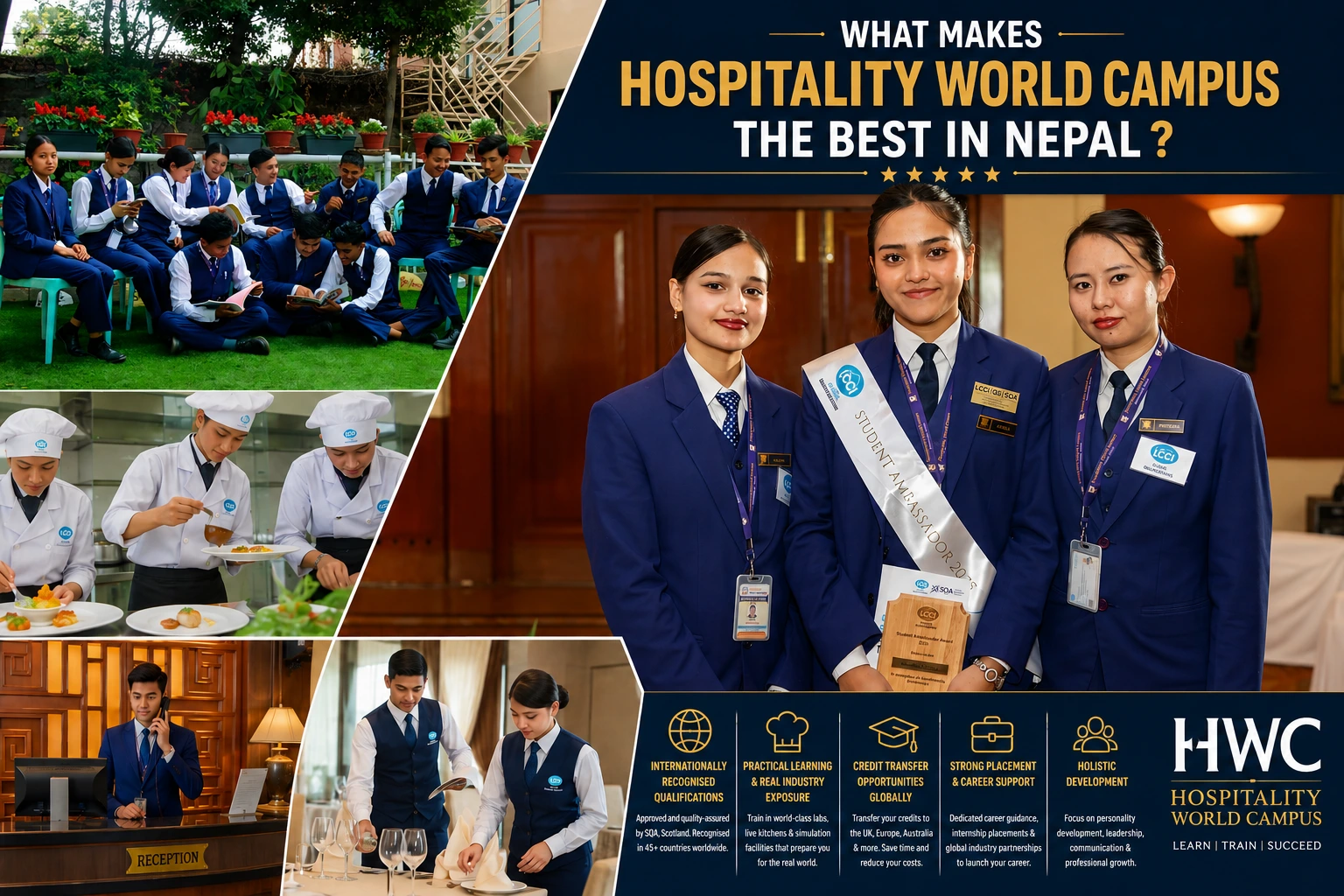
A diploma in hotel management in Nepalusually takes between 1 and 3 years to complete. Most students finish in 18 months to 2 years. The course includes both classroom study and practical training in real hotels and restaurants. Students can join after completing SEE, SLC, or +2, depending on which college they choose.
In this guide, you will learn everything about hotel management diploma programs in Nepal how long they take, who can join, what subjects are taught, what jobs you can get, and whether the course is worth your time and money.
How Long Does a Diploma in Hotel Management Take in Nepal?
Most hotel management diploma programs in Nepal take 18 months to 2 years. A short-term diploma in hospitality management can be done in just 1 year. Advanced diploma programs may last up to 3 years. The exact time depends on the college you choose and whether an internship is included in the program.
Program Type
Duration
Basic / Short-Term Diploma
1 Year
Standard Diploma
18 Months – 2 Years
Advanced Diploma
2 – 3 Years
Hotel Management Diploma Duration in Nepal
Not all diploma programs are the same. Here is a simple breakdown of the three main types you will find in Nepal.
One-Year Diploma Programs
A 1-year hotel management diploma is the shortest option. It teaches you the basics of hospitality how to welcome guests, serve food, manage rooms, and communicate well. This is a good choice if you want to enter the workforce quickly or if you are still deciding whether this is the right career for you.
You learn basic skills in front office, food service, and housekeeping. After finishing, you can apply for entry-level jobs in hotels and restaurants. If you are interested in shorter programs, a 1 year diploma in culinary arts in Nepal is another popular option that focuses specifically on cooking and kitchen skills.
Two-Year Diploma Programs
The 2-year hotel management diploma is the most common choice among students in Nepal. It gives you more time to learn both theory and practice. You spend time in classrooms learning the rules of hospitality, and you also do hands-on training in hotel departments.
Most colleges include a supervised internship in a real hotel during this program. This helps you understand how the industry actually works before you graduate. The diploma in hotel management in Nepal at this level is often the best balance between time, cost, and career readiness.
Advanced Diploma Programs
An advanced diploma can take up to 3 years. This program goes deeper into management topics like human resources, hotel accounting, event planning, and leadership. It is designed for students who want to move into supervisory or management roles faster after graduation.
If you want to focus more on management and guest services across different types of hospitality businesses, the advanced diploma in hospitality management is one path worth exploring.
Who Can Study a Diploma in Hotel Management in Nepal?
Students who have completed SEE or +2 can join most hotel management diploma programs in Nepal. Some colleges also welcome working adults who want to change careers. Requirements vary by college, so always check directly with the institution.
After SEE
If you have passed your SEE (Secondary Education Examination), you are eligible for many diploma programs. You do not need to wait until you finish +2. This is a big advantage you can start your career training earlier and enter the workforce sooner than your peers who take a traditional academic path.
Currently Studying +2
Those who are currently studying +2 can also easily join diploma in hospitality management in Nepal
After +2
Students who have completed +2 (Class 11–12) can also join diploma programs. In fact, some advanced diploma or higher diploma programs prefer students who have finished +2. Having a +2 background may also give you slightly more subject knowledge to build on.
Career Changers
You do not have to be a fresh school graduate to join. Many working adults in Nepal people already working in shops, offices, or small businesses also join hotel management diploma programs. If you want to switch to the hospitality industry, a diploma is a practical and relatively fast way to get qualified.
What Subjects Are Taught in a Hotel Management Diploma?
Hotel management is not just about cooking or cleaning rooms. It is a wide subject that covers many departments of a hotel or restaurant. Here is what you will typically study.
Front Office Operations
This subject teaches you how to handle hotel check-ins and check-outs, manage reservations, answer guest questions, and use hotel management software. The front office is the “face” of any hotel, and these skills are always in demand.
Food Production and Culinary Arts
You learn how to prepare different types of food Nepali, Indian, Chinese, Continental, and more. You spend time in a real kitchen learning knife skills, cooking methods, food safety, and how to manage a busy kitchen. If you love cooking, this subject alone makes the course worthwhile. Students who want to go even deeper into cooking can also look at the professional chef course – advanced or the diploma in global culinary arts in Nepal, which focus entirely on professional cooking skills.
Housekeeping Management
This subject covers how rooms and public areas in a hotel are cleaned and maintained. You learn about linen management, guest room setup, cleaning chemicals, and managing a housekeeping team. Good housekeeping directly affects how guests feel about a hotel.
Food and Beverage Service
You learn how to serve food and drinks to guests in a professional way, table setup, service styles, menu knowledge, bar basics, and how to handle difficult situations. Good service is what makes guests come back to a restaurant or hotel.
Hospitality Communication
English communication is a very important part of this subject. You learn how to speak to guests politely, write professional emails, handle complaints, and communicate effectively with your team. Strong communication skills can help you get better jobs and earn more.
Tourism and Hospitality Management
This subject gives you a bigger picture of Nepal’s tourism industry how it works, who the major players are, what tourists want, and how hospitality businesses make money. Understanding the business side helps you grow faster in your career.
Does a Hotel Management Diploma Include Internship Training?
Yes. Most diploma programs in hotel management in Nepal include a practical internship. Students work in real hotels, resorts, or restaurants for a fixed period usually 3 to 6 months as part of their course. This hands-on experience is included before graduation and is counted toward your final evaluation.
The internship is one of the most valuable parts of the program. Here is why it matters:
You get to work in a real hotel and understand day-to-day operations
You build professional contacts that can help you find a full-time job later
You learn things in practice that are hard to understand from a textbook alone
Many students get job offers from the same hotel where they interned
Some students even get internships in hotels in Pokhara, Chitwan, or Kathmandu and sometimes abroad
Before you apply to any college, ask them specifically about internship placements. A good college will have connections with reputed hotels and ensure you get a quality placement.
What Jobs Can You Get After a Hotel Management Diploma in Nepal?
After finishing your diploma, you can apply for many different jobs. Nepal’s growing tourism industry and international hospitality sector offer good opportunities for qualified graduates.
Front Office Executive
You manage the reception desk, welcome guests, handle check-ins, and solve problems. This is one of the most common starting positions. Starting salary in Nepal: NPR 18,000–25,000/month.
Hotel Receptionist
Similar to a front office executive but usually at a slightly more junior level. You answer calls, take bookings, and assist guests with their needs. Starting salary in Nepal: NPR 15,000–22,000/month.
Guest Relations Officer
Your main job is to make guests feel welcome and valued. You handle VIP guests, collect feedback, and make sure each stay is memorable. This role often leads to faster promotions.
Restaurant Supervisor
You oversee the daily running of a restaurant — managing staff, checking food quality, handling customer complaints, and ensuring smooth service. Starting salary in Nepal: NPR 20,000–30,000/month.
Food and Beverage Assistant
You assist in serving food and drinks in a hotel’s dining areas. This role helps you learn all aspects of restaurant operations and is a stepping stone to higher positions.
Housekeeping Supervisor
You manage a team of room cleaners, inspect rooms for quality, and ensure the hotel always looks its best for guests.
Hospitality Coordinator
Some graduates work in event management, travel agencies, airlines, or tourism companies. The skills from a hotel management diploma are useful across the entire hospitality and travel industry.
Working Abroad: Many Nepali hotel management graduates find jobs in the UAE, Qatar, Malaysia, South Korea, Japan, and Australia. These positions often pay significantly more than jobs within Nepal. A diploma combined with English proficiency and international internship experience greatly improves your chances of getting hired abroad.
Is a Diploma in Hotel Management Worth It in Nepal?
A diploma in hotel management can be a good investment for students in Nepal because of the steady growth in tourism, hotels, and international employment. The course gives you practical skills that help you get a job faster than a traditional 4-year degree, often at a lower overall cost.
Here are some reasons why many students in Nepal choose this path:
Nepal’s tourism keeps growing. More tourists mean more hotels, restaurants, and resorts — and more jobs for trained hospitality staff.
You can work globally. Hotel management skills are recognized worldwide. Nepali graduates regularly find work abroad.
Faster entry to the workforce. You can start working in 1–2 years instead of waiting 4 years for a bachelor’s degree.
Lower total cost. A diploma typically costs much less than a full bachelor’s degree.
Practical training is built in. Most programs include an internship, so you are already job-ready when you graduate.
However, it is also honest to mention some things to consider:
Starting salaries in Nepal are modest. Growth usually comes after 2–3 years of experience.
If you want a senior management role quickly, a bachelor’s degree may eventually be needed.
The quality of the program matters a lot choose a college with a good internship network and experienced teachers.
Diploma vs. Bachelor’s Degree in Hotel Management in Nepal
Factor
Diploma
Bachelor’s Degree
Duration
1–3 Years
4 Years
Eligibility
After SEE or +2
After +2
Cost
Lower (NPR 1.5L–4L)
Higher (NPR 4L–10L+)
Entry to Workforce
Faster
Slower
Academic Depth
Moderate
Advanced
Best For
Quick career start, practical skills
Long-term management roles
International Jobs
Good access
Better access for senior roles
Diploma vs. Certificate in Hotel Management in Nepal
Factor
Certificate
Diploma
Duration
3–6 Months
1–3 Years
Depth
Basic skills only
Comprehensive training
Internship
Usually not included
Usually included
Job Opportunities
Limited
Wider range
Suitable For
Quick skill boost
Full career start
Key Takeaways
Most hotel management diplomas in Nepal take 18 months to 2 years to complete.
Students can often enroll after SEE or +2.
Practical training and internships are usually included in the program.
Graduates can work in hotels, resorts, restaurants, airlines, and tourism companies in Nepal and abroad.
Diploma programs offer a faster and lower-cost path to a hospitality career than a bachelor’s degree.
Nepal’s growing tourism industry means demand for trained hospitality workers is increasing.
Frequently Asked Questions
How many years is a hotel management diploma in Nepal?
A hotel management diploma in Nepal usually takes 1 to 3 years. The most common programs are 18 months to 2 years long and include both classroom learning and hotel internships.
Can I study hotel management after SEE in Nepal?
Yes. Many colleges in Nepal accept students who have passed SEE for diploma programs in hotel management. You do not need to complete +2 first to start this course.
Is a diploma in hotel management enough to get a job?
Yes. A diploma in hotel management is enough to get entry-level jobs in hotels, restaurants, resorts, and airlines. Most diploma graduates find jobs within a few months of completing their internship.
What is the fee for a hotel management diploma in Nepal?
Fees for a hotel management diploma in Nepal generally range from NPR 1,50,000 to NPR 4,00,000 depending on the college, program duration, and facilities. Always confirm the full fee structure including exam fees and uniform costs before enrolling.
Which hotel management course is best after +2 in Nepal?
After +2, you can choose a 2-year standard diploma, an advanced diploma, or even a bachelor’s degree. The best choice depends on how quickly you want to start working and your long-term goals. If you want to specialize in cooking, a diploma in global culinary arts in Nepal or the professional chef course – advanced are also strong options.
Does hotel management require internships in Nepal?
Yes. Most diploma programs in hotel management in Nepal require students to complete an internship of 3 to 6 months in a hotel, resort, or restaurant before graduating. This practical training is a very important part of the course.
Can I work abroad after completing a diploma in hotel management in Nepal?
Yes. Many Nepali graduates find hospitality jobs in UAE, Qatar, Malaysia, Japan, South Korea, and Australia after completing their diploma. International employers value Nepali hospitality workers highly, especially those with proper training and English communication skills.
What is the salary after hotel management in Nepal?
Entry-level salaries in Nepal typically range from NPR 15,000 to NPR 30,000 per month depending on the job role, city, and hotel category. With 2–3 years of experience, salaries can grow significantly. Working abroad in countries like UAE or Qatar, salaries for hospitality workers often start from NPR 60,000–1,00,000+ equivalent per month.
Hotel Management in Nepal is growing day by day due to the booming of the hospitality and tourism industry. That’s what the reason that students are doing diploma in hospitality management, diploma in global culinary arts, and advanced professional chef courses, and other courses as well. Students do a diploma due to its features like a short-term course with global value, credit transfer to different countries, and job guaranteed in different hotels, airplanes, and travel agencies and many other events as well.
Nepal welcomed over 1.15 million international tourists in 2025, and 2026 has already started even stronger. January 2026 alone saw a 15.7% jump in arrivals compared to the same month last year. More tourists mean more hotels, more resorts, more restaurants, and more need for trained hospitality professionals. If you are a student who just finished +2 and are wondering what to do next, this guide is for you.
Hotel management is not just a course; it is a career that can take you from Kathmandu to the Maldives, from Pokhara to Dubai, from a small cafe in your hometown to running a five-star resort. In this blog, you will learn exactly what hotel management is, why it is growing so fast in Nepal, what jobs and salaries you can expect, which courses are available, and why 2026 is actually one of the best times to enter this field.
What is Hotel Management?
Understanding the Hotel Management Industry
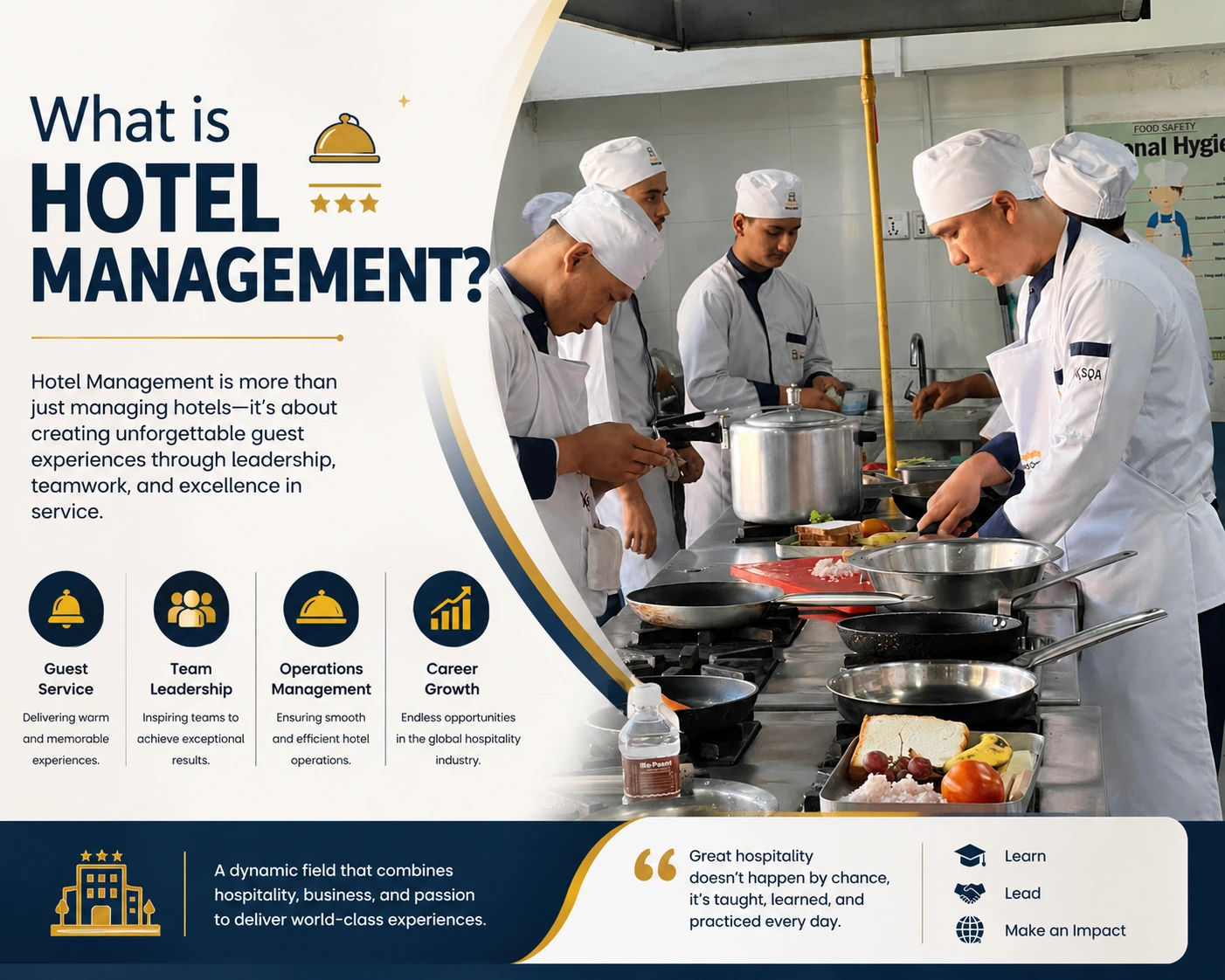
Hotel management is the study and practice of running hotels, resorts, restaurants, and other hospitality businesses. It covers everything from how a guest is welcomed at the front desk to how the kitchen operates, how rooms are kept clean, and how a business earns profit. It combines people skills, business knowledge, and practical service training all in one.
Unlike general management, which focuses mostly on theory and business administration, hotel management is very hands-on. You do not just sit in a classroom and read books; you practice cooking, you serve guests, you operate a real front desk, and you learn by doing. This practical approach is what makes it different and more exciting for students who enjoy working with people.
Major Departments in Hotel Management
Hotel management covers several key departments, each with its own role and career path:
Front Office: The first point of contact for guests. Receptionists, guest service agents, and front office managers work here. This team handles check-in, check-out, reservations, and guest queries.
Food and Beverage Service: This department manages restaurants, room service, banquets, and bars. You learn how to serve food professionally and manage dining operations.
Housekeeping: Keeping hotel rooms, corridors, and public areas spotless. Housekeeping managers ensure that cleanliness standards are always met and that guests feel comfortable.
Culinary or Kitchen Operations: Chefs and cooks prepare food for guests. This area teaches you culinary arts, food safety, menu planning, and kitchen management.
Hospitality Marketing and Sales: Getting guests to book the hotel through digital marketing, travel agencies, and corporate tie-ups. Sales teams also handle group bookings and events.
Event and Tourism Management: Planning conferences, weddings, cultural events, and tours. Nepal is growing fast in destination weddings and MICE (Meetings, Incentives, Conferences, and Exhibitions) tourism.
Skills Required to Succeed in Hotel Management
Hotel management is about people as much as it is about operations. The skills that help you succeed include:
Strong communication: You must speak clearly and listen carefully to guests from different countries and backgrounds.
Customer service mindset: You genuinely care about making the guest’s experience positive, even when things go wrong.
Teamwork and leadership: Hotels run on teams. You must work well with others and eventually lead your own team.
Time management: In a busy hotel, every minute matters. Breakfast must be ready at 7 AM, check-out by noon, and a banquet ready by 7 PM. You learn to manage this all at once.
Problem-solving: A guest’s room has no hot water, a reservation was double-booked, or the chef called in sick. Hotel managers face real problems every day and must solve them calmly and quickly.
Why Hotel Management is Growing Fast in Nepal in 2026
Growth of Nepal’s Tourism Industry
The numbers speak clearly. Nepal welcomed 1,158,459 international tourists in 2025, almost back to the pre-pandemic peak of 1,197,191 in 2019. Then in January 2026 alone, 92,573 tourists arrived, which is a 15.7% increase over January 2025. Industry experts are now projecting between 1.3 to 1.5 million international tourists in 2026, which would be a historic record.
Adventure tourism remains Nepal’s biggest draw Everest treks, Annapurna circuits, white water rafting, bungee jumping. But religious tourism is growing too, with Lumbini attracting pilgrims from India, Sri Lanka, Japan, and China. Domestic tourism has also increased, with Nepali families and young people travelling more within the country. All of this means demand for hotels and trained staff is rising every year.
Expansion of Hotels and Resorts in Nepal
Nepal’s hotel industry is expanding at a rate that has not been seen before. Major international brands are entering the Nepal market right now:
IHG Hotels and Resorts has signed agreements to open four properties in Nepal InterContinental Kathmandu Lazimpat (225 rooms), Hotel Indigo Pokhara, InterContinental Resort Pokhara Begnas Lake, and InterContinental Resort Chitwan. These four hotels will bring close to 500 international-standard rooms to Nepal.
Centara Hotels and Resorts from Thailand entered Nepal for the first time with the opening of the Himalayan Hideaway Resort Pokhara in January 2026, located in the scenic Kaskikot area with views of the Fishtail Mountain range.
Royal Tulip Chitwan, a brand under the Louvre Hotel Group, launched in Sauraha with an investment of Rs 1.5 billion, becoming Chitwan’s first international five-star resort.
Boutique hotels and eco-resorts are growing around trekking routes, lake sides, and heritage areas.
When international brands open hotels in Nepal, they need locally trained professionals who understand both global service standards and Nepali culture. That is exactly what a hotel management graduate can offer.
Increasing Demand for Skilled Hospitality Professionals
Nepal’s hospitality industry has a clear and well-documented shortage of trained manpower. Hotels are expanding, but the supply of trained graduates is not keeping pace. Employers consistently say that students with formal hotel management education those who have done practical training, understand hygiene and service standards, and can communicate in English are far more preferable than someone without any training.
When you study hotel management, you are not just getting a certificate. You are becoming the kind of professional that a Marriott, a Hyatt, or a luxury boutique resort in Pokhara will actually want to hire.
Scope of Hotel Management in Nepal
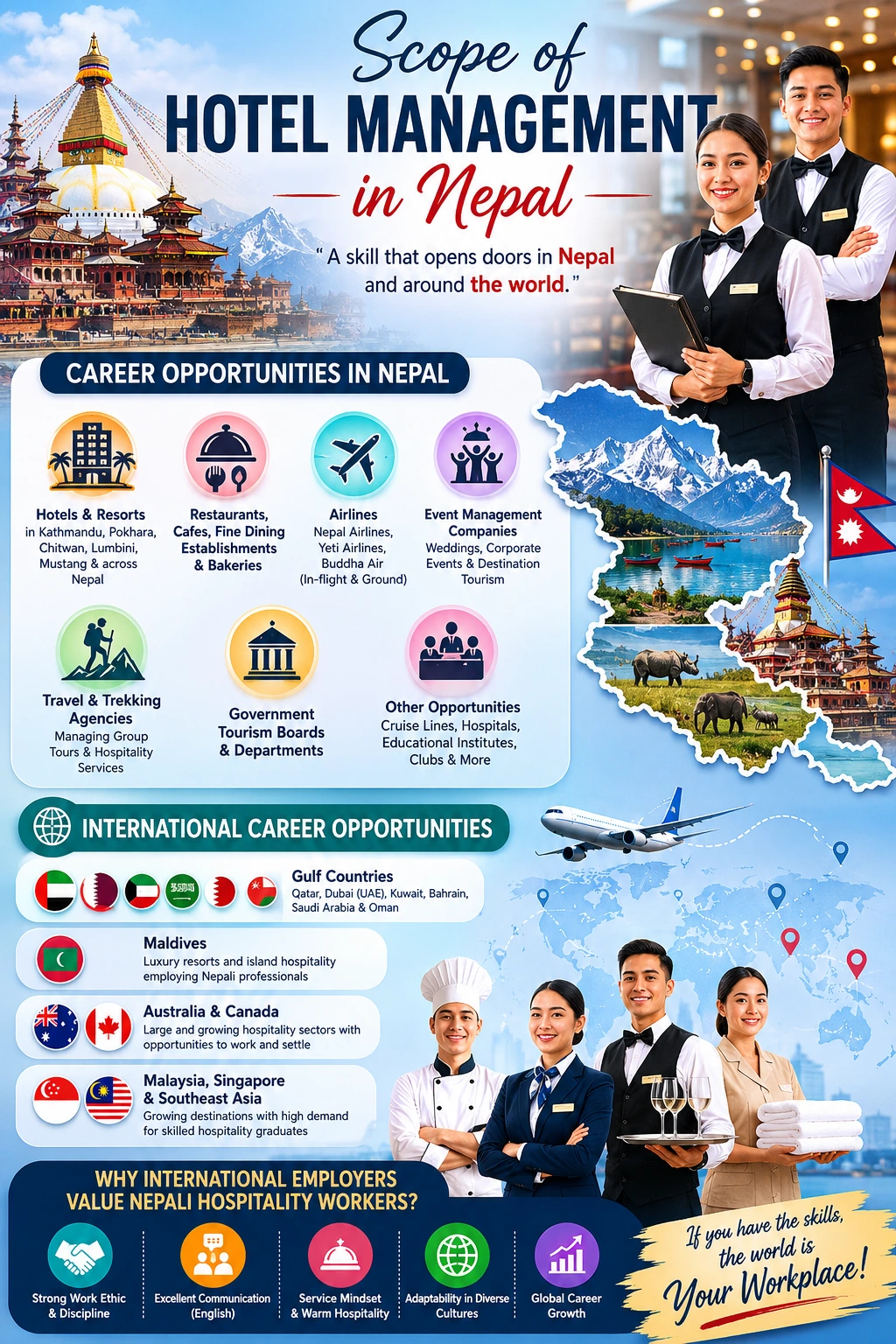
Career Opportunities in Nepal
After completing your hotel management course, you can work in a wide range of industries within Nepal itself:
Hotels and resorts in Kathmandu, Pokhara, Chitwan, Lumbini, Mustang, and across Nepal’s growing tourism belt
Restaurants, cafes, fine dining establishments, and bakeries
Airlines Nepal Airlines, Yeti Airlines, Buddha Air all have in-flight and ground hospitality roles
Event management companies handling weddings, corporate events, and destination tourism
Travel and trekking agencies where hospitality skills are valued for managing group tours
Government tourism boards and departments that need hospitality-trained staff
International Career Opportunities
This is where hotel management truly opens big doors. Hotel jobs abroad from Nepal are among the most accessible international opportunities for Nepali graduates. Countries actively hiring Nepali hospitality professionals include:
Gulf countries: Qatar, Dubai (UAE), Kuwait, Bahrain, Saudi Arabia, and Oman. International hotel groups like Marriott, Hilton, and Hyatt operate hundreds of properties in these countries and regularly hire trained Nepali staff. Most international employers in the Gulf provide accommodation, meals, transport, and medical insurance on top of the salary.
Maldives The island resort economy of the Maldives employs large numbers of South Asian hospitality workers, including Nepalis, across its luxury overwater resort properties.
Australia and Canada These countries have large and growing hospitality sectors, and their immigration programs create opportunities for skilled hospitality professionals to work and eventually settle.
Malaysia, Singapore, and Southeast Asia Growing as destinations for experienced Nepali hospitality graduates.
International employers value Nepali hospitality workers for service discipline, adaptability, and a genuine warmth that guests appreciate. If you have good English communication and practical hotel skills, the world is your workplace.
Entrepreneurship Opportunities
Not every hotel management graduate wants to work for someone else and that is perfectly fine. Nepal’s growing cafe culture, food delivery market, and tourism-linked economy create real entrepreneurship opportunities for hospitality graduates. You can start:
A cafe or specialty coffee shop Kathmandu and Pokhara’s cafe scenes are growing, and there is real demand for quality experiences
A restaurant or bakery: Food businesses are one of the most accessible ways to use hospitality skills
A homestay or guesthouse: Nepal’s government is actively supporting community homestay programs in rural and trekking areas
A catering company: Weddings, corporate events, and social gatherings are a steady market
An eco-resort or boutique hotel: Nepal’s nature tourism creates demand for small, experience-focused stays
When you study hotel management, you learn business accounting, marketing, and human resource management alongside service skills. This combination makes you a better entrepreneur, not just a better employee.
Top Career Options After Hotel Management in Nepal
Hotel Manager
The hotel manager oversees all hotel operations staff, guest satisfaction, budgets, and standards. It is the most senior role you can reach in a hotel property. In Nepal, experienced hotel managers with a bachelor’s degree can earn between NPR 100,000 to over NPR 200,000 per month at upper-scale properties. Getting there takes 8 to 12 years of experience, starting from entry-level roles and moving through supervisor and department head positions. In Kathmandu, a hotel manager with a bachelor’s degree earns an average of around NPR 2 million per year.
Chef and Culinary Expert
Nepal has a growing restaurant culture, and trained chefs are in demand. You can specialize in Nepali cuisine, Continental, Asian, or pastry and baking. International opportunities are particularly strong a trained Nepali chef can find work in hotel kitchens across the Gulf, Southeast Asia, Australia, and beyond. Culinary specialization is a path where your skill grows continuously throughout your career the better your cooking, the more you earn.
Front Office Executive
Front office work is where most hotel management graduates begin. As a front office executive, you manage guest check-in and check-out, handle reservations, deal with guest complaints, and make sure every guest leaves with a positive impression. Good communication skills and a pleasant personality are the main requirements. Entry salary starts at NPR 20,000 to 40,000 per month and grows quickly with experience.
Food and Beverage Manager
The F&B manager oversees restaurants, room service, bars, and banquets. This is a well-paying and dynamic role because food service is at the heart of a hotel’s daily revenue. F&B managers at quality hotels in Nepal can earn NPR 50,000 to 80,000 per month, with additional benefits like service charges that can add meaningful income on top of the base salary.
Housekeeping Manager
Housekeeping may not sound glamorous, but it is one of the most important departments in any hotel. Guests will forgive slow room service, but they will not forgive a dirty bathroom. Housekeeping managers at luxury hotels earn competitive salaries and often have strong opportunities to move into operations management roles. International luxury hotel chains particularly value well-trained housekeeping professionals.
Event and Tourism Manager
Nepal is growing as a destination wedding and MICE tourism destination. Couples from India and other countries are choosing Pokhara and Kathmandu for their wedding events. Corporate groups are using Nepal for conferences and retreats. Event managers plan and execute these experiences from décor and catering to accommodation and cultural activities. This is a creative, high-energy role with growing demand.
Salary of Hotel Management Professionals in Nepal in 2026
Entry-Level Salary in Nepal
Fresh hotel management graduates in Nepal typically start with monthly salaries ranging from NPR 20,000 to NPR 40,000. The specific amount depends on the hotel’s star rating, the city, and the department. In addition to the base salary, many hotels offer practical benefits that add real value meals during shift, accommodation if the property is a resort in Pokhara or Chitwan, uniform allowances, and service charge sharing that can add NPR 5,000 to 10,000 per month.
During internship, stipends range from NPR 8,000 to 15,000 per month, but the experience and hotel network you build is more valuable than the stipend itself.
Mid-Level and Experienced Salary
With two to five years of experience, salaries increase to NPR 30,000 to 60,000 per month as you take on supervisory roles. At the senior and management level department heads, food and beverage managers, operations managers salaries range from NPR 60,000 to 120,000 per month or more. A Hotel Manager with a bachelor’s degree in Nepal earns an average of around NPR 158,000 per month, with the top earners reaching NPR 250,000 or higher at premium properties.
International Salary Opportunities
This is the real earning potential for Nepali hospitality graduates. Working in Gulf countries, the Maldives, or Southeast Asia typically means a base salary that is 3 to 5 times what you would earn in Nepal for the same role, plus accommodation, meals, transport, and medical insurance provided by the employer. A front office executive earning NPR 25,000 in Kathmandu can earn the equivalent of NPR 80,000 to 120,000 per month in Qatar or Dubai without paying for rent or food. The savings potential is significantly higher, and the experience you gain accelerates your career back home or internationally.
Best Hotel Management Courses in Nepal
Diploma in Hotel Management
A diploma in hotel management is typically a one to two year program. It is the fastest way to enter the hospitality industry with proper training. Diploma graduates learn the practical skills needed for front office, food service, housekeeping, and kitchen operations. This is a good choice if you want to start working quickly or if you plan to go abroad for hotel work after your training.
Bachelor in Hotel Management (BHM)
The Bachelor of Hotel Management is a four-year undergraduate degree. It gives you both the practical skills and the management knowledge needed to grow into leadership roles. A BHM graduate is better positioned for promotion to supervisory and management levels than a diploma holder. The curriculum covers hotel operations, food and beverage management, housekeeping, hospitality marketing, hotel accounting, human resource management, and business communication all combined with hands-on practical training. Internship is a required part of the BHM program, and this is where students get their first real hotel experience and often their first job offers.
The average cost of a BHM program in Nepal ranges from NPR 4,00,000 to NPR 10,00,000 depending on the institution and its facilities.
Short-Term Hospitality Courses
For students who want to build specific skills quickly, short-term courses are available in areas like barista and coffee making, bakery and pastry, professional cooking, front office operations, and housekeeping fundamentals. These can be completed in a few weeks to a few months and are useful for students who want to start a small food business or secure a specific entry-level role.
Hotel Management Subjects and Skills You Will Learn
Practical Hospitality Training
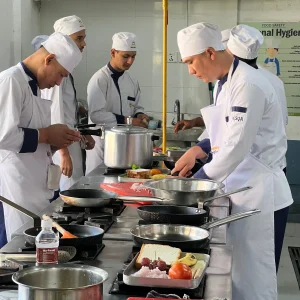
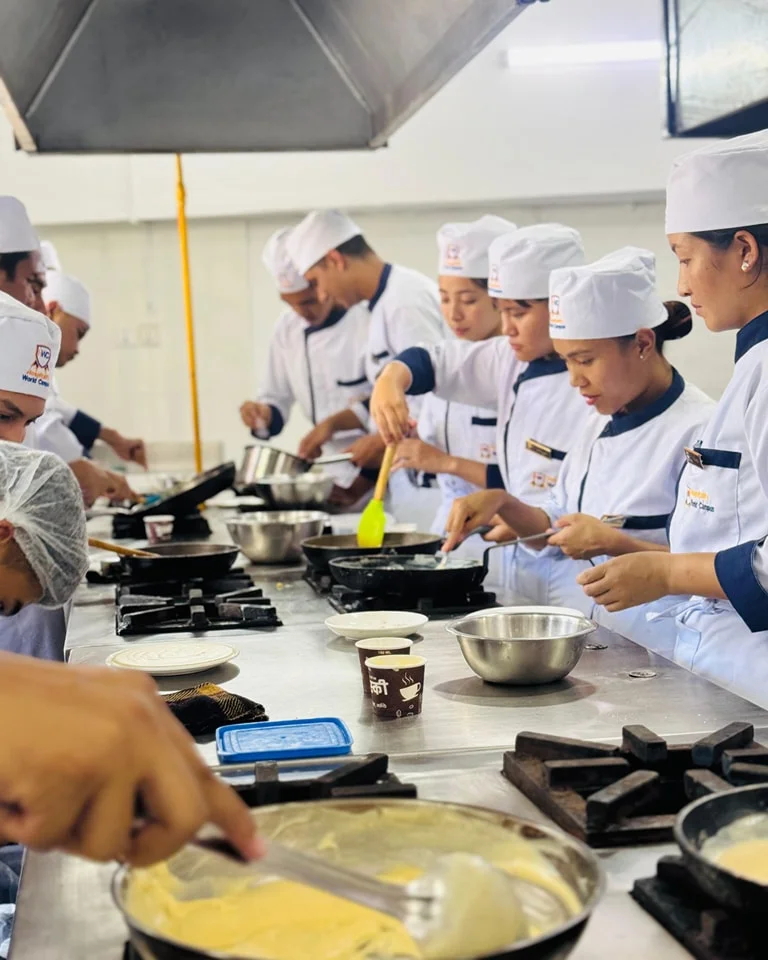
Hotel management education is built around doing, not just reading. In your course, you will actually cook in a training kitchen, practice serving guests at a training restaurant, make beds and maintain rooms in a housekeeping lab, and handle reservations at a simulated front desk. This practical training is what separates a hotel management graduate from someone who has just read about hospitality theory.
Personality and Communication Development
One underrated part of hotel management education is how much it develops you as a person. You will learn professional grooming standards how to dress, how to stand, how to make eye contact. You will practice public speaking, guest interaction role plays, and professional telephone etiquette. By the time you finish your course, the way you carry yourself and communicate will have changed noticeably. This confidence and polish is something employers in Nepal and abroad both notice immediately.
Business and Management Knowledge
As you progress through your BHM program, you also gain solid business knowledge that makes you a better manager. This includes hotel accounting understanding revenue, costs, and profit in a hospitality business. You will study hospitality marketing, learning how hotels attract guests through online platforms, travel agencies, and direct bookings. Human resource management teaches you how to recruit, train, and lead a team. These business skills are what allow hotel management graduates to eventually run their own businesses or reach general manager level in an international hotel.
Best Colleges for Hotel Management in Nepal
What to Look for in a Hotel Management College
Not all hotel management colleges in Nepal offer the same quality of education. When choosing a college, focus on these key factors:
Practical training facilities: Does the college have a real training kitchen, a front office lab, a housekeeping lab, and a training restaurant? Theory without practice is not real hotel management education.
Industry internship partnerships: Which hotels does the college send its students to for internships? A college with partnerships at four and five-star properties gives you a much stronger start than one without hotel connections.
Faculty experience: Are your teachers people who have actually worked in hotels or only academics? Real hotel experience in the classroom makes a significant difference.
Affiliation and recognition: Is the program affiliated with a recognized university? International affiliations add global credibility to your degree.
Placement support: Does the college help graduates find jobs? A good college tracks and supports its graduates after they finish studying.
Importance of Industry Internships
The internship period in a hotel management course is not just a requirement to complete it is often the most important part of your education. During an internship, you work in a real hotel, following real schedules, serving real guests, and making real mistakes that you learn from. You build a professional network of hotel industry contacts. Many students receive job offers from the same hotel where they interned. The quality of your internship hotel matters enormously.
Questions Students Should Ask Before Admission
Before you pay your admission fee and commit to a hotel management college, ask these questions directly:
What is the college’s affiliation and which university is the degree recognized by?
Which hotels does the college partner with for student internships?
What percentage of graduates from the last batch found employment within six months of graduating?
Can I visit the training kitchen and front office lab before enrolling?
What is the total course fee including all semesters, and are there any hidden costs?
Advantages of Studying Hotel Management in Nepal
Strong Career Growth Opportunities
Hospitality is one of the few industries where hard work, personality, and practical skill genuinely determine how fast you grow more than connections or family background. A motivated hotel management graduate who does good work during internship, keeps learning, and treats every guest interaction as important can reach supervisor level within two years and management level within five to seven years. The industry is large and still growing in Nepal, which means there is consistent room to move upward.
Opportunities to Work Abroad
For young Nepalis who want to see the world while building a career, hotel management is one of the most reliable paths. Unlike many foreign employment opportunities which are unskilled labor, hotel management graduates go abroad as skilled professionals as front office executives, as trained cooks, as housekeeping supervisors. This means better salary, better treatment, and a career that keeps developing internationally.
Personality and Confidence Development
Students who go through a proper hotel management program change in ways that go beyond technical skill. The training in communication, professional behavior, guest handling, and leadership builds genuine confidence. This confidence helps not just in a hotel career but in any professional or personal situation in life. Many hotel management graduates say that the personality development they experienced during their studies was as valuable as the job skills they learned.
Challenges in the Hotel Management Industry
Work Pressure and Long Hours
Let us be honest about the realities. Hospitality is not a nine-to-five job. Hotels operate 24 hours a day, 365 days a year. As a new professional, you will work morning shifts, evening shifts, and sometimes night shifts. Peak tourist season means busier days and longer hours. Weekends and festivals when your friends are resting may be your busiest working days. This is the reality of the industry, and it is important to understand this before choosing the field. The good news is that with experience and seniority, your schedule and conditions improve significantly.
Importance of Patience and Customer Handling
Not every guest is easy. Some guests complain about things that are not your fault. Some are rude, some are demanding, and some are simply having a bad day and taking it out on hotel staff. Learning to handle these situations professionally to remain calm, listen carefully, apologize genuinely, and resolve the issue is one of the most important skills you develop in hotel management. It takes patience, and it takes practice, but it makes you a stronger professional.
Competition in the Hospitality Industry
As more colleges offer hotel management courses and more graduates enter the market, competition for good positions increases. The way to stand out is to invest in continuous learning learn a second language (even basic Mandarin or Japanese can help significantly in Nepal’s hotel industry), stay updated on new hospitality technology, and build a genuine reputation for excellent service wherever you work. Your personal brand matters.
Is Hotel Management a Good Career in Nepal in 2026?
Who Should Choose Hotel Management?
Hotel management is the right choice for students who genuinely enjoy working with people, who take satisfaction from making someone’s experience comfortable and positive, who are curious about food, culture, and different parts of the world, and who do not mind a dynamic, fast-moving work environment. If you are someone who likes variety, who enjoys problem-solving, and who wants a career that can take you internationally, hotel management fits you well.
It is not the right choice for someone who wants a quiet, desk-based nine-to-five routine. Be honest with yourself about what kind of work environment suits you.
Future Scope of Hospitality Careers
The hospitality industry is evolving. Technology is becoming part of everyday hotel operations from online booking systems to digital check-in, from property management software to revenue management tools. Hotel management graduates who are comfortable with technology will have an advantage. Sustainable tourism is also a growing priority, with eco-resorts, responsible travel, and community tourism all creating new types of hospitality roles.
As Nepal aims to reach 2 million tourists annually in the coming years, the demand for trained hospitality professionals will only grow. The government is investing in new airports, road connectivity, and tourism infrastructure. The private sector is bringing in international hotel brands. All of this creates long-term career stability for trained hotel management professionals.
Final Verdict on Hotel Management Scope
Hotel management in Nepal in 2026 is a strong career choice. The industry is growing, international brands are entering the market, tourism numbers are recovering and climbing, and there is a genuine shortage of well-trained professionals. Salaries may start modestly, but they grow with experience. The international opportunities are real and accessible. And if you want to be your own boss someday, the business skills you learn in hotel management will support that goal too.
The key is to choose the right institution one with real practical training facilities, real hotel internship partnerships, and a genuine track record of placing graduates in the industry.
Frequently Asked Questions (FAQs)
What is the scope of hotel management in Nepal?
The scope is strong and growing. Graduates can work in hotels, resorts, restaurants, airlines, event companies, and travel agencies in Nepal. Internationally, countries like Qatar, Dubai, the Maldives, Australia, and Malaysia actively hire Nepali hospitality professionals. Entrepreneurship in food and hospitality is also a growing option.
Is hotel management a good career in Nepal in 2026?
Yes. Nepal’s tourism sector is expanding, international hotel brands are entering the market, and there is a documented shortage of trained hospitality professionals. The timing is genuinely good for students entering this field in 2026.
What is the salary of hotel management graduates in Nepal?
Fresh graduates typically earn NPR 20,000 to 40,000 per month in entry-level roles. With two to five years of experience, salaries reach NPR 30,000 to 60,000. Senior managers and department heads can earn NPR 60,000 to 120,000 or more. Many positions also include additional benefits like meals, accommodation allowances, and service charges.
Can hotel management students work abroad?
Yes. Countries in the Gulf region (Qatar, UAE, Kuwait, Bahrain), the Maldives, Malaysia, Australia, and Canada are among the most common destinations for Nepali hospitality graduates. Most international hospitality employers provide accommodation, meals, and medical insurance in addition to salary.
Which course is best for hotel management in Nepal?
A Bachelor of Hotel Management (BHM) provides the most comprehensive education and opens the widest career doors, including management-level roles and international opportunities. For quicker entry into the workforce, a Diploma in Hotel Management is a solid option. The most important factor, however, is the quality of the institution and its internship partnerships.
How many years does it take to study hotel management?
A BHM degree takes four years. A diploma program typically takes one to two years. Short-term specialized courses can be completed in a few weeks to a few months.
Is hotel management difficult to study?
Hotel management requires effort, but it is not academically overwhelming in the way some pure science or law programs are. The bigger demand is on your attitude and energy the willingness to work with people, to practice service skills repeatedly, and to maintain professionalism even under pressure. If you have the right attitude, the learning comes naturally.
What skills are needed for hotel management?
Communication, customer service mindset, teamwork, time management, problem-solving, and professional grooming are the core skills. English language proficiency is important for working in international standard hotels. A second language Mandarin, Japanese, or Arabic is increasingly valuable.
Conclusion
Key Takeaways About Hotel Management Scope in Nepal
Nepal’s tourism industry is growing, with over 1.15 million tourists in 2025 and a 15.7% surge in arrivals at the start of 2026. International hotel brands like IHG and Centara are opening multiple properties in Nepal. There is a clear shortage of well-trained hospitality professionals. Hotel management graduates can work across hotels, airlines, restaurants, event companies, and travel agencies in Nepal and abroad. Salaries start at NPR 20,000 to 40,000 at the entry level and grow significantly with experience. International earnings are 3 to 5 times higher than domestic, with employer-provided benefits.
Why 2026 is the Right Time to Enter Hospitality
The combination of recovering tourism, new hotel investments, growing international interest in Nepal, and a documented shortage of trained manpower makes 2026 an ideal time to enter hotel management. Students who start a four-year BHM program now will graduate into a market that will be even more active by 2030. Students who start a diploma program now can be working in a hotel within one to two years, right in the middle of Nepal’s hospitality expansion.
Next Step for Students Interested in Hotel Management
Start by visiting colleges that offer real practical training not just theory. Ask about their hotel internship partnerships. Talk to students who are already studying there. And then commit fully, because hotel management is a field where your effort and attitude directly determine how far you go.
If you are looking for a college in Nepal where hotel management education is both practical and career-focused, visit
If you are ready to take the next step, explore the hotel management courses offered at HWC Nepal (hwc.edu.np). HWC offers diploma in hospitality programs with real practical training, industry internship connections, and career placement support. Your hospitality career can start here.
FAQ on Hotel Management Scope in Nepal in 2026
What is the scope of hotel management in Nepal?
Hotel management has strong career scope in Nepal due to the rapid growth of tourism, hotels, resorts, airlines, and restaurants. Graduates can work in hospitality businesses across Nepal or apply for international jobs in countries like Qatar, the UAE, the Maldives, Australia, and Canada.
Is hotel management a good career in Nepal in 2026?
Yes. With Nepal’s tourism industry expanding and international hotel brands entering the market, hotel management is one of the fastest-growing career sectors in Nepal in 2026.
What is the salary of hotel management graduates in Nepal?
Fresh graduates usually earn between NPR 20,000 to NPR 40,000 per month. Experienced professionals and hotel managers can earn NPR 60,000 to NPR 2,00,000+ depending on experience, position, and hotel category.
Can hotel management students work abroad after graduation?
Yes. Hotel management graduates from Nepal are highly demanded in Gulf countries, the Maldives, Southeast Asia, Australia, and Canada. Many employers also provide accommodation, meals, and medical insurance.
Which hotel management course is best in Nepal?
A Bachelor of Hotel Management (BHM) is considered the best option for long-term career growth and management positions. A diploma in hotel management is suitable for students who want faster entry into the hospitality industry.
How many years does it take to study hotel management?
A BHM degree takes four years to complete, while diploma programs usually take one to two years depending on the institution.
What are the eligibility requirements for hotel management in Nepal?
Students who have completed +2 or equivalent education from any stream can apply for hotel management courses in Nepal.
Is hotel management difficult to study?
Hotel management is more practical than theoretical. Students who enjoy communication, teamwork, and hospitality usually find the course engaging and manageable.
What skills are required for hotel management?
Important skills include communication, customer service, teamwork, leadership, time management, problem-solving, and English language proficiency.
Does hotel management include practical training?
Yes. Hotel management courses include hands-on practical training in kitchens, restaurants, housekeeping labs, and front office operations, along with industry internships.
Introduction: Your Hospitality Career Starts in Just 6 Months
What if you could launch a professional career in the global hospitality industry without waiting years or spending lakhs studying abroad?
That is exactly what the 6 months certificate courses in hotel management in Nepal with 6 months of internships are designed to do. In Nepal’s fast-growing tourism and hospitality sector, trained hotel management professionals are in high demand from five-star properties in Kathmandu and Pokhara to luxury resorts in the Himalayas, and from international cruise lines to award-winning restaurants in Dubai and Australia.
At HWC (Hospitality World Campus), we offer a structured, industry-aligned 6-month hotel management course in Nepal that equips you with practical skills, an internationally recognized DHM Level 5 certificate, and direct pathways to continue your studies or work abroad. Whether you have just passed your SEE (Class 10) or are currently studying in +2, you can join this program and start building a career that truly travels the world.
This guide covers everything you need to know the course structure, eligibility, what you will learn, career opportunities, credit transfer destinations, and how to apply.
Why Choose a 6-Month Hotel Management Course in Nepal?
Fast-Track Your Career Without Wasting Years
Traditional degree programs in hospitality can take 3 to 4 years. A focused 6-month hotel management certificate course in Nepal gives you the foundational skills and industry confidence to enter the job market much faster. You will finish job-ready while your peers are still in their first year of college.
This short-duration format is especially valuable if you want to:
Enter the workforce quickly and start earning
Test the hospitality industry before committing to a longer programme
Complete a globally valued qualification before pursuing a bachelor’s degree abroad
Gain a practical head start on your hospitality career while still young
Ideal for SEE Pass-Outs and +2 Students in Nepal
One of the biggest advantages of the HWC hotel management course is its flexible eligibility. You do not need a bachelor’s degree or any prior hospitality experience. If you have passed your SEE (Class 10) or are currently enrolled in +2, you are fully eligible to join. This means students as young as 16 can begin building an international career foundation.
Many +2 students use this period productively studying their board subjects while simultaneously earning a professional hospitality certificate that opens doors globally.
Internationally Recognised Education at a Fraction of the Cost
Studying hotel management abroad can cost NPR 30 to 50 lakh or more. At HWC Nepal, you receive the same international-standard hospitality education at a fraction of that cost right here in Nepal. Our curriculum is designed to match global hospitality benchmarks, which is precisely why our credits are accepted for transfer to universities and colleges in Australia, the UK, Canada, Dubai, and across Europe.
DHM Level 5 Certificate – What It Is and Why It Matters
Understanding the Diploma in Hotel Management (DHM) Level 5
The DHM Level 5 (Diploma in Hotel Management, Level 5) is a professional, internationally recognised qualification SQA certified in the hospitality sector. It is awarded upon successful completion of the 6-month hotel management program at HWC and validates your competency across key areas of hotel and hospitality operations.
Unlike basic vocational certificates, the DHM Level 5 is structured to align with international qualification frameworks, making it a credible and valued credential whether you are applying for jobs in Nepal or seeking further education abroad.
Who Is Eligible to Enroll?
Admission to the HWC DHM Level 5 programme is straightforward:
Students who have passed SEE or Class 10 from any recognised board in Nepal
Students currently studying in +2 (the course can be taken alongside your +2 studies)
No prior hospitality experience required we start from the basics and build up
No entrance exam admission is based on your academic documents and a counselling session
Credit Transfer: Study in Nepal, Graduate Internationally
This is where the HWC programme becomes truly life-changing. The DHM Level 5 certificate is structured to allow credit transfer to internationally accredited institutions.
Credit transfer means you do not need to restart your education from scratch when you go abroad. The months you study in Nepal count toward your international qualification, saving you both time and tuition fees.
What You Will Learn: Course Curriculum Overview
The 6-month hotel management course at HWC Nepal covers three core operational areas of the modern hospitality industry. Every module combines classroom theory with hands-on practical training.
1. Front Office and Guest Services
The front office is the face of any hotel and the skills you learn here are directly transferable to properties worldwide.
Hotel reception and check-in/check-out procedures
Reservation systems and property management software
Professional guest communication, complaint handling, and upselling techniques
Telephone etiquette and concierge operations
Revenue management basics
2. Food Production and Culinary Fundamentals
Nepal’s tourism sector is expanding rapidly, and skilled food service professionals are among the most sought-after staff in the industry globally.
Kitchen organisation, brigade system, and mise en place
Food safety, hygiene standards, and HACCP principles
Cooking techniques and food presentation basics
Menu planning and portion control
International cuisine awareness
3. Housekeeping and Hotel Operations
Behind every spotless hotel room is a well-trained housekeeping team — a critical function often overlooked by hospitality students.
Room attendant procedures and professional cleaning standards
Laundry, linen management, and inventory control
Coordination between housekeeping, front office, and F&B departments
Guest privacy, security protocols, and lost-and-found procedures
Sustainable and eco-friendly housekeeping practices
4. Soft Skills, Communication, and Hospitality Etiquette
HWC’s programme goes beyond technical training. Our students also develop the professional confidence and communication skills that employers in the global hospitality industry specifically look for.
Business English and guest-facing communication
Professional grooming and workplace etiquette
Teamwork, leadership basics, and time management
Cross-cultural communication for an international workplace
Career Opportunities After Completing the Course
Graduates of the HWC 6-month hotel management course are prepared for a wide range of entry-level to supervisory roles across the hospitality industry both within Nepal and internationally.
Jobs in Hotels, Resorts, and Restaurants in Nepal
Nepal’s tourism industry is one of the fastest-growing sectors in the country, powered by trekking, wildlife tourism, pilgrimage circuits, and luxury mountain hospitality. Employers in Nepal actively hire DHM-certified candidates for:
Front Desk Officer / Receptionist
Guest Relations Executive
Food and Beverage Assistant
Housekeeping Supervisor Trainee
Room Service Attendant
Restaurant Host/Hostess
Key hospitality employers in Nepal include five-star chains such as Hyatt, Marriott, Radisson, Everest Hotel, and Dwarika’s, along with a growing number of boutique and eco-resorts.
Cruise Lines and Airlines: Hospitality Beyond Borders
The global luxury travel sector offers some of the most exciting opportunities for trained hospitality professionals. Cruise lines such as Royal Caribbean, MSC Cruises, and Norwegian Cruise Line regularly recruit from South Asia, including Nepal.
Airlines including Qatar Airways, Emirates, and Air Arabia also seek candidates with a foundation in guest service and hospitality operations for cabin crew and ground service roles.
Working Abroad with Credit Transfer
For students who complete the DHM Level 5 and wish to pursue further qualifications abroad, HWC’s credit transfer support enables you to:
Enrol in a hospitality degree programme in Australia or Canada with partial credit exemptions
Access student work rights in countries like Australia, where you can work part-time while studying
Build an international career portfolio within 2 to 3 years of leaving Nepal
Why HWC is the Right Place to Start Your Hospitality Career
Trainers with Real-World Hotel Industry Experience
At HWC, you do not learn hospitality from a textbook alone. Our faculty members include professionals who have worked in four-star and five-star hotel operations, food service management, and international resort environments. This means every lesson comes with real stories, real scenarios, and genuine industry insight.
Internship Support and Industry Placement Assistance
We connect our students with internship opportunities at reputed hospitality establishments in Nepal and abroad. Our placement support includes:
CV building and cover letter guidance
Mock interviews and grooming workshops
Industry networking events and career fairs
Ongoing alumni connections and job referrals
Modern Training Facilities
HWC’s campus includes purpose-built facilities for hospitality training:
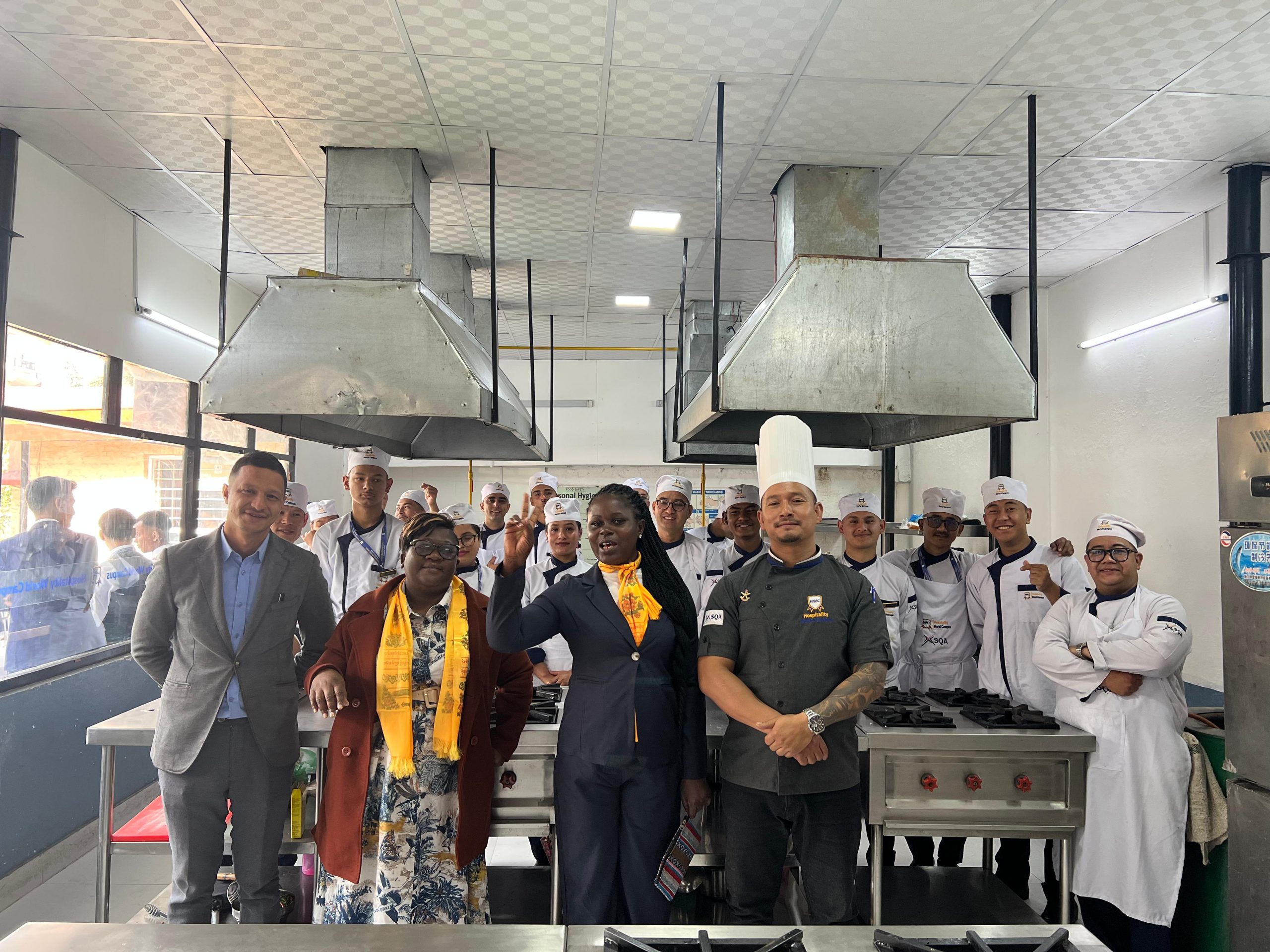
A fully equipped practical kitchen laboratory for culinary training
A mock front office setup replicating real hotel reception environments
Dedicated housekeeping training areas
A professional and welcoming learning atmosphere
Credit Transfer Guide: Where Your DHM Level 5 Takes You
Australia
Australia is one of the top study-abroad destinations for Nepali students, and the hospitality sector is among the strongest employment markets there. With the HWC DHM Level 5 credit transfer, you can apply to diploma or advanced diploma programmes in hospitality management at TAFE institutes or registered private colleges, with your Nepal credits counted toward your qualification.
Australia’s Temporary Graduate visa (subclass 485) also allows graduates to work after completing their studies, giving you valuable international work experience.
Canada
Canada’s hospitality and tourism industry is actively growing, particularly in cities like Toronto, Vancouver, Calgary, and Banff a global destination for mountain tourism. Canadian colleges such as George Brown, Humber, and SAIT recognise international hospitality qualifications and offer credit transfer pathways for DHM Level 5 graduates from Nepal.
United Kingdom and Europe
The UK hospitality sector employs over 3 million people and is one of the most globally connected industries. HWC maintains academic pathways with UK-affiliated institutions, and European hospitality schools in countries like Switzerland, Germany, and the Netherlands provide additional options for advanced study with credit recognition.
Dubai and the Middle East
Dubai, Abu Dhabi, and the broader GCC region are home to some of the world’s most prestigious hotel brands Burj Al Arab, Atlantis, Armani Hotel, and others. These properties recruit trained hospitality professionals from Nepal, and HWC graduates with a DHM Level 5 are positioned to apply for entry-level roles with a competitive edge.
How to Apply for the HWC 6-Month Hotel Management Course
Applying to the HWC hotel management programme is simple and straightforward. Here is the step-by-step process:
Step 1 – Contact HWC for Free Counselling Visit hwc.edu.np or contact the admissions office directly. Our counsellors will walk you through the course structure, fees, credit transfer options, and career pathways at no charge.
Step 2 – Submit Your Application Fill out the admission form online or in person. No entrance exam is required.
Step 3 – Submit Required Documents
SEE/Class 10 marksheet and character certificate (or +2 documents if applicable)
National ID card or citizenship certificate (or birth certificate for younger students)
2 recent passport-size photographs
Passport copy (if applying for credit transfer pathway)
Step 4 – Confirm Your Seat Once your documents are reviewed, you will receive an admission confirmation. Seats are limited in each batch, so early application is strongly advised.
Step 5 – Begin Your Hospitality Journey Start your classes, training, and internship placement and in just 6 months, hold a globally recognised DHM Level 5 certificate.
Frequently Asked Questions (FAQ)
Can I join the hotel management course after passing Class 10 (SEE) in Nepal?
Yes. The HWC 6-month hotel management certificate course is open to all students who have passed their SEE or Class 10 from any recognised board in Nepal. No further educational qualification is required for admission.
Can I study hotel management while I am in +2?
Absolutely. Many HWC students complete this course alongside their +2 studies. The schedule is designed to be flexible enough for students who are simultaneously enrolled in other academic programmes.
What is a DHM Level 5 certificate and is it recognised internationally?
DHM stands for Diploma in Hotel Management. Level 5 refers to the professional qualification level. The DHM Level 5 issued by HWC is structured to align with international qualification frameworks and is accepted for credit transfer to institutions in Australia, Canada, the UK, Dubai, and Europe.
How does credit transfer work from Nepal to abroad?
Credit transfer allows the academic credits you earn in Nepal to be recognized by partner institutions abroad. This means when you enroll in a hospitality diploma or degree program overseas, you may be exempted from certain subjects you have already completed, saving you time and tuition costs.
Are there internship opportunities during or after the course?
Yes. HWC actively supports students with internship placements at reputed hotels, resorts, and restaurants in Nepal. For credit transfer students going abroad, we also provide guidance on international internship opportunities.
Q: Where is HWC located and how do I contact them?
HWC (Hospitality World Campus) is located in Jawalkhel, Lalitpur. Visit hwc.edu.np for the latest contact details, campus address, course fees, and admission schedule.
What is the medium of instruction?
The course is taught in English and Nepali both, which also prepares students for international employment and further education abroad.
Conclusion: Learn in Nepal, Work Worldwide
The global hospitality industry does not wait and neither should you. A 6-month hotel management certificate course at HWC gives you a decisive head start: a professional qualification, real practical skills, industry connections, and a clear pathway to continue your education or launch your career anywhere in the world.
Whether your dream is to manage a mountain resort in Nepal, serve guests on a luxury cruise liner, work at a five-star hotel in Dubai, or complete your degree in Australia it all starts with one decision and six months of focused training.
Visit hwc.edu.np today to speak with a counsellor, check the next admission date, and secure your seat in Nepal’s most career-focused hotel management programme.
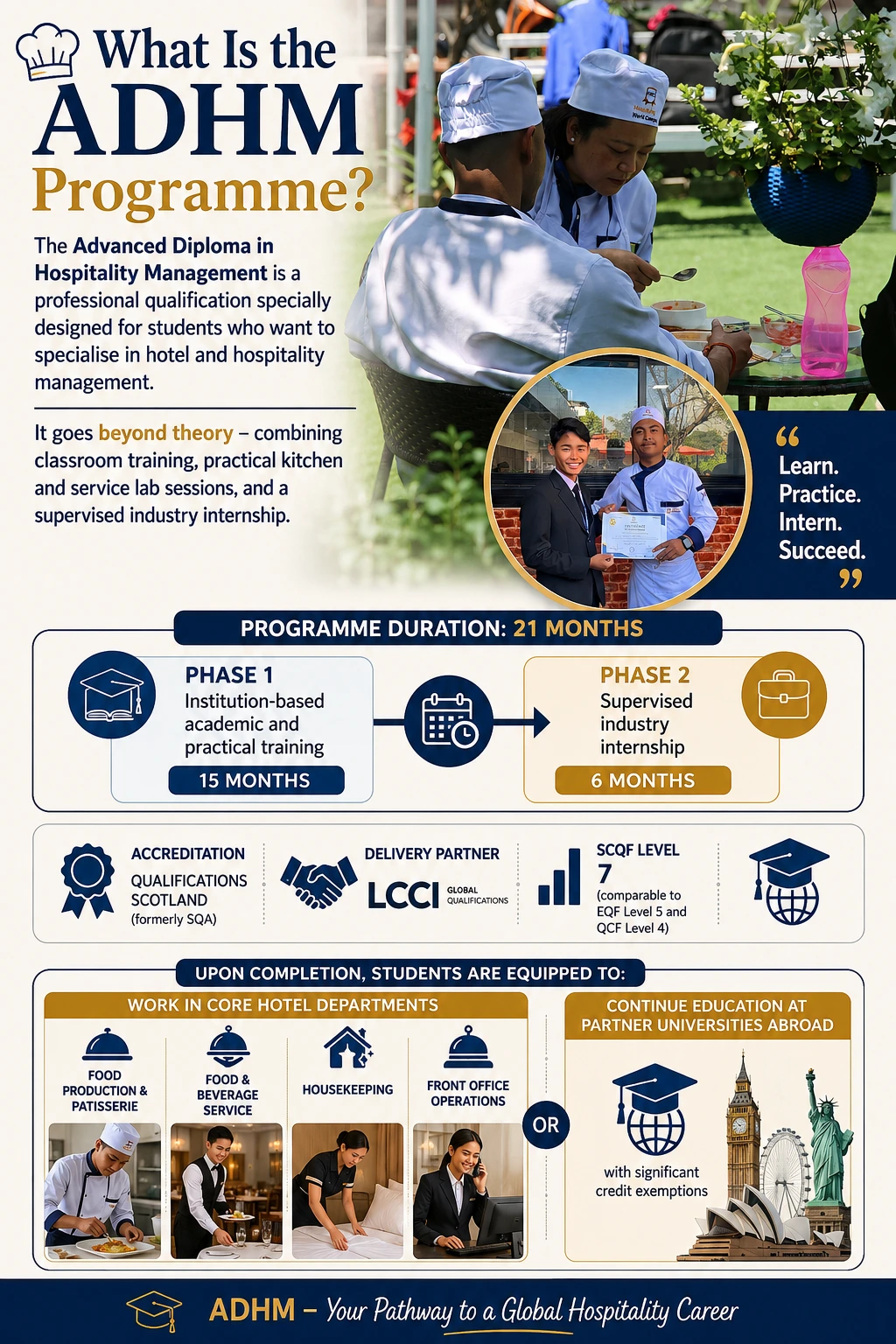
Accredited by Qualifications Scotland and delivered in association with LCCI Global Qualifications, the ADHM from HWC is recognized worldwide and credit-rated at SCQF Level 7, equivalent to Level 5 of the European Qualifications Framework (EQF) and Level 4 of the Qualifications and Credit Framework of England (QCF).
Whether your goal is to launch a career in Nepal’s growing hospitality sector, work in a 5-star hotel abroad, or progress to a bachelor’s degree at a top international university, HWC’s ADHM gives you the qualifications, skills, and industry experience to get there.
What Is the ADHM Program?
The Advanced Diploma in Hospitality Management is a professional qualification specially designed for students who want to specialize in hotel and hospitality management. It goes beyond theory, combining classroom training, practical kitchen and service lab sessions, and a supervised industry internship.
Programme duration: 21 months Phase 1 – Institution-based academic and practical training: 15 months Phase 2 – Supervised industry internship: 6 months Accreditation: Qualifications Scotland (formerly SQA) Delivery partner: LCCI Global Qualifications SCQF Level: 7 (comparable to EQF Level 5 and QCF Level 4)
Upon completion, students are equipped to work in core hotel departments, including food production and patisserie, food and beverage service, housekeeping, and front office operations, or to continue their education at partner universities abroad with significant credit exemptions.
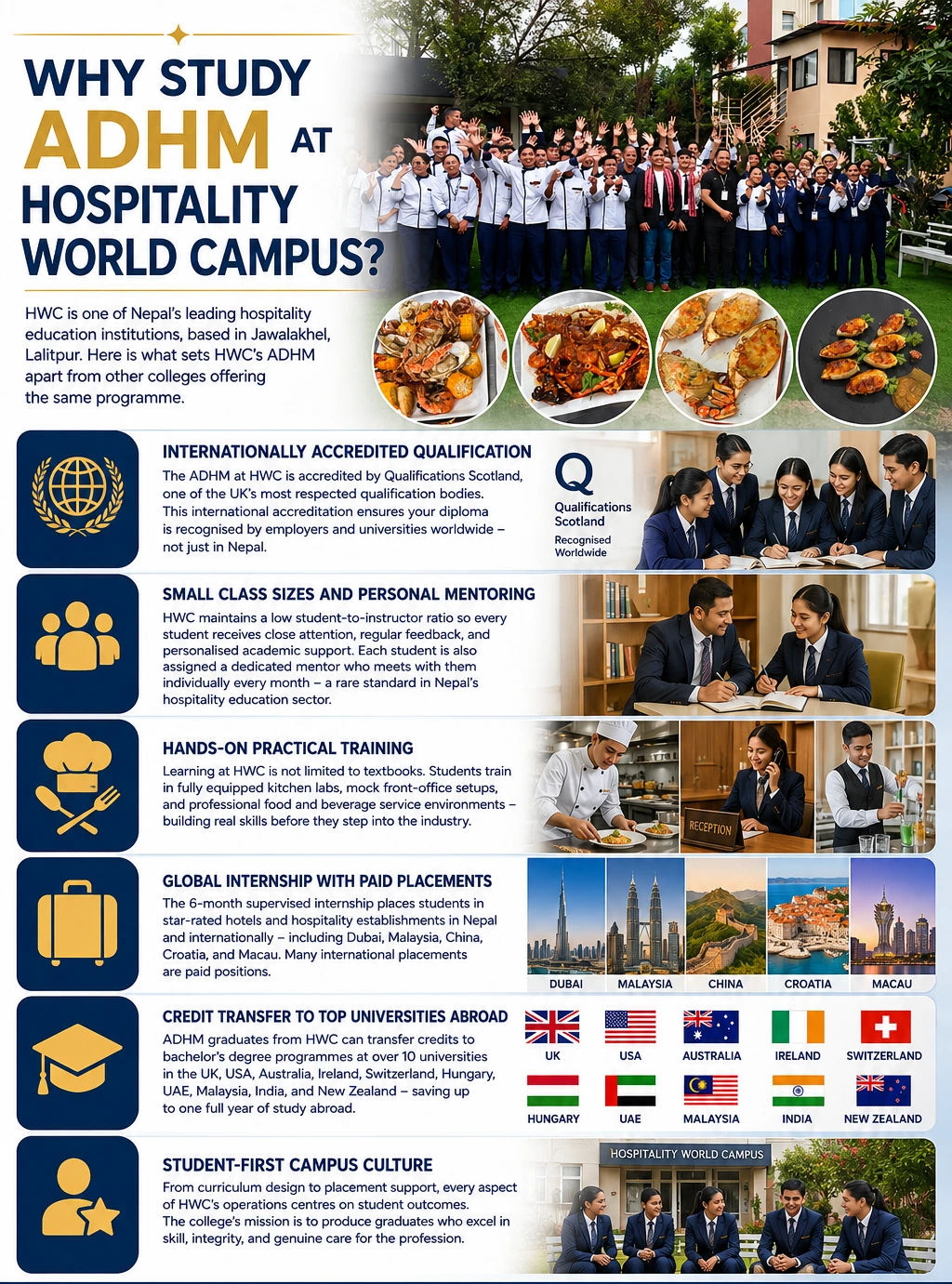
Why Study ADHM at Hospitality World Campus?
HWC is one of Nepal’s leading hospitality education institutions, based in Jawalakhel, Lalitpur. Here is what sets HWC’s ADHM apart from other colleges offering the same program.
Internationally Accredited Qualification
The ADHM at HWC is accredited by Qualifications Scotland, one of the UK’s most respected qualification bodies. This international accreditation ensures your diploma is recognized by employers and universities worldwide, not just in Nepal.
Small Class Sizes and Personal Mentoring
HWC maintains a low student-to-instructor ratio so every student receives close attention, regular feedback, and personalized academic support. Each student is also assigned a dedicated mentor who meets with them individually every month a rare standard in Nepal’s hospitality education sector.
Hands-On Practical Training
Learning at HWC is not limited to textbooks. Students train in fully equipped kitchen labs, mock front-office setups, and professional food and beverage service environments, building real skills before they step into the industry.
Global Internship with Paid Placements
The 6-month supervised internship places students in star-rated hotels and hospitality establishments in Nepal and internationally including Dubai, Malaysia, China, Croatia, and Macau. Many international placements are paid positions.
Credit Transfer to Top Universities Abroad
ADHM graduates from HWC can transfer credits to bachelor’s degree programmes at over 10 universities in the UK, USA, Australia, Ireland, Switzerland, Hungary, UAE, Malaysia, India, and New Zealand saving up to one full year of study abroad.
Student-First Campus Culture
From curriculum design to placement support, every aspect of HWC’s operations centres on student outcomes. The college’s mission is to produce graduates who excel in skill, integrity, and genuine care for the profession.
ADHM Curriculum: What You Will Study
The ADHM curriculum at HWC covers all core departments of a professional hotel operation, supplemented by management, business, and professional development modules.
Food Production and Patisserie
Students learn professional culinary techniques, international and Nepali cuisine preparation, kitchen management, food safety and hygiene, baking, and pastry arts developing a strong foundation for food production careers.
Food and Beverage Service
This module covers restaurant operations, table service standards, menu planning, bar and beverage management, banqueting and catering services, and customer relations preparing students for front-of-house careers in hotels, restaurants, and event venues.
Front Office Operations
Students develop competency in guest services, reservation management, check-in and check-out procedures, property management systems (PMS), concierge services, and front desk supervision.
Housekeeping Management
This module addresses room preparation and inspection standards, laundry operations, housekeeping supervision, hygiene and sanitation protocols, linen inventory management, and health and safety compliance.
Hospitality Business and Management
Students gain an understanding of hotel accounting basics, human resource management practices, marketing for hospitality, revenue management principles, and relevant hospitality laws and regulations.
Professional Development
HWC’s professional development module covers communication skills, personal grooming and presentation, interview preparation, career counseling, life skills, business etiquette, and hospitality leadership preparing students for workplace success from day one.
ADHM Internship and Industry Placement
The 6-month supervised internship is a core component of the ADHM programme not an optional add-on. It is where students translate classroom learning into professional performance.
HWC’s placement team works with a wide network of domestic and international hotel and restaurant partners to secure internship positions for each student.
Internship Destinations
Nepal – 3-star to 5-star hotels in Kathmandu Valley, Pokhara, Chitwan, and trekking properties
Dubai, UAE – International chain hotels and luxury resort properties
Malaysia – Hospitality groups and world-class resort operations
China – Metropolitan hotel properties in major cities
Croatia and Europe – Seasonal placements in boutique hotels and resorts
Macau and Southeast Asia – Luxury casino-resort and hospitality operations
What Students Gain from HWC Internships
Supervised practical experience in a real professional hospitality environment
Mentorship and progress tracking by HWC throughout the placement
A structured internship report that contributes to the final assessment
In many international placements, a paid position with accommodation
Direct employment offers many HWC students are hired full-time by their internship employer upon graduation
Credit Transfer: Study Abroad After ADHM
One of the most valuable benefits of completing ADHM at HWC is the ability to use your diploma for lateral entry into bachelor’s degree programmes at universities worldwide. Credit exemptions can save you significant time and tuition fees.
Universities Accepting ADHM Credit Transfer
Canterbury Institute of Management, Australia Enter BBA in Tourism and Hospitality with 8 course exemptions out of 24.
National University of Ireland Galway: Shannon College of Hotel Management, Ireland Enter Bachelor of Business in International Hotel Management with 90 credits exempted out of 240.
University College Birmingham, UK Enter the 4-year Bachelor in International Hospitality Business Management with 120 credits (1 year) exempted.
Queen Margaret University, Edinburgh, Scotland Direct entry into BA International Hospitality and Tourism Management.
Northern Arizona University, USA Enter Bachelor of Science in Hotel and Restaurant Management with 13 credits exempted out of 120.
Northwood University, USA Enter BBA in Hospitality Management with 38 credit exemptions.
IMI University Center, Switzerland Enter Bachelor of International Tourism and Hotel Management.
Britts Imperial University College, UAE Enter BBA in Tourism and Hospitality Management with 60 credits exempted out of 180.
Budapest Metropolitan University, Hungary Enter BA in Tourism and Catering with 90 credits exempted out of 210.
Berjaya University College of Hospitality, Malaysia Enter Bachelor in Hospitality Management with 16 credit exemptions.
Southern Institute of Technology, New Zealand Direct entry into 2nd year of Bachelor of Hotel Management.
Graphic Era Hill University, India Direct entry into 1st or 2nd year of Bachelor of Hotel Management.
Lovely Professional University, India Direct entry into 1st or 2nd year of BSc Hotel Management.
Contact HWC’s admissions team for the most current information on available credit transfer partnerships.
Career Scope and Job Prospects After ADHM
The global hospitality and tourism industry continues to grow, creating consistent demand for qualified professionals at every level. ADHM graduates from HWC are considered highly skilled professionals by employers in Nepal and internationally.
Career Roles for ADHM Graduates
Hotel and Resort Operations Front Desk Officer, Guest Relations Executive, Housekeeping Supervisor, Front Office Manager, Rooms Division Manager
Food and Beverage Restaurant Supervisor, F&B Manager, Banquet Coordinator, Catering Manager, Bar Manager, Sous Chef, Pastry Chef
Travel and Tourism Hotel Sales Executive, Tour Operations Coordinator, Hospitality Consultant, Tourism Officer
Entrepreneurship Restaurant owner, café operator, catering company, event management firm, or hospitality consultancy with some industry experience, ADHM graduates are well-positioned to launch their own ventures.
Industries That Hire ADHM Graduates
International hotel chains Marriott, Hilton, Hyatt, IHG, Radisson, Accor, and others
Luxury resorts and boutique properties across Nepal, India, Southeast Asia, and the Middle East
Airlines and in-flight catering services
Cruise lines operating in Mediterranean, Caribbean, and Asia-Pacific routes
Corporate catering and event management companies
Hospitals and healthcare hospitality a rapidly expanding sector in Nepal
Government tourism and hospitality institutions
Eligibility and Admission Requirements
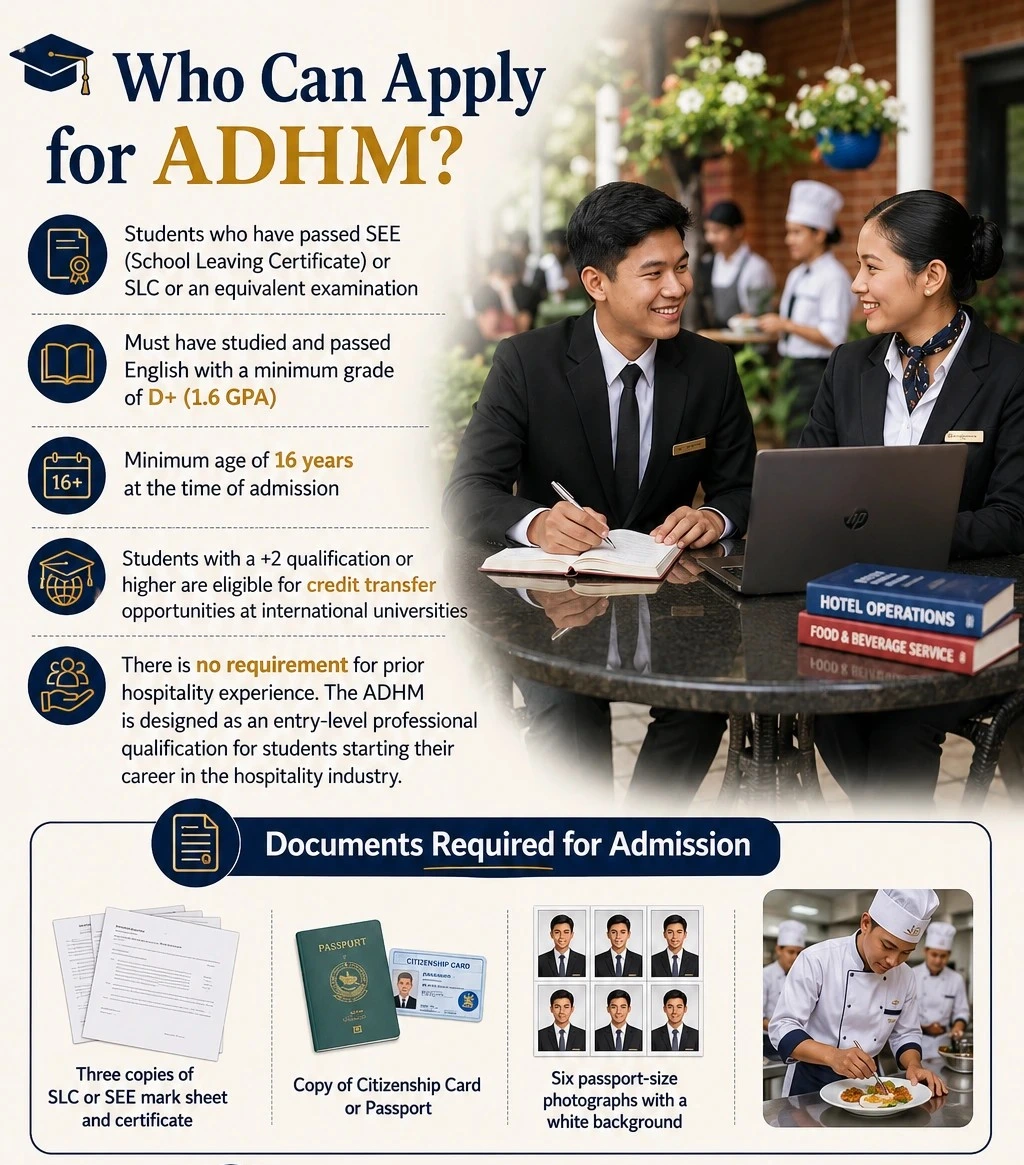
Who Can Apply for ADHM?
Students who have passed SEE (School Leaving Certificate) or SLC or an equivalent examination
Must have studied and passed English with a minimum grade of D+ (1.6 GPA)
Minimum age of 16 years at the time of admission
Students with a +2 qualification or higher are eligible for credit transfer opportunities at international universities
There is no requirement for prior hospitality experience. The ADHM is designed as an entry-level professional qualification for students starting their career in the hospitality industry.
Documents Required for Admission
Three copies of SLC or SEE mark sheet and certificate
Copy of Citizenship Card or Passport
Six passport-size photographs with a white background
Admission Intakes
1st Intake: June / July 2nd Intake: November / December
Seats are limited in each intake. Early application is strongly recommended to secure your place.
Frequently Asked Questions About ADHM in Nepal
Is the ADHM from HWC recognised internationally?
Yes. The ADHM at HWC is accredited by Qualifications Scotland and delivered through LCCI Global Qualifications. It is credit-rated at SCQF Level 7, which is internationally benchmarked and recognised by universities and employers across the UK, USA, Australia, Europe, and beyond.
What is the difference between DHM and ADHM?
The Diploma in Hospitality Management (DHM) is a 15-month foundation-level programme. The Advanced Diploma in Hospitality Management (ADHM) is the 21-month advanced qualification that covers all DHM content plus advanced management subjects, the 6-month industry internship, and the international credit transfer eligibility. The ADHM is the stronger qualification for both employment and further study abroad.
Can I get into a bachelor’s degree abroad after ADHM?
Yes. The ADHM qualifies you for lateral entry into bachelor’s degree programmes at over 13 universities in countries including the UK, USA, Australia, Ireland, Switzerland, Hungary, UAE, Malaysia, New Zealand, and India often with significant credit exemptions that reduce your remaining study time.
Are international internships paid?
Many of the international internship placements particularly in Dubai, Malaysia, China, and Croatia include a salary, and some include accommodation. Nepal-based placements may include meals or accommodation in lieu of pay. HWC’s placement team advises each student batch on the specific terms available.
How many intakes does the ADHM have per year?
HWC accepts students twice per year in June/July and again in November/December. Due to small class sizes, seats fill quickly and early applications are encouraged.
Where is Hospitality World Campus located?
HWC is located in Jawalakhel, Lalitpur easily accessible from across the Kathmandu Valley including Kathmandu, Bhaktapur, and Patan.
What makes HWC different from other colleges offering ADHM?
HWC combines the standard ADHM curriculum with a personal mentoring system, small class sizes, hands-on lab training, a dedicated internship placement team, and a student-first philosophy. Rather than treating students as a batch, HWC focuses on individual progress, career readiness, and long-term success in the industry.
Apply for ADHM at Hospitality World Campus
Take the first step toward a globally recognized hospitality qualification and a career in one of the world’s most dynamic industries.
Hospitality World Campus (HWC) stands as the premier destination for students aiming to excel in the global hospitality industry. With a commitment to world-class standards and industry-relevant training, HWC is widely recognized as the best college for hotel management and professional diploma programs in Nepal. By bridging the gap between classroom theory and international industry demands, HWC provides the practical skills and global recognition necessary to launch a successful career, whether you aspire to lead a luxury resort in Europe or manage a high-end property right here in Nepal.
The answer lies not just in the course name, but in international recognition, practical training, globally accepted qualifications, and the opportunity to transfer your credits to universities abroad. In this guide, we walk you through everything you need to know and show you why Hospitality World Campus (HWC) stands apart as Nepal’s most globally recognized hospitality institution.
“Your hospitality career can start in Nepal and grow worldwide.”
Why Hotel Management is One of the Best Career Choices in Nepal
Before choosing a college, it helps to understand just how big and how bright the future of hospitality truly is. Hotel management is no longer just about checking guests in or serving meals. It is a dynamic, internationally-driven career that can take you anywhere in the world.
The Growing Hospitality and Tourism Industry in Nepal
Nepal’s tourism sector has experienced remarkable recovery and growth in recent years. With international arrivals rising steadily, global hotel brands increasingly setting up operations in Kathmandu and beyond, and the government doubling down on tourism infrastructure, the demand for skilled, professionally trained hospitality workers has never been higher.
From luxury properties along the Himalayan foothills to boutique hotels in Pokhara and Chitwan, Nepal’s hospitality landscape is expanding rapidly. And every new property needs trained front office executives, skilled chefs, professional housekeeping managers, and experienced food and beverage specialists all of which are produced by strong hospitality programs like those at HWC.
Global Career Opportunities After Hotel Management
One of the most exciting things about a career in hotel management is that it is truly borderless. Your qualifications, especially when internationally recognized, can take you to some of the most extraordinary places on earth.
Graduates from globally accredited programs go on to work in:
Five-star and luxury hotel chains across the Middle East, UK, Europe, and Southeast Asia
International cruise lines sailing the Mediterranean, Caribbean, and beyond
High-end resorts in the Maldives, Bali, Switzerland, and more
World-class restaurants and fine dining establishments
Corporate event and conference management companies
The international salary potential is significant too. Hospitality professionals working in countries like the UAE, the UK, Australia, or Singapore can earn between USD 2,500 and USD 6,000 per month, depending on their role and experience figures that far exceed many other career paths available to Nepali graduates.
Multiple Career Paths Beyond Hotels
Many students do not realize that a hotel management degree is actually a gateway into a wide variety of industries and entrepreneurial paths. Beyond traditional hotel careers, graduates can pursue:
Culinary entrepreneurship: opening restaurants, cloud kitchens, and food businesses
Event management: planning weddings, corporate events, and international conferences
Travel and tourism: running travel agencies or destination management companies
Luxury hospitality consulting: advising hotels and resorts on service standards and operations
Food and beverage management: managing chains, franchises, or independent F&B outlets
The skills you develop, communication, problem-solving, customer service, leadership, and operational management, are transferable across dozens of industries worldwide.
Ready to explore a career that knows no borders? Start your hospitality journey with globally recognized qualifications at HWC.
What Makes a Hospitality World Campus One of the Best Colleges for Hotel Management in Nepal?
Not all hotel management colleges in Nepal are created equal. The difference between a degree that opens global doors and one that limits you to local opportunities comes down to a few critical factors. Here is what you should always look for and why HWC meets every benchmark.
Internationally Recognised Qualifications Matter
In the hospitality world, where you studied matters but what your qualification says on paper matters even more. A degree from a college with international accreditation tells global employers and foreign universities that your education has been verified and quality-assured by a trusted international body.
HWC’s hospitality programs are approved and quality-assured by the Scottish Qualifications Authority (SQA), Scotland, one of the most respected awarding bodies in the world. These programs are benchmarked on the Scottish Credit and Qualifications Framework (SCQF) and the European Qualifications Framework (EQF), which means:
Your qualification maps directly onto European academic levels
It is recognised by universities and employers across 45+ countries
You do not need to sit additional exams or verification processes to have your credential accepted internationally
You stand on the same academic footing as students who studied in the UK or Europe
This is not something most Nepali colleges can claim. Studying at HWC means your degree carries real, verifiable international weight from day one.
Practical Learning and Real Industry Exposure
Hospitality is a hands-on profession. The best hotel management colleges do not just teach you theory they put you in real environments where you develop real skills. At HWC, students train in:
Live training kitchens: professional-grade cooking facilities where you learn culinary arts, kitchen management, and food safety to international standards
Front office simulation labs: where you master check-in systems, reservation management, guest relations, and hotel software used in top properties worldwide
Housekeeping and room management labs: developing the meticulous attention to detail demanded by luxury hotels everywhere
Food and beverage service training: mastering table service, beverage knowledge, and the art of creating exceptional guest experiences
Every practical session at HWC mirrors what actually happens on the floor of a five-star hotel so by the time you enter the industry, you already feel at home.
Credit Transfer Opportunities to Different Countries
One of the most powerful advantages of studying at HWC is the ability to transfer your credits to universities in the UK, Europe, Australia, and other countries after completing your program in Nepal.
This matters enormously for students who dream of studying or working abroad. Instead of starting from scratch at an international university paying full tuition for three or four years HWC graduates can transfer their credits and complete a degree in significantly less time. This saves years of study and hundreds of thousands in tuition fees, while still earning a world-class international qualification.
Think of it this way: you study in Nepal, close to home, at a fraction of the international cost and when you are ready to take the global leap, your academic journey is already well underway.
Placement and Career Support
A great college does not just educate you it supports you every step of the way toward your career. HWC provides:
Dedicated career counselling to help students identify the right career path and international opportunities
Structured internship placements with leading hotel brands in Nepal and internationally
Industry partnerships that give students direct access to hiring managers and HR teams
Ongoing alumni support, including guidance for students pursuing credit transfer and international study pathways
Choose a college that prepares you not just for exams but for global hospitality careers.
Can You Join Hotel Management After SEE or While Studying +2?
This is one of the most common questions students and parents ask and the answer at HWC is a clear, resounding yes. You do not need to wait until you have completed your +2 to begin building a world-class hospitality career.
DHM Certificate Level 5: Open to SEE Graduates (Class 10)
HWC offers the Diploma in Hotel Management (DHM) at Certificate Level 5, which is specifically designed to be accessible to students who have passed their SEE (Class 10) examinations. This means:
You can begin your internationally recognised hospitality education immediately after completing your SEE
You start gaining practical, industry-relevant skills while many of your peers are still completing their +2
By the time your classmates are just finishing school, you could already have a certificate recognised in the UK and Europe, and be midway through an international career
The DHM Level 5 program is not a consolation path it is a fully quality-assured, SQA-approved qualification that gives students a genuine head start in the global hospitality industry.
Why Students Currently Studying +2 Also Choose Hospitality Programs at HWC
Even if you are currently enrolled in +2 whether in the science, management, or humanities stream there is no reason to wait. Many HWC students pursue hospitality education alongside their +2, using the program to:
Develop a complementary skill set that any future employer will value
Earn an internationally recognised qualification to accompany their +2 certificate
Gain real industry experience through HWC’s practical training and internship programs
Explore whether hospitality is the right long-term career path before committing further
No matter what stream you are studying, the skills you develop at HWC leadership, communication, guest management, culinary arts add extraordinary value to your profile.
Advantages of Starting Hospitality Education Early
The hospitality industry rewards experience. The sooner you start, the faster your career accelerates. Students who begin their hospitality education after SEE at HWC benefit from:
Faster entry into the workforce graduating earlier than peers who wait until after +2 or university
Earlier access to international pathways credit transfer opportunities abroad become available sooner
More accumulated experience every internship placement, practical training hour, and industry interaction adds to a compelling professional portfolio
Greater earning potential, sooner hospitality graduates often progress quickly, with significant salary growth within the first three to five years
The message is simple: the earlier you start, the further you go.
Passed SEE? Studying in +2? You can begin your international hospitality career today right here in Nepal.
International Recognition That Makes HWC Students Globally Competitive
When students and parents hear phrases like “internationally recognised” or “globally accredited,” it is natural to wonder what that actually means in practice. At HWC, these are not marketing buzzwords they are specific, verifiable credentials that change the trajectory of a student’s career.
What is the Scottish Qualifications Authority (SQA)?
The Scottish Qualifications Authority (SQA) is Scotland’s national awarding and accreditation body, responsible for developing, accrediting, assessing, and certifying qualifications. Founded and backed by the Scottish Government, SQA is one of the most rigorous and respected qualification authorities in the world.
When an institution receives SQA approval, it means that its courses, teaching standards, assessment methods, and quality assurance processes have been reviewed and certified by SQA. The institution must continue to meet those standards through ongoing quality reviews.
HWC is an SQA-approved institution, which means every hospitality qualification issued by HWC carries the backing of one of the world’s most trusted educational bodies. When you hand your certificate to an employer in London, Hamburg, Melbourne, or Dubai — they recognise it.
Understanding SCQF and EQF Benchmarking
Going even further, HWC’s programs are benchmarked on two major international qualification frameworks:
The Scottish Credit and Qualifications Framework (SCQF) is the national qualifications framework for Scotland, used to compare and understand qualifications across different learning and work contexts. SCQF levels are internationally understood and respected, particularly across the UK and Commonwealth countries.
The European Qualifications Framework (EQF) is a common European reference framework that links the qualifications systems of different countries, acting as a translation tool to make qualifications readable and comparable across Europe and beyond. The EQF covers qualifications from basic schooling through to doctoral level.
HWC’s DHM program is benchmarked at SCQF Level 5 / EQF Level 5 meaning it is directly comparable to qualifications held by students educated in Scotland and across Europe at the same level. This is why HWC graduates can transfer credits to international universities without having to repeat work they have already done.
How International Recognition Benefits HWC Students
The practical benefits of studying with SQA-approved, SCQF and EQF-benchmarked qualifications are substantial:
Credit transfer to international universities becomes straightforward, as your academic level is clearly established and understood
Global employers recognise your qualification without requiring additional verification or converting your credential
You are academically mobile you can study further, or change countries for work, with full confidence that your education is portable
You compete on equal footing with graduates from the UK, Europe, and Australia, giving you a significant advantage over holders of purely local qualifications
Visa and immigration processes in some countries recognise SCQF and EQF qualifications favourably for skilled worker assessments
In an industry that is as internationally fluid as hospitality, having a globally portable qualification is not a luxury it is a necessity.
Study in Nepal. Compete globally. HWC’s SQA-approved qualifications are recognised far beyond Nepal’s borders.
Best Hotel Management Courses Students Can Choose at HWC Nepal
HWC offers a range of professionally structured programs designed to cater to different career goals, interests, and starting points. Whether you dream of becoming a five-star chef, a luxury hotel general manager, or a hospitality entrepreneur, there is a program built for your future.
Diploma in Hospitality Management (DHM)
The DHM is HWC’s flagship program and the most comprehensive hospitality management qualification available in Nepal with full international recognition.
Who it is for: Students who have passed SEE (Class 10) or are currently studying +2 and want to begin an internationally recognised hospitality career immediately.
What you learn: Front office operations, housekeeping management, food and beverage service, hospitality law, communication and professional etiquette, customer service excellence, and hotel operations management — all aligned to international industry standards.
Why it stands out: The DHM at HWC is SQA-approved and benchmarked at SCQF/EQF Level 5, making it directly transferable to universities in the UK, Europe, and partner institutions worldwide. Graduates leave with both the theoretical knowledge and the hands-on practical skills that top hospitality employers demand globally.
Career outcomes: Front office executive, guest relations manager, food and beverage supervisor, housekeeping manager, hotel operations trainee, and multiple international pathways for further study and credit transfer.
Culinary Arts and Professional Cooking Programs
For students who are passionate about food and the culinary arts, HWC’s professional cooking programs offer world-class training in one of the hospitality industry’s most sought-after skill areas.
Who it is for: Aspiring chefs, food entrepreneurs, and anyone who wants to turn a passion for cooking into a professional international career.
What you learn: Classical and international cuisine, kitchen operations and management, food hygiene and safety (to international standards), pastry and baking arts, menu planning, and the business side of running a professional kitchen.
Why it stands out: Internationally qualified chefs are among the most in-demand professionals worldwide. A chef with SQA-recognised training can work in Michelin-starred restaurants in London, luxury resorts in the Maldives, or cruise ship kitchens sailing the world all before the age of 25.
Career outcomes: Line cook, sous chef, pastry chef, kitchen manager, culinary entrepreneur, and international opportunities in hotels, restaurants, cruise lines, and airlines.
Hospitality Management Programs with Global Exposure
For students who want a broader, more advanced understanding of how international hospitality businesses are run at the highest level, HWC’s hospitality management programs provide the strategic and operational knowledge to compete on a global stage.
Who it is for: Students looking beyond entry-level positions, aiming for management roles in international hotel chains, luxury properties, or the corporate hospitality sector.
What you learn: International hospitality standards and service excellence, revenue management and financial operations, human resources in hospitality, marketing and brand management for hotel properties, luxury guest experience design, and advanced food and beverage management.
Why it stands out: The program is structured around real international industry frameworks and delivers the kind of strategic thinking and management capabilities that global hotel brands actively recruit for from Marriott and Hilton to IHG and Four Seasons.
Career outcomes: Hotel manager, operations manager, revenue manager, F&B director, hospitality entrepreneur, and senior roles in international luxury hotel chains.
Whether you dream of being a chef, a hotel manager, or a hospitality entrepreneur HWC has a program designed for your future.
Facilities Students Should Expect from a Top Hotel Management College
The facilities at a hospitality college are not just a nice-to-have they are fundamental to the quality of education you receive. In an industry where practical skills determine your hireability, the environment in which you learn matters enormously. Here is what HWC offers.
Modern Practical Labs and Professional Training Kitchens
HWC’s campus is equipped with industry-standard practical facilities that replicate the real working environments students will encounter in their careers:
Professional training kitchens fitted with commercial-grade equipment, matching what you will find in hotel kitchens and restaurants across the world
Front office and reception simulation labs featuring hotel management software, reservation systems, and guest interaction practice areas
Housekeeping training rooms where students learn the meticulous standards of room preparation, linen management, and property presentation demanded by luxury properties
Food and beverage service areas designed to simulate fine dining, banquet, and café service environments
These are not classroom simulations; they are real, hands-on training environments that build the kind of practical confidence you simply cannot develop from a textbook.
Experienced Hospitality Trainers and Industry Mentors
The quality of your training is only as good as the people who deliver it. HWC’s faculty team brings direct, real-world industry experience to every session, not just academic credentials. Trainers have worked in leading hotel chains, international kitchens, and hospitality management roles, which means every lesson is grounded in how the industry actually operates.
Students at HWC benefit from mentors who can share genuine industry insights, guide career planning decisions, and connect students with professional networks that open doors. This kind of mentorship combining academic instruction with real-world wisdom is something that only a truly industry-connected institution can offer.
Internship and Industry Exposure Opportunities
Learning in labs is powerful, but nothing replaces the experience of working on the floor of an actual hotel or restaurant. HWC has established strong relationships with leading hospitality properties in Nepal and internationally, providing students with structured internship placements that deliver real, resume-building experience.
Through these placements, students:
Apply their classroom learning in live professional environments
Build relationships with hotel management teams and industry professionals
Develop the professional confidence and adaptability that top employers look for
Add verified, practical experience to their portfolios before graduation
Create networks that often lead directly to job offers, both in Nepal and abroad
A great hospitality college does not just teach theory; it prepares you for the real industry. Come see HWC for yourself. 👉 Visit the Campus at hwc.edu.np
Why Students Prefer International Hospitality Programs in Nepal
You might wonder: if an international education is so valuable, why not just go abroad from the start? The answer is that studying at HWC in Nepal gives you the best of both worlds international recognition and quality, at a fraction of the cost, right here at home.
An Affordable Alternative to Studying Abroad Immediately
Pursuing a hospitality degree directly in the UK, Australia, or Europe typically costs hundreds of thousands of rupees per year in tuition fees alone, before living expenses. For many Nepali students and families, this is simply not an accessible option at the start of a career.
HWC solves this problem. By offering SQA-approved, internationally benchmarked qualifications delivered in Nepal, HWC gives students access to a world-class education at a cost that is dramatically more accessible. You receive the same quality and global recognition without leaving home and without taking on the financial burden of living abroad before your career has even begun.
Easier Transition for Future International Studies
Studying at HWC does not close international doors; it opens them in a structured, strategically intelligent way. Because HWC’s qualifications are benchmarked on SCQF and EQF, students who want to continue their education at an international university can do so by transferring their HWC credits.
This means:
You might complete a 1–2 year program at HWC in Nepal, then continue at a UK or European university and graduate with a full bachelor’s degree in significantly less time
Your total educational investment time and money is reduced considerably compared to studying the full degree abroad
You arrive at the international university with relevant practical experience, recognised credentials, and a clear head start over students who are starting fresh
This pathway is not theoretical; it is a real, established route that HWC students have used to successfully continue their studies in the UK, Europe, and other countries.
Building Global Skills from Nepal
Perhaps most importantly, studying at HWC builds the soft skills and professional attributes that international hospitality employers specifically look for regardless of where you end up working.
From day one, HWC’s curriculum is aligned to international hospitality standards. Students develop:
Cross-cultural communication skills essential when working with guests and colleagues from around the world
Professional etiquette and grooming standards matching those of luxury international properties
Problem-solving and adaptability in fast-paced, service-driven environments
English language proficiency in professional hospitality contexts
International service mindset understanding and exceeding the expectations of global guests
By the time you graduate, you are not just a hospitality professional from Nepal; you are a globally competitive hospitality professional who happens to be from Nepal. The difference matters enormously in the international job market.
Start locally. Compete globally. Build your international hospitality career from Nepal with HWC.
How to Choose the Right Hotel Management College for Your Future
With multiple colleges offering hotel management programs in Nepal, making the right choice requires careful evaluation. Here is a practical framework to guide your decision and why, by every measure, HWC stands at the top.
Always Check International Accreditation and Recognition First
This is the single most important factor. A qualification that is only recognized within Nepal will severely limit your career options in an increasingly global industry. Before enrolling anywhere, ask:
Is the college’s qualification approved by an internationally recognized body?
Is the program benchmarked on a global qualifications framework?
Can credits from this institution be transferred to universities in the UK, Europe, or Australia?
If the answer to any of these is “no” or “we are not sure,” the college cannot offer you the global future you deserve. HWC answers all three with a clear, verifiable yes backed by SQA, SCQF, and EQF recognition.
Compare Practical Training Opportunities Not Just Theory
Hospitality is a skills-based profession. You cannot learn to manage a front desk from a textbook, and you cannot develop culinary expertise without spending hours in a professional kitchen. When evaluating colleges, ask to see:
The quality and modernity of training labs and kitchens
Whether the institution has genuine partnerships with industry for internship placements
How much of the curriculum is delivered through practical, hands-on training versus lectures and theory
Whether faculty have real industry experience, or are purely academic instructors
At HWC, practical training is at the core of every program. The facilities, faculty, and industry relationships are all structured to ensure that graduates are fully job-ready, not just academically qualified.
Look at Student Success Stories and Career Outcomes
The true measure of a college is what happens to its students after graduation. When researching hotel management colleges in Nepal, ask for concrete evidence of:
Alumni working in international hospitality roles
Students who have successfully completed credit transfers to foreign universities
Internship placement rates and the quality of partner hotels
Graduate salary data and career progression statistics
HWC students have gone on to pursue careers across the Middle East, Europe, and beyond, and the credit transfer pathway has enabled graduates to continue their education at international universities with measurable advantages in time and cost.
Frequently Asked Questions About Hotel Management in Nepal
Which is the best hotel management college in Nepal?
Hospitality World Campus (HWC) stands out as Nepal’s most internationally recognised hotel management college. With SQA-approved qualifications benchmarked on SCQF and EQF, modern practical training facilities, real industry internship placements, and established credit transfer pathways to international universities, HWC provides a level of global recognition and career preparation that no other Nepali college currently matches. Visit hwc.edu.np to learn more.
Can I study hotel management after SEE?
Yes, absolutely. HWC’s Diploma in Hotel Management (DHM) at Certificate Level 5 is specifically designed to be accessible to students who have completed their SEE (Class 10) examinations. You do not need to wait until after +2. Enrolling after SEE gives you a significant head start you can begin building an internationally recognized hospitality career while your peers are still completing high school.
Is hotel management good for jobs abroad?
Hotel management is one of the best qualifications for international career opportunities. The global hospitality industry employs millions of people in over 190 countries, and there is a consistent, growing demand for professionally trained hospitality workers everywhere from the UK and UAE to Australia and Singapore. HWC’s SQA-approved, SCQF and EQF-benchmarked qualifications ensure that graduates are recognised by employers and universities worldwide, giving them a genuine competitive edge in the international job market.
What is DHM Level 5?
DHM Level 5 refers to HWC’s Diploma in Hotel Management benchmarked at Level 5 on both the Scottish Credit and Qualifications Framework (SCQF) and the European Qualifications Framework (EQF). This means the qualification is equivalent to a Level 5 academic credential in Scotland and across Europe a standard recognized by universities and employers in the UK, European Union member states, and many other countries worldwide. It is not a purely local qualification; it is a genuinely portable, internationally recognized credential.
Are SQA-approved hospitality programs internationally recognised?
Yes. SQA (Scottish Qualifications Authority) is Scotland’s national awarding body, and its approval is respected by universities and employers across the UK, Europe, Commonwealth nations, and beyond. When a program carries SQA approval and is additionally benchmarked on SCQF and EQF, it is recognised within a framework that spans over 45 countries. HWC’s programs meet all of these benchmarks, making them among the most internationally portable hospitality qualifications available in Nepal.
Can students transfer credits to foreign universities?
Yes. One of the most significant advantages of studying at HWC is the credit transfer pathway that allows graduates to continue their education at partner universities abroad. Because HWC’s qualifications are benchmarked on SCQF and EQF, their academic value is clearly established and understood by international institutions. Students who complete their HWC program can transition to a foreign university to complete a full bachelor’s degree, saving significant time and tuition costs. Specific credit transfer pathways and partner institutions can be discussed with HWC’s counselling team.
What salary can hotel management graduates expect?
Salary expectations vary by country, role, and level of experience, but hotel management graduates with internationally recognised qualifications enjoy strong earning potential. In Nepal, entry-level positions in quality hotel properties typically offer NPR 25,000–60,000 per month, with management roles reaching NPR 100,000 and above. Internationally, entry-level hospitality roles in countries like the UAE, UK, Australia, and Singapore range from USD 1,800 to USD 3,500 per month, with management positions commanding USD 5,000–10,000 or more. Progression in hospitality can be rapid, and those who build experience and further qualifications internationally often see significant salary growth within five years.
Final Conclusion: Start Your Global Hospitality Career Today
Hospitality is More Than a Course – It is a Global Career
Hotel management at HWC is not just a qualification you add to your CV. It is the beginning of a career that can take you around the world managing luxury hotels, leading culinary teams, creating extraordinary guest experiences in destinations you may have only dreamed of visiting. The hospitality industry is one of the few fields where talent, ambition, and the right qualifications can genuinely take you anywhere.
International Recognition Gives HWC Students a Real Competitive Advantage
In a world where employers receive hundreds of applications for every desirable international position, your qualification needs to speak for itself before you even walk through the door. HWC’s SQA-approved, SCQF and EQF-benchmarked programs do exactly that. They signal to every employer and every university anywhere in the world that you have been educated to verified international standards. That is not a minor advantage. In the competitive global hospitality job market, it can be the difference between being shortlisted and being overlooked.
Nepal is Becoming a Strong Destination for Hospitality Education
For far too long, Nepali students who wanted a truly international hospitality education felt they had no choice but to go abroad. HWC is changing that narrative. With world-class international accreditation, modern practical training facilities, a faculty with genuine industry experience, and a credit transfer pathway to universities around the world, Nepal now has a hospitality college that can hold its own against institutions anywhere in the world.
You no longer need to leave Nepal to start building a global career. You just need to choose the right college.
Ready to Build Your Career in Global Hospitality?
At Hospitality World Campus (HWC), we give you everything you need to compete and succeed in the global hospitality industry:
✅ Internationally recognised programs approved by SQA, Scotland
✅ Qualifications benchmarked on SCQF and EQF recognised in 45+ countries
✅ DHM Certificate Level 5 open after SEE or while studying +2
✅ Credit transfer pathways to the UK, Europe, and beyond
✅ Professional training kitchens, labs, and industry internship placements
✅ Experienced faculty with real-world hospitality industry backgrounds
✅ Career counselling and international placement support
“Your future in global hospitality starts with the right college. Make the right choice today.”
If you are looking for a hospitality training institute near Kathmandu, Hospitality World Campus (HWC) is one name worth knowing first. HWC offers programs ranging from short-term barista and bakery courses to full diplomas and advanced diploma in hospitality management all with practical, hands-on training designed to get students job-ready. But this guide is not just about one institute. It will help you understand the full picture of hospitality education near Kathmandu, so you can make the right decision for your future.
Why Hospitality Education is Growing Around Kathmandu
Nepal’s hospitality industry is not slowing down. According to a January 2025 survey, the food and accommodation sector alone generates more than Rs 326 billion annually and directly employs over 106,000 people across 142,223 establishments. International visitor arrivals reached 1,147,567 in 2024 a 13.1% jump over the previous year. And in Bagmati Province, which includes Kathmandu, hotel investments and guest arrivals are both rising. International brands like IHG Hotels and Resorts and Hyatt Centric have open job listings in Kathmandu and Pokhara right now in 2026. The demand for trained hospitality professionals has never been clearer.
The result? More students are turning to hospitality training as a serious career path. Not as a backup plan but as a first choice. This guide gives you everything you need to understand why, and how to pick the right institute.
Who Should Read This Guide?
SEE graduates who want to enter the workforce quickly with practical, job-ready skills
+2 completers exploring hotel management and culinary arts as a career
Students who want short-term courses in barista training, bakery, or front office
Working professionals looking to upgrade their hospitality skills for better pay or international jobs
What You Will Learn in This Blog
What hospitality training actually covers and why it is different from regular academic education
Why Kathmandu is the best place in Nepal to study hospitality
Types of courses available near Kathmandu from short certifications to full diplomas
How to choose the right institute based on facilities, internships, and placement support
Real salary figures and international job opportunities after your training
What is hospitality training?
Understanding Hospitality Education
Hospitality training is the process of learning how to serve guests, run food and beverage operations, manage hotel departments, and work professionally in the tourism and service industry. It is different from a standard academic degree in one important way: you spend a large part of your time actually doing things cooking in a real kitchen, checking in guests at a front desk, setting up a banquet, and practicing how you speak and carry yourself in a professional environment.
Traditional education gives you theory and asks you to apply it later. Hospitality training puts you in situations that mirror real work from day one. This is why employers in Nepal and abroad prefer graduates who have gone through certified hospitality programs over candidates who have no formal training.
Main Areas Covered in Hospitality Training
Hotel management: Operations, front office, housekeeping, sales, and guest relations
Culinary arts and cooking: Professional kitchen skills, food preparation, and food safety
Bakery and pastry: Bread making, cake decoration, pastry production, and dessert preparation
Barista and bartending: Espresso-based drinks, coffee techniques, and beverage service
Front office operations: Reservations, check-in and check-out, guest handling, and PMS software
Housekeeping and customer service: Room setup, cleaning standards, and guest care
Skills Students Learn in Hospitality Institutes
Beyond technical skills, hospitality training builds the kind of professional you become. The real learning includes:
Communication: Speaking clearly with guests from different countries, handling complaints calmly, and writing professional emails and messages
Guest handling: Reading what a guest needs before they ask, solving problems quickly, and turning a difficult situation into a positive one
Leadership and teamwork: Hospitality runs on coordinated teams. You learn to follow instructions precisely, then eventually to lead your own team
Professional grooming and etiquette: How you look, how you stand, how you greet guests. These things matter enormously in hospitality, and they are formally trained, not assumed
Why Kathmandu is a Hub for Hospitality Training in Nepal
Presence of Nepal’s Top Hotels and Tourism Businesses
Kathmandu is Nepal’s capital and its main tourism entry point. Almost every international tourist who comes to Nepal passes through Kathmandu. The valley is home to the country’s largest concentration of four-star and five-star hotels, international restaurant chains, airline offices, tour operators, and event management companies. For a hospitality student, this concentration of industry creates something that no other city in Nepal can match: constant, real exposure.
When you study hospitality near Kathmandu, you are not learning in isolation. Your institute is surrounded by working hotels, busy restaurants, and active event venues. Internship opportunities at properties like Marriott, Hyatt Centric, and Dwarika’s which are all based in Kathmandu are accessible in a way they are simply not in smaller cities.
Better Career and Networking Opportunities
Nepal’s hotel recruitment events, hospitality fairs, and industry workshops largely happen in Kathmandu. This matters more than students realize. The connections you build during your training period — with hotel HR managers, event coordinators, senior chefs, and F&B managers — often become the direct bridge to your first job. Many students receive job offers not through formal applications but through the relationships they built during internship and training. Being near Kathmandu puts you inside that network from day one.
Availability of Practical Hospitality Facilities
Quality hospitality institutes near Kathmandu invest in proper training infrastructure: professional-grade kitchens with commercial equipment, front office lab setups that mirror actual hotel reception desks, housekeeping training rooms with proper linen and cleaning tools, and training restaurants where students serve real guests. This kind of infrastructure is difficult to build and maintain outside major cities, which is why Kathmandu-based training tends to be more thorough in practice than regional alternatives.
Best Hospitality Training Institutes Near Kathmandu
Here are some of the best hospitality training institutes near Kathmandu for hotel management, culinary arts, tourism, bakery, and hospitality-related professional courses.
1. Hospitality World Campus (HWC)
Located in Jawalakhel, Lalitpur, Hospitality World Campus (HWC) is one of the growing hospitality education institutions in Nepal. HWC offers internationally benchmarked programs such as Diploma in Global Culinary Arts, Diploma in Hospitality Management, and Advanced Diploma in Hospitality Management. Their programs are quality assured by the Scottish Qualifications Authority (SQA), Scotland, helping students gain globally recognized hospitality skills. The institute focuses heavily on practical learning, internships, communication skills, and industry exposure, making it suitable for students looking for careers in hotels, restaurants, cruise lines, airlines, and tourism industries.
2. Kathmandu Institute of Hospitality Management
KIHM is a well-known hospitality institute in Lalitpur that provides vocational hospitality education affiliated with CTEVT. The institute offers diploma and advanced diploma programs in hospitality management along with practical hospitality training. KIHM emphasizes communication skills, hotel operations, and tourism industry readiness.
3. International Hotel Training School (IHTS)
IHTS is popular for culinary arts, bakery, front office, and hotel management training. The school is known for hands-on practical training and industry-oriented hospitality programs. Many students join IHTS for bakery, pastry, and culinary specialization courses.
4. Silver Mountain School of Hotel Management
Silver Mountain is one of Nepal’s recognized hotel management schools offering hospitality education with international exposure. It is known for professional hospitality training, industry internships, and hotel management degree pathways.
5. Nepal School Of Hotel Management
This institute offers professional hotel management and hospitality training programs focused on practical hotel operations, culinary arts, and tourism-related skills. It has strong student reviews and practical training facilities.
6. Worldwide Institute of Hotel Management
Located in Lalitpur, this institute provides hospitality and hotel management courses designed for students seeking careers in hotels, restaurants, cruise industries, and tourism sectors.
7. Ouzo Institute of Hotel Management- Basundhara, Kathmandu
Ouzo Institute is known for practical hotel management, barista, bakery, and culinary training. Students often choose this institute for skill-based hospitality education and short professional courses.
8. Shangri-La Hotel Training Center
This training center provides hospitality-related vocational and professional skill training in Kathmandu. It is known for hospitality operational training and service-focused learning.
9. Greenland Hotel Management & Sushi Training Institute
Greenland Institute specializes in hotel management, sushi training, bakery, and culinary arts programs with practical hospitality training modules.
10. Nepal College of Travel and Tourism Management – NCTTM
NCTTM focuses on tourism management, travel operations, and hospitality-related academic programs designed for students interested in tourism and hotel sectors.
Types of Hospitality Courses Available Near Kathmandu
Diploma in Hotel Management
A Diploma in Hotel Management (DHM) is typically a one to two year program open to both SEE graduates and +2 completers. It covers the core departments of hotel operations: front office, food and beverage service, housekeeping, and basic culinary skills. A diploma is the fastest formal route into the hotel industry with proper credentials.
After completing a diploma, graduates can take up roles as front office assistants, food and beverage service staff, or housekeeping supervisors. With two to three years of experience, they can advance to supervisory and team leader roles. The diploma also serves as a foundation for students who want to continue to an Advanced Diploma or bachelor’s program later.
Culinary Arts and Professional Chef Courses
Chef courses in Nepal are growing in demand as the restaurant industry expands and international hotel properties raise their kitchen standards. A professional chef course covers knife skills, cooking techniques, food safety and sanitation, menu planning, kitchen organization, and a range of cuisines from Nepali to Continental, Asian, and bakery.
Entry-level chefs in Nepal start at NPR 12,000 to 20,000 per month at small restaurants, and NPR 18,000 to 26,000 per month at four-star and five-star Kathmandu hotels. With three to six years of experience, a Chef de Partie can earn NPR 45,000 to 90,000 monthly. Executive chefs at top Kathmandu properties earn NPR 90,000 to NPR 150,000 or more per month. The gap between entry and expert is wide — and it is filled by the quality of your training and your consistency in the kitchen.
HWC offers both a Professional Chef Course (Advanced) and a Diploma in Global Culinary Arts (DGCA) — both designed for students who want to build a serious career in the kitchen rather than just learn basic cooking.
Bakery, Barista, and Short-Term Hospitality Courses
Not every student wants or needs a full diploma. Short-term hospitality courses are ideal for students who want to start working quickly, launch a small food business, or add a specific skill to their existing career. The most popular short-term options near Kathmandu include:
Barista training: Learning espresso extraction, milk steaming, latte art, and cafe operations. Nepal’s cafe culture in Kathmandu and Pokhara is growing fast, creating real demand for trained baristas.
Bakery and pastry courses: Bread, cakes, pastry, and dessert production. These skills are valuable for working in hotel bakeries, independent bakeries, or starting your own business.
Front office and housekeeping courses: Short, skill-focused programs for students who want to enter hotel operations quickly without a full diploma.
HWC offers a Certificate in Bakery, Pastry and Patisserie and a Professional Certificate in Barista and Bartending — both practical, short-format programs with direct career application.
How to Choose the Best Hospitality Training Institute Near Kathmandu
Check Practical Training Facilities
Before you commit to any institute, visit in person and ask to see the training kitchen, the front office lab, and the housekeeping training room. If the kitchen has commercial-grade equipment real stoves, ovens, prep stations and the front office area looks like an actual hotel reception, that is a good sign. If the ‘practical lab’ is a demonstration room where the instructor cooks while students watch, that is not real practical training.
The ratio of practical hours to classroom hours also matters. In a quality hospitality program, practical sessions should account for at least 40 to 50 percent of the total training time. Ask the institute directly: how many hours per week are hands-on, and what exactly do students do during those sessions?
Look at Internship and Placement Support
The internship is often the most important part of hospitality training. It is where classroom skills meet real work, where you build your professional network, and where your first job offer often comes from. Ask every institute you visit the same questions:
Which hotels are your internship partners? Are these properties you have actually heard of three-star, four-star, or five-star hotels with real operational standards?
How does the placement process work? Does the institute introduce you to hotel HR managers, or do students find internships on their own?
What percentage of last year’s batch found employment within six months of completing the course?
Institutes that cannot answer these questions specifically — or give vague answers — likely do not have strong industry connections. This matters enormously for your career start.
Compare Course Fees and Value
Hospitality training fees near Kathmandu vary widely based on the level and duration of the course. Short-term courses (barista, bakery) typically cost NPR 15,000 to 50,000. Diploma programs range from NPR 80,000 to 200,000 depending on duration and institute. Advanced diploma or management-level programs can go up to NPR 300,000 to 500,000 for the full course duration.
Fee alone is not a reliable measure of quality. A more expensive program at an institute with weak practical facilities and no hotel internship connections is worse value than a moderately priced program at an institute with real industry partnerships. Focus on what you get for the fee: practical hours, equipment quality, internship access, and placement support.
Facilities to Look for in a Hospitality Institute
Modern Training Kitchens and Labs
A professional training kitchen is not optional it is the core of any culinary or hotel management program. Look for institutes with commercial ovens, proper stoves and cooktops, refrigeration and cold storage, clean prep areas, and individual workstations where each student can cook rather than only observe. The same standard applies to front office labs, which should have reservation software, communication systems, and a realistic reception layout.
Experienced Hospitality Trainers
The person teaching you kitchen skills should have actually worked in a hotel or restaurant kitchen. The person teaching front office operations should have actually managed a hotel reception. Industry experience in the instructor is not a bonus it is a requirement for effective hospitality education. Ask each institute: what is the professional background of your lead trainers? Have they worked in four-star or five-star hotels? Do they have international experience?
Instructors who combine real hotel experience with teaching ability will show you things that no textbook covers — how a busy Saturday kitchen actually operates, what a hotel GM expects from a new front desk executive, how to handle a difficult guest without losing your composure. That kind of knowledge can only come from someone who has lived it.
Personality Development and Communication Classes
This is one area many students overlook when choosing an institute and it is one of the most valuable things hospitality training provides. English communication training, professional grooming, public speaking practice, and guest interaction role plays are all part of a complete hospitality curriculum. If an institute does not have these as a structured part of the program, what you get is technical skill without the professional presentation needed to use it at a high level.
At Hospitality World Campus (HWC), personality development is built into the program through the mentoring system each student meets individually with a mentor monthly, and soft skills training runs alongside technical training throughout the course.
Career Opportunities After Hospitality Training
Hotel and Resort Jobs
Hotels and resorts remain the primary employer of hospitality graduates in Nepal. The most common entry-level roles include:
Front Office Executive: Managing guest check-in, check-out, reservations, and communication. This is often the first role for diploma graduates with strong communication skills.
Food and Beverage Service Staff: Restaurant service, banquet service, and room service operations. F&B roles require attention to detail, service etiquette, and energy.
Housekeeping Staff and Supervisors: Maintaining room cleanliness, linen management, and public area upkeep. Housekeeping supervisors at luxury properties have significant responsibility and reasonable pay.
Kathmandu has the highest concentration of hotel jobs in Nepal. Properties ranging from boutique hotels in Thamel to five-star resorts in the outskirts of the valley regularly hire trained hospitality graduates. Job portals like Kumari Job and Neco Jobs show consistent new openings in Kathmandu’s hotel sector every week.
Culinary and Bakery Careers
Trained chefs are in genuine shortage across Nepal. As international hotel brands set higher kitchen standards and as Kathmandu’s restaurant scene continues to grow, the demand for formally trained culinary professionals keeps rising. Entry-level commis chefs at five-star hotels in Kathmandu start at NPR 18,000 to 26,000 per month. By mid-career — three to six years in — a Chef de Partie earns NPR 45,000 to 90,000 monthly. Head chefs and executive chefs at top properties earn NPR 90,000 to 150,000 or more.
Bakery and pastry is a growing niche with specific demand. Specialized pastry chefs with proper training earn NPR 60,000 to 90,000 at established hotel properties. The bakery business also offers clear entrepreneurship potential — Kathmandu’s growing demand for quality bread, cakes, and pastry products means a skilled baker with business sense can build a real customer base.
Entrepreneurship Opportunities
Hospitality training gives you the skills to work for others — and the knowledge to eventually work for yourself. Students who complete hotel management or culinary programs and want to start their own business have real advantages: they understand food cost and menu pricing, they know hygiene and safety standards, they can manage a small team, and they understand what guests actually want from a food or accommodation experience.
Practical entrepreneurship options for hospitality graduates in Nepal include starting a specialty cafe, a bakery, a catering business, a community homestay, or a small restaurant. Nepal’s growing domestic tourism and food culture create genuine market space for well-run small hospitality businesses — especially those that offer a distinct product or experience.
Salary and Job Scope After Hospitality Courses in Nepal
Entry-Level Hospitality Salaries
Entry-level hospitality salaries in Nepal range from NPR 12,000 to NPR 30,000 per month, depending on the role and the property. At small restaurants and guesthouses, waiters and receptionists typically start at NPR 12,000 to 18,000. At three-star and four-star hotels in Kathmandu, trained graduates with a diploma start at NPR 18,000 to 30,000. Five-star properties pay NPR 22,000 to 35,000 for entry-level diploma holders in operations roles.
On top of base salary, many hotel positions include practical benefits: meals provided during shift, accommodation allowances if the property is outside the city, uniforms, and service charge sharing — which at busy hotels can add NPR 5,000 to 12,000 per month on top of the base salary. For fresh graduates, these benefits are meaningful additions to the total compensation.
Internship stipends during training range from NPR 8,000 to 15,000 per month. The stipend is secondary — the real value of internship is the work experience, the industry contacts, and the performance review that often becomes your first job reference.
Career Growth in Hospitality Industry
Hospitality is one of the few industries in Nepal where growth is genuinely performance-based. A motivated diploma graduate who works hard during internship, takes every shift seriously, and continuously improves can reach supervisor level within two years and team leader or junior manager level within four to five years. With mid-level experience, salaries reach NPR 30,000 to 60,000 per month. Department heads and operations managers at quality hotels earn NPR 60,000 to 120,000 or more.
The hotel industry also rewards specialist skills. A front office executive who becomes fluent in Mandarin or Japanese becomes significantly more valuable in Kathmandu’s hotel market. A chef who develops expertise in a specific cuisine commands higher pay. Continuous skill building is both possible and clearly rewarded in this industry.
International Hospitality Job Opportunities
This is where the earning potential of hospitality training becomes most visible. Nepali hospitality workers are consistently hired in Qatar, the UAE (Dubai), Kuwait, Bahrain, Oman, the Maldives, Malaysia, and Australia. International hotel employers in these countries — including Marriott, Hilton, Accor, and IHG properties regularly recruit trained Nepali hospitality staff because of their reputation for genuine warmth and service discipline.
A front office executive earning NPR 22,000 in Kathmandu can earn the equivalent of NPR 80,000 to 130,000 per month in Qatar or the UAE — with accommodation, meals, transport, and medical insurance all provided by the employer. The net savings potential is dramatically higher. More importantly, working internationally adds a credential to your career that is recognized wherever you go next. Many Nepali hospitality professionals who spend three to five years abroad return home to take senior management roles at a level they could not have reached as quickly through domestic experience alone.
Benefits of Studying Hospitality Near Kathmandu
Better Industry Exposure
Kathmandu gives you direct access to Nepal’s most active hospitality market. The Bagmati Province, which includes Kathmandu Valley, has witnessed the largest hotel investment in Nepal’s history and continues to see rising guest arrivals. Studying hospitality here means your internship is likely in a property that is genuinely busy not a slow guesthouse with minimal operations, but a working hotel with real service demands that teach you real skills under pressure.
Higher Chances of Practical Learning
The density of hospitality businesses near Kathmandu means that the practical learning opportunities extend beyond your institute’s walls. Guest interaction and service practice happen in real restaurants you can visit, real cafes where trained baristas work, and real hotels where you can observe and eventually participate in professional operations. This environmental exposure accelerates learning in ways that are hard to replicate in cities with fewer hospitality businesses.
Easier Access to Career Opportunities
When you complete your training near Kathmandu, you are also completing it in the city where most of Nepal’s hospitality job openings are posted. Recruitment events, hotel job fairs, and industry gatherings are concentrated in Kathmandu. Even if you eventually want to work in Pokhara, Chitwan, or abroad, starting your career search from Kathmandu where you have built industry connections during your training gives you a practical advantage over graduates from smaller cities who have to travel to access the same opportunities.
Challenges Students Should Know Before Joining Hospitality Training
Hospitality Industry Requires Patience and Discipline
Let us be direct about the realities. Hotels and restaurants do not run on a nine-to-five schedule. Your shifts will include mornings starting at 6 AM, evenings ending at 11 PM, and sometimes nights. Weekends and public holidays when friends and family are resting will often be your busiest days. During tourist seasons and festivals, the pressure is higher and the hours are longer. This is not unique to Nepal it is the nature of the hospitality industry globally. Students who go in with clear eyes about this reality adjust much better than those who are surprised by it after starting work.
Practical Learning Can Be Demanding
Hospitality training is not just about sitting in class and watching demonstrations. You will be in the kitchen for hours learning to do things repeatedly until they are correct. You will serve guests at a training restaurant and be evaluated on your posture, your speech, and your speed. You will practice grooming standards daily. This level of attention to detail can feel demanding at first but it is exactly what makes hospitality graduates stand out when they enter the workforce. The discipline built during training is the discipline that impresses hotel managers during internship.
Competition in Hospitality Careers
More students are entering hospitality every year as the industry grows, which means competition for the best entry-level positions is increasing. The way to stand out is straightforward: invest in your practical skills, maintain professional grooming and communication, learn at least one additional language (even basic Mandarin, Japanese, or Arabic gives you an edge in Nepal’s hotel market), and build genuine relationships with hotel industry professionals during your internship. Your reputation in the industry grows from your very first shift take it seriously from day one.
Is Hospitality Training Worth It in Nepal in 2026?
Growing Demand for Hospitality Professionals
The data is clear. Nepal’s hospitality industry generated Rs 326 billion in 2024, tourism arrivals grew 13.1% in that same year, and the Nepal Tourism Board’s target is 1.5 million visitors annually by 2025-2026. The hotel industry generated 311,125 jobs in 2022 with projections showing growth to over 412,000 jobs by 2033. Eighteen new five-star hotels are currently under development across Nepal. International brands are entering the market. And yet, as reported in the Kathmandu Post in July 2025, hotels across Nepal are actively struggling to find and retain trained hospitality staff with many properties short-staffed despite offering steady employment.
The gap between supply and demand for trained hospitality professionals is real and measurable. Entering this field now in 2026 means entering a market where your skills are in active demand.
Strong Career Opportunities in Nepal and Abroad
Hospitality is genuinely one of the most portable careers available to Nepali graduates. The skills you learn guest handling, food preparation, hotel operations, professional communication are needed in hotels, restaurants, airlines, cruise lines, and resorts in virtually every country. This portability is not theoretical; thousands of Nepali hospitality workers are employed across the Gulf, the Maldives, Malaysia, and Australia right now, earning three to five times their Nepal salary with employer-provided accommodation and benefits.
Why Hospitality Remains a Smart Career Choice
Hospitality is a skill-based field where your effort directly determines your progress. It is open to SEE graduates and +2 completers alike. It offers a clear path from entry level to management without requiring years of academic study before you can earn. It provides international career mobility that few other fields match. And if you want to be your own boss someday, the business knowledge and customer service skills you build in hospitality are directly transferable to running a food business, a cafe, or a guesthouse of your own.
Frequently Asked Questions (FAQs)
Which is the best hospitality training institute near Kathmandu?
There are several quality institutes near Kathmandu including KIHM, IHTS, LPSHM, and Shangri-la Training Center. Among them, Hospitality World Campus (HWC) is a strong choice for students looking for practical, career-focused training with personal mentorship, small class sizes, and a range of courses from short certificates to advanced diplomas. The best institute for you depends on which course you need, your budget, and the quality of their internship partnerships so always visit and ask questions before enrolling.
What courses are available in hospitality institutes near Kathmandu?
Courses range from short-term certificates (barista training, bakery, front office) lasting a few weeks to a few months, to diploma programs in hotel management lasting one to two years, and advanced diplomas in hospitality management running two years or more. The right course depends on how quickly you want to enter the workforce and what area of hospitality interests you most.
What is the fee for hospitality training in Nepal?
Short-term hospitality courses near Kathmandu typically cost NPR 15,000 to 50,000. Diploma programs range from NPR 80,000 to 200,000 depending on the duration and institute. Advanced diploma programs can cost NPR 300,000 to 500,000 for the full program. Always confirm what is included in the fee some institutes charge separately for uniform, equipment, and exam fees.
Can I study hospitality after SEE?
Yes. Many hospitality institutes near Kathmandu accept SEE graduates directly into diploma programs. You do not need to complete +2 before starting your hospitality training. This is one of the fastest pathways from SEE to earning a real income, since a one-year diploma program followed by internship can have you working in a hotel within 12 to 18 months of finishing your SEE exams.
Is hospitality training good for working abroad?
Yes, and it is one of the most reliable paths to skilled international employment available to Nepali graduates. Countries like Qatar, Dubai (UAE), Kuwait, Bahrain, the Maldives, Malaysia, and Australia actively hire trained Nepali hospitality workers. Most international hotel employers provide accommodation, meals, transport, and medical insurance in addition to salary. The formal training certificate and practical skills make you a qualified candidate for international hotel recruitment.
How long does hospitality training take?
Short-term certificates in barista, bakery, or front office can be completed in four weeks to three months. A Diploma in Hotel Management typically takes one to two years. An Advanced Diploma in Hospitality Management is generally a two-year program. Your choice depends on how quickly you need to enter the workforce versus how deeply you want to build your management-level credentials.
What jobs can I get after hospitality training?
After completing hospitality training, graduates work in roles including front office executive, food and beverage service staff, housekeeping supervisor, commis chef, pastry chef, barista, banquet coordinator, event assistant, and hospitality trainee at four-star and five-star hotels. With two to five years of experience, diploma holders move into supervisor and junior manager roles. Internationally, the same training qualifies you for hotel positions across the Gulf, Maldives, and Southeast Asia.
Are internships included in hospitality courses?
Most quality diploma programs include internship as a required component, not an optional extra. Internship is where classroom skills become real work experience. Before enrolling, confirm which hotels the institute partners with for internship placement, whether internship placement is guaranteed or the student’s own responsibility, and what support the institute provides during and after internship.
Conclusion
Key Takeaways About Hospitality Institutes Near Kathmandu
Nepal’s hospitality industry is one of the fastest-growing employment sectors in the country. Tourism arrivals are rising, international hotel brands are entering the Nepal market, eighteen new five-star properties are under development, and hotels across the country report a genuine shortage of trained staff. Kathmandu is the center of this growth and the best place in Nepal to get the training that gives you real access to these opportunities.
The quality of your training matters as much as the credential. An institute with real practical facilities, genuine hotel internship partnerships, experienced industry trainers, and proven graduate placement is worth more than a cheaper program that delivers theory without practice.
How to Select the Right Hospitality Institute
Visit every institute you are considering before you pay any fees. Ask to see the kitchen, the front office lab, and the housekeeping training room. Ask for the names of hotel partners where students go for internship. Ask what percentage of last year’s students found employment within six months. Ask who your trainers are and what hotel properties they have worked in. The answers to these questions will tell you far more than any brochure.
Final Thoughts for Students Interested in Hospitality Careers
If you enjoy working with people, if you take satisfaction from making someone’s experience smooth and positive, if you want a career that can take you from Nepal to the Maldives, Qatar, Australia, or beyond hospitality is a field worth committing to. The work is real, the hours are demanding, and the rewards are genuine. Start with the right training and the right institute, and the career path opens up clearly from there.
If you are ready to take the first step, explore the hospitality courses at Hospitality World Campus (HWC): hwc.edu.np. From short-term barista and bakery certificates to the Diploma in Hospitality Management (DHM), Advanced Diploma in Hospitality Management (ADHM), and Diploma in Global Culinary Arts (DGCA), HWC offers the range, the facilities, and the student-focused approach to help you build a career you are genuinely proud of.
The academy of culinary arts and hospitality management, i.e., HWC (Hospitality World Campus) prepares students for careers in hotels, restaurants, tourism, food production, and customer service industries. Through practical training, industry exposure, and professional skill development, students gain the knowledge required to succeed in the global hospitality sector.
If you are considering a career in cooking, hotel management, or tourism or trying to decide which hospitality program is the right fit, this guide covers everything you need to know. From courses and skills to career paths, salaries, and admission requirements, every important question is answered here.
What Is an Academy of Culinary Arts and Hospitality Management?
An academy of culinary arts and hospitality management is an educational institution that trains students for professional careers in two closely connected industries food production and hotel or tourism services. These academies combine classroom learning with hands-on practical training so that graduates enter the workforce ready to work on their very first day.
Many students are unsure about the difference between culinary arts and hospitality management. Here is a clear breakdown:
Culinary Arts: covers professional cooking techniques, kitchen management, food safety and hygiene, international cuisines, pastry and bakery arts, menu planning, and culinary business operations. It prepares students for roles as chefs, cooks, and food production professionals.
Hospitality Management: covers hotel operations, front office procedures, housekeeping management, food and beverage service, customer relations, tourism, and event management. It prepares students for roles in hotels, resorts, airlines, cruise ships, and tourism companies.
Is Hospitality Management Only for Hotels?
No. Hospitality management extends across restaurants, airlines, cruise lines, tourism agencies, event companies, catering firms, and corporate hospitality. The skills are transferable across all of these sectors.
The global hospitality industry is one of the largest employment sectors in the world. The travel and tourism sector accounts for approximately 10 percent of global GDP and supports over 300 million jobs worldwide. This creates enormous and consistent demand for trained hospitality and culinary professionals every year.
What sets a good academy apart from other forms of education is the emphasis on practical learning. Students train in professional kitchens, work in mock hotel environments, serve real guests in training restaurants, and complete internships with industry partners. This hands-on approach ensures that theory and practice always go hand in hand.
Why Students Choose Culinary Arts and Hospitality Management
Students from many different backgrounds choose culinary arts and hospitality management programs each year. The combination of creative work, human interaction, fast career growth, and global job opportunities makes this one of the most appealing educational paths available today.
Passion for Cooking and the Food Industry
For many students, the decision begins with a genuine love of food. Culinary academies transform that passion into professional skill, teaching everything from knife techniques and flavor development to international cuisines and restaurant operations. A culinary education gives creative people the tools to build real, well-paying careers around something they care about deeply.
Interest in Hotel and Tourism Careers
Hotels, resorts, and tourism businesses need trained professionals at every level from front desk executives to general managers. Hospitality management programs create a clear career path within organizations that actively promote talent from within. Many large hotel chains run graduate management programs specifically to develop hospitality academy graduates into future leaders.
Global Job Opportunities
One of the strongest reasons students choose hospitality education is the international job market. Qualified hospitality professionals are in high demand across the Middle East, Europe, Southeast Asia, North America, and Australia. A diploma or degree from an accredited hospitality academy is a recognized qualification in most countries, opening doors to careers in some of the world’s most desirable destinations.
Creative and People-Oriented Career Paths
Both culinary arts and hospitality management attract people who enjoy working with others and solving problems in real time. These are not desk-bound careers. Professionals in this field work in dynamic environments, lead teams, interact with guests from around the world, and face new challenges every single day.
Fast Career Growth in the Hospitality Industry
The hospitality sector promotes talent quickly. A motivated graduate can move from an entry-level position to a supervisory or management role within two to three years. This growth speed is significantly faster than many other professional sectors, making it an attractive choice for ambitious students who want to advance quickly.
List of Academy of Culinary Arts and Hospitality Management Academies
Diploma in Hotel Management, Culinary Arts, Hospitality & Tourism Training
Courses Offered in Culinary Arts and Hospitality Management Academies
Leading hospitality and culinary academies offer a wide range of programs designed for different career goals, timelines, and specializations. Here is a breakdown of the most common courses available:
Diploma in Culinary Arts
Duration: 6 to 18 months
This program is the most direct path for students who want to become professional chefs or food production specialists. It covers cooking techniques, kitchen operations, international cuisines, food safety and hygiene, portion control, and menu planning. Graduates work in restaurants, hotels, and catering businesses and can also start their own food ventures.
Best for: Students who want to become a professional chef or work in food production.
Hotel Management Programs
Duration: 1 to 3 years
Hotel management programs prepare students for operational and management roles across all hotel departments front office, housekeeping, food and beverage, sales, and guest relations. These programs include significant internship components, allowing students to train in real hotel environments before they graduate.
Best for: Students who want to build a career in hotel operations or management.
Bakery and Pastry Courses
Duration: 3 to 12 months
Pastry programs specialize in baked goods, desserts, chocolate work, bread-making, cake decorating, and patisserie arts. The global demand for skilled pastry chefs and bakers remains consistently high in luxury hotels, fine dining restaurants, and specialty bakeries worldwide.
Best for: Students who want to work as pastry chefs or open their own bakery business.
Food Production Training
Food production programs focus on the commercial and industrial side of cooking bulk preparation, food science, nutrition awareness, supply chain management, and quality control standards. Graduates find roles in catering companies, institutional kitchens, airline catering, and food manufacturing businesses.
Front Office Operations
This course trains students in guest check-in and check-out procedures, reservation management, property management systems, communication skills, and guest complaint handling. Front office professionals are the first point of contact between a hotel and its guests, making this one of the most visible and important roles in any property.
Food and Beverage Service
Food and beverage programs cover restaurant service, banquet operations, bar management, wine and beverage knowledge, and event catering. This specialization prepares students for roles in restaurants, hotels, cruise ships, and event companies. Food and beverage is one of the most actively hired departments in the hospitality industry globally.
Housekeeping Management
Housekeeping programs train students in cleanliness standards, linen management, room inspection, cleaning protocols, team supervision, and quality control. Experienced housekeeping managers are essential in large hotel properties and luxury resorts, and there is consistent hiring demand for trained professionals in this area.
Hospitality Leadership Programs
Leadership programs are designed for students who want to move into management roles faster. They combine operational hospitality knowledge with business management, finance basics, human resources, and strategic planning. These programs bridge the gap between operations and executive management within hospitality organizations.
Which course has the highest salary potential?
Hotel management and food and beverage management programs generally offer the strongest salary growth over time, especially for graduates who move into director and general management roles within luxury hotel brands.
Skills Students Learn in Hospitality and Culinary Education
Beyond technical knowledge, hospitality and culinary programs develop a broad set of professional skills that serve graduates throughout their entire careers, including in industries beyond hospitality itself.
Customer Service Skills
Every hospitality program places guest satisfaction at the center of its teaching. Students learn how to anticipate guest needs, handle complaints calmly and professionally, communicate clearly and courteously, and create positive experiences that keep customers returning. These skills are directly transferable into any client-facing professional environment.
Communication and Soft Skills
Hospitality professionals work with diverse teams and international guests every day. Programs develop confidence in professional communication both verbal and written and build cultural awareness essential for working in multinational environments. Employers consistently rank strong soft skills as the most important quality they look for when hiring hospitality graduates.
Kitchen and Food Preparation Techniques
Culinary students develop hands-on mastery in knife skills, cooking methods such as grilling, sautéing, braising, baking, and steaming, food presentation, flavor profiling, portion control, and kitchen safety. These technical competencies form the core foundation of any professional chef’s career and are tested and refined throughout the program.
Hotel Operations Management
Students learn how every department in a hotel works and how they work together. Understanding the full picture of hotel operations, from housekeeping and front office to sales and food service, equips graduates to manage teams, solve cross-departmental problems, and contribute meaningfully to overall property performance from early in their careers.
Leadership and Team Management
Both kitchens and hotels run on well-coordinated teams. Programs develop skills in delegation, shift scheduling, performance management, staff motivation, and conflict resolution. These leadership skills ensure that graduates are ready for supervisory responsibilities from the moment they enter their first role, not years down the line.
Problem-Solving in the Hospitality Industry
Hospitality is a real-time industry where situations change quickly and things rarely go exactly as planned. Students develop situational thinking how to handle a fully booked hotel during an unexpected event, manage a guest complaint during peak service hours, or address a kitchen emergency without disrupting the dining experience. This kind of practical problem-solving cannot be learned from books alone.
Career Opportunities After Hospitality and Culinary Studies
One of the first questions students ask before enrolling in a hospitality program is whether they will actually find a job after graduation. The short answer is yes and the variety of available career paths is wider than most students expect.
Starting Salary: $25,000 to $45,000 per year (varies by country and employer)
Career Path: Commis Chef → Demi Chef → Sous Chef → Head Chef → Executive Chef
The chef career path is one of the most clearly structured in any industry. With experience and continuous skill development, a professional chef can reach executive positions in luxury hotels and fine dining restaurants or build an independent restaurant business.
Hotel Manager
Industry: Hotels, Resorts, Serviced Apartments
Starting Salary: $35,000 to $60,000 per year
Career Path: Assistant Manager → Department Manager → Hotel Manager → General Manager
Hotel managers oversee daily operations, manage staff, maintain service standards, and drive property revenue. This is one of the highest-earning roles available to hospitality management graduates over the long term.
Restaurant Supervisor
Industry: Restaurants, Hotel Dining, Clubs
Starting Salary: $22,000 to $38,000 per year
Restaurant supervisors manage daily dining operations, lead service teams, handle guest feedback, and coordinate with kitchen staff. This role is a common entry point for culinary and food service graduates who prefer front-of-house work.
Front Office Executive
Industry: Hotels, Resorts, Serviced Residences
Starting Salary: $20,000 to $35,000 per year
Front office executives manage guest arrivals, departures, inquiries, and reservations. This is a guest-facing role that requires excellent communication skills and a strong service orientation. It is one of the most common starting roles for hospitality management graduates in international hotel brands.
Food and beverage managers oversee all dining and drinks operations within a property restaurant service, bar management, banquets, and in-room dining. This is a high-responsibility role with strong salary growth, especially in luxury hotel brands.
Cruise Line Hospitality Staff
Industry: Cruise Industry
Starting Salary: $18,000 to $36,000 per year, plus free accommodation, meals, and travel
Cruise lines hire trained hospitality professionals for cabin steward roles, restaurant service, bar operations, and guest entertainment coordination. The additional benefits of free housing and global travel make this a popular early-career option for graduates who want international experience quickly.
Airline Catering Careers
Industry: Aviation Catering and In-Flight Services
Starting Salary: $22,000 to $40,000 per year
Airline catering companies produce thousands of meals daily for international flights. They hire trained culinary and hospitality graduates for food production, quality control, logistics, and supervisory roles in their large-scale catering kitchens.
Entrepreneurship in the Food Business
Many culinary arts graduates use their training and industry experience to start their own businesses restaurants, cafes, catering companies, home bakeries, food trucks, or private dining services. A culinary academy education provides both the technical skills and the business awareness needed to run a food business successfully.
Can I work abroad after hospitality education?
Yes. Hospitality is one of the most internationally portable professions available. Countries including the UAE, Maldives, Singapore, UK, Germany, Australia, Canada, and the United States regularly hire qualified hospitality graduates from around the world. Many luxury hotel chains actively recruit from hospitality academies in South Asia, Southeast Asia, and Africa for their international properties.
Benefits of Joining an Academy of Culinary Arts and Hospitality Management
Not all hospitality education delivers the same outcomes. A specialized academy provides structured advantages that self-study programs and general university degrees simply cannot match.
Industry-Focused Practical Training
Academies design their programs around the actual standards and expectations of the hospitality industry. Students cook in professional kitchens, practice hotel procedures at real front desks, and work through real service scenarios before they graduate. This practical exposure means that a qualified academy graduate is genuinely job-ready on their first day at work — something employers value highly.
Internship and Placement Support
Beyond the classroom, the most valuable thing a good academy offers is access to its industry network. Leading hospitality academies maintain active partnerships with hotel chains, restaurant groups, resorts, and catering companies. These relationships create internship placements that frequently convert into permanent job offers. A student who performs well during their internship at a partner hotel often receives an offer before they have even formally graduated.
Experienced Faculty and Mentorship
The best programs employ instructors who have worked in the industry themselves — executive chefs, former hotel managers, and experienced hospitality consultants who bring real-world knowledge into every class. This kind of mentorship gives students practical career guidance, industry connections, and honest insight into what the profession actually involves day to day.
Modern Kitchen and Hospitality Labs
Professional-grade kitchens, training restaurants that serve real guests, mock hotel rooms, and beverage labs give students daily access to the same equipment and environments they will work in throughout their careers. Learning on industry-standard tools eliminates the adjustment period that graduates from less practical programs typically face when entering the workforce.
International Exposure Opportunities
Many academies offer study tours, international exchange programs, or collaborative programs with overseas hospitality institutions. This exposure develops cultural awareness, strengthens language confidence, and builds professional networks that span multiple countries — all genuinely valuable in an industry that serves guests from every part of the world.
How to Choose the Right Hospitality and Culinary Academy
Selecting the right academy is one of the most important decisions a student will make before starting their hospitality career. Here are the key factors to evaluate carefully before enrolling in any program:
Accreditation and Certifications
Verify that the academy is formally recognized by national education authorities or international hospitality accreditation bodies. Accredited qualifications carry significantly more weight with employers than unrecognized certificates. Before enrolling, confirm that the qualification you will receive is recognized in the country or region where you intend to work.
Placement Record
Ask directly about the academy’s placement rates. Strong institutions publish their placement statistics and can provide employer references or alumni contacts. A consistently high placement rate is the clearest evidence that a program actually prepares students for the workforce — not just for examinations.
Practical Training Facilities
If possible, visit the campus before enrolling. Professional kitchens, hospitality training labs, and modern equipment indicate genuine investment in student learning outcomes. Outdated or poorly maintained facilities are a reliable indicator of outdated teaching practices.
Internship Opportunities
Find out where previous students have completed their internships. Active partnerships with recognized hotel brands, restaurant chains, or international hospitality groups are a strong indicator that the academy has real credibility within the industry, not just on paper.
Industry Reputation
Research what employers, working professionals, and alumni genuinely think of the academy. Online reviews, testimonials from current students, and recognition from industry bodies all help build an accurate picture of what the experience and qualification are actually worth in the job market.
Course Curriculum and Specializations
Review the course content carefully before applying. A strong program should include both theoretical foundations and extensive practical work, with content that is reviewed and updated regularly to reflect current industry practices. Ask when the curriculum was last revised and what changes were made.
Faculty Background
Find out whether the instructors have genuine industry experience or are purely academic. Faculty who have worked as executive chefs, hotel managers, or hospitality professionals teach in ways that are directly connected to real career scenarios something that purely academic instructors often cannot replicate.
Admission Process for Culinary Arts and Hospitality Management Courses
The admission process for hospitality programs is generally more accessible than many other academic fields. Here is a step-by-step breakdown of what most academies require:
Step 1: Eligibility Criteria
Most certificate and diploma programs accept students who have completed secondary school education (Grade 10 or equivalent). Degree-level programs typically require Grade 12 or equivalent. Some programs do not apply strict academic cut-offs and instead focus on motivation, communication ability, and service orientation during the selection process.
Step 2: Application Process
Applications can usually be submitted online through the academy’s website or in person at the admissions office. Most academies require a completed application form, recent passport-size photographs, and copies of educational certificates. Some programs run rolling admissions throughout the year, while others have fixed intake periods typically at the start of each semester.
Step 3: Entrance Exams or Interviews
Many hospitality academies conduct an admission interview or basic aptitude assessment rather than a formal written entrance exam. The interview is designed to assess communication skills, motivation, and service-mindedness qualities that matter far more in hospitality careers than academic scores alone. Students should prepare to speak clearly about why they are interested in the industry.
Step 4: Required Documents
Standard documents typically include academic certificates and mark sheets, a government-issued identity document, passport-size photographs, and a character or conduct certificate from the previous institution. International students may also need to provide English language proficiency scores and a copy of their passport.
Step 5: Course Fees and Scholarships
Fees vary widely between programs, institutions, and countries. Many academies offer merit-based scholarships, early admission discounts, or installment payment plans. It is always worth asking each academy directly about available financial support options, as this information is not always prominently advertised but is often available to students who enquire.
Future Trends in Culinary Arts and Hospitality Industry
The hospitality industry is changing faster than at any previous point in its history. Students entering this field today will work in an environment shaped by technology, sustainability, global cuisine diversity, and rapidly evolving guest expectations. Understanding these trends helps students and institutions prepare effectively for what is ahead.
Digital Hospitality Services
Mobile check-in, AI-powered guest service chatbots, contactless payment systems, and app-based concierge services are now standard features in modern hotel properties worldwide. Hospitality graduates who understand how to use and manage these digital tools alongside traditional service skills have a clear competitive advantage in the current hiring market.
Sustainable Hospitality Practices
Hotels and restaurants face increasing pressure from both regulators and guests to reduce waste, source food locally, minimize carbon footprints, and operate more responsibly. Sustainability is no longer just a marketing position it is becoming a core operational and management skill required at every level in all major hotel brands.
International Cuisine Training
Guest expectations around food diversity are growing. Training in Japanese, Korean, Middle Eastern, Southeast Asian, and Latin American cuisines alongside traditional European cooking techniques gives culinary graduates significantly wider career options and higher market value particularly in international luxury hotels and destination resort kitchens.
AI and Technology in Hospitality
Revenue management systems, AI-powered demand forecasting, automated kitchen equipment, and robot-assisted service are entering more properties every year. The hospitality professionals who will thrive in this environment are those who can work alongside technology — using it to enhance service quality while maintaining the human connection that guests still fundamentally value.
Luxury Hospitality and Tourism Growth
The luxury hospitality segment is growing faster than mid-market and budget categories. High-net-worth travelers demand exceptional, highly personalized service experiences. Training in luxury service standards, personalized guest relations, and high-end food and beverage opens doors to the most prestigious and highest-paying roles in the entire industry.
Frequently Asked Questions
What is culinary arts and hospitality management?
Culinary arts covers professional cooking, food production, kitchen techniques, and culinary business skills. Hospitality management covers hotel operations, front office, housekeeping, food and beverage services, and tourism management. Together, they prepare students for careers across the global food service and hotel industry.
Is hospitality management a good career?
Yes. Hospitality management offers strong employment demand, international career mobility, and faster-than-average promotion cycles compared to many other industries. The global tourism and food service sectors continue to grow, creating a consistent need for trained professionals at every level from entry roles to general management.
What jobs can I get after hospitality studies?
Graduates pursue careers as professional chefs, hotel managers, restaurant supervisors, front office executives, food and beverage managers, housekeeping managers, cruise line hospitality staff, airline catering professionals, and food business entrepreneurs. The variety of career paths is one of the most appealing aspects of a hospitality education.
How long does culinary training take?
Culinary programs range from 6-month short courses and certificates to 1 to 3-year diploma and degree programs. The duration depends on the level of specialization and the type of institution. Certificate programs are suitable for focused skill development, while diploma and degree programs provide comprehensive preparation for long-term career progression.
Can I work internationally after hospitality education?
Yes. Hospitality is a genuinely globally portable profession. Qualifications from accredited academies are recognized in most major hiring countries. The UAE, Maldives, Singapore, UK, Australia, Canada, and many European countries actively recruit qualified hospitality graduates from around the world throughout the year.
What skills are required for hospitality careers?
The most important skills are customer service orientation, clear and professional communication, teamwork, problem-solving under pressure, attention to detail, and cultural awareness. Technical skills such as cooking methods or property management systems are also essential depending on the specific role, but employers consistently prioritize strong soft skills above all other hiring criteria.
Which hospitality course is best for becoming a chef?
The Diploma in Culinary Arts is the most direct and well-recognized route to becoming a professional chef. This program provides structured training in cooking techniques, kitchen management, international cuisines, and food safety. Students who want to specialize further in pastry, for example should look for programs that offer dedicated bakery and pastry modules within or alongside their core culinary diploma.
Do hospitality academies provide placements?
Most established hospitality academies include internship programs and formal placement support as a structured part of their curriculum. The quality and reach of placement support varies between institutions. Before enrolling, prospective students should ask specifically about placement rates, active employer partnerships, and where previous graduates are currently employed this information is the most reliable indicator of real placement support.
Start Your Culinary and Hospitality Career Today
Culinary arts and hospitality management offer one of the most dynamic, people-centered, and internationally rewarding career paths available to students today. The right academy will give you practical training, industry connections, and professional skills that open doors in hotels, restaurants, cruise lines, airlines, and tourism businesses around the world.
Whether your goal is to become a professional chef, manage a five-star hotel, or build your own food business an academy of culinary arts and hospitality management is the foundation that makes it possible.
Ready to Start Your Hospitality Career?
Culinary arts and hospitality management offer one of the most dynamic, people-centered, and internationally rewarding career paths available today. The right academy will give you the practical training, industry connections, and professional skills to build a career you are genuinely proud of.
Why Active Listening Is a Revenue Strategy, Not Just a Soft Skill
Let’s start with an honest question: When did you last feel truly heard at a hotel front desk?
Not nodded at. Not smiled at while the receptionist typed. Not answered with a rehearsed phrase. Truly heard where the staff member paused, processed your words, reflected them back, and then responded in a way that made you think, “They actually got it.”
If you’re struggling to remember, you’re not alone. And that gap between being heard and feeling heard is exactly where hotels win or lose their guests.
According to the J.D. Power 2025 North America Hotel Guest Satisfaction Index Study, which analysed more than 39,000 guest experiences across 102 hotel brands, “staff service” is one of only seven core dimensions used to measure overall guest satisfaction. It sits alongside the guest room, facilities, and value all things that cost significant capital to improve. Staff communication skills cost almost nothing by comparison, yet the payoff is enormous.
“The front office is not merely a service touchpoint, but rather a critical hub for guest satisfaction and brand perception.”
The same research found that front desk staff capable of active listening, empathetic communication, and timely responses can transform even negative guest experiences complaints, delays, room issues into loyalty-building moments. That’s not a training cliché. That’s an empirically documented business outcome.
And here’s the commercial truth: loyal guests spend more, complain less, write better reviews, and refer others. Active listening is, quite literally, a revenue-generating skill.
Pro insight: Hotels that invest in listening skills not just standard scripts see measurable improvement in review scores within 60–90 days of training implementation. The change is perceived by guests immediately because it feels rare and human.
The 12 Active Listening Techniques for Hotel Reception Staff
These aren’t generic communication tips. Each technique below is mapped to real hotel front desk scenarios, complete with example scripts your team can use from tomorrow.
The LASER Focus Method: Give Your Full Attention
The most powerful signal you can send to a guest is that they are the only person in the world right now. That means stop typing, step away from the monitor, uncross your arms, and face them directly. Distractions a ringing phone, a colleague passing by shatter trust in seconds.
LASER stands for “Look at the guest.” → Ask internally before responding → Stop all other tasks → Eliminate environmental noise → Raise your posture and lean in slightly.
“Please give me just one moment to put this aside so I can give you my full attention.” [Closes or minimises screen.] “Now, how can I help you today?”
Reflective Paraphrasing: Prove You Heard Them
Reflective paraphrasing is the act of restating what a guest said in your own words, slightly condensed. It serves two purposes: it confirms your understanding, and it makes the guest feel genuinely heard, which is rare and therefore memorable.
The key is to paraphrase, not parrot. Repeating exact words back sounds mechanical. Reprocessing the meaning sounds human.
“So just to make sure I understand you were expecting a room away from the lift, on a higher floor, and the room you have now faces the car park? Let me look into the best options for you right now.”
Empathy Mirroring: Acknowledge the Feeling First
Before you solve any problem, acknowledge the emotional experience. Guests who feel frustrated, tired, or let down need to know their emotion has been noticed, not bypassed in favor of logistics. Skipping this step, even to offer the perfect solution, makes guests feel processed rather than valued.
Research on hotel complaint management consistently identifies empathetic listening as the single most important factor in service recovery more than the compensation offered or the speed of resolution.
“I can hear how frustrating that must be, especially after such a long journey. That’s the last thing you should have to deal with when you arrive. Let me personally make this right for you.”
Strategic Note-Taking: Let Your Pen Say “I Care”
The simple act of writing something down is one of the most powerful non-verbal signals of attentiveness a receptionist can send. It communicates: “What you’re telling me is important enough to record.” It also dramatically reduces errors and creates accountability.
Train your team to note names, preferences, arrival details, and any special requests. Never rely on memory for anything emotionally significant to a guest.
[Picks up pen and notepad.] “Let me just note that down so nothing gets missed. You mentioned your anniversary is on Thursday I’ll make sure that’s flagged for our team.”
Open-Ended Questioning: Invite the Full Story
Closed questions (Did you enjoy your stay?) produce closed answers. Open-ended questions (What was the highlight of your stay, and is there anything we could have done better?) invite dialogue, surface hidden needs, and make guests feel like conversation partners rather than check-in objects.
The golden rule: start questions with “What,” “How,” or “Tell me about it,” never with “Did,” “Is,” or “Are” when you want genuine insight.
“What brings you to the area, business or leisure? And is there anything specific I can arrange to make your stay more comfortable?”
The 3-Second Silence Rule Let the Thought Land
Most receptionists jump to respond the instant a guest finishes speaking. This feels efficient but communicates haste, not care. Practicing a deliberate 2–3 second pause after a guest speaks signals that you are actually thinking about what they said a rare and precious quality in a busy front desk environment.
Silence is not awkward. Silence is respectful. Silence is what separates active listeners from reactive ones.
[Guest finishes speaking. 2 seconds of genuine pause.] “Thank you for sharing that. I want to make sure I address everything properly.” [Then respond.]
Positive Body Language: Align Your Body With Your Words
Communication researchers consistently find that body language accounts for more perceived meaning than the actual words spoken. For hotel receptionists, this means that a tense posture, crossed arms, or a glance at a screen will undermine even the most empathetic verbal response.
The key signals: open posture, forward lean (10–15 degrees), genuine nodding (not robotic), soft, warm eye contact, and a relaxed face. Mirror the guest’s energy: not too formal if they’re casual, not too casual if they’re distressed.
Ask team members to practice in front of a mirror. The difference between “attentive lean” and “default standing posture” is surprisingly dramatic when you see it visually.
Tone Matching: Adapt Your Energy to Theirs
An exhausted business traveller and an excited family on vacation require completely different energy levels. Active listeners adapt their tone, pace, and vocabulary dynamically softening for distress, lightening for celebration, becoming precise and efficient for guests who clearly want speed over warmth.
This is sometimes called code-switching in hospitality training. It’s the difference between a receptionist who sounds great and one who sounds right .
[To a stressed corporate traveler:] “I’ll have that sorted in under two minutes.” [To an anniversary couple:] “How wonderful let me make sure everything is just perfect for your evening.”
Validation Before Solution – Never Skip This Step
This may be the single most violated principle in hotel front desk training. When a guest complains, the natural human instinct and the standard corporate script is to jump immediately to the solution. “Let me move you to another room.” “Here’s a voucher.”
This is wrong. Not because the solution is bad, but because it bypasses the emotional experience entirely. Research on Bali hotel complaint management found that properties which validated feelings before offering resolution achieved significantly higher guest loyalty scores than those that offered immediate compensation without emotional acknowledgment.
“Before I tell you what we can do I want you to know that what you’ve described is not acceptable, and I’m genuinely sorry it happened during your stay. Now, let me tell you exactly how we’re going to fix this.”
Emotional Labelling – Name What You’re Observing
Borrowed from crisis negotiation and therapy, emotional labeling involves naming the emotion a guest appears to be experiencing without projecting or assuming. It creates a moment of deep human connection that most guests never expect from a hotel front desk interaction.
It sounds unnatural at first. Practice makes it transformational.
“It sounds like this has been a really stressful experience for you — and after a long trip, that’s the last thing you needed. I hear you. Let’s start fresh.”
Active Verbal Acknowledgments – “I’m With You” Signals
Strategic use of short verbal affirmations not filler words throughout a guest’s explanation signals ongoing attentiveness. Phrases like “I understand,” “Absolutely,” “Of course,” and “That makes complete sense” punctuate the conversation in a way that reassures the guest they haven’t lost your attention.
The trap to avoid: overusing them. Three or four well-placed affirmations feel genuine. Ten in a row feels like a call center script.
“I understand.” / “Of course, that’s completely reasonable.” / “That makes perfect sense.” / “We sincerely apologize for this inconvenience.” / “I’ll take care of that personally.”
Personalisation Callbacks – Use What You Learned
The most memorable listening moments happen when a guest realizes you remembered something they mentioned in passing and acted on it. This is the crown jewel of active listening: it closes the loop and proves that your attentiveness wasn’t performative.
This is also a powerful driver of repeat bookings. Guests return to hotels where they feel known. Personalization callbacks create that feeling at almost zero cost.
“Mr. Tanaka, I noticed during check-in that you mentioned you preferred a higher floor for the city views. I’ve arranged a complimentary upgrade to a corner suite I hope that makes your stay even more enjoyable.”
The LAST Framework: Active Listening Under Pressure
When complaints arrive and they will your team needs a reliable, memorable framework that activates automatically, even under stress. The LAST model is the industry gold standard for hotel complaint management, and active listening is baked into every step.
Common mistake: Many receptionists jump to “S” (Solve) before completing “L” (Listen) or “A” (Apologize). Research from a Bali hotel study found this is the most common failure point in complaint resolution and the one most likely to escalate a manageable situation into a negative online review.
Training Your Team: Exercises That Actually Work
Active listening is not a personality trait. It is a learnable, practicable skill. The following training methods are drawn from hospitality management best practices and can be implemented without specialist external trainers.
The Most Powerful Training Principle: Make It Safe to Fail
Role-play exercises only work if staff feel psychologically safe enough to try and get it wrong without embarrassment. The manager’s role is to model vulnerability first. Run the role-play yourself, invite feedback on your performance, and create a team culture where imperfect attempts are celebrated over polished non-attempts.
7 Active Listening Mistakes Hotel Receptionists Must Avoid
Knowing what to do is only half the picture. These are the most damaging failures some obvious, some surprisingly subtle.
Interrupting before the guest finishes. Even if you know the solution before they finish explaining, wait. Interrupting signals impatience and invalidates the guest’s experience.
The “Fake Nod”: Nodding continuously without actually processing what’s being said. Guests can feel this. They’ll stop sharing and go write a review instead.
Multitasking during conversation. Typing while listening, glancing at the screen, or letting your eyes drift to another guest. Divided attention destroys trust instantly.
Offering solutions before acknowledgment. See Technique 9. This is the single most common and most damaging failure in hotel complaint handling.
Using robotic script phrases. “We apologize for any inconvenience caused” has been heard so often it means nothing. Replace scripted formality with human specificity.
Assuming you understand before confirming. Even experienced receptionists misread guest needs. Always paraphrase and confirm before acting.
Not following through on what was noted. Note-taking without follow-through is worse than no note-taking it raises and then shatters expectations.
The Front Desk Active Listening Quick-Reference Checklist
Print this. Laminate it. Put it at every front desk station. Train your team to internalise it until it becomes invisible happening naturally in every guest interaction.
Stop all other tasks before speaking to a guest
Make warm, steady eye contact (not a stare natural engagement)
Lean slightly forward to signal attentiveness
Let the guest finish speaking before you respond
Use the 3-second pause after they stop speaking
Paraphrase the key points back in your own words
Acknowledge the emotion before offering a solution
Use personalised, specific language not scripted phrases
Take brief, visible notes for requests and preferences
Confirm understanding before acting: “Is that right?”
Adapt your tone and energy to match the guest’s state
Follow throughand personalise the callback
Conclusion: Your Front Desk Is Your Brand
In a world where guests can opt for self-check-in kiosks, app-based arrivals, and AI concierges, the human interactions that remain become disproportionately powerful. When a guest chooses to speak with a person at your front desk, they are consciously or not hoping for something a screen cannot provide: to be truly heard.
Active listening is how you deliver that. It’s not a script. It’s not a personality. It’s a disciplined, practical set of habits that any hotel can build into its culture starting this week, with the team it already has, at almost zero cost.
The hotels winning on guest satisfaction right now are not necessarily the ones with the most beautiful lobbies or the most advanced technology. They are the ones where guests leave feeling known .
That feeling starts at your front desk. It starts with listening.
“True leadership and true hospitality is a continuous process of growth and improvement. Incorporating active listening takes time and effort, but the rewards are worth it.”
A Diploma in Hotel Management (DHM) in Nepal is a professional hospitality course that provides students with practical skills and industry knowledge in areas such as food production, front office, housekeeping, and food & beverage service in a short period of time with theoretical knowledge and real-world work experience. It prepares students for careers in hotels, resorts, restaurants, airlines, and other hospitality sectors in Nepal and abroad.
In Nepal, a chef earns between NPR 12,000 and NPR 150,000 per month depending on experience, role, and workplace. An entry-level commis chef earns NPR 12,000–20,000. An executive chef at a 5-star hotel earns NPR 90,000–150,000.
What Is the Average Chef Salary in Nepal in 2026?
In Nepal, the average chef salary in 2026 ranges from NPR 12,000 per month at the entry level to NPR 150,000 per month at the executive level. Most working chefs in Nepal earn between NPR 25,000 and NPR 60,000 per month. Chefs at 4-star and 5-star hotels also receive service charges and benefits that add 20–40% on top of base pay.
Level
Experience
Monthly Salary (NPR)
Typical Role
Entry level
0–1 year
12,000 – 20,000
Commis Chef
Junior
1–3 years
18,000 – 30,000
Demi Chef
Mid-level
3–6 years
28,000 – 50,000
Chef de Partie
Senior
6–10 years
45,000 – 90,000
Sous Chef
Expert
10+ years
80,000 – 1,50,000
Head / Executive Chef
Chef Salary by Experience Level
Commis Chef Salary in Nepal (0–2 Years)
A commis chef in Nepal earns NPR 12,000 to NPR 25,000 per month. Pay depends on the type of workplace.
Position
Experience
Monthly Salary (NPR)
Workplace
Commis Chef I
0–1 year
12,000 – 16,000
Small restaurant / café
Commis Chef II
1–2 years
15,000 – 20,000
3-star hotel / resort
Commis Chef
0–2 years
18,000 – 25,000
5-star hotel, Kathmandu
Demi Chef Salary in Nepal (2–4 Years)
A demi chef in Nepal earns NPR 18,000 to NPR 35,000 per month.
Position
Experience
Monthly Salary (NPR)
Demi Chef de Partie
2–3 years
18,000 – 28,000
Demi Chef (5-star hotel)
3–4 years
25,000 – 35,000
Chef de Partie Salary in Nepal (4–7 Years)
A chef de partie in Nepal earns NPR 26,000 to NPR 55,000 per month. Pay varies by specialization.
Specialization
Monthly Salary (NPR)
Hot Kitchen
28,000 – 45,000
Cold Kitchen / Garde Manger
26,000 – 40,000
Pastry
30,000 – 50,000
Continental / International
32,000 – 55,000
Sous Chef Salary in Nepal (7–10 Years)
A sous chef in Nepal earns NPR 28,000 to NPR 90,000 per month depending on the hotel type.
Hotel Type
Monthly Salary (NPR)
5-star hotel
55,000 – 90,000
4-star hotel
40,000 – 60,000
3-star hotel
28,000 – 40,000
Resort (Pokhara / Chitwan)
35,000 – 55,000
Head Chef and Executive Chef Salary in Nepal (10+ Years)
A head chef in Nepal earns NPR 50,000 to NPR 1,10,000 per month. An executive chef earns NPR 90,000 to NPR 1,50,000 per month.
Role
Monthly Salary (NPR)
Key Benefits
Head Chef (4-star)
50,000 – 75,000
Accommodation, meals
Head Chef (5-star)
75,000 – 1,10,000
Full benefits package
Executive Chef (5-star)
90,000 – 1,50,000
Housing, medical, transport
Corporate Chef
80,000 – 1,40,000
Bonus + profit share
Chef Salary by Hotel and Workplace Type
In Nepal, hotel type is the single biggest factor affecting chef pay. Here is how salaries compare across different workplaces.
Workplace
Commis (NPR/month)
Chef de Partie (NPR/month)
Head Chef (NPR/month)
5-star hotel, Kathmandu
18,000 – 25,000
38,000 – 58,000
90,000 – 1,50,000
4-star hotel
15,000 – 20,000
28,000 – 42,000
55,000 – 80,000
3-star hotel
12,000 – 18,000
22,000 – 32,000
35,000 – 50,000
Tourist restaurant
12,000 – 18,000
20,000 – 35,000
35,000 – 60,000
Café / bakery
10,000 – 16,000
18,000 – 28,000
25,000 – 40,000
Resort, Pokhara or Chitwan
14,000 – 20,000
25,000 – 40,000
45,000 – 70,000
Trekking / Everest region
18,000 – 28,000
30,000 – 50,000
55,000 – 85,000
Chef Salary by City in Nepal
City / Region
Monthly Salary Range (NPR)
Key Employers
Notes
Kathmandu Valley
20,000 – 1,20,000
Hyatt, Marriott, Radisson, Taj
Highest pay, highest cost of living
Pokhara
15,000 – 60,000
Lakeside resorts, boutique hotels
Strong tourism season
Chitwan (Sauraha)
14,000 – 45,000
Safari lodges, jungle resorts
Often includes free accommodation
Lumbini
12,000 – 35,000
Pilgrim hotels, guesthouses
Growing destination
Everest / Annapurna region
20,000 – 55,000
Trekking lodges, high camps
Full board and seasonal bonuses
Hotel Chef vs Restaurant Chef vs Café Chef: Which Pays More?
A 5-star hotel chef earns the highest base salary in Nepal. A restaurant chef in a tourist area can match hotel pay when tips and service charges are included. A café chef earns the least but has the most creative freedom.
Factor
5-Star Hotel
Tourist Restaurant
Café / Bakery
Base salary
Highest
Medium
Lowest
Service charge
15–25% extra
Variable
Minimal
Benefits
Full (medical, PF, bonus)
Partial
Usually none
Working hours
10–14 hrs/day
8–12 hrs/day
8–10 hrs/day
Career growth
Structured and fast
Depends on owner
Limited
Creative freedom
Low (fixed menus)
Medium
High
Best for
Career builders
Balanced lifestyle
Passion-led chefs
What Increases a Chef’s Salary in Nepal?
These skills and qualifications directly raise a chef’s earning power in Nepal:
International cuisine skills — Continental, Japanese, and French cuisine command higher pay.
Pastry and bakery specialization — high demand, short supply in Nepal. Pastry chefs earn 20–30% more than general cooks at the same level.
5-star hotel experience — one year at a 5-star property adds significant value to your CV for the next decade.
Foreign work experience — returning chefs from UAE, Qatar, or Malaysia are hired at senior rates.
English communication skills — required for guest interaction at upscale properties.
Food costing and kitchen management — these skills are what get you promoted from chef to head chef.
Culinary certifications — from recognized institutions in Nepal or abroad.
Barista or bartending cross-training — especially valued at boutique hotels and resorts.
Highest-Paid Chef Positions in Nepal in 2026
Position
Monthly Salary (NPR)
Key Skill Required
Executive Chef (5-star)
90,000 – 1,50,000
Full kitchen management and menu innovation
Corporate Chef
80,000 – 1,40,000
Multi-outlet management and brand building
Pastry Chef (specialist)
45,000 – 90,000
Artisan desserts, chocolate, plated desserts
Luxury Resort / Cruise Chef
60,000 – 1,00,000
International experience and remote resilience
Chef Salary in Nepal vs Abroad
Nepali chefs who go abroad earn 3 to 10 times more than they would earn in Nepal. Here is the direct comparison.
Country
Average Monthly Salary
NPR Equivalent
Contract Type
Nepal
NPR 20,000 – 40,000
—
Permanent
Malaysia
MYR 2,000 – 3,500
~60,000 – 1,10,000
2–3 year contract
Qatar
QAR 1,800 – 3,000
~65,000 – 1,10,000
2-year renewable
Dubai / UAE
AED 2,500 – 5,000
~90,000 – 1,80,000
2–3 year contract
Australia
AUD 3,500 – 5,500
~2,50,000 – 4,00,000
Permanent / PR track
Canada
CAD 3,000 – 4,500
~2,00,000 – 3,00,000
Permanent / PR track
Important: Going abroad requires NPR 80,000–2,00,000 or more in recruitment and documentation costs. Cost of living abroad is significantly higher than Nepal. Plan your full financial picture before deciding.
Career Growth Timeline: What a Chef Earns Year by Year in Nepal
Year
Position
Monthly Salary (NPR)
Key Milestone
Year 1–2
Commis Chef
12,000 – 22,000
Learning kitchen fundamentals
Year 3–4
Demi Chef / Chef de Partie
22,000 – 40,000
First specialization
Year 5–7
Chef de Partie
35,000 – 55,000
Abroad decision point
Year 8–10
Sous Chef
50,000 – 90,000
Management exposure
Year 10+
Head Chef / Executive Chef
80,000 – 1,50,000
Peak Nepal earning
The abroad decision usually happens at years 5–7. A chef de partie earning NPR 40,000 in Kathmandu can earn the equivalent of NPR 1,60,000–2,00,000 in Dubai doing the same job.
Chef Salary After BHM or Culinary Diploma in Nepal
Fresh graduates from hotel management or culinary programs in Nepal typically start at NPR 18,000–30,000 per month. The starting salary depends on the school’s industry placement network.
Institute
Programs
Graduate Starting Salary (NPR)
GATE
BHM, Hotel Management
18,000 – 25,000
Silver Mountain
BHM, Culinary Arts
18,000 – 26,000
IST
BHM, Food Production
16,000 – 24,000
Hospitality World Campus (HWC)
DGCA, DHM, Bakery & Pastry, Barista
18,000 – 30,000
Hospitality World Campus (HWC) offers hands-on programs including Diploma in Global Culinary Arts, Certificate in Bakery & Pastry, Professional Chef Course (Advanced), Barista and Bartending, and Diploma in Hospitality Management. HWC has small class sizes, mentorship, and strong placement support that helps graduates get hired at hotels that actually pay well. Learn more at hwc.edu.np.
Is Being a Chef in Nepal Worth It Financially?
Yes, if you treat it as a career ladder, not a single destination. The kitchen offers real income growth, but only if you train in the right skills and choose your first employer carefully. A chef who starts at a 5-star hotel, builds a specialization, and makes strategic moves can reach NPR 80,000–1,50,000 within 10–12 years in Nepal. The abroad option multiplies those numbers further.
For Restaurant Owners: Fair Chef Salaries in Nepal (2026)
What to Pay by Role
Role
Fair Monthly Salary (NPR)
Recommended Benefits
Kitchen Helper / Steward
10,000 – 15,000
Meals
Commis Chef
14,000 – 22,000
Meals + PF
Chef de Partie
28,000 – 48,000
Meals + PF + Bonus
Sous Chef
45,000 – 75,000
Full benefits
Head Chef
60,000 – 1,10,000
Full benefits + performance bonus
How to Retain Good Chefs
Give a clear promotion path within 2 years of joining.
Pay on time — delayed salary is the top reason chefs leave in Nepal.
Offer a small monthly learning budget (NPR 2,000–3,000) for skill development.
Maintain scheduled days off — consistent rest dramatically improves retention.
Create a respectful kitchen culture with recognition for good work.
Paying below market does not save money. It creates staff turnover that costs more in recruitment, training, and lost consistency.
Full Salary Table: All Chef Roles in Nepal (2026)
Position
Experience
Café (NPR)
3-Star (NPR)
4-Star (NPR)
5-Star (NPR)
Commis Chef
0–2 yrs
10–15K
12–18K
16–22K
18–26K
Demi Chef
2–4 yrs
14–20K
18–25K
22–32K
25–38K
Chef de Partie
4–7 yrs
18–28K
22–34K
30–48K
38–60K
Pastry Chef (CDP)
4–7 yrs
20–30K
24–36K
32–52K
40–65K
Sous Chef
7–10 yrs
25–38K
28–40K
42–65K
55–90K
Head Chef
10+ yrs
30–45K
38–55K
55–80K
80–1,20K
Executive Chef
12+ yrs
—
—
70–90K
90–1,50K
Frequently Asked Questions
What is the starting salary of a chef in Nepal?
A beginner Commis Chef earns NPR 12,000 to NPR 20,000 per month. In 5-star hotels in Kathmandu, starting salaries reach NPR 18,000–26,000, while small cafes offer NPR 10,000–15,000 for entry-level kitchen staff.
Which chef earns the most in Nepal?
Executive Chefs and Corporate Chefs earn the most NPR 90,000 to NPR 1,50,000 per month in top 5-star hotels. Specialized Pastry Chefs with international training also command NPR 60,000–90,000.
Which chef earns the most in Nepal?
Executive Chefs and Corporate Chefs earn the most NPR 90,000 to NPR 1,50,000 per month in top 5-star hotels. Specialized Pastry Chefs with international training also command NPR 60,000–90,000.
Do chefs earn more in hotels or restaurants?
5-star hotel chefs earn higher base salaries with structured benefits. Restaurant chefs in popular tourist areas can earn comparable totals when tips and service charges are included. Hotels offer better career structure; restaurants offer more creative freedom.
How much does a chef earn after BHM?
Fresh BHM or culinary diploma graduates typically earn NPR 18,000 to NPR 28,000 per month. Graduates from institutions with strong 5-star hotel placement networks often start at NPR 22,000–30,000.
Why do Nepali chefs go abroad?
A Chef de Partie earning NPR 40,000 in Kathmandu can earn the equivalent of NPR 1,60,000–2,00,000 per month in Dubai doing the same role. International exposure, faster career advancement, global cuisine experience, and PR opportunities in Australia and Canada are additional motivators.
Shopping Basket
WhatsApp us
We use cookies to ensure that we give you the best experience on our website. If you continue to use this site we will assume that you are happy with it.