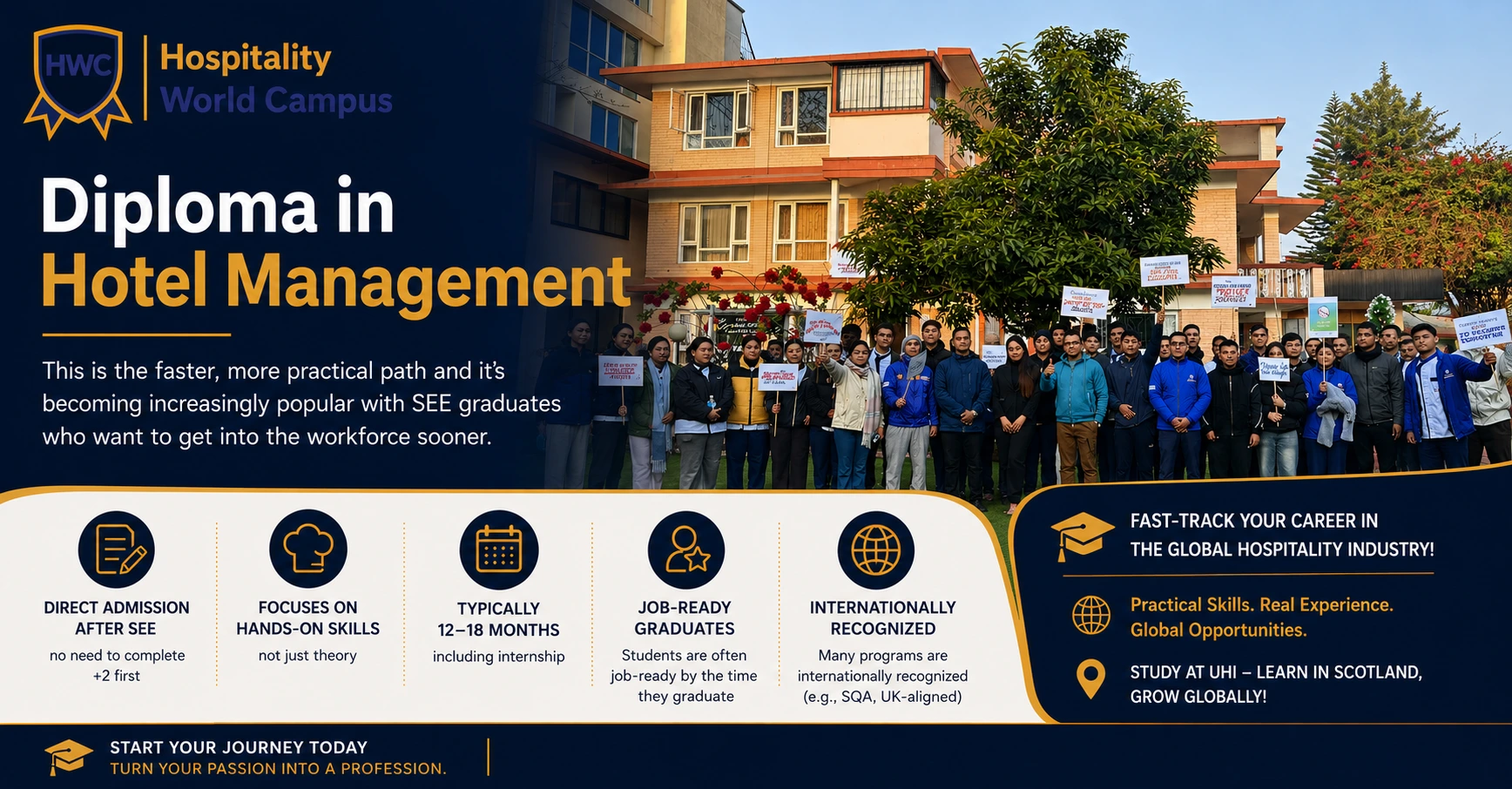
Every year, thousands of students in Nepal finish their SEE and face the same question: What should I study next? For students drawn to travel, service, and people, hotel management is one of the most exciting paths available. But then comes the real confusion.
Which diploma? How long? Which college? Will it get me a job?
The hospitality industry is one of the fastest-growing sectors in the world. Nepal, with its booming tourism, luxury resorts, international hotel chains, and growing restaurant culture, sits right at the heart of this opportunity. But not every diploma will give you the same career outcomes. Some open doors to management. Some lead to specialized culinary careers. Some are recognized globally. Some are not.
If your goal is to build a real, sustainable career in hotels, resorts, restaurants, cruise lines, airlines, or international hospitality brands, understanding the differences between hotel management diplomas is essential. This guide will help you make the right decision without the confusion.
Which Diploma is Best for Hotel Management?
For students in Nepal who want the broadest career opportunities in hotel management, a Diploma in Hospitality Management particularly one with international accreditation, is generally considered the best choice. It covers guest service, food and beverage operations, front office management, housekeeping, and hospitality administration, while internationally recognized programs go a step further by preparing students for global employment.
Students who want to become professional chefs may consider a Diploma in Global Culinary Arts or Diploma in Culinary Arts. Students who want management roles across hotels, resorts, airlines, and tourism businesses will benefit most from a comprehensive hospitality management diploma.
What Is a Hotel Management Diploma in Nepal?
A diploma in hotel management in Nepal is a professionally structured course that trains students in the operational and administrative functions of the hospitality industry. Unlike a general degree, a diploma is focused, practical, and career-oriented, meaning you spend more time learning actual skills than sitting through years of theory.
Hotel management diplomas in Nepal typically cover:
- Front office and guest relations
- Food and beverage service
- Food production and culinary basics
- Housekeeping operations
- Hotel administration and communication
- Industry internship or placement
These programs are available at different levels and durations from short certificates (3–12 months) to full diplomas (15–21 months) to advanced diplomas (21+ months). The right one for you depends entirely on your career goal.
Who Should Study Hotel Management?
Hotel management is a great fit for you if:
- You enjoy working with people and creating memorable experiences
- You are interested in travel, food, culture, or event management
- You want a career that can take you across Nepal and internationally
- You are a student after SEE looking for a direct path to employment
- You want to run your own restaurant, café, or hospitality business one day
Why Is Hotel Management Popular in Nepal?
Nepal is not just a country of mountains. It is a destination. Every year, hundreds of thousands of international tourists arrive in Nepal, staying in hotels ranging from simple guesthouses to five-star properties. The country has seen steady growth in luxury resorts, boutique hotels, and international hospitality chains entering the market.
This directly creates demand for trained hospitality professionals at every level — from front desk executives to food and beverage supervisors to hotel managers. Beyond Nepal, Nepali hospitality graduates are sought in Gulf countries, Southeast Asia, Australia, Europe, and beyond.
The hospitality industry is also one of the few sectors where:
- A diploma (not a degree) is often sufficient to land a well-paying job
- Practical skills matter more than academic grades
- International opportunities are genuinely accessible
- Entrepreneurship (owning a restaurant, café, or lodge) is a realistic path
Top Hotel Management Diploma Options in Nepal
Before deciding which diploma is best for you, it helps to understand what your options actually are. Here is a comparison of the most common diploma paths for hotel management students in Nepal.
| Diploma | Duration | Best For | Career Opportunities |
|---|---|---|---|
| Diploma in Hospitality Management | 15 months | Complete Hotel Operations + Global Careers | Hotels, Resorts, Airlines, Cruise, Tourism |
| Advanced Diploma in Hospitality Management | 21 months | Senior Management Roles | Hotel Managers, F&B Directors, Operations Leaders |
| Diploma in Global Culinary Arts | 12 months | Professional Chef Career | Restaurants, Hotels, International Kitchens |
| CTEVT Diploma in Hotel Management (DHM) | 3 years | Government-recognized Hotel Operations | Hotels, Resorts, Restaurants in Nepal |
| Diploma in Food Production | 1 year | Kitchen-only Roles | Cook, Chef de Partie |
| Diploma in Tourism & Hospitality | 1–2 years | Tourism Sector | Travel Agents, Tour Operators |
Each path has its purpose. But not all are equal in terms of global recognition, career flexibility, or quality of training.
Why the Diploma in Hospitality Management Is the Best Choice for Most Students
For most students in Nepal who want a career in hotel management — not just a qualification — the Diploma in Hospitality Management (DHM) offered by internationally accredited institutions gives the strongest foundation.
Here is why it consistently stands out.
1. Comprehensive Industry Coverage
Unlike specialized courses that focus only on the kitchen or only on service, a Diploma in Hospitality Management covers the entire spectrum of hotel operations. Students graduate understanding how every department of a hotel works — and how they connect.
This matters enormously in the real world. Hotel managers are not specialists. They are generalists who can move between departments, solve problems, and lead teams. A diploma that mirrors this reality prepares you better than one that only teaches you one skill.
2. International Accreditation Changes Everything
This is the single biggest differentiator between different hotel management diplomas in Nepal — and it is often the one students overlook.
A diploma accredited by an internationally recognized body such as the Scottish Qualifications Authority (SQA) and benchmarked against the Scottish Credit and Qualifications Framework (SCQF) and European Qualifications Framework (EQF) carries genuine global recognition. This means your qualification is not just accepted in Nepal it is understood and respected by employers in the United Kingdom, Europe, Australia, the Gulf, and beyond.
Programs affiliated with organizations like LCCI GQ an award-winning body in soft skills and management training give students access to curriculum, standards, and learning frameworks that are tested across multiple countries.
In contrast, a locally affiliated diploma may be perfectly good for employment within Nepal but offers limited advantage if you want to work internationally.
3. Strong Practical Learning and Internship
The best hospitality diplomas are not classroom-heavy. They are built around hands-on learning working in professional kitchen labs, front office simulations, mock hotel environments so that by the time you sit in front of an industry recruiter, you have actual skills to demonstrate.
Internship components embedded in the program give students real-world exposure to hotel operations, service standards, and professional expectations before they even graduate. This is often how students secure their first job through their internship placement.
4. Pathway to Higher Education
A well-structured Diploma in Hospitality Management is not a dead end. It is a launchpad. Students who hold an internationally recognized diploma can:
- Progress to an Advanced Diploma in Hospitality Management for senior roles
- Credit-transfer into Bachelor’s programs in hospitality management abroad
- Pursue further education in the UK, Australia, Canada, or Europe with recognized credentials
This is a major advantage over purely local qualifications where higher education pathways can be limited.
5. Career Flexibility Across the Hospitality Ecosystem
Hospitality management graduates do not only work in hotels. They work in:
- International hotel chains (Marriott, Hilton, Hyatt, Radisson)
- Luxury resorts and boutique properties
- Airlines and airport lounges
- Cruise ships
- Restaurants and F&B chains
- Tourism companies and travel agencies
- Event management companies
- Their own entrepreneurial ventures
This breadth of career opportunity is unique to hospitality management. A chef diploma typically leads to kitchens. A hospitality management diploma leads almost anywhere in the service industry.
CTEVT Diploma in Hotel Management (DHM) vs Internationally Accredited Diploma: What Is the Difference?
This is one of the most common questions students ask — and it deserves a clear, honest answer.
The CTEVT Diploma in Hotel Management is a 3-year government-recognized program offered by institutions across Nepal. It is affiliated with the Council for Technical Education and Vocational Training, covers all major hotel departments, and leads to qualifications recognized by the Nepal government’s public service framework.
For students whose primary goal is employment within Nepal in local hotels, restaurants, and tourism businesses — the CTEVT DHM is a solid, accessible pathway.
However, if you are comparing it to an internationally accredited Diploma in Hospitality Management, there are meaningful differences.
| Feature | CTEVT DHM | Internationally Accredited DHM (e.g., SQA) |
|---|---|---|
| Duration | 3 years | 15–21 months |
| International Recognition | Limited | High (SQA/EQF/SCQF) |
| Higher Education Pathway | TU/Nepal colleges | International universities |
| Employment in Nepal | Strong | Strong |
| Employment Abroad | Limited | Significantly better |
| Curriculum Standards | Nepal government | International benchmarks |
| Credit Transfer Abroad | Generally not available | Available |
| Practical Focus | Moderate | High |
The right choice depends on your goal. If you want to work locally and value a longer, government-recognized qualification, CTEVT DHM is a reasonable path. If you want global career options, faster completion, and international recognition, an SQA-accredited diploma from a quality institution is the stronger investment.
Diploma in Hospitality Management vs Diploma in Global Culinary Arts
Another common dilemma for students is whether to study hospitality management broadly or focus specifically on culinary arts to become a professional chef.
Here is how to think about it clearly.
| Feature | Diploma in Hospitality Management | Diploma in Global Culinary Arts |
|---|---|---|
| Career Scope | Very broad | Specialized to kitchen |
| Chef Career | Possible (basic coverage) | Comprehensive |
| Hotel Operations | Full coverage | Limited |
| Management Skills | Strong | Not the focus |
| F&B Service | Yes | Limited |
| Entrepreneurship | High (restaurants, hotels, tourism) | Medium (own restaurant) |
| Global Employment Options | Wide | Kitchen/Chef focused |
| Duration (Typical) | 15 months | 12 months |
Choose Diploma in Hospitality Management if: You want the flexibility to work across hotel departments, pursue management roles, work internationally in diverse hospitality settings, or eventually lead teams and run operations.
Choose Diploma in Global Culinary Arts if: Your singular passion is professional cooking. You want to be a chef. You are specifically drawn to food production, culinary techniques, international cuisines, and kitchen management. You see yourself in kitchens not behind a front desk.
Neither choice is wrong. They are simply different destinations. The most important question to ask yourself is: Do I want to manage the hotel or do I want to cook for it?
Skills You Build in a Hotel Management Diploma
One reason hospitality diplomas are highly valued by employers is that they develop both hard operational skills and soft professional skills simultaneously. This combination is rare and genuinely useful.
Operational Skills:
- Front office procedures and guest check-in/check-out
- Food and beverage service standards
- Housekeeping operations and quality control
- Kitchen hygiene, food safety, and basic food production
- Hotel administration and record keeping
Professional and Soft Skills:
- Effective communication with guests and teams
- Problem-solving under pressure
- Leadership and team management
- Customer service excellence
- Cross-cultural awareness (critical for international tourism)
- Grooming standards and professional presentation
These are not just skills for hotel jobs. They are life skills that make graduates employable across dozens of industries — from airlines to corporate hospitality to event management.
Career Opportunities After a Hotel Management Diploma
One of the biggest misconceptions students have is that a hotel management diploma only leads to jobs in hotels. In reality, the scope is far wider.
Here are the roles hospitality diploma graduates in Nepal pursue:
Hotel and Resort Careers:
- Front Office Executive / Receptionist
- Guest Relations Officer
- Housekeeping Supervisor
- Food and Beverage Supervisor
- Restaurant Manager
- Banquet Coordinator
Management Track (with experience or Advanced Diploma):
- Front Office Manager
- Food and Beverage Manager
- Hotel Operations Manager
- General Manager (senior hotels)
Beyond Hotels:
- Cabin Crew / Flight Attendant
- Airport Lounge Staff
- Cruise Ship Hospitality Staff
- Resort and Safari Camp Staff
- Tourism and Travel Agency Professional
- Event Manager
- Corporate Catering Manager
Entrepreneurship:
- Restaurant or Café Owner
- Boutique Hotel or Homestay Operator
- Catering Business Owner
- Food Delivery Brand Founder
The diversity of paths available makes hospitality one of the most career-flexible diplomas you can pursue after SEE.
Salary After a Hotel Management Diploma in Nepal
Salary in hospitality depends on your role, employer, experience level, and whether you are working in Nepal or internationally. Here is a realistic picture of what graduates can expect.
| Position | Estimated Monthly Salary (Nepal) |
|---|---|
| Trainee / Fresher | NPR 15,000 – 25,000 |
| Front Office Executive | NPR 25,000 – 40,000 |
| F&B Service Staff (Star Property) | NPR 25,000 – 40,000 |
| Supervisor Level | NPR 40,000 – 70,000 |
| Manager Level | NPR 70,000 – 1,20,000+ |
| International Placement (Gulf, Europe) | NPR 1,50,000 – 3,00,000+ equivalent |
Internationally recognized diploma holders — particularly those whose credentials are accepted by employers in the Gulf, Southeast Asia, UK, and Australia — have access to significantly higher salary brackets from early in their careers.
Experience is the multiplier. Graduates who internship in strong properties, perform well, and build industry connections typically move up faster and earn more within 2–3 years of graduating.
Note: Salary figures are estimates based on industry averages. Actual earnings vary based on employer, property rating, city, experience, and international versus domestic placement.
Eligibility for Hotel Management Diplomas in Nepal
For CTEVT Diploma in Hotel Management (3-year):
- Completion of SEE (School Leaving Certificate) examination
- Minimum grade C in Compulsory Mathematics, Compulsory English, and Science
- Entrance test as required by the institution
For Internationally Accredited Diplomas (e.g., SQA-affiliated):
- Completion of SEE
- Basic English proficiency
- Some institutions may conduct orientation or admission interviews
- No mandatory subject-specific grade requirements in most cases (eligibility varies by institution)
The accessibility of internationally accredited diplomas which do not always demand specific subjects — means students from diverse academic backgrounds can enter and succeed in professional hospitality education.
Is a Hotel Management Diploma Worth It in 2026?
The short answer: yes but the quality of your diploma matters more than ever.
Here is the reality of the industry in 2026:
Tourism is recovering and growing. Nepal’s tourism sector has seen strong recovery and continued growth. International arrivals, luxury hotel development, and new resort properties across the country continue to create demand for trained professionals.
Global mobility is a real advantage. Countries in the Gulf, Southeast Asia, Europe, and Australia continue to recruit Nepali hospitality graduates — particularly those holding internationally recognized qualifications. An SQA-accredited diploma from Nepal carries real weight with foreign employers.
The industry rewards practical skills fast. Unlike many white-collar sectors where career progression is slow and tied to years of experience in an office, hospitality rewards people who perform quickly. Students who intern well, learn fast, and build a strong guest service mindset often move into supervisory roles within 1–2 years of graduation.
Entrepreneurship opportunities are expanding. Nepal’s café culture, boutique hotel industry, and adventure tourism sector are all growing. Hospitality diploma graduates are well-positioned to start their own ventures with relatively low capital compared to other industries.
The risk of not having a quality diploma is real. An unaccredited or poorly structured diploma may give you a certificate but not a career. Always verify the accreditation body, curriculum quality, practical infrastructure, and placement track record before enrolling.
How to Choose the Right Hotel Management Diploma: A Decision Framework
Use this simple framework to make your decision.
Choose a Diploma in Hospitality Management if:
- You want broad career options across hotels, airlines, resorts, and tourism
- You want management roles and leadership opportunities
- You want international employment opportunities
- You want a qualification recognized by global employers
- You want a faster path to employment (15–21 months vs 3 years)
- You want to pursue higher education abroad later
Choose CTEVT Diploma in Hotel Management if:
- You want a government-recognized qualification for employment in Nepal
- You prefer a longer, structured 3-year program
- International employment is not your primary goal
- Cost is a significant factor and local institutions suit your situation
Choose Diploma in Global Culinary Arts if:
- Your passion is cooking specifically and exclusively
- You want to be a professional chef in a hotel or restaurant kitchen
- You are interested in international cuisines, food production, and culinary creativity
- You do not see yourself in front office, housekeeping, or hotel management roles
Choose Advanced Diploma in Hospitality Management if:
- You have already completed a Diploma in Hospitality Management
- You want to qualify for senior management positions
- You want a higher-level credential for further international education
What to Look for in a Hotel Management College in Nepal
Not all hospitality colleges in Nepal are equal. Before you enroll, ask these questions.
Accreditation and Recognition: Is the diploma recognized by a credible national or international body? Local affiliations may be sufficient for Nepal-based careers. For international opportunities, look for SQA, City & Guilds, or equivalently recognized accreditation.
Practical Infrastructure: Does the college have professional kitchen labs, mock hotel setups, and real training environments? Hospitality is a practical profession. You cannot learn it from textbooks alone.
Internship Partnerships: Does the college have established partnerships with hotels, resorts, and hospitality businesses for internship placements? The quality of your internship often shapes the trajectory of your early career.
Class Size and Mentoring: Smaller class sizes mean more individual attention. Look for programs that provide personal mentorship alongside classroom instruction.
Placement Support: Does the institution have a track record of helping students secure jobs after graduation? Ask about placement rates, alumni careers, and industry connections.
Faculty Experience: Are the instructors industry professionals with real hospitality experience? Theoretical knowledge is not enough in this field.
Why Students Choose Hospitality World Campus (HWC)
Hospitality World Campus (HWC), located at Jawalakhel, Lalitpur, is one of Nepal’s most distinctive hospitality education institutions and it is built around a simple idea: that students deserve training that is genuinely world-class, not just locally adequate.
HWC is a unit of LCCI GQ, an award-winning organization in soft skills and management training. Its hospitality programs are:
- Approved and quality-assured by the Scottish Qualifications Authority (SQA), one of the most respected education quality bodies in the world
- Benchmarked at the Scottish Credit and Qualifications Framework (SCQF) — the same framework used in the UK
- Aligned with the European Qualifications Framework (EQF) — making HWC diplomas recognized across Europe and internationally
This is not a small detail. It means an HWC student graduating with a Diploma in Hospitality Management holds a qualification that a hotel employer in Edinburgh, Dubai, Sydney, or Kuala Lumpur can understand, verify, and trust.
Programs Offered at HWC
- Diploma in Global Culinary Arts (DGCA): 12 months For students who want to build a professional culinary career with globally recognized training.
- Diploma in Hospitality Management (DHM): 15 months For students who want comprehensive hotel and hospitality operations training with an internationally recognized qualification.
- Advanced Diploma in Hospitality Management (ADHM): 21 months For students who want to position themselves for senior management roles and advanced international opportunities.
- Professional Chef Course – Advanced Intensive, skills-focused training for aspiring professional chefs.
- Certificate in Bakery, Pastry & Patisserie Specialized pastry and baking skills for careers in high-end food production.
- Professional Certificate in Barista and Bartending Practical beverage skills for café, bar, and F&B careers.
What Makes HWC Different
Small class sizes ensure that every student gets individual attention not just a seat in a lecture hall. Instructors know your name, track your progress, and genuinely invest in your development.
A dedicated mentoring system means each student is assigned a personal mentor who meets with them monthly. This is rare in Nepali education, and it makes a real difference in how students navigate their learning journey.
Student-first focus is not a marketing slogan at HWC it is the operational principle. From curriculum design to pastoral care, every decision is made with the student’s outcome in mind.
Industry-connected internships give HWC students access to placements in quality hospitality properties where they build real skills, real professional networks, and real career momentum.
For students in Nepal who want more than a local diploma who want a credential that travels with them wherever their career takes them — HWC represents one of the strongest options available.
Frequently Asked Questions
Which diploma is best for hotel management in Nepal?
A Diploma in Hospitality Management from an internationally accredited institution (such as one approved by SQA and benchmarked at SCQF/EQF) is generally the best diploma for hotel management in Nepal. It provides comprehensive training across all major hotel departments and opens pathways for both domestic and international careers.
Is a Diploma in Hospitality Management better than CTEVT DHM?
They serve different purposes. CTEVT DHM is government-recognized and suitable for careers within Nepal. An internationally accredited Diploma in Hospitality Management is better if you want global career opportunities, international recognition, or pathways to higher education abroad.
Can I study hotel management after SEE?
Yes. Most hotel management diploma programs in Nepal are designed for students after SEE. You typically need to have passed SEE with at least a C grade. Some internationally accredited programs have more flexible entry requirements.
What is the salary after a hotel management diploma in Nepal?
Starting salaries typically range from NPR 15,000 to NPR 25,000 for trainees and freshers. With 2–3 years of experience, supervisors earn NPR 40,000–70,000. Managers earn NPR 70,000 and above. International placements offer significantly higher earnings.
Is hotel management a good career in Nepal?
Yes. With Nepal’s growing tourism sector, expanding hotel industry, and increasing international hospitality brands entering the market, hotel management remains one of the strongest career paths after SEE. Students with internationally recognized qualifications have even greater opportunities.
How many years is a Diploma in Hospitality Management?
Duration varies. CTEVT DHM is 3 years. Internationally accredited diploma programs in Nepal typically range from 12 to 21 months depending on the level (diploma to advanced diploma).
Which hotel management course has the highest demand?
A Diploma in Hospitality Management from an internationally recognized institution currently has the highest demand because it opens both domestic and international employment opportunities and is accepted by global hotel chains and hospitality employers.
Can I work abroad after completing a hotel management diploma in Nepal?
Yes, particularly if your diploma is internationally recognized (SQA, SCQF, EQF). Graduates from accredited programs have secured positions in the Gulf, Southeast Asia, Australia, and Europe. Local-only recognized diplomas may require additional credential evaluations abroad.
What is the difference between Diploma in Hospitality Management and Diploma in Global Culinary Arts?
Hospitality Management covers the entire hotel operation front office, housekeeping, F&B service, administration and leads to management careers across the hospitality sector. Global Culinary Arts focuses specifically on professional cooking, kitchen operations, and culinary skills, leading primarily to chef careers.
Which is the best college for hotel management diploma in Nepal?
The best college for you depends on your goals. For internationally recognized qualifications with strong practical training, mentoring, and global career pathways, Hospitality World Campus (HWC) in Jawalakhel, Lalitpur is one of Nepal’s most credible options. HWC’s programs are quality-assured by SQA (Scotland) and benchmarked at SCQF and EQF.
Final Verdict: Which Hotel Management Diploma Should You Choose?
The right diploma is the one that matches your career goal — not just the one that sounds popular or is closest to your home.
If you want to become a professional chef, the Diploma in Global Culinary Arts is your path.
If you want management roles, international employment, or the flexibility to work across hotels, airlines, resorts, and tourism the Diploma in Hospitality Management from an internationally accredited institution is the strongest choice available to students in Nepal today.
And if you want to go further into senior management, operations leadership, or international hotel brands the Advanced Diploma in Hospitality Management builds directly on that foundation.
In 2026, having a diploma is not enough. Having the right diploma from the right institution is what separates students who get quality employment from those who struggle despite years of study. International accreditation, practical training infrastructure, personal mentoring, and genuine industry placement support are what turn a qualification into a career.
If you are serious about building a future in hospitality, take the time to visit the campus, speak to current students and alumni, ask about placement records, and verify the accreditation status of the program you are considering.
Your diploma is not just a piece of paper. It is the foundation of your career. Choose it wisely.
Interested in learning more about internationally accredited hospitality programs in Nepal? Visit Hospitality World Campus (HWC) in Jawalakhel, Lalitpur, or contact the admissions team to discuss which program best fits your goals.