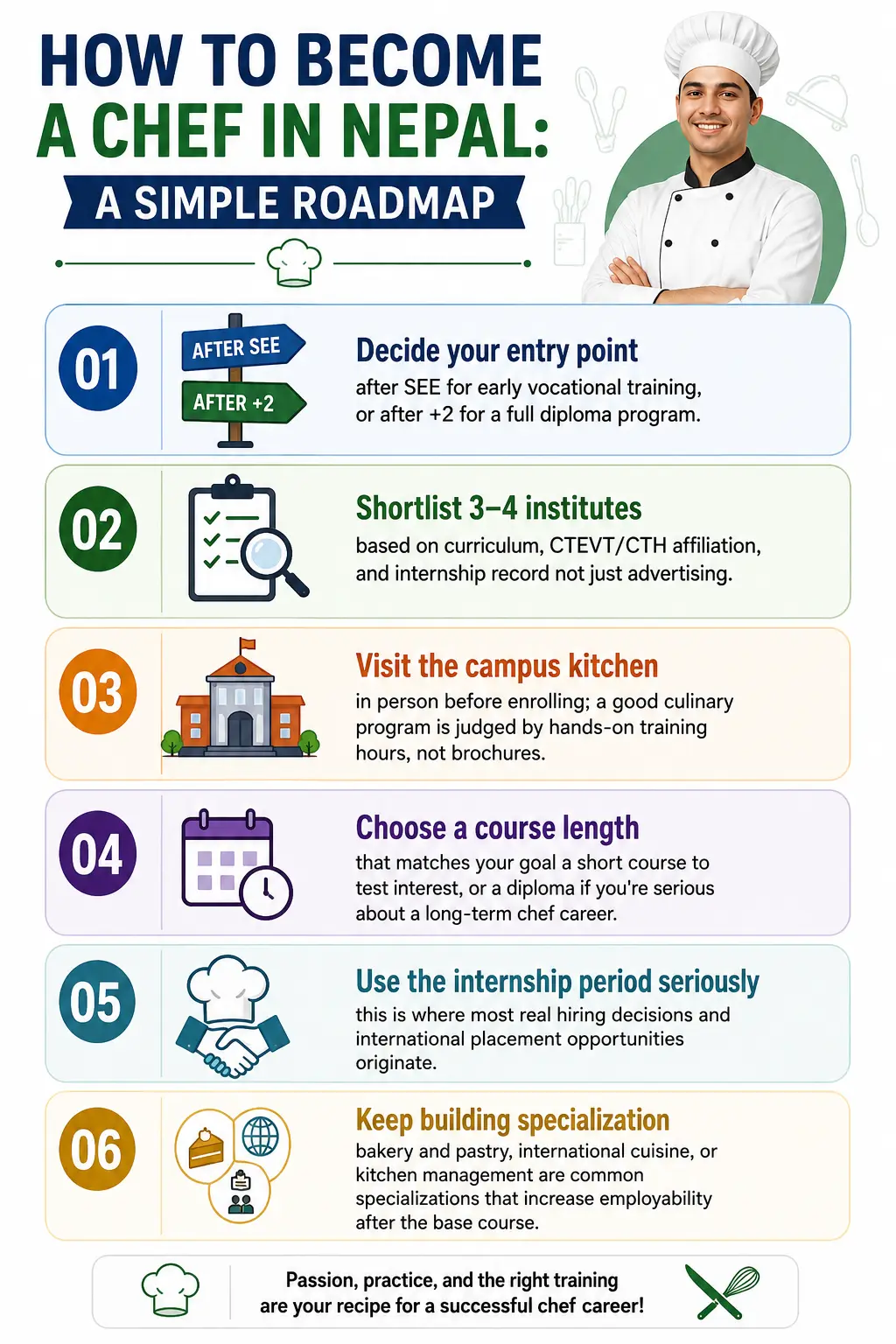
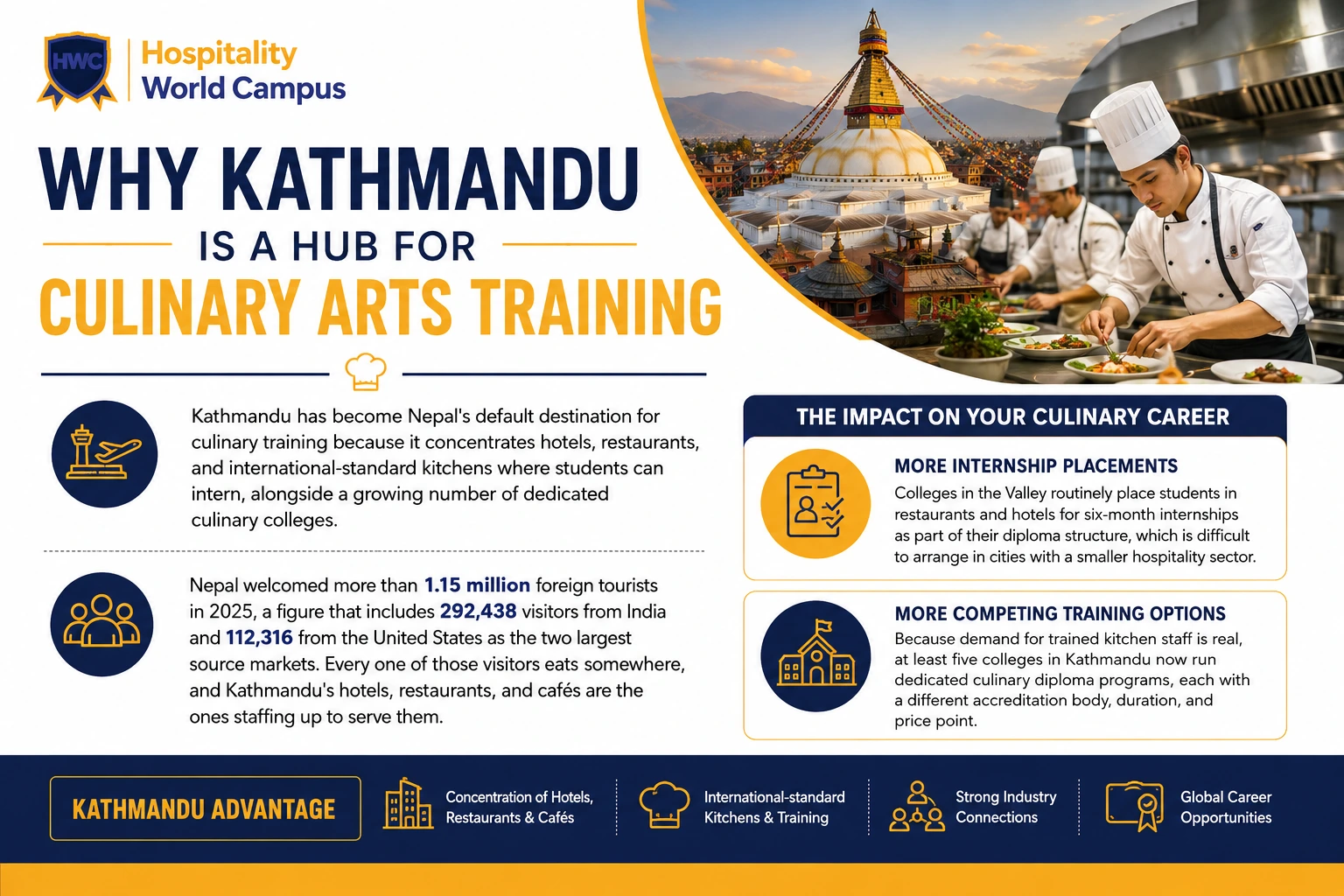
culinary arts diploma in nepal

Culinary Arts Diploma in Nepal: 2026 College Comparison Guide

If you are researching a culinary arts diploma in Nepal, you are probably comparing the same handful of institutions everyone else finds: Hospitality World Campus (HWC) in Jawalakhel, the Academy of Culinary Arts (ACA) in Lagankhel, GATE College in Mandikhatar, and International Hotel Training School (IHTS) in Old Baneshwor.

At HWC, the Diploma in Global Culinary Arts (DGCA) is built around a 12-month structure of six months of hands-on kitchen training followed by a six-month internship, and the curriculum is quality assured by the Scottish Qualifications Authority (SQA), credit-rated on the Scottish Credit and Qualifications Framework (SCQF) at Level 6, and benchmarked against the European Qualifications Framework (EQF) at Level 4, giving graduates a diploma with a recognized international framework behind it rather than a purely local certificate.

That said, every serious applicant deserves an honest look at the full field, so this guide walks through what each college actually offers: duration, accreditation, fees where they are published, internship networks, and eligibility so you can make a decision based on facts rather than marketing copy.

What Is a Diploma in Culinary Arts?

what is a diploma in culinary arts

A diploma in culinary arts is a structured, industry-focused training program that teaches professional cooking, kitchen management, food safety, and menu planning, combined with real kitchen practice and, in most Nepali programs, a supervised hotel internship. It is not a short recreational cooking class. It is designed to take a beginner to a job-ready commis chef in about a year.

Most programs in Nepal follow one of two tracks. The first is affiliation with an international awarding body such as the UK’s CTH or Scotland’s SQA. The second is affiliation with Nepal’s own Council for Technical Education and Vocational Training (CTEVT), a government body that regulates vocational diplomas nationwide. Some colleges combine both.

Core Components Every Program Shares

  • Kitchen hygiene, food safety, and sanitation standards
  • Cookery methods for meat, poultry, seafood, vegetables, and eggs
  • Baking, pastry, and dessert preparation
  • Menu planning and basic food costing
  • A supervised internship, typically 6 months, inside a working hotel or restaurant kitchen

Why Study Culinary Arts in Nepal Right Now

Nepal’s tourism and hospitality sector is expanding, hotel openings are increasing in Kathmandu and Pokhara, and the country still faces a shortage of professionally trained chefs, which means demand for skilled diploma graduates continues to outpace supply.

Nepal’s hospitality industry contributes a meaningful share of national GDP and supports hundreds of thousands of jobs, according to figures HWC has compiled from tourism sector data. Kitchens, in particular, are one of the fastest-growing hiring areas because international hotel chains entering Nepal expect staff trained to consistent, exportable standards, not just informal on-the-job cooking experience.

This is also why international accreditation matters more in Nepal’s culinary education market than it might elsewhere. A diploma benchmarked against a recognised framework like SCQF or assessed by a body like CTH gives graduates a credential that hotels in the Gulf, the UK, Australia, and Southeast Asia can actually evaluate, rather than a locally issued certificate they have never seen before.

HWC’s Diploma in Global Culinary Arts (DGCA)

HWC’s DGCA is a 12-month program (6 months training, 6 months internship) located in Jawalakhel, Lalitpur, with a curriculum designed by LCCI Global Qualifications and quality assured by Scotland’s SQA, placing it on the SCQF at Level 6 and benchmarked against the EQF at Level 4.

HWC is a unit of LCCI GQ, an internationally recognised organisation in professional and management skills training. The DGCA covers food preparation, cooking techniques, presentation, food safety and sanitation, nutrition, menu planning, and baking and pastry, with practical instruction delivered in HWC’s own kitchens rather than borrowed facilities.

Program Snapshot

DetailHWC DGCA
Duration12 months (6 months training + 6 months internship)
LocationJawalakhel, Lalitpur, Kathmandu
AccreditationLCCI Global Qualifications curriculum, quality assured by SQA (Scotland)
FrameworkSCQF Level 6 (67 credit points), benchmarked to EQF Level 4
EligibilitySEE/SLC with minimum D+ (GPA 1.6), minimum D+ in English, age 17+
Class structureSmall class sizes with a low teacher-to-student ratio
SupportOne-on-one mentor meetings held monthly with every student

Why the SCQF Benchmark Matters

A diploma that sits on a recognised international qualifications framework is easier for foreign employers and credit-transfer offices to interpret than a diploma with no external quality assurance at all. This is one of the clearer differentiators between HWC’s DGCA and diploma programs that rely solely on an in-house or purely domestic curriculum.

Internship and Industry Placement

HWC treats industry placement as a core part of the program rather than an add-on. The college has placed students with international hospitality groups including Raffles Doha, The Ritz-Carlton, Jumeirah Beach Hotel, Burj Al Arab, Shangri-La, Fairmont The Palm, JW Marriott, Hyatt Regency, and several UK and Australian properties such as The Gleneagles Hotel and Park Hyatt Sydney. Placement opportunities depend on what roles partner employers have open at the time, so not every student is guaranteed a specific property, but the partner network itself is real and verifiable.

Mentoring and Small Class Sizes

Each HWC student is paired with a mentor who meets them individually once a month. Combined with a deliberately low teacher-to-student ratio, this is meant to catch problems early rather than let a struggling student fall through the cracks in a large lecture-style class, which is a common complaint students raise about bigger vocational institutes.

Culinary Arts Diploma Colleges in Nepal: Comparison Table

Nepal’s main culinary arts diploma providers are HWC (12-month SQA-benchmarked DGCA in Lalitpur), ACA (CTH UK-affiliated diploma in Lalitpur, established 2010), GATE College (CTEVT-affiliated diploma in Kathmandu with a TAFE NSW partnership), and IHTS (1,860-hour, CTEVT and CTH-affiliated diploma in Old Baneshwor with 100% internship placement).

CollegeProgram NameDurationLocationAffiliationEligibility
HWCDiploma in Global Culinary Arts (DGCA)12 monthsJawalakhel, LalitpurLCCI GQ curriculum, SQA quality assured, SCQF Level 6SEE min D+ (GPA 1.6), English D+, age 17+
ACACTH Level 2 Diploma in Culinary Skills6 months (3 months practical + 3 months internship)Lagankhel, LalitpurCTH (UK)+2 with English, age 16+
GATE CollegeDiploma in Culinary ArtsVaries by intake; CTEVT-coordinatedMandikhatar, BudhanilkanthaCTEVT, plus Certificate III in Commercial Cookery via TAFE NSWSEE/SLC, medical fitness check, basic English
IHTSDiploma in Culinary Arts1 year, 1,860 hours (6 months training + 6 months internship)Old Baneshwor, KathmanduCTEVT + CTH (UK)SEE or +2, entrance test and interview

A note on accuracy: fee figures are not published on every college’s own site, and some colleges quote duration differently across their marketing pages depending on which specific diploma level or intake they mean. Where a college does not publish exact figures, this guide says so rather than guessing.

Academy of Culinary Arts (ACA), Lalitpur

ACA has offered culinary education in Nepal since 2010 and delivers a CTH (UK)-affiliated Diploma in Culinary Skills that, as listed on their own program page, runs 6 months, split into 3 months of practical training and 3 months of internship.

ACA operates under the Academy of Culinary Arts and Hospitality Management, in Lagankhel, Lalitpur, and is the vocational training arm of a larger group that also runs the Center for Leadership and Entrepreneurship (CLE) and a bachelor’s program in hospitality management affiliated with Lincoln University College, Malaysia. The diploma is awarded in partnership with the Confederation of Tourism and Hospitality (CTH), a UK-based awarding body for hospitality and tourism qualifications.

The curriculum covers kitchen hygiene and food safety, mise en place, cookery methods, meat and poultry preparation, stocks and sauces, pastry and dough, and cold and hot desserts. Admission requires completion of +2 with English as a compulsory subject, and candidates go through an entrance test and interview before enrollment. ACA runs multiple intakes across the year: August, November, February, and May.

ACA does not publish its exact diploma fee on its program page. Independent Nepal college-fee research, including HWC’s own published fee guide, has estimated ACA’s broader culinary diploma offerings in the range of roughly NPR 4 to 7 lakh, though prospective students should confirm current pricing directly with ACA’s admissions office rather than relying on third-party estimates.

GATE College, Kathmandu

GATE College, based in Mandikhatar, Budhanilkantha, runs a CTEVT-coordinated Diploma in Culinary Arts and also offers the SIT30816 Certificate III in Commercial Cookery in partnership with TAFE NSW, Australia, giving students an Australian-recognised vocational qualification alongside the Nepali one.

GATE has built a large alumni base, with more than 9,000 graduates working in hospitality-related roles internationally, according to GATE’s own institutional profile. The college positions itself around “edutainment” and experiential learning rather than a purely lecture-based model, and it runs intakes for its diploma-level programs in January and August each year.

The published curriculum for GATE’s culinary diploma covers hygiene, safety and nutrition, cookery methods in both theory and practice, basic kitchen management, identification of kitchen tools and equipment, cake and pastry production, menu planning and cost control, and inventory and stock management. GATE also offers need-based and merit-based scholarships, though, like most colleges in this space, it asks prospective students to contact the admissions office directly for the current fee structure rather than publishing it openly online.

International Hotel Training School (IHTS)

IHTS, located in Old Baneshwor, Kathmandu, runs a 1-year, 1,860-hour Diploma in Culinary Arts affiliated with both CTEVT and the UK’s CTH, structured as 6 months of in-house training followed by a 6-month internship, and the school advertises 100% job placement assistance through a network of more than 64 partner hotels.

IHTS is ISO 19001:2015 certified and markets itself as a comparatively budget-friendly option in Kathmandu’s culinary training market, with HWC’s own published fee-comparison research placing IHTS’s diploma fee at approximately NPR 2 lakh, notably lower than several of its competitors. The curriculum spans Continental, Italian, Chinese, Indian, and Japanese cuisines, along with bakery, pastry, and sushi preparation, and covers food safety, occupational health, and kitchen maintenance as standalone modules rather than folding them into general cookery classes.

Admission requires SEE or +2 completion from any stream, followed by an entrance test and interview. Internships are placed in 3 to 5 star hotels in Nepal, and IHTS also runs a range of shorter, standalone courses, such as bartending, sushi, and single-cuisine cook training, for students who want a narrower specialization instead of the full diploma.

The CTEVT-Affiliated Diploma Route

Separate from privately branded diploma programs, Nepal’s Council for Technical Education and Vocational Training (CTEVT) directly accredits a standardised Diploma in Culinary Arts offered through 8 registered institutions nationwide, 3 of which operate in Kathmandu district, according to Edusanjal’s institutional directory.

This CTEVT track is a useful reference point because it represents the government-recognised baseline qualification in culinary training, separate from privately negotiated international affiliations like CTH or SQA. Institutions listed under this CTEVT pathway include IHTS, the Oriental Hospitality and Tourism Training Center in New Baneshwor, and Pinnacle Training Academy in Lagankhel, among others across Kathmandu, Pokhara, and other districts.

If your priority is a government-recognised local qualification at the lowest possible cost, the CTEVT route is worth comparing against internationally affiliated diplomas. If your priority is a credential that a hotel outside Nepal can immediately understand and evaluate, an internationally quality-assured diploma, such as HWC’s SQA-linked DGCA or ACA’s CTH-affiliated program, generally carries more weight abroad.

How to Choose the Right Culinary College

Compare colleges on four factors in this order: internship quality and named hotel partners, the specific international or CTEVT accreditation behind the diploma, the total real cost including uniforms and exam fees, and class size or mentoring support, rather than choosing based on brochure photos alone.

Questions Worth Asking Before You Enroll

  • Which specific hotels have recent graduates interned at, not just which brands the college claims a partnership with?
  • Is the accrediting body (SQA, CTH, CTEVT, or another) one that employers abroad will recognise?
  • What is the full cost, including kitchen uniforms, tools, and examination fees, not just the headline tuition figure?
  • What is the average class size, and how much individual feedback do students get in the kitchen?
  • Does the college disclose real placement outcomes, or only a small number of highlighted success stories?

A Quick Comparison by Priority

If you care most about…Consider
International qualifications framework recognitionHWC (SCQF/EQF-benchmarked DGCA) or ACA (CTH, UK)
Lowest published tuition costIHTS (~NPR 2 lakh, per independent fee research)
Australian vocational credentialingGATE College (TAFE NSW partnership)
Government-recognised local diplomaAny CTEVT-affiliated institution
Personal mentoring and small classesHWC (monthly one-on-one mentor meetings)

Career Paths and Salaries After a Culinary Diploma

Graduates typically start as a Commis Chef earning roughly NPR 18,000 to 30,000 per month, progress to Chef de Partie and then Sous Chef over 5 to 8 years, and can reach Executive Chef roles paying NPR 1.2 lakh to 2.5 lakh or more per month at 5-star properties, with meaningfully higher pay for chefs who move abroad.

Career StageTypical TimelineMonthly Salary Range (NPR)
Commis Chef / Junior CookYear 0 to 218,000 to 30,000
Chef de Partie / Station ChefYear 2 to 530,000 to 60,000
Sous ChefYear 5 to 860,000 to 100,000
Executive Chef / Head ChefYear 8 to 10+1,20,000 to 2,50,000+ (5-star hotels)
International Career (UAE, Australia, Japan, Europe)VariesEquivalent of roughly NPR 2 to 5 lakh/month abroad

These figures come from HWC’s own published career-outcomes research and should be treated as general market ranges rather than guarantees. Actual pay depends heavily on the hotel category, city, and the graduate’s own performance during internship, since internship supervisors are frequently the first reference a graduate uses when applying for a permanent role.

Cost of a Culinary Arts Diploma in Nepal

Published or independently researched culinary diploma fees in Nepal range from roughly NPR 2 lakh at the budget end (IHTS) to NPR 4 to 7 lakh at institutions with premium international affiliations (ACA), while several colleges, including GATE, do not publish exact figures and require a direct inquiry.

CollegeApproximate FeeSource
IHTS~NPR 2 lakhHWC’s published fee-comparison research
ACANPR 4 to 7 lakh (broader diploma offerings)HWC’s published fee-comparison research
GATE CollegeNot publicly disclosedGATE admissions office (contact required)
HWCHWC’s related DHM program is listed at NPR 225,000HWC’s own published fee guide

Whatever fee a college quotes, ask specifically whether it includes kitchen uniforms, knife kits, examination fees, and internship-related costs, since these are commonly billed separately and can add a noticeable amount to the headline tuition figure.

FAQs

What is a Diploma in Culinary Arts?

It is a structured professional training program in cooking, kitchen management, food safety, and menu planning that combines classroom theory with hands-on kitchen practice and a supervised hotel internship, usually completed in about a year.

How long does a culinary arts diploma take in Nepal?

Most programs run around 12 months, typically split into 6 months of training and 6 months of internship, though ACA’s CTH Level 2 diploma runs 6 months and some CTEVT programs vary by institution.

What is the minimum qualification needed to apply?

Most colleges accept SEE (Grade 10) completion or above, though the exact grade requirement varies. HWC requires a minimum D+ (GPA 1.6) overall and in English; ACA and IHTS generally require or prefer +2 completion.

Is a culinary diploma from Nepal recognized abroad?

Recognition depends on the accrediting body behind the diploma. Programs quality assured by SQA, CTH, or similar international bodies are generally easier for foreign employers to evaluate than diplomas with no external accreditation.

What is SCQF and why does it matter for HWC’s DGCA?

The Scottish Credit and Qualifications Framework (SCQF) is an internationally referenced qualifications framework. HWC’s DGCA is credit-rated at SCQF Level 6 with 67 credit points and benchmarked against the EQF at Level 4, giving it a defined position that international employers and credit-transfer offices can interpret.

What is the difference between CTEVT and CTH-affiliated diplomas?

CTEVT is Nepal’s own government body for technical and vocational education, producing a locally regulated qualification. CTH is a UK-based awarding body, so a CTH-affiliated diploma carries international recognition that a purely CTEVT diploma may not.

Does the diploma include an internship?

Yes, nearly every diploma reviewed here, HWC, ACA, GATE, and IHTS, includes a supervised internship, generally lasting several months, inside a working hotel or restaurant kitchen.

Can I go straight into a culinary diploma after SEE (Grade 10)?

At several colleges, yes. HWC and IHTS both accept SEE-level applicants who meet the minimum grade requirements, while ACA’s diploma is designed around +2 completion.

What is the difference between a diploma and a bachelor’s in culinary arts or hospitality?

A diploma is a shorter, skills-focused program aimed at getting graduates job-ready quickly, usually around a year. A bachelor’s degree, such as ACA’s affiliated BHM program, takes several years and covers broader management theory alongside practical skills.

What cuisines will I learn?

Programs generally cover Nepali, Continental, Indian, and Chinese cuisine at minimum. IHTS specifically lists Italian, Japanese, and sushi training as well, alongside bakery and pastry across most programs.

Will I get a job after completing the diploma?

Most colleges support job placement through hotel partnerships and internship networks. IHTS explicitly advertises 100% job placement assistance, while HWC and others rely on internship-to-employment pathways through named industry partners.

What is the starting salary for a chef in Nepal?

Entry-level Commis Chef roles typically pay between NPR 18,000 and NPR 30,000 per month, based on HWC’s published career-outcomes research, rising with experience and hotel category.

Can I use a Nepal culinary diploma to work in the UAE, UK, or Australia?

It depends on the diploma’s accreditation. Internationally benchmarked or affiliated diplomas, such as HWC’s SQA-linked DGCA, ACA’s CTH program, or GATE’s TAFE NSW-linked Certificate III, are generally more transferable abroad than a purely local qualification.

What is the difference between HWC’s DGCA and ACA’s Diploma in Culinary Skills?

HWC’s DGCA runs 12 months with an SQA-quality-assured, SCQF Level 6 curriculum. ACA’s CTH Level 2 Diploma in Culinary Skills, as listed on ACA’s own program page, runs 6 months and is affiliated with the UK’s CTH rather than Scotland’s SQA.

What is CTEVT and why do some colleges follow it?

CTEVT (Council for Technical Education and Vocational Training) is Nepal’s government body regulating vocational and technical diplomas. Colleges follow it to offer a nationally recognised, regulated qualification, often alongside an additional international affiliation.

Are there entrance exams for culinary colleges in Nepal?

Yes, at several institutions. ACA and IHTS both require candidates to pass an entrance test and interview before admission is finalized.

What documents are required for admission?

Typically academic transcripts and certificates from SEE onward, citizenship documents (or a passport for foreign nationals), and passport-sized photographs, though exact requirements vary by college.

What is the class size like at HWC compared to other colleges?

HWC specifically markets a low teacher-to-student ratio and small class sizes as a core part of its model, paired with individual monthly mentoring, which is a more personalized structure than larger lecture-based vocational institutes typically offer.

Is mentoring included in culinary diploma programs?

At HWC, yes, every student is assigned a mentor who meets with them individually once a month throughout the program. This is not standard across every college in this comparison.

What age can I start a culinary arts diploma?

Minimum ages vary: HWC requires students to be at least 17, while ACA’s program accepts candidates from age 16 upward, provided they meet the academic eligibility criteria.

What is the difference between Diploma in Culinary Arts and Diploma in Hospitality Management?

A culinary arts diploma focuses specifically on cooking, kitchen operations, and food production. A hospitality management diploma, such as HWC’s DHM, covers broader hotel operations, including front office, housekeeping, and food and beverage management, alongside some culinary basics.

How many intakes does each college have per year?

ACA runs four intakes annually (August, November, February, May). GATE runs two intakes for its diploma programs (January and August). Intake schedules for other colleges should be confirmed directly, as they can change between academic years.

What should I check before choosing a culinary college?

Verify the specific hotels recent graduates interned at, confirm the accrediting body and whether it is recognised where you eventually want to work, get the full cost breakdown including uniforms and exam fees, and ask about class size and mentoring support.

What career growth is possible after 5 to 10 years as a chef?

Based on HWC’s published career-path data, a chef can progress from Commis Chef to Chef de Partie, then Sous Chef, and ultimately Executive Chef, with 5-star hotel Executive Chef salaries reported in the range of NPR 1.2 lakh to 2.5 lakh or more per month.

Final Thoughts

Every college compared here, HWC, ACA, GATE, and IHTS, offers a legitimate pathway into Nepal’s culinary industry, and the right choice depends on what you are optimizing for. If an internationally benchmarked qualification and close mentoring matter most to you, HWC’s SQA-quality-assured, SCQF Level 6 DGCA in Jawalakhel is built specifically around that combination.

If cost is your primary constraint, IHTS’s roughly NPR 2 lakh program is worth a serious look. If you want an Australian-recognised vocational credential alongside a CTEVT diploma, GATE’s TAFE NSW partnership stands out. Whichever college you shortlist, ask for the full fee breakdown in writing, ask which specific hotels recent graduates interned at, and talk to a current student or recent graduate before you commit.

Ready to see if HWC’s Diploma in Global Culinary Arts is the right fit for you?

Book a free consultation with HWC’s admissions team to walk through eligibility, the current intake schedule, and what a typical week in the kitchen actually looks like.
hotel management in lalitpur

Hotel Management College in Lalitpur: Complete Guide to HWC’s SQA-Affiliated Diplomas

If you are comparing hotel management colleges in Lalitpur, the short answer is this: look for a college that pairs an internationally recognized qualification with real internship placements, not just classroom theory. Hospitality World Campus (HWC), based in Jawalakhel, Lalitpur, is one such option. Its Diploma in Hospitality Management (DHM) and Advanced Diploma in Hospitality Management (ADHM) are quality assured by the Scottish Qualifications Authority (SQA), Scotland, which means the credential is benchmarked against international frameworks rather than issued only for local use.

This guide walks through what a hotel management education in Lalitpur actually involves: the programs available, what SQA affiliation means for your career, real graduate placements, admission requirements, and the questions students and parents ask most often before enrolling.

Why Lalitpur Is a Practical Choice for Hotel Management Education

Lalitpur, particularly the Jawalakhel area, sits close to Kathmandu’s hotel and restaurant corridor, which makes it a practical base for hands-on hospitality training. Students can commute easily to internship sites, industry events, and five-star properties across the valley without relocating.

Nepal’s tourism sector adds weight to this choice. The country welcomed approximately 1.15 million international tourists in 2024, and arrivals have kept climbing into 2026. That growth has created a well-documented problem for employers: the Hotel Association Nepal has publicly confirmed that the hospitality sector nationwide is facing a skilled-worker crisis, with hotels struggling to find trained chefs, housekeepers, and managers. For a student, this gap is an opportunity. When qualified graduates are scarce and demand is high, trained professionals are hired faster and negotiate better starting roles.

Lalitpur’s location, combined with this national skills shortage, is exactly why a properly accredited hotel management college in the area matters more than choosing based on proximity alone.

What to Check Before Choosing a Hotel Management College in Lalitpur

A good hotel management college in Lalitpur should offer an internationally recognized qualification, a structured internship of several months, small class sizes with mentorship, transparent eligibility criteria, and verifiable placement outcomes with named hotels or employers.

Before shortlisting any college, review these five factors:

  • Accreditation and quality assurance. Ask which body approves the diploma and whether it is recognized outside Nepal. A qualification tied to an international framework carries more weight with employers and universities abroad.
  • Internship length and structure. A diploma that blends classroom training with a genuine internship (not a two-week observation period) builds job-ready skills.
  • Class size and mentorship. Hospitality is a practical, people-facing field. Smaller cohorts usually mean more time behind the front desk, in the kitchen, or on the floor practicing real service scenarios.
  • Verified placement record. Ask for named alumni, their job titles, and their employers. Vague claims about “100% placement” without specifics are a red flag.
  • Eligibility and entry requirements. Confirm the minimum SEE/SLC grade, English requirement, and age criteria so you are not surprised mid-application.

Hospitality World Campus: An SQA-Affiliated Hotel Management College in Lalitpur

Hospitality World Campus (HWC) is located at Jawalakhel, Lalitpur, and operates as a unit of LCCI GQ, a professional and management skills training organization. HWC has trained students across culinary arts, hospitality management, barista skills, and bakery and pastry since 2022.

The college positions itself around three operating principles: individual mentoring, small class sizes, and hands-on training through industry placements. Each student is assigned a mentor who meets with them once a month, which is meant to catch academic or personal issues early rather than after a student falls behind. HWC’s official course catalogue and current intake details are available at hwc.edu.np.

What Makes HWC Different From a Typical Vocational Institute

Most short-term hospitality institutes in Nepal issue a certificate recognized only locally. HWC’s diploma programs are built around an SQA-approved framework, and the college maintains partnerships that allow instruction to combine Nepali classroom delivery with an internationally benchmarked syllabus. That distinction matters if you plan to work abroad or later pursue a degree through credit transfer.

SQA Affiliation Explained: What It Means for Your Diploma

SQA stands for the Scottish Qualifications Authority, Scotland’s national awarding and accreditation body. When a hotel management diploma is SQA affiliated, it is quality assured against Scottish and European qualification frameworks, making the credential easier to use for international jobs or further study abroad.

HWC states that its hospitality programs are approved and quality assured by the Scottish Qualifications Authority (SQA), Scotland, and benchmarked at the Scottish Credit and Qualifications Framework (SCQF) and the European Qualifications Framework (EQF).

To understand why this matters, it helps to know what SQA actually is. SQA is Scotland’s national awarding and accreditation body and a global provider of internationally recognized qualifications and assessment services. Its diplomas are developed with input from colleges, universities, and industry partners, which is why employers and academic institutions abroad tend to trust them.

There is also a documented pathway specific to Nepal. According to reporting from The PIE News, SQA has an established partnership with LCCI Global Qualifications in Nepal, which developed its own SQA-approved Customised Award in Hospitality Management. Through an articulation agreement, students who complete this award in Nepal can progress into year three of a degree in International Hospitality Management at Queen Margaret University in Edinburgh. Since HWC operates as a unit of LCCI GQ, this is the same qualification family its DHM and ADHM programs sit within, giving graduates a documented route into a UK bachelor’s degree rather than starting a foreign degree from scratch.

Why SQA Recognition Matters for Nepali Students Specifically

  • Credit transfer abroad. SQA-benchmarked diplomas are designed to align with degree-level entry points, so credits earned in Lalitpur can, in principle, count toward further study overseas.
  • Employer trust. International hotel chains and airline catering companies recognize SQA-linked qualifications more readily than purely local certificates.
  • Structured, quality-checked curriculum. SQA approval means the syllabus and assessment methods are reviewed against a set standard rather than designed independently by a single institute.

Diploma in Hotel Management in Nepal: Programs, Duration, and Eligibility

A diploma in hotel management in Nepal typically runs 12 to 21 months, combining classroom training in front office, food and beverage, and hospitality operations with a supervised internship. Entry usually requires a minimum SEE/SLC grade of D+ and applicants must be at least 17 years old.

HWC offers a structured ladder of hospitality and culinary programs. Here is how the core diplomas compare:

ProgramDurationStructureBest For
Diploma in Hospitality Management (DHM)15 months9 months training + 6 months internshipStudents starting their first hospitality qualification
Advanced Diploma in Hospitality Management (ADHM)21 months15 months training + 6 months internshipStudents seeking leadership-track skills and a stronger pathway to study abroad
Diploma in Global Culinary Arts (DGCA)12 monthsKitchen-focused training and placementStudents aiming for chef and culinary careers
Professional Chef Course (Advanced)Short-termIntensive culinary skillsCareer changers or working cooks upgrading skills
Certificate in Bakery, Pastry & PatisserieShort-termHands-on baking and pastry trainingStudents focused on bakery and dessert careers
Professional Certificate in Barista and BartendingShort-termBeverage service trainingStudents targeting café, bar, and beverage roles

DHM Curriculum Coverage

The Diploma in Hospitality Management covers customer service, front desk operations, food and beverage management, and event planning, with hands-on practice built into the schedule rather than left to a final internship alone.

ADHM Curriculum Coverage

The Advanced Diploma extends into strategic management, financial analysis, and marketing, preparing students for supervisory and leadership roles rather than entry-level positions only. HWC also offers flexible scheduling and online coursework within this program for students juggling other commitments.

Eligibility Requirements

  • Minimum SEE/SLC grade of D+ (GPA 1.6), including at least D+ (GPA 1.6) in English
  • Minimum age of 17 years
  • Students from any academic stream are eligible to apply

Career Pathways After a Hotel Management Diploma

Speaking about the career paths, a hotel management diploma does not lead to one fixed job title. It opens a range of entry points depending on which department you specialize in during training and internship.

  • Front office and guest services: front desk agent, guest relations officer, reservations agent
  • Food and beverage: commis chef, restaurant supervisor, banquet coordinator
  • Housekeeping and operations: housekeeping supervisor, executive housekeeper (with experience)
  • Airline and travel catering: in-flight catering roles with companies serving international carriers
  • Abroad opportunities: hotel and catering roles in the Gulf, Cyprus, and other markets that actively recruit trained Nepali hospitality staff

Industry commentary reinforces why timing favors students entering this field now. As tourist arrivals climb, hotels report they cannot staff up fast enough, and training a single new employee costs hotels at least Rs 1,00,000, with many recruits leaving shortly after being trained on the job. A structured diploma addresses that exact gap: it delivers trained, internship-tested candidates instead of staff who need to be built from zero on a hotel’s own budget.

Graduates who gain international placements, even short-term ones, often return with higher earning potential, since global service standards and language exposure are valued by upscale properties in Nepal as well.

Real Success Stories: Where HWC Graduates Work Today

Rather than general claims, here is where named HWC alumni are currently working, based on the college’s published placement records:

GraduateRoleEmployerLocation
Sundar LamaCommis IIUptown Square RestaurantsCyprus
Sharan RaiCommis III, Pastry & BakerySoaltee WesternItahari, Nepal
Intab HawariCommis ChefApex CateringDubai
Sunil KhatriCommis IIIHilton Kathmandu Hotel & ResortKathmandu, Nepal
Shanti Kala RaiCommis ChefSoaltee HotelKathmandu, Nepal
Nishank PokharelCommis ChefChulo ThakaliKathmandu, Nepal
Parash SijapatiCommis IIQatar Airways, SSPDoha, Qatar
Asmin RautCommis IIIHilton Kathmandu Hotel & ResortKathmandu, Nepal
Sanu BishwakarmaCommis IIQatar Airways, SSPDoha, Qatar
Anish ShakyaCommis IQatar Airways, SSPDoha, Qatar

This spread across five-star hotels in Kathmandu, catering operations serving Qatar Airways, and international postings in Dubai and Cyprus shows a pattern worth noting: graduates are entering both the domestic hotel market and international hospitality supply chains. The full, updated list is maintained on HWC’s Success Stories page.

Student Experience: Mentorship, Small Classes, and Alumni Voices

HWC structures its student experience around three pillars: mentoring, small class sizes, and hands-on internships arranged with industry partners.

Each student is paired with a mentor who checks in monthly, a system designed to catch struggling students before they fall too far behind, rather than relying on end-of-term evaluations. Class sizes are kept low so lecturers can track individual progress and flag concerns directly to the Academic Director.

Alumni have described their time at HWC as central to building both technical skill and career confidence. Graduates commonly point to two things when asked what stood out: the amount of hands-on kitchen or service practice they got, and the personal attention from mentors and instructors, something larger, lecture-based institutions rarely offer at the diploma level. This kind of practical, mentor-guided training is consistent with what industry groups say Nepal’s hospitality sector currently lacks most.

Diploma vs BBM/BHM in Hospitality: Which Path Fits You

Many families comparing a hotel management college in Lalitpur also weigh whether a Bachelor of Business Management (BBM) or Bachelor of Hotel Management (BHM) is a better route. Both are valid, but they serve different goals.

FactorHospitality Diploma (DHM/ADHM)BBM/BHM Degree
Duration12 to 21 months3 to 4 years
FocusPractical, operations-first trainingBroader business theory plus hospitality specialization
Entry pointFaster entry into paid rolesLonger runway before first job
Cost over timeGenerally lower total investmentHigher, spread across multiple years
Best forStudents who want to start earning and gaining experience quicklyStudents targeting management-track or corporate roles requiring a full degree
Upgrade pathCan articulate into a degree abroad through SQA/university partnershipsAlready a full bachelor’s qualification

Neither path is objectively better. A diploma suits students who want to work sooner and build experience before deciding whether to pursue a degree. A BBM or BHM suits students certain they want a four-year academic foundation before entering the workforce. Some students use the diploma route specifically as a stepping stone, since SQA-linked diplomas can articulate into later years of a bachelor’s program abroad, effectively shortening the overall time to a degree.

Admission Process and How to Apply

Applying to a diploma program at a hotel management college in Lalitpur, including HWC, generally follows these steps:

  1. Check eligibility. Confirm your SEE/SLC grades meet the minimum D+ (GPA 1.6) requirement, including in English, and that you are at least 17 years old.
  2. Book a consultation. Most colleges, including HWC, offer a free consultation to walk through program options, duration, and internship structure before you commit.
  3. Submit academic documents. Have your SEE/SLC or equivalent transcripts ready for verification.
  4. Choose your program track. Decide between DHM, ADHM, DGCA, or a shorter certificate based on whether you want a hospitality management path or a culinary path.
  5. Complete enrollment. Once accepted, you will receive an intake schedule and orientation details.

Because intake dates, current fees, and seat availability change between terms, confirm the latest details directly through the college’s Contact page rather than relying on older third-party listings.

Frequently Asked Questions

1. What is the best hotel management college in Lalitpur? The right college depends on your goals, but look for one with international accreditation, verified placements, and structured internships. HWC in Jawalakhel, Lalitpur, is one option offering SQA-affiliated diplomas with named alumni placements at hotels like Hilton Kathmandu and Soaltee.

2. Is a hotel management diploma worth it in Nepal? Yes, especially given the current skilled-worker shortage in Nepal’s hospitality sector. Diplomas offer faster entry into paid roles compared to a full bachelor’s degree.

3. What is SQA affiliation in hotel management colleges? SQA stands for the Scottish Qualifications Authority. SQA affiliation means a diploma is quality assured against Scottish and European qualification frameworks, improving its international recognition.

4. How long does a diploma in hotel management take in Nepal? Most diplomas run between 12 and 21 months, depending on whether the program includes basic or advanced training and how long the internship component lasts.

5. What is the eligibility for a hotel management diploma in Nepal? Typically a minimum SEE/SLC grade of D+ (GPA 1.6), including D+ in English, and a minimum age of 17 years.

6. Can I study hotel management after SEE without +2? Yes. Diploma programs like DHM are designed for students directly after SEE/SLC, without requiring +2 completion first.

7. What is the difference between DHM and ADHM? DHM is a 15-month program (9 months training plus 6 months internship) for students starting their first hospitality qualification. ADHM is a 21-month program (15 months training plus 6 months internship) with added leadership, strategy, and financial training.

8. Do hotel management diplomas include internships? Yes, reputable diploma programs, including HWC’s DHM and ADHM, build a multi-month supervised internship directly into the course structure.

9. Can I work abroad after a hotel management diploma from Nepal? Yes. Graduates from SQA-affiliated diploma programs have gone on to roles in Qatar, Dubai, and Cyprus, based on published alumni placement records.

10. What jobs can I get after a hotel management diploma? Common entry roles include front desk agent, commis chef, restaurant supervisor, housekeeping supervisor, and airline catering staff, with progression into management roles over time.

11. Is hotel management a good career in Nepal in 2026? Industry data shows strong demand, since Nepal welcomed roughly 1.15 million international tourists in recent years and hotels report an ongoing shortage of trained staff, which favors qualified graduates.

12. What is the difference between a hotel management diploma and a BBM degree? A diploma is shorter (12 to 21 months) and practical, focused on operational skills. A BBM is a 3 to 4 year degree with broader business theory. Diplomas can sometimes articulate into later years of a bachelor’s program abroad.

13. Where is Hospitality World Campus located? HWC is located at Jawalakhel, Lalitpur, Kathmandu.

14. Does HWC offer culinary arts courses along with hotel management? Yes. Alongside hospitality management diplomas, HWC offers a Diploma in Global Culinary Arts, an advanced chef course, and bakery, pastry, and barista certificates.

15. What is the class size like at HWC? HWC maintains small class sizes intentionally, aiming for close interaction between students and lecturers and consistent mentor support.

16. Does HWC assign mentors to students? Yes. Each student is assigned a personal mentor who meets with them once a month to track academic and personal progress.

17. What qualifications do HWC instructors have? HWC states its faculty are hands-on teachers experienced in hospitality training; specific instructor credentials are best confirmed directly with the admissions team.

18. Can I transfer credits from an SQA diploma to a university abroad? In some cases, yes. SQA has an established articulation route through LCCI Global Qualifications in Nepal into Queen Margaret University in Edinburgh for hospitality management, though transfer terms depend on the receiving university.

19. What is the Scottish Credit and Qualifications Framework (SCQF)? SCQF is Scotland’s national framework for comparing and benchmarking qualifications across levels, which SQA uses to align diploma credits with recognized academic standards.

20. How much does a hotel management diploma cost in Nepal? Fees vary by institute, program length, and intake. Contact the college directly for current fee structures, since published third-party figures can be outdated.

21. Is hotel management a good option for students who are not academically strong in theory subjects? Yes. Hospitality diplomas are practical and skills-based, which suits students who prefer hands-on learning over heavy theoretical study.

22. What is the age limit to apply for a hotel management diploma? The minimum age is generally 17 years, with no strict upper age limit for most diploma programs.

23. Do hotel management colleges in Lalitpur help with job placement? Reputable colleges arrange internships with hotel and hospitality partners, which often lead directly to job offers, though placement outcomes vary by student and employer needs at the time.

24. What is the difference between a certificate and a diploma in hospitality? A certificate is a shorter, narrower course (such as barista or bakery training), while a diploma is longer and covers a fuller range of hospitality management skills.

25. Can I switch from a culinary arts diploma to a hospitality management diploma later? Program switching depends on the specific institute’s policy. It is best to confirm with the admissions office before enrolling if you are unsure which track fits you.

26. What documents are needed to apply for a hotel management diploma? Typically SEE/SLC or equivalent academic transcripts, along with standard identification documents required by the institute.

27. Are online or flexible study options available for hotel management diplomas? Some advanced programs, such as HWC’s ADHM, offer flexible scheduling and online coursework components for students balancing other commitments.

28. What skills do you learn in a hotel management diploma? Common skills include front office operations, food and beverage service, event planning, customer service, and for advanced programs, financial analysis and strategic management.

29. Is Lalitpur a good location to study hotel management compared to central Kathmandu? Lalitpur, particularly Jawalakhel, is close to Kathmandu’s hotel and dining district, giving students easy access to internship sites and industry events without needing to be based in the city center.

30. How do I contact a hotel management college in Lalitpur for more information? Most colleges offer a free consultation through their website. For HWC, this can be booked through the Contact page or by phone at +977 980-1185389.

Call to Action

If you are ready to compare programs, ask about intake dates, or understand how an SQA-affiliated diploma could fit your career goals, book a free consultation with Hospitality World Campus through their Contact page. It costs nothing to ask the questions that will shape the next two years of your career.

international certificate hotel management college in nepal

International Certificate Hotel Management College in Nepal: The Complete 2026 Guide

Hospitality World Campus (HWC) is one of Nepal’s leading internationally affiliated hospitality colleges, offering Scottish Qualifications Authority (SQA), Scotland-approved diploma programs benchmarked to the Scottish Credit and Qualifications Framework (SCQF) and the European Qualifications Framework (EQF). HWC provides globally recognized qualifications, industry-focused practical training, guaranteed internships, and international credit transfer pathways for hospitality and culinary careers

Choosing a hotel management college is one of the biggest decisions a student in Nepal will make after finishing SEE or +2. It affects not just where you study, but whether your qualification will actually mean something to an employer in Kathmandu, Dubai, or Sydney five years from now.

Most hotel management programs in Nepal follow the same pattern: a three or four year bachelor’s degree affiliated with a Nepali university. That path works well for many students, but it is not the only one, and it is not always the fastest way to an internationally recognized qualification.

This guide breaks down what an “international certificate” in hotel management actually means, walks through how Hospitality World Campus (HWC) structures its programs around UK-benchmarked qualifications, and compares that model against the other hospitality colleges students in Nepal typically research: NATHM, GATE, Mid Valley International College, and Royal International College of Hotel Management.

What Does “International Certificate” Mean in Hotel Management Education?

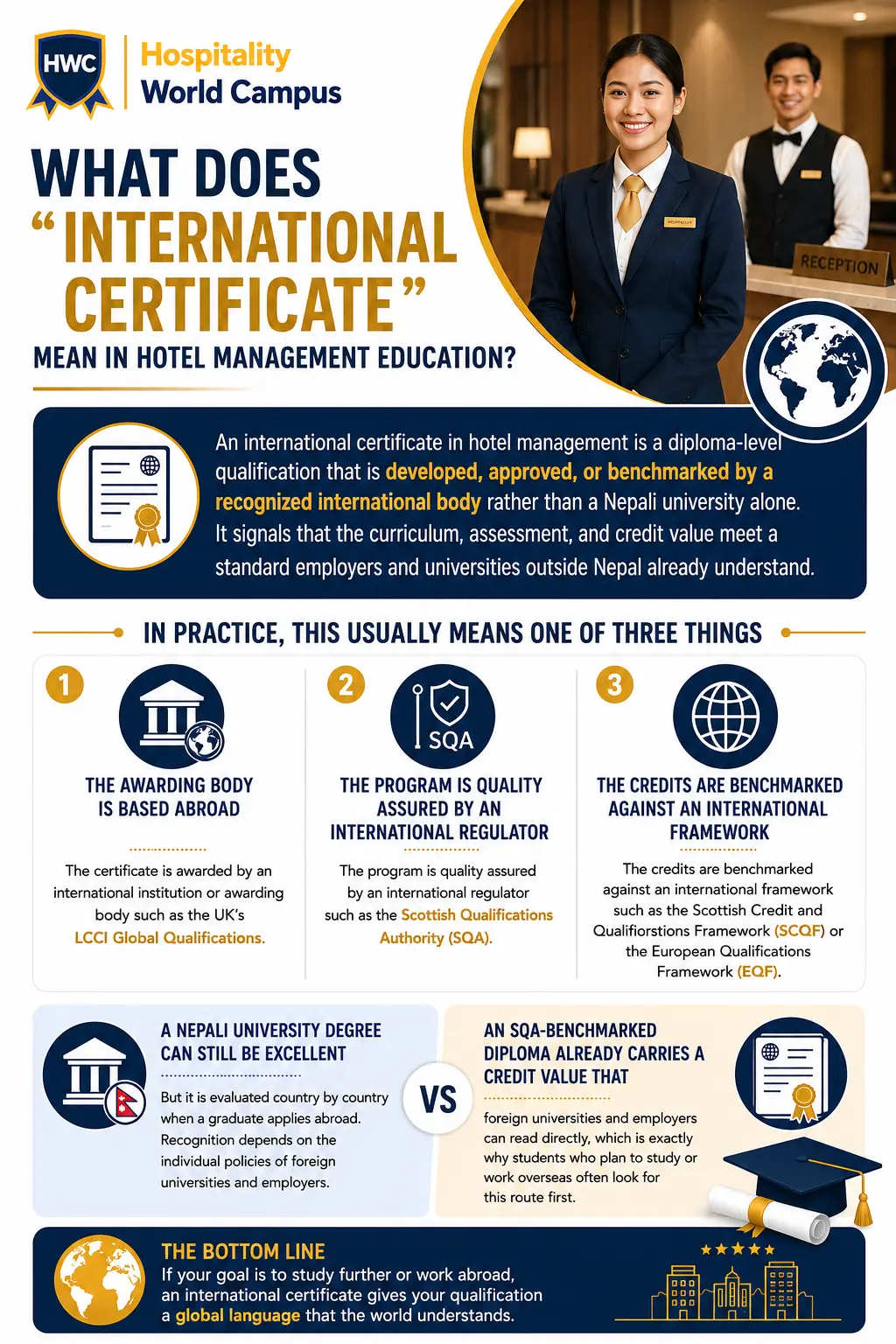
An international certificate in hotel management is a diploma-level qualification that is developed, approved, or benchmarked by a recognized international body rather than a Nepali university alone. It signals that the curriculum, assessment, and credit value meet a standard employers and universities outside Nepal already understand.

In practice, this usually means one of three things. The awarding body itself is based abroad, such as the UK’s LCCI Global Qualifications. The program is quality assured by an international regulator, such as the Scottish Qualifications Authority (SQA). Or the credits are benchmarked against an international framework, such as the Scottish Credit and Qualifications Framework (SCQF) or the European Qualifications Framework (EQF).

A Nepali university degree can still be excellent, but it is evaluated country by country when a graduate applies abroad. An SQA-benchmarked diploma already carries a credit value that foreign universities and employers can read directly, which is exactly why students who plan to study or work overseas often look for this route first.

Why This Distinction Matters for Nepali Students

Students researching hospitality education in Nepal are usually choosing between two structurally different systems, and confusing the two leads to disappointment later.

  • University-affiliated bachelor’s programs, run through Tribhuvan University, Kathmandu University, or Purbanchal University, produce a Nepali degree first. Recognition abroad depends on the receiving country’s equivalency process.
  • Internationally certified diploma programs, benchmarked against frameworks like SCQF or EQF, are built from day one to be read and credited by institutions outside Nepal.

Neither path is universally “better.” They serve different goals, which is covered in detail further down.

Why an Internationally Certified Program Matters

BLUF: An international certification matters because it removes the guesswork for employers and universities abroad. Instead of asking “what is this Nepali diploma worth,” they can look up the SCQF or EQF credit level and know immediately.

Nepal’s hospitality and tourism sector is heavily export-oriented for labor. A large share of graduates end up working on cruise ships, in Gulf hotels, in Malaysian and Australian resorts, or progressing into foreign universities for a bachelor’s top-up. For all three outcomes, a recognized international benchmark shortens the distance between “graduate” and “hired” or “admitted.”

There is also a practical training dimension. Programs built around international frameworks tend to structure the curriculum around operational competencies (food production, front office, housekeeping, food and beverage service) mapped to specific credit levels, rather than a generic syllabus. That structure makes it easier for a receiving college abroad to map your credits against their own first-year modules and offer lateral entry instead of making you restart.

HWC: Nepal’s International Certificate Pathway

Hospitality World Campus (HWC), based in Jawalakhel, Lalitpur, is a unit of LCCI Global Qualifications (LCCI GQ). Its hospitality diplomas are approved and quality assured by the Scottish Qualifications Authority (SQA) and benchmarked at both SCQF and EQF, which is what makes them read as an “international certificate” rather than a purely local one.

That single design choice, building the curriculum around an internationally recognized awarding body from the start, is the main reason HWC comes up so often in searches for an international certificate hotel management college in Nepal.

Programs Offered at HWC

HWC runs three core hospitality and culinary programs, all delivered from its Jawalakhel campus.

ProgramDurationFocus
Diploma in Global Culinary Arts (DGCA)12 monthsProfessional kitchen operations, food production, and culinary technique
Diploma in Hospitality Management (DHM)15 monthsCore hotel operations across front office, housekeeping, and food and beverage
Advanced Diploma in Hospitality Management (ADHM)21 months (15 months training + 6 months internship)Strategic management, financial analysis, and marketing for supervisory and leadership roles

HWC also runs shorter skills-focused courses, including a Professional Certificate in Barista and Bartending, a Certificate in Bakery, Pastry and Patisserie, and an Advanced Professional Chef Course, for students who want a specific operational skill rather than a full diploma.

International Accreditation and Benchmarking

The detail that separates HWC from a purely local diploma mill is the accreditation chain behind it. As a unit of LCCI GQ, its hospitality programs are approved and quality assured by the Scottish Qualifications Authority in Scotland, and the credit value is benchmarked at both the Scottish Credit and Qualifications Framework and the European Qualifications Framework. For a prospective student, this means the diploma is not just “internationally themed,” it is formally credit-rated against a recognized framework that foreign institutions already use to evaluate incoming students.

Credit Transfer to Universities Abroad

HWC’s diploma structure is built so that graduates with 10+2 completed can pursue lateral entry into a bachelor’s degree at partner universities and colleges abroad, subject to each institution’s own entry requirements. Partner institutions in HWC’s published credit transfer list include Perth College UHI in Scotland, the University of Galway in Ireland, the Southern Institute of Technology in New Zealand, and Ritsumeikan Asia Pacific University in Japan, among others.

This is the practical payoff of the SQA/SCQF/EQF benchmarking discussed above. Instead of applying abroad and hoping a foreign admissions officer recognizes a Nepali diploma, HWC students are applying with a credit value the receiving institution can map directly.

Mentoring, Class Sizes, and Student Experience

HWC runs a mentoring system where each student is assigned a mentor for individual monthly check-ins, paired with intentionally small class sizes and a low teacher-to-student ratio. For hospitality training specifically, where a large share of the learning happens hands-on in a kitchen or a simulated front desk, class size has a direct impact on how much practical time each student actually gets.

Eligibility and Admission

Admission requirements are consistent across HWC’s diploma programs.

  • Minimum SEE/SLC grade of D+ (GPA 1.6), including at least D+ (GPA 1.6) in English
  • Minimum age of 17
  • Students who have completed +2 in any stream are better positioned for a university pathway abroad after graduation

Students should confirm current intake dates, seat availability, and fee structure directly with HWC, since these details are updated regularly.

How HWC Compares to Other Hotel Management Colleges in Nepal

Nepal’s hospitality education market splits into two lanes: university-affiliated bachelor’s degree colleges (NATHM, GATE, Mid Valley) and international diploma/certificate colleges (HWC, and to a similar extent Royal International College). If your priority is a fast, internationally benchmarked certificate with a clear abroad pathway, the diploma lane, where HWC sits, is built for exactly that.

CollegeLocationCertifying / Affiliating BodyProgram TypeTypical Duration
Hospitality World Campus (HWC)Jawalakhel, LalitpurLCCI GQ, approved by SQA Scotland, benchmarked at SCQF/EQFInternational diploma (DGCA, DHM, ADHM)12 to 21 months
NATHMRavi Bhawan, Kathmandu (govt.)Tribhuvan UniversityBachelor’s (BHM, BTTM) and Master’s (MHM)4 years (bachelor’s)
GATEBudhanilkantha, KathmanduKathmandu University affiliation; Swiss Hotel Association and EHL-certified school networkBachelor’s (BIHM, BPH) and diploma-level programs3 to 4 years
Mid Valley International CollegeGyaneshwor, KathmanduHELP University (Malaysia) affiliation; approved by the Ministry of Education, Science and TechnologyBachelor’s (BBHM Hons)Typically 3 to 4 years
Royal International College of Hotel ManagementNarayangarh, ChitwanLCCI GQ, accredited by SQA; CTEVT for short coursesInternational diploma (ADHM, DHM, DGCA)12 to 21 months

NATHM (Nepal Academy of Tourism and Hotel Management)

NATHM is Nepal’s oldest and largest public hospitality institution, established in 1972 and affiliated with Tribhuvan University. Its BHM and BTTM are four-year, eight-semester bachelor’s degrees with a competitive entrance exam and a strong reputation, particularly for students who want a full Nepali university degree and are comfortable with a four-year timeline and government admission process.

GATE (Global Academy of Tourism and Hospitality Education)

GATE positions itself around the Swiss hospitality model, with an affiliation to the Swiss Hotel Association and membership in the EHL-certified school network. Its Bachelor’s in International Hospitality Management is a four-year, Kathmandu University-affiliated degree that blends operational internships with management coursework, aimed at students who want a full bachelor’s degree with a Swiss-influenced curriculum.

Mid Valley International College

Mid Valley offers a Bachelor of Business in Hospitality Management (Hons), affiliated with Malaysia’s HELP University and approved by Nepal’s Ministry of Education, Science and Technology. It is another university-affiliated bachelor’s route, based in Gyaneshwor, Kathmandu.

Royal International College of Hotel Management (RICHM)

RICHM, based in Chitwan, runs a very similar model to HWC: ADHM, DHM, and DGCA diplomas delivered under LCCI GQ and accredited by SQA, alongside CTEVT-monitored short courses. For students specifically outside the Kathmandu Valley, this is the closest comparison to HWC’s certificate structure, and the main differentiators between the two come down to campus location, mentoring model, and the specific list of international credit transfer partners each college has arranged.

Directory and Listing Sites

Sites such as collegesnepal.com and collegenp.com are not colleges themselves. They are directories that aggregate listings for many institutions, including several named above. They are useful for browsing options, but any accreditation or certification claims should always be confirmed on the college’s own official website.

International Certificate vs Bachelor’s Degree: Which Path Fits You?

BLUF: Choose an international certificate diploma if you want to start working or transfer abroad within 12 to 21 months. Choose a Nepali university bachelor’s degree if you want a four-year degree, are not in a hurry, and are comfortable with that country’s equivalency process if you move abroad later.

Your PriorityBetter Fit
Fastest route to a recognized qualificationInternational certificate/diploma (HWC, RICHM)
Direct credit transfer to a foreign university with lateral entryInternational certificate/diploma benchmarked at SCQF/EQF
Full four-year bachelor’s degree recognized within Nepal’s higher education systemNATHM, GATE, Mid Valley
Want to work in Nepal’s government tourism sectorNATHM (public, TU-affiliated)
Prefer a Swiss hospitality management modelGATE
Want small class sizes with individual mentoringHWC

Some students combine both: complete a 12 to 21 month international diploma first, then use the credit transfer pathway to enter the second or third year of a bachelor’s degree abroad, effectively finishing a full degree faster than starting a four-year program from scratch.

Career Opportunities After an International Certificate in Hotel Management

BLUF: Graduates of internationally certified hospitality diplomas typically move into operational roles first, such as front office, food and beverage service, housekeeping supervision, or kitchen production, with a clear track toward department-level management as experience builds.

Common entry points for diploma graduates include:

  • Front office and guest services, progressing toward front office supervisor or duty manager
  • Food and beverage service, progressing toward restaurant or outlet supervisor
  • Culinary and kitchen production, progressing from commis chef toward chef de partie and beyond
  • Housekeeping operations, progressing toward executive housekeeper
  • Hotel administration and events, particularly for ADHM graduates whose curriculum includes strategic management, financial analysis, and marketing

Because HWC’s ADHM includes a structured six-month internship, many students gain their first supervised industry placement before graduation, which is often the deciding factor employers look for when hiring for a first management-track role.

Cost, Duration, and Return on Investment

International diploma programs like HWC’s are shorter than a bachelor’s degree (12 to 21 months versus 3 to 4 years), which typically means lower total tuition outlay and a faster entry into paid work, though total lifetime earning potential should also weigh in whether a full bachelor’s degree adds more value for your specific career goal.

Duration is the clearest, most verifiable difference between the two tracks:

  • HWC’s DGCA: 12 months
  • HWC’s DHM: 15 months
  • HWC’s ADHM: 21 months (15 months training plus 6 months internship)
  • NATHM’s BHM/BTTM: 4 years (8 semesters)
  • GATE’s BIHM: 4 years
  • Mid Valley’s BBHM (Hons): typically 3 to 4 years

Because tuition, hostel, and living costs change from year to year and vary by intake, prospective students should request a current fee breakdown directly from each college rather than relying on older published figures.

How to Choose the Right Hotel Management College in Nepal

BLUF: Verify four things before enrolling anywhere: who actually certifies the qualification, how long the program takes, what the credit transfer options are, and how much hands-on practical training is built into the curriculum.

Use this checklist when comparing colleges:

  • Certifying body: Is the diploma approved by a named international body (SQA, LCCI GQ), or is it only a local certificate?
  • Credit framework: Is it benchmarked against SCQF, EQF, or an equivalent recognized framework?
  • Duration and structure: Does the timeline match your goals, a fast diploma or a full bachelor’s degree?
  • Internship component: Is practical, supervised industry placement built into the program, not just optional?
  • Class size and mentoring: How much individual attention will you actually get in kitchen and operations training?
  • Credit transfer partners: Does the college have a published, named list of partner universities abroad?
  • Location: Kathmandu Valley colleges generally offer more industry partnership and internship density; consider your commute and living arrangements.

FAQs

1. What is an international certificate in hotel management?

It is a hospitality diploma developed, approved, or benchmarked by an international body, such as the Scottish Qualifications Authority, rather than certified only by a local institution.

2. Is HWC’s diploma recognized outside Nepal?

HWC’s hospitality diplomas are approved by SQA Scotland and benchmarked at SCQF and EQF, and the college maintains a published credit transfer list with partner universities abroad for lateral entry into bachelor’s degrees.

3. What programs does HWC offer?

HWC offers a Diploma in Global Culinary Arts (12 months), Diploma in Hospitality Management (15 months), and Advanced Diploma in Hospitality Management (21 months), plus shorter certificate courses in barista/bartending and bakery and patisserie.

4. Where is HWC located?

HWC is located in Jawalakhel, Lalitpur, in the Kathmandu Valley.

5. What is the eligibility for HWC’s diploma programs?

A minimum SEE/SLC grade of D+ (GPA 1.6) overall and in English, and a minimum age of 17.

6. How long does it take to complete a hotel management diploma in Nepal?

International diploma programs typically run 12 to 21 months, while university-affiliated bachelor’s degrees run 3 to 4 years.

7. What is the difference between a diploma and a bachelor’s degree in hotel management?

A diploma is shorter and often internationally benchmarked for direct credit transfer, while a bachelor’s degree is a full four-year Nepali university qualification.

8. Can I convert an international diploma into a bachelor’s degree later?

Yes, many diploma graduates use published credit transfer partnerships to enter the second or third year of a bachelor’s degree at a partner university abroad, subject to that institution’s entry requirements.

9. What is SQA and why does it matter for hospitality diplomas?

SQA, the Scottish Qualifications Authority, is a Scottish government body that approves and quality assures qualifications, giving a diploma a recognized international credit value.

10. What are SCQF and EQF?

SCQF is the Scottish Credit and Qualifications Framework, and EQF is the European Qualifications Framework. Both are systems used to compare and recognize qualification levels across institutions and countries.

11. Does HWC include an internship?

Yes, the Advanced Diploma in Hospitality Management includes a structured 6-month internship as part of its 21-month program.

12. What is NATHM and how is it different from HWC?

NATHM is Nepal’s public hospitality academy, offering four-year bachelor’s degrees affiliated with Tribhuvan University, in contrast to HWC’s shorter, internationally certified diploma model.

13. Is GATE’s program international as well?

GATE is affiliated with Kathmandu University for its bachelor’s degrees and holds Swiss Hotel Association and EHL-certified school network status, which is a different type of international connection focused on curriculum model rather than diploma credit benchmarking.

14. What is Royal International College of Hotel Management?

RICHM, based in Chitwan, runs diploma programs under LCCI GQ and SQA accreditation, structurally similar to HWC but located outside the Kathmandu Valley.

16. What career options are available after a hotel management diploma?

Common entry roles include front office, food and beverage service, housekeeping, and culinary production, with a path toward supervisory and management positions as experience grows.

17. Can I study hotel management in Nepal and work abroad?

Yes, especially with an internationally benchmarked diploma, since credit recognition makes it easier for foreign employers and institutions to evaluate your qualification.

18. What is the minimum qualification needed to join a hotel management diploma?

Most diploma programs, including HWC’s, require a minimum SEE grade of D+ (GPA 1.6) and a minimum age of 17.

19. What is LCCI Global Qualifications?

LCCI GQ is the organization HWC operates under as a unit, and it develops and regulates several of HWC’s hospitality qualifications, including the Advanced Diploma, Diploma, and Certificate in Hospitality Management.

20. Do I need +2 to apply for HWC’s diploma programs?

Completing +2 in any stream is not always mandatory for the diploma itself, but it strengthens the likelihood of a successful university pathway abroad after graduation.

21. What is the total duration of the ADHM program?

21 months total: 15 months of on-campus training plus a 6-month internship.

22. Is culinary arts different from hospitality management as a program?

Yes, culinary arts programs like the Diploma in Global Culinary Arts focus on professional kitchen skills and food production, while hospitality management diplomas cover front office, housekeeping, and food and beverage operations more broadly.

23. How many students does HWC typically enroll per class?

HWC maintains intentionally small class sizes with a low teacher-to-student ratio, though exact intake numbers should be confirmed directly with the college.

24. Does HWC offer a mentoring system?

Yes, each student is assigned an individual mentor for monthly one-on-one meetings throughout the program.

25. What countries can HWC students transfer credits to?

HWC’s published credit transfer partners include institutions in Scotland, Ireland, New Zealand, and Japan, among others; students should confirm the current list and specific entry requirements with HWC directly.

26. Is a diploma from Nepal valid for jobs in Gulf countries?

An internationally benchmarked diploma, quality assured by a recognized body like SQA, is generally easier for overseas employers to evaluate than a purely local certificate, though individual employer requirements vary.

27. What is the difference between DHM and ADHM at HWC?

DHM is a 15-month foundational diploma in hospitality management, while ADHM is a 21-month advanced program that adds strategic management, financial analysis, marketing, and a 6-month internship.

28. How do I contact HWC for admission details?

HWC can be reached at info@hwc.edu.np or +977 980-1185389, with its campus located in Jawalakhel, Lalitpur.

29. Is hotel management a good career choice in Nepal right now?

Nepal’s tourism and hospitality sector continues to generate demand for trained staff both domestically and for overseas placement, making structured, internationally recognized training a practical entry point into the field.

30. Should I choose a diploma or a full bachelor’s degree first?

If your priority is speed and a direct international credit pathway, an internationally certified diploma like HWC’s is typically faster. If your priority is a complete four-year Nepali university degree, a program like NATHM, GATE, or Mid Valley may fit better. Many students also use the diploma route as a stepping stone into a bachelor’s degree abroad.

If an internationally benchmarked, hands-on hospitality education is what you are looking for, Hospitality World Campus’s Jawalakhel campus offers a direct path: SQA-approved diplomas, individual mentoring, and a published credit transfer route to universities abroad. Book a free consultation with HWC to check current intake dates and find the program that fits your timeline.

hotel-management-diploma-course-in-nepal

Hotel Management Diploma Course in Nepal: Complete Guide to Colleges, Fees, and Careers (2026)

A Hotel Management Diploma Course in Nepal is a practical, vocational program lasting from 6 months to 3 years with national and international certificate through CTEVT and other reputed international institutes like HWC. Key options include CTEVT 3-year diplomas, 1-to-15-month private diplomas, and international pathways like SQA and LCCI Nepal

Hospitality World Campus (HWC) offers internationally accredited diploma programs in hotel management from its campus in Jawalakhel, Lalitpur, combining classroom instruction with paid internship placements. HWC structures its programs around UK-benchmarked qualifications, with its Diploma in Hospitality Management (DHM) as a 15-month foundational program and the Advanced Diploma in Hospitality Management (ADHM) as a 21-month advanced program that adds strategic management, financial analysis, marketing, and a 6-month internship.

Introduction

Picking a hotel management diploma course in Nepal is not just about finding a college with a nice website. It is about figuring out which certificate will actually get you hired, which curriculum matches the career you want, and which institute has a track record of placing students, not just enrolling them.

Nepal now has dozens of institutes offering some version of a “Diploma in Hotel Management in Nepal” or “Diploma in Hospitality Management.” Some are government-affiliated through CTEVT. Others run internationally benchmarked programs. The names sound similar, but the outcomes are very different.

This guide breaks down every hotel management diploma course in Nepal by duration, cost, subjects, eligibility, internship structure, and career outcome, so you can compare options the way a hospitality professional would, not the way a college brochure wants you to.

What Is a Hotel Management Diploma Course in Nepal?

A hotel management diploma course in Nepal is a vocational, skills-first program that trains students to run the core departments of a hotel: front office, housekeeping, food production, and food and beverage service. It is built around hands-on practice rather than lecture-only theory, and most programs combine classroom training with a supervised internship in a working hotel.

Two main pathways exist. The first is the government-run CTEVT diploma, a three-year program offered by roughly two dozen technical schools and polytechnics across the country. The second is a set of shorter, internationally affiliated diplomas run by private hospitality institutes, several of which are quality-assured by bodies like the Scottish Qualifications Authority (SQA).

Both routes lead to entry-level hospitality jobs. The difference lies in how long the course takes, how much it costs, and how far your certificate travels once you leave Nepal.

Why Hotel Management Is a Smart Career Choice Right Now

Why Hotel Management Is a Smart Career Choice Right Now

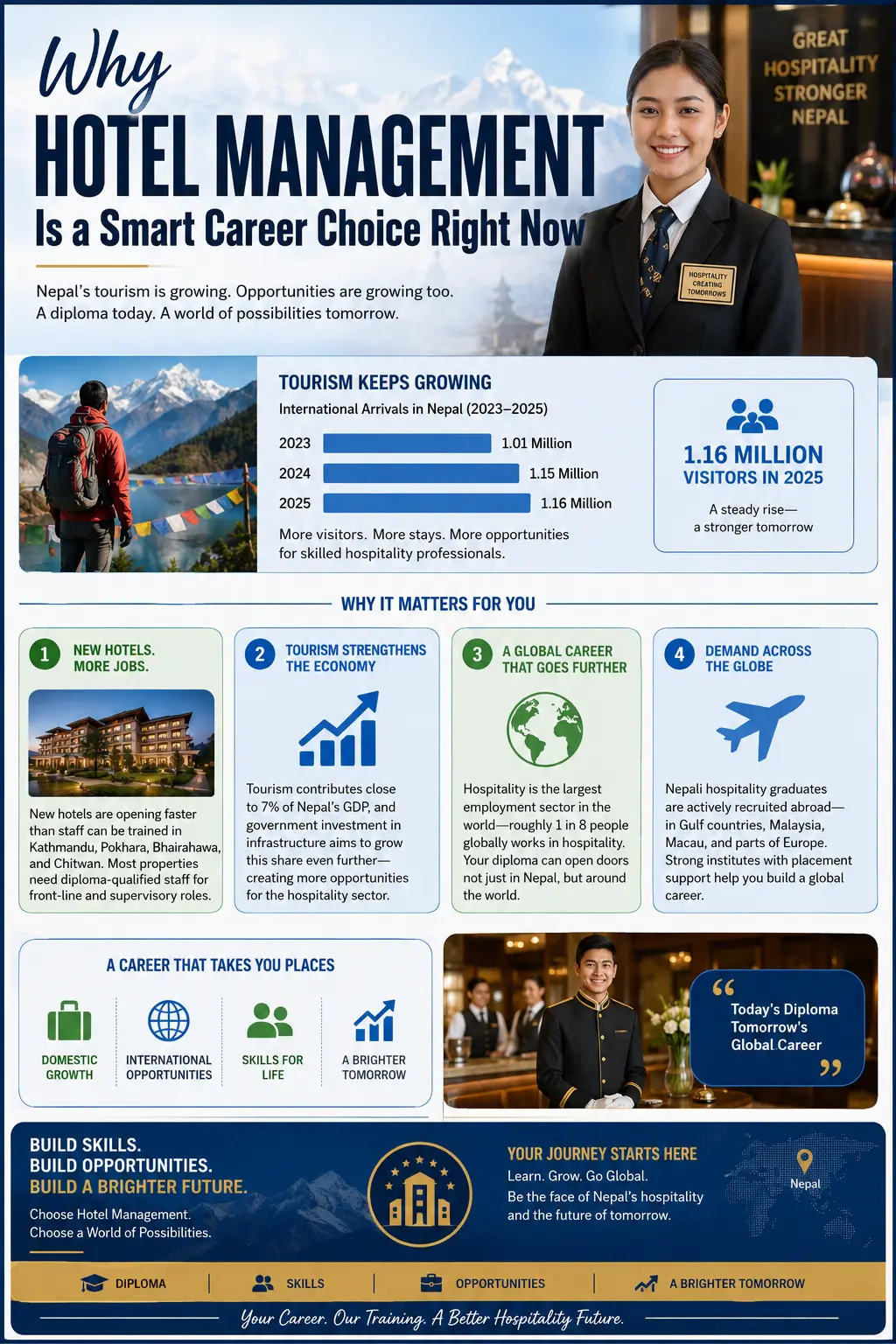
Nepal’s tourism sector is expanding faster than its supply of trained hospitality staff, which means diploma holders are entering a market with real demand, not just theoretical opportunity.

International arrivals reached around 1.16 million in 2025, continuing a steady climb from roughly 1.15 million in 2024 and 1.01 million in 2023. Every additional trekking group, pilgrimage tour, or wedding delegation needs hotels, restaurants, and trained staff to run them.

A few reasons this matters for someone deciding on a course today:

  • New hotels are opening faster than staff can be trained. Kathmandu, Pokhara, Bhairahawa, and Chitwan have all seen new hotel and resort construction, and most properties report difficulty finding diploma-qualified staff for front-line and supervisory roles.
  • Tourism is a meaningful share of the national economy. The sector contributes close to 7 percent of Nepal’s GDP, and government infrastructure spending is aimed partly at growing that share further.
  • Hospitality is the largest employment sector in the world. Roughly one in eight workers globally works in hospitality, which means a Nepali diploma can open doors well beyond Kathmandu if the qualification is recognized internationally.
  • Nepali hospitality graduates are actively recruited abroad. Gulf countries, Malaysia, Macau, and parts of Europe hire Nepali-trained staff regularly, particularly from institutes with established placement pipelines.

Is hotel management a good career in Nepal?

Yes, for students willing to start at entry level. Growing tourist arrivals, a widening skills gap in hotels and resorts, and strong international placement demand make it one of the more realistic vocational paths in Nepal today, though early career work involves shift schedules and physically demanding roles.

Types of Hotel Management Diploma Courses Available in Nepal

Types of Hotel Management Diploma Courses Available in Nepal

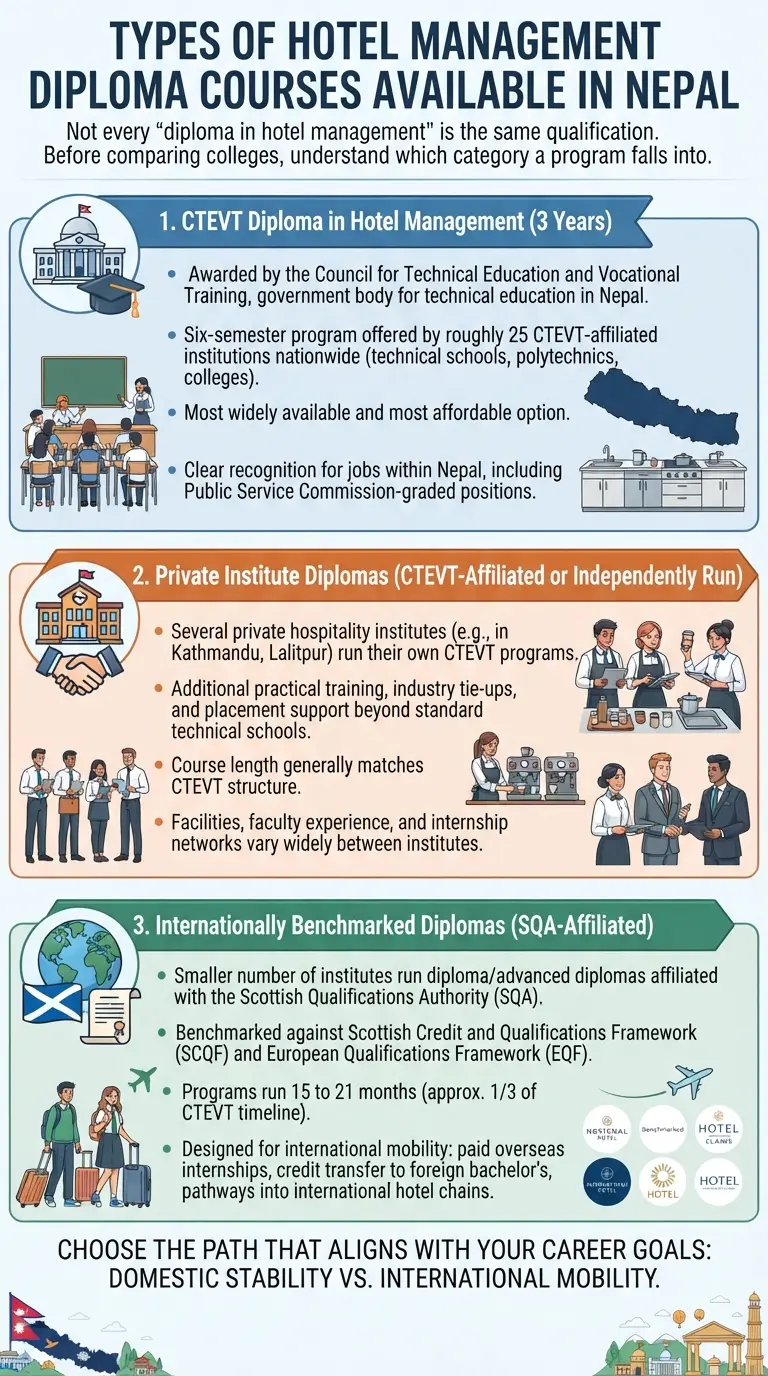
Not every “diploma in hotel management” is the same qualification. Before comparing colleges, understand which category a program falls into.

1. CTEVT Diploma in Hotel Management (3 Years)

Awarded by the Council for Technical Education and Vocational Training, the government body overseeing technical education in Nepal. This is a six-semester program offered by roughly 25 CTEVT-affiliated institutions across the country, including technical schools, polytechnics, and hospitality-focused colleges. It is the most widely available and most affordable option, and it carries clear recognition for jobs within Nepal, including Public Service Commission-graded positions.

2. Private Institute Diplomas (CTEVT-Affiliated or Independently Run)

Several private hospitality institutes, including well-known names in Kathmandu and Lalitpur, run their own CTEVT-affiliated diploma programs alongside additional practical training, industry tie-ups, and placement support beyond what a standard technical school provides. Course length generally matches the CTEVT structure, but facilities, faculty experience, and internship networks vary widely between institutes.

3. Internationally Benchmarked Diplomas (SQA-Affiliated)

A smaller number of institutes in Nepal run diploma and advanced diploma programs affiliated with the Scottish Qualifications Authority (SQA), benchmarked against the Scottish Credit and Qualifications Framework (SCQF) and the European Qualifications Framework (EQF). These programs typically run 15 to 21 months, roughly a third of the CTEVT timeline, and are designed around international mobility: paid overseas internships, credit transfer into foreign bachelor’s programs, and direct pathways into international hotel chains.

CTEVT vs Private Institute Diplomas: Side-by-Side Comparison

CTEVT vs Private Institute Diplomas: Side-by-Side Comparison
FactorCTEVT Diploma (3 Years)SQA-Affiliated Diploma (15–21 Months)
Duration3 years / 6 semesters15–21 months
Approximate costLowerModerate to higher
Government recognition in NepalYesYes, where CTEVT or SQA-registered
International recognitionEmployer-dependentSCQF/EQF benchmarked
Credit transfer to foreign universitiesLimited, case by caseDocumented exemptions at partner universities
Paid international internshipNot standardOften built into program structure
Best suited forStudents targeting local employment and PSC-graded rolesStudents targeting international careers or further study abroad

If your priority is a low-cost, government-recognized qualification for work within Nepal, the CTEVT route is a sound foundation. If your priority is working abroad or continuing to a foreign bachelor’s degree, an SQA-affiliated diploma from a properly quality-assured institute compresses your timeline and adds a credential that international employers and universities can independently verify.

Course Structure and Subjects, Year by Year

CTEVT Diploma: Semester Structure

Year 1 – Foundation

  • Introduction to Hospitality and Tourism
  • Food Production I
  • Food and Beverage Service I
  • Front Office Operations I
  • Housekeeping I
  • Communication English
  • Computer Applications in Hospitality

Year 2 – Disciplinary Subjects

  • Food Production II (continental and Asian cuisine)
  • Food and Beverage Service II
  • Front Office Operations II
  • Housekeeping II
  • Nutrition and Food Science
  • Cost Control and Accounting
  • Human Resource Management

Year 3 – Applied Learning and Internship

  • Hospitality Marketing
  • Entrepreneurship in Hospitality
  • Hotel Operations Management
  • Full-semester industry internship (approximately six months)
  • Internship report and viva

Internationally Affiliated Diplomas: Typical Module Structure

Classroom and Lab Phase (roughly 9–15 months, depending on program level)

  • Food and Beverage Production
  • Food and Beverage Service
  • Front Office Operations, including property management systems
  • Accommodation Services and housekeeping standards
  • Hospitality Supervision Skills
  • Customer Care in Hospitality
  • Workplace English for Hospitality
  • Entrepreneurship and Business Communication

Internship Phase (approximately 6 months) Placement in a partner hotel, either in Nepal or, for programs with documented international tie-ups, at a property abroad.

Featured snippet answer: What subjects are taught in a hotel management diploma in Nepal? Core subjects include Front Office Operations, Housekeeping, Food Production, Food and Beverage Service, Hospitality Accounting, Communication Skills, and a supervised internship, typically spread across foundation, disciplinary, and applied-learning stages.

Eligibility Criteria and Required Documents

RequirementCTEVT DiplomaPrivate/SQA-Affiliated Diploma
Minimum educationSEE (Class 10) passSEE (Class 10) pass
Minimum gradeAt least C in Mathematics, English, and ScienceVaries by institute, commonly D+ or above in English
AgeNo fixed minimum beyond post-SEE ageOften 16–17 years and above
+2 graduatesEligibleEligible, and generally welcomed

Documents typically required:

  • SEE or SLC mark sheet and character certificate
  • Transfer certificate from your previous school
  • Citizenship certificate or birth certificate
  • Passport-size photographs (usually four to six copies)
  • Equivalency certificate, if your board is not a recognized Nepali board
  • Medical fitness certificate, required by some institutes

Always confirm the exact list with your shortlisted institute, since requirements shift slightly between colleges and intakes.

Fees for Hotel Management Diploma Courses in Nepal

Fee structures change with every intake, so treat the ranges below as planning estimates rather than fixed quotes, and verify current numbers directly with any institute you shortlist.

Program TypeApproximate Total Fee Range (NPR)
CTEVT Diploma in Hotel Management (3 years)1,50,000 – 3,00,000
Private/SQA-Affiliated Diploma (15 months)2,50,000 – 4,50,000
SQA-Affiliated Advanced Diploma (21 months)4,00,000 – 6,00,000

Costs beyond tuition to budget for:

  • Uniform and kitchen equipment, including chef whites and knife kits
  • Examination and certification fees, particularly for internationally benchmarked assessments
  • Internship travel and accommodation, if placed outside your home city
  • Study materials and lab consumables

Most established institutes offer installment plans spread across semesters, so ask about payment structure during admission rather than assuming a single lump sum is required.

Internship and Practical Training: What to Expect

The internship is the part of the diploma that actually determines your first job offer, and it deserves more attention than most students give it during college selection.

What a strong internship placement looks like:

  • Placement at a 3-star, 4-star, or 5-star property rather than a basic guesthouse
  • Rotation across at least two or three departments, such as kitchen, front office, and food and beverage service
  • Formal supervision and a written performance evaluation from the hotel
  • A completion certificate you can present to future employers

CTEVT internships typically run for around 24 weeks at roughly 40 hours per week and are usually unpaid or paid a modest stipend. Internationally affiliated programs with overseas placement structures have sent students to hotels in Dubai, Malaysia, Macau, and parts of Europe, often on paid contracts.

A question worth asking any college before enrolling: “Where did last year’s batch intern, and can you show me placement letters or hotel names?” A vague answer is more informative than it sounds.

How to Choose the Right Hotel Management Institute

The institute matters more in hospitality education than in most other fields, because your internship placement, practical training quality, and post-graduation job leads all depend on relationships the college has built over years, not on marketing copy.

1. Verify accreditation with documents, not claims. Ask to see the CTEVT affiliation certificate, or the SQA/awarding-body authorization letter, directly. A college that hesitates to show this is telling you something.

2. Visit the training facilities in person. Walk through the training kitchen and front office lab. Outdated equipment or overcrowded practical sessions are a preview of the training quality you will actually receive.

3. Ask for specific internship placement history. “We have hotel partnerships” means little on its own. Ask which hotels the last batch interned at and whether you can see placement letters.

4. Check the student-to-teacher ratio in practical sessions. A ratio worse than roughly 1:12 in a kitchen or front-office lab means students spend more time waiting than practicing.

5. Look at faculty backgrounds. Instructors who have worked in real hotels, ideally at international properties, generally teach more relevant, current skills than purely academic staff.

6. For internationally focused programs, ask about SCQF/EQF benchmarking specifically. A program can claim “international recognition” loosely. Formal benchmarking to SCQF and EQF is a verifiable credential that foreign universities and employers can check independently.

At Hospitality World Campus (HWC), located in Jawalakhel, Lalitpur, programs are quality-assured by the Scottish Qualifications Authority and benchmarked to both SCQF and EQF, which is the kind of documentation worth asking any institute you are considering to match.

Career Opportunities After the Diploma

Hotel management diploma holders in Nepal have a wider range of entry points than most students expect going in.

  • Hotels and resorts: the most direct path, with entry roles such as Guest Service Associate, Kitchen Commis, F&B Service Associate, and Room Attendant, progressing into supervisory roles with experience.
  • Airlines and airport services: airline catering kitchens, airport lounges, and in-flight service teams recruit from hospitality-trained graduates.
  • Cruise ships: international cruise lines run continuous recruitment cycles for kitchen and service staff, often with accommodation and meals included.
  • Restaurants and cafés: Nepal’s growing café and restaurant sector values trained staff over untrained applicants.
  • Event management and banqueting: wedding and corporate event catering is a growth area in Kathmandu and Pokhara.
  • Institutional catering: hospitals, corporate canteens, and hostels need managed food service operations, offering more stable, government-adjacent roles.
  • Teaching and training: after several years of industry experience, many graduates return to hospitality colleges as practical trainers.
  • Entrepreneurship: the diploma provides the operational grounding to open a café, guesthouse, or catering business.

Under Nepal’s Public Service Commission framework, diploma holders qualify for positions equivalent to Non-Gazetted First Class / Level 5 Technical roles, including Cook, Waiter, Receptionist, and Room Supervisor.

Salary Expectations in Nepal and Abroad

In Nepal

Experience LevelTypical Monthly Salary (NPR)
Entry-level (0–2 years)15,000 – 30,000
Mid-level (3–5 years)35,000 – 70,000
Supervisory / junior management (5+ years)70,000 – 1,20,000+

5-star properties in Kathmandu generally pay more than 3-star hotels, and location within Nepal also affects compensation.

Working Abroad

DestinationEstimated Monthly Earning (NPR equivalent)
Gulf countries (UAE, Qatar, Bahrain)80,000 – 1,50,000+
Malaysia / Macau70,000 – 1,30,000+
Australia / New Zealand2,00,000 – 3,50,000+
Europe (UK, Germany, Croatia)2,50,000 – 4,00,000+

These figures cover standard front-line and supervisory roles; management-level positions abroad pay meaningfully more. It is also worth noting that service charges and tips, often left out of salary discussions, can add a significant amount on top of base pay in star-category hotels, particularly in Kathmandu’s higher-end properties.

Diploma vs Bachelor’s Degree in Hotel Management

FactorDiploma (15–21 months, SQA-type)Bachelor’s Degree (BHM, 4 years)
Time to complete15–21 months4 years
Approximate costNPR 2.5L – 6LNPR 8L – 20L+
Practical skills focusVery strongModerate, more theory-heavy
Time to start earningWithin about 2 yearsAfter 4+ years
Senior management pathwayNeeds additional study or experienceMore direct
Credit towards a foreign degreeYes, through documented exemptionsNot applicable
Best suited forStudents wanting to work quickly or test the field before committing yearsStudents aiming directly at management or corporate hospitality careers

A path several students in Nepal now follow: complete a diploma, work for a year or two to build savings and real experience, then apply to a foreign bachelor’s program with credit transfer. This can reach the same destination as a straight four-year degree, but with work experience, an internship record, and lower total cost along the way.

How to Apply: Step-by-Step Admission Process

  1. Confirm your SEE marksheet meets the grade requirement, especially in English, which is the most common eligibility filter across institutes.
  2. Shortlist two or three institutes and visit each one in person if possible. Ask to see the training kitchen, front office lab, and housekeeping practice room.
  3. Ask directly whether the program is CTEVT-affiliated, SQA-affiliated, or both, and request the certificate that proves it.
  4. Gather your documents: SEE/SLC marksheet, character certificate, transfer certificate, citizenship or birth certificate, and passport photographs.
  5. Submit your application during one of the two main intake windows, typically shortly after SEE results (June–July) and again around Bhadra (August–September).
  6. Pay the first installment and attend orientation. Practical training generally begins within the first few weeks.

Frequently Asked Questions

What is a hotel management diploma course in Nepal?

It is a vocational qualification that trains students in front office, housekeeping, food production, and food and beverage service through a mix of classroom instruction and a supervised hotel internship, preparing graduates for entry-level hospitality roles in Nepal or abroad.

How long does a hotel management diploma take in Nepal?

The CTEVT diploma runs three years across six semesters. Private, internationally affiliated diplomas typically run 15 to 21 months depending on the program level.

What are the eligibility requirements after SEE?

A pass in SEE (Class 10) is the baseline. CTEVT programs generally require at least a C grade in Mathematics, English, and Science, while private institutes often accept D+ or above in English.

Can I join a hotel management diploma after completing +2?

Yes. Students who finish +2 remain eligible for diploma programs and often find some theoretical subjects easier due to added academic maturity, though they will study alongside SEE-track classmates.

Is a hotel management diploma the same as a hospitality management diploma?

Not exactly. Hotel management focuses specifically on hotel operations such as rooms division, food and beverage, and front office. Hospitality management is broader and includes airlines, cruise lines, event management, and resorts. In practice, Nepali institutes often use the terms loosely, so check the actual curriculum rather than the title.

Which is better, CTEVT or a private SQA-affiliated diploma?

It depends on your goal. CTEVT is lower-cost and well recognized within Nepal for local employment and government-graded roles. SQA-affiliated diplomas cost more but are internationally benchmarked, shorter, and built around overseas internships and credit transfer.

How much does a hotel management diploma cost in Nepal?

CTEVT programs generally range from NPR 1,50,000 to 3,00,000 over three years. Internationally affiliated diplomas range from roughly NPR 2,50,000 to 6,00,000, depending on program level and duration.

Does the course include an internship?

Yes. Internships are a required, formally evaluated component of every recognized hotel management diploma in Nepal, typically running about six months.

Is the internship paid?

CTEVT internships are usually unpaid or offer a small stipend. Internationally affiliated internships, particularly those placed abroad, are more commonly paid at local rates in the host country.

What subjects will I study?

Core subjects include Front Office Operations, Housekeeping, Food Production, Food and Beverage Service, Hospitality Accounting, Communication Skills, and applied project or internship work, usually structured across foundation, disciplinary, and applied stages.

What documents do I need for admission?

Typically your SEE/SLC marksheet, character certificate, transfer certificate, citizenship or birth certificate, and passport-size photographs. Some institutes also require a medical fitness certificate.

Can I get a job immediately after finishing the diploma?

Often, yes, particularly if your internship performance was strong. Many students receive offers directly from the hotel where they interned.

What jobs can I get after a hotel management diploma?

Common entry roles include front desk agent, housekeeping attendant or supervisor, food and beverage service staff, commis chef, banquet crew, and resort staff, progressing to supervisory and management roles with experience.

What is the starting salary after a hotel management diploma in Nepal?

Entry-level roles typically start between NPR 15,000 and 30,000 per month, with service charges and tips in star-category hotels adding a meaningful amount on top.

Can diploma graduates work abroad?

Yes. This is one of the more realistic international pathways for Nepali diploma holders, particularly graduates of institutes with documented overseas placement and internship networks.

Which countries hire Nepali hotel management graduates most actively?

The UAE and other Gulf states lead in volume and established recruitment channels, followed by Malaysia, Macau, parts of Europe, and increasingly Australia and New Zealand for candidates who meet English requirements.

What is the difference between a diploma and a bachelor’s degree in hotel management?

A diploma takes 15 months to 3 years, is skills-focused, and gets you working sooner. A bachelor’s degree (BHM) takes about 4 years, is more theory-heavy, and provides a more direct route into senior management and corporate hospitality roles.

Can I do a bachelor’s degree after finishing a diploma?

Yes, and this is a common path. Diploma holders, particularly from SCQF/EQF-benchmarked programs, can receive documented credit exemptions at partner foreign universities, sometimes entering directly into the second year of a bachelor’s program.

What is SCQF and why does it matter?

The Scottish Credit and Qualifications Framework assigns a level and credit value to qualifications it endorses. It allows foreign universities to assess how much of their own program a diploma holder should be exempted from, which can save both time and tuition cost abroad.

What is EQF?

The European Qualifications Framework is a pan-European system for comparing qualifications across countries, allowing a Nepal-based diploma to be formally compared against equivalent qualifications from EU member states.

How many institutes in Nepal offer a CTEVT hotel management diploma?

Approximately 25 CTEVT-affiliated institutions currently offer the Diploma in Hotel Management, spread across districts including Kathmandu, Kaski, Chitwan, Jhapa, and several others.

Is CTEVT recognized outside Nepal?

CTEVT is fully recognized within Nepal, including for government-graded positions. Recognition outside Nepal depends on the individual employer’s assessment rather than a formal international framework.

What is the class size or teacher-to-student ratio like in these programs?

CTEVT curriculum guidelines specify a practical/demonstration ratio of roughly 1:10. Private institutes vary, so ask directly during your college visit rather than assuming.

Do I need to know how to cook already before joining?

No prior cooking or hospitality experience is required. Food production and service skills are taught from the basics in Year 1 or the first training phase.

What is the minimum age to apply for a hotel management diploma?

There is no universally fixed minimum beyond having passed SEE, though many private institutes set a minimum age around 16 to 17 years.

How many intakes happen per year?

Most institutes run two main intakes annually, one shortly after SEE results in June or July, and another around Bhadra (August–September).

What is the teacher qualification requirement under CTEVT?

CTEVT curriculum guidelines require teachers to hold at least a master’s degree in a related field, and instructors to hold at least a bachelor’s degree in a related field.

Are there scholarships available for hotel management diploma courses?

Some institutes offer merit-based fee waivers or installment concessions, though these vary by college and intake. Ask directly about scholarship or financial assistance policies during admission.

What is the grading system for the CTEVT diploma?

Results are graded as Distinction (80 percent and above), First Division (65 to under 80 percent), Second Division (50 to under 65 percent), and Pass (40 to under 50 percent), based on aggregate final semester examination marks.

Is hotel management a good career choice for someone who doesn’t want an office job?

Yes. Hospitality roles are hands-on and people-facing by nature, involving shift work rather than a fixed desk schedule, which suits students who prefer active, varied days over routine office work.

Final Thoughts

Nepal’s hospitality industry is not slowing down, and a hotel management diploma remains one of the more practical educational investments available to students finishing SEE or +2. The choice that matters most is not diploma versus no diploma, it is which type of program and which institute.

If your goal is local employment and a lower upfront cost, a CTEVT diploma from an established institute is a sound foundation. If your goal includes working internationally or continuing to a foreign bachelor’s degree, an SQA-affiliated, SCQF/EQF-benchmarked program compresses your timeline and gives you a credential that travels with documentation behind it, not just a claim.

Whichever path you choose, verify accreditation documents in person, ask for real internship placement records, and talk to current students before you commit.

If you are comparing hotel management diploma options in Nepal and want to see how an SQA-affiliated, internationally benchmarked program actually works in practice, book a free consultation with Hospitality World Campus in Jawalakhel, Lalitpur. You can review affiliation documentation, walk through the training kitchen and front office lab, and speak directly with current students before you decide.

hotel management training college in kathmandu

Hotel Management Training College in Kathmandu: A Complete Comparison Guide (2026)

Introduction

If you have searched for a hotel management training college in Kathmandu, you have probably noticed the same problem every student runs into: too many names, too little clarity. Tribhuvan University affiliated BHM colleges, government run academies, and private diploma institutes all advertise themselves as the best option, and it is hard to tell what actually separates one from another. Hospitality World Campus (HWC), based in Jawalakhel, Lalitpur, is one of the training providers in this space, offering SQA Scotland benchmarked diplomas in hospitality management and culinary arts rather than a traditional university degree.

That model is only one path among several, so this guide lays out HWC’s programs alongside those of Kathmandu Institute of Hospitality Management (KIHM), the government run Nepal Academy of Tourism, Hotel and Mountaineering (NATHM), and the wider network of Bachelor of Hotel Management (BHM) colleges listed on directories like CollegeNP. By the end, you should be able to tell the difference between a diploma pathway, a vocational certificate, and a full bachelor’s degree, and know which questions to ask before you commit three or four years (or fifteen to twenty one months) of your life to a program.

Why Hotel Management Training Matters in Kathmandu Right Now

Why Hotel Management Training Matters in Kathmandu Right Now

Nepal’s tourism sector is recovering steadily, helping sustain demand for skilled hospitality professionals. Nepal welcomed 1,158,459 international visitors in 2025, a modest increase over 2024 and approximately 97% of its pre-pandemic 2019 visitor level, according to the Nepal Tourism Board.

Kathmandu remains the primary gateway for international visitors, making the valley a major hub for hotels, restaurants, resorts, and tourism businesses. These employers regularly recruit front-office staff, food and beverage professionals, kitchen personnel, and housekeeping teams, particularly during peak tourism seasons.

However, rising tourism does not mean every graduate is guaranteed a job. Success in hotel management depends largely on the quality of training, practical experience, and industry exposure a student receives. That is why choosing the right training college matters, especially in Kathmandu, where the number of hospitality institutes has grown significantly over the past decade.

Hospitality businesses in Kathmandu range from boutique guesthouses in Thamel to luxury international hotels, and each expects different technical and customer-service skills. Students who receive extensive practical training through kitchen laboratories, simulated hotel operations, and supervised internships are generally better prepared for professional roles than those whose education is primarily theory-based.

The Three Pathways: Bachelor’s Degree, Diploma, and Government Vocational Training

Hotel management training in Kathmandu generally falls into three tracks: a three to four year Bachelor of Hotel Management (BHM) degree affiliated with a university, a fifteen to twenty-one month diploma benchmarked against a foreign qualifications framework, or short vocational courses run by government or CTEVT-affiliated institutes. Each track suits a different kind of student and a different timeline.

The Bachelor’s degree route. Most BHM programs in Kathmandu are affiliated with Tribhuvan University (TU) or Purbanchal University (PU), run over four years, and combine general education subjects with hospitality specific coursework. Colleges such as ISMT College, Padmashree College, Kantipur International College, and many others listed on CollegeNP follow this format. It suits students who want a conventional university degree and are comfortable with a longer academic timeline, including subjects outside hospitality.

The diploma / international qualification route. Institutes such as HWC and KIHM offer diplomas benchmarked against a UK based framework, typically the Scottish Qualifications Authority (SQA) and the Scottish Credit and Qualifications Framework (SCQF), often delivered under the LCCI GQ umbrella. These programs run shorter, usually 12 to 21 months depending on the diploma level, and are built around a heavier ratio of practical training to classroom theory, including a structured paid internship as part of the course.

The government / CTEVT vocational route. NATHM offers both full academic degrees (BHM, BTTM, MHM) and shorter craft level vocational trainings such as cook, bakery, barista, and trekking guide courses. KIHM is registered with the Council for Technical Education and Vocational Training (CTEVT) and also runs short courses in areas like housekeeping, front office operation, and food and beverage service alongside its diploma programs. These vocational tracks are the fastest way into an entry level hospitality role and often the most affordable.

None of these tracks is objectively “better.” A BHM degree carries more academic weight for students who may later want a master’s degree or a government sector career. A diploma track gets you into paid, hands on work faster. A short vocational course is ideal if you want one specific skill, such as bartending or bakery, rather than a full management qualification.

Hotel Management Training College in Kathmandu

Below are the best hotel management training college in Kathmandu:

Hospitality World Campus (HWC): Programs and Accreditation

HWC is a private diploma institute in Jawalakhel, Lalitpur, operating as a unit of LCCI GQ and offering hospitality and culinary diplomas benchmarked against the Scottish Qualifications Authority (SQA) framework rather than a Nepali university degree. It has trained students since 2022 and focuses on a smaller, practice heavy model rather than a large lecture hall format.

HWC’s current program lineup includes:

ProgramDurationStructure
Diploma in Global Culinary Arts (DGCA)12 monthsCulinary and kitchen focused training
Diploma in Hospitality Management (DHM)15 months9 months training + 6 months paid internship
Advanced Diploma in Hospitality Management (ADHM)21 months15 months training + 6 months paid internship
Professional Chef Course – AdvancedShort courseKitchen and culinary skills
Professional Certificate in Barista and BartendingShort courseBeverage service skills
Certificate in Bakery, Pastry & PatisserieShort courseBakery and pastry skills

All three diploma programs (DGCA, DHM, ADHM) are approved and quality assured by the Scottish Qualifications Authority (SQA), Scotland, and benchmarked at the Scottish Credit and Qualifications Framework (SCQF) and European Qualifications Framework (EQF). This matters for students who may want to transfer credits toward further study abroad later, since the qualification is recognized outside Nepal, not just domestically.

Admission to DHM and ADHM requires a minimum SLC/SEE or equivalent grade of D+ (GPA 1.6), including D+ in English, and a minimum age of 17. HWC also accepts students directly after SEE, without requiring completion of +2 first, which shortens the overall time to a working qualification for students who know early that hospitality is their chosen field.

Two features come up often in how HWC describes its own model:

  • Mentoring: each student is assigned a personal mentor who meets with them individually once a month, in addition to regular classroom instruction.
  • Small class sizes: HWC maintains a lower teacher to student ratio than a typical large lecture based college, which allows closer, more individual attention during practical labs.

Because HWC is a diploma provider and not a TU or PU affiliated college, students who later want a full bachelor’s degree should ask directly about credit transfer arrangements with any partner institution before enrolling, rather than assuming automatic equivalence.

Kathmandu Institute of Hospitality Management (KIHM)

KIHM is a private vocational training institute in Kupondole, Lalitpur, registered with the Government of Nepal and affiliated with the Council for Technical Education and Vocational Training (CTEVT), running a model similar to HWC’s in structure but with a longer operating history in Kathmandu. KIHM states it has been conducting hospitality training programs for close to two decades.

KIHM’s main programs are the Diploma in Hospitality Management (DHM) and the Advanced Diploma in Hospitality Management (ADHM), both delivered under UK certification through its association with LCCI GQ and Qualifications Scotland (the body that oversees SQA). Beyond these diplomas, KIHM also runs a wider set of shorter vocational courses, including:

  • Food & Beverage Production (Cook)
  • Food & Beverage Services
  • Front Office Operation
  • Housekeeping
  • Diploma in Secretarial Management
  • Sales & Salesmanship
  • Caregiver training

This broader course catalog makes KIHM a reasonable option for a student who wants a narrower, faster vocational skill rather than a full diploma. KIHM also lists partnerships and MOUs with hotel properties such as Best Western Plus Godawari Resort and Vivanta Kathmandu by Taj, along with associations with the Hotel Association Nepal (HAN) and REBAN.

Because KIHM and HWC both run SQA benchmarked DHM and ADHM programs under the LCCI GQ structure, the practical differences between them tend to come down to campus location (Kupondole versus Jawalakhel, both in Lalitpur), class size, mentoring approach, and the specific list of partner hotels each has arranged for internships. Prospective students researching either college should ask each institute directly for its current internship placement partners, since these change over time.

NATHM: Nepal’s Government Tourism and Hotel Academy

The Nepal Academy of Tourism, Hotel and Mountaineering (NATHM) is Nepal’s public tourism and hospitality training institution, established in 1972 and operating under the Ministry of Culture, Tourism and Civil Aviation (MoCTCA), located at Rabi Bhawan, Kathmandu. It is the only institution in this comparison that is a direct government body rather than a private college.

NATHM’s academic offerings include Bachelor of Hotel Management (BHM), Bachelor in Travel and Tourism Management (BTTM), Master of Hospitality Management (MHM), Master of Adventure Tourism Studies (MATS), M.Sc. in Mountain and Mountaineering Science, and a Bachelor of Mountaineering Studies (BMS). Admission to these degree programs runs through the CMAT entrance exam, and BHM/BTTM registration is processed through Tribhuvan University.

Separately from its degree programs, NATHM runs shorter craft and supervisory level vocational trainings, including cook, bakery, barista, tourist guide, and trekking guide courses. These shorter trainings are open on a rolling admission and interview basis and are a common entry point for students who want a government recognized certificate without committing to a full degree.

As a government academy, NATHM differs from HWC, KIHM, and the private BHM colleges in a few structural ways:

  • Public institution status, which typically means lower tuition than private colleges, though seats are limited and competitive through CMAT.
  • A wide range of program levels in one place, from short craft trainings up to a master’s degree.
  • Long institutional history, with alumni working across major Kathmandu hotel brands and government tourism bodies.
  • Government affiliations with bodies including the Ministry of Culture, Tourism and Civil Aviation, Nepal Tourism Board, and the Hotel Association of Nepal.

The trade off is competition for seats and a more rigid academic calendar tied to government and university schedules, compared to the rolling or more flexible intakes some private diploma colleges offer.

University-Affiliated BHM Colleges in Kathmandu

Beyond HWC, KIHM, and NATHM, Kathmandu has a large number of private colleges offering a standard three to four year Bachelor of Hotel Management (BHM) degree, most of them affiliated with Tribhuvan University or Purbanchal University. According to CollegeNP’s directory of hotel management colleges in Kathmandu, examples include:

CollegeLocationProgram
ISMT CollegeTinkuneBSc (Hons) International Tourism and Hospitality Management
Padmashree CollegeTinkuneBachelor of Hospitality Management (BHM)
Kantipur International CollegeNew BaneshworBHM, MHHM, BHCM
KFA Business SchoolMid BaneshworBSc (Hons) in Hospitality Management
Padmakanya Multiple CampusBagbazarBachelor of Hotel Management
Gateway College of Professional StudiesBasundharaBHM, MHHM
GATE CollegeMandikhatarBachelor in Professional Hospitality, BIHM
IIMS CollegeDhobidharaBachelor of International Hospitality Management (Hons)
International College of Hospitality Management (ICHM)GaushalaBachelor of Hotel Management
International School of Tourism and Hotel Management (IST College)GyaneshworFHS Diploma in Hotel Management

This is not an exhaustive list. CollegeNP and similar directories add and remove listings as colleges open, close, or change affiliation, so always verify a college’s current affiliation status directly with Tribhuvan University or Purbanchal University before applying, rather than relying only on a directory listing.

This BHM route suits a student who wants the broader academic credential of a bachelor’s degree, is comfortable with a four year commitment, and may want the option of postgraduate study (an MHM or MBA in hospitality, for example) after graduating. It generally involves more general education coursework alongside hospitality subjects, compared to the more concentrated, practice heavy diploma tracks at HWC or KIHM.

Side-by-Side Comparison Table

The fastest way to see the real differences between these options is to compare duration, credential type, and admission route side by side.

FeatureHWCKIHMNATHMTypical BHM College
TypePrivate diploma institutePrivate vocational instituteGovernment academyPrivate, university-affiliated
LocationJawalakhel, LalitpurKupondole, LalitpurRabi Bhawan, KathmanduVarious (Kathmandu Valley)
Main credentialSQA-benchmarked Diploma / Advanced DiplomaSQA-benchmarked Diploma / Advanced DiplomaTU-affiliated BHM, BTTM, MHMTU or PU-affiliated BHM
Typical duration12–21 monthsVaries by program4 years (BHM)3–4 years
Admission routeDirect, min. SEE D+Direct applicationCMAT entrance examCollege-specific entrance/interview
Internship built inYes, 6 months paidYesYes (industrial visit/internship)Varies by college
Regulatory bodySQA Scotland / LCCI GQCTEVT / SQA Scotland / LCCI GQMoCTCA / Tribhuvan UniversityTribhuvan University / Purbanchal University

How to Choose Between These Options

There is no single best hotel management training college in Kathmandu. The right choice depends on how much time you can commit, whether you want a foreign-benchmarked diploma or a Nepali university degree, and how much weight you put on hands-on training versus academic breadth.

Before enrolling anywhere, private or government, ask each shortlisted college these questions directly:

  • What is the exact duration, including any internship period, not just the classroom months?
  • Which body accredits or benchmarks the qualification, and can that be verified independently?
  • Is the internship paid, and which specific hotels or restaurants currently host students?
  • What is the class size in practical labs, not just the marketing material’s claim?
  • What documentation do graduates receive, and is it recognized for further study abroad if that matters to you?
  • What are the current tuition fees and payment structure? (Fee structures change and are best confirmed directly with the admissions office rather than relying on older published figures.)

Visiting the campus in person, if possible, and speaking with current students rather than only admissions staff, remains one of the most reliable ways to judge whether a college’s practical training matches what it advertises.

Eligibility and Admission Process

Most hotel management programs in Kathmandu, whether diploma or degree, require at minimum an SEE (or equivalent) pass, though the exact grade requirement and whether +2 completion is needed varies by institution and program level.

For diploma programs like HWC’s DHM and ADHM, the published requirement is a minimum SLC/SEE grade of D+ (GPA 1.6), including D+ in English, and a minimum age of 17, which allows direct entry without waiting to finish +2. NATHM’s bachelor’s degree programs (BHM, BTTM) require +2 completion and admission through the CMAT entrance examination, since they are full university-affiliated degrees. Most private BHM colleges affiliated with TU or PU similarly require +2 completion, along with the university’s own entrance process, which varies by institution.

Because entrance requirements, intake dates, and required documents change from year to year, always confirm the current admission cycle directly with the college’s admissions office rather than relying on older published information.

Career Scope After Hotel Management Training in Kathmandu

Graduates of any of these pathways typically start in entry-level operational roles, such as front office assistant, food and beverage service staff, commis chef, or housekeeping supervisor, before moving into management positions with experience. The specific starting role often depends on the program track: culinary diploma graduates usually enter kitchens as commis chefs, while hospitality management diploma or BHM graduates more often start in front office, guest services, or food and beverage management tracks.

With Nepal’s tourism sector continuing to recover toward pre-pandemic arrival numbers, hotels across Kathmandu, Pokhara, and other tourist hubs continue to need trained staff across departments. Career paths within Nepal include hotel and resort operations, restaurant management, and event and catering services, while graduates with internationally benchmarked qualifications (SQA, City & Guilds, or similar) sometimes pursue opportunities in hospitality markets abroad, including the Gulf, Malaysia, Australia, and parts of Europe, depending on visa and work permit requirements at the time.

Long-term growth in the field generally comes from a combination of practical experience, further study (an advanced diploma, bachelor’s degree, or MHM), and building a track record with recognized hotel brands, rather than from the entry qualification alone.

FAQ Section

What is the best hotel management training college in Kathmandu?

There is no single “best” college for everyone. HWC and KIHM suit students who want a shorter, SQA-benchmarked diploma with a built-in paid internship. NATHM and TU/PU-affiliated colleges suit students who want a full bachelor’s degree. The right fit depends on your timeline and goals.

What is the difference between a hotel management diploma and a BHM degree?

A diploma, such as HWC’s or KIHM’s DHM/ADHM, typically runs 12 to 21 months and focuses heavily on practical training and internships. A BHM degree runs three to four years, is affiliated with a university like Tribhuvan University, and includes broader general education subjects alongside hospitality coursework.

Can I join a hotel management college in Kathmandu right after SEE?

Yes, for some diploma programs. HWC’s DHM and ADHM accept students directly after SEE with a minimum D+ (GPA 1.6) grade, including in English. Most BHM degree programs require +2 completion first.

Is NATHM a government college?

Yes. NATHM (Nepal Academy of Tourism, Hotel and Mountaineering) operates under Nepal’s Ministry of Culture, Tourism and Civil Aviation and was established in 1972.

What does SQA accreditation mean for a diploma?

SQA stands for the Scottish Qualifications Authority. When a diploma is approved and benchmarked by SQA, it is measured against the Scottish Credit and Qualifications Framework (SCQF) and European Qualifications Framework (EQF), which can support credit recognition if a graduate later studies abroad.

Is HWC affiliated with a university?

No. HWC is a diploma-granting institute under LCCI GQ, with its programs benchmarked by SQA Scotland. It does not offer a Tribhuvan University or Purbanchal University affiliated bachelor’s degree.

How long is HWC’s Diploma in Hospitality Management (DHM)?

HWC’s DHM runs 15 months total, made up of 9 months of classroom and lab training plus a 6-month paid internship.

How long is HWC’s Advanced Diploma in Hospitality Management (ADHM)?

The ADHM runs 21 months total: 15 months of training followed by a 6-month paid internship.

What is the minimum age to join a hotel management diploma in Kathmandu?

For HWC’s DHM and ADHM programs, the minimum age is 17, alongside the academic grade requirement.

Which is faster: a diploma or a BHM degree?

A diploma is faster. HWC’s DHM takes 15 months and ADHM takes 21 months, compared to three to four years for a typical BHM degree.

Do hotel management colleges in Kathmandu include internships?

Most reputable programs do. HWC’s DHM and ADHM include a structured 6-month paid internship. NATHM and most BHM colleges also include an internship or industrial visit component, though the length and structure vary by institution.

Is a diploma from HWC or KIHM recognized outside Nepal?

Both HWC’s and KIHM’s diploma programs are benchmarked against the SQA Scotland framework, which supports international recognition, though specific credit transfer or work recognition depends on the receiving country and institution. Always confirm directly with the destination university or employer.

What subjects are covered in a hospitality management diploma?

Programs typically cover front office operations, housekeeping, food and beverage service and management, customer service, and in advanced diplomas, topics like strategic management, financial basics, and marketing.

What is the difference between DGCA and DHM at HWC?

DGCA (Diploma in Global Culinary Arts) is a 12-month culinary and kitchen-focused program. DHM (Diploma in Hospitality Management) is a 15-month program covering broader hotel operations, including front office and food and beverage management, not just the kitchen.

Where is HWC located?

HWC is located in Jawalakhel, Lalitpur, within the Kathmandu Valley.

Can I study hotel management part-time while working in Kathmandu?

Some advanced diploma programs, including HWC’s ADHM, offer flexible scheduling and online coursework options for working students. Confirm current scheduling options directly with the institute, as this can change between intakes.

What jobs can I get after a hotel management diploma?

Common entry-level roles include front office assistant, food and beverage service staff, housekeeping supervisor, and commis chef (for culinary diploma graduates), with progression into management roles over time.

What is LCCI GQ?

LCCI GQ is an international organization involved in professional and management skills training. Both HWC and KIHM operate their diploma programs under the LCCI GQ structure, alongside SQA Scotland benchmarking.

How is a private BHM college different from HWC or KIHM?

Private BHM colleges award a four-year Tribhuvan University or Purbanchal University affiliated bachelor’s degree with broader academic coursework. HWC and KIHM award shorter, practice-focused diplomas benchmarked by SQA Scotland, without a university-affiliated bachelor’s degree.

Should I visit a college in person before enrolling?

Yes. Speaking with current students, checking the actual practical lab facilities, and asking admissions staff detailed questions about internship placements, accreditation, and fees in person is one of the most reliable ways to verify what a college’s marketing materials describe.

Call to Action

If you are comparing hotel management training options in Kathmandu and want to understand whether HWC’s SQA-benchmarked diploma and internship model fits your goals, book a consultation with HWC’s admissions team in Jawalakhel, Lalitpur, or reach out through the contact page for current intake dates and program details.

chef course in kathmandu

Chef Course in Kathmandu: A Complete Guide for Aspiring Culinary Students

If you are searching for a chef course in Kathmandu, the short answer is this: Kathmandu Valley today has a healthy mix of CTEVT-affiliated vocational institutes; private hospitality colleges like HWC (a unit of LCCI GQ, an award-winning and one of the leading organizations in soft skills and management skills training and approved and quality assured by the Scottish Qualifications Authority (SQA), Scotland, and benchmarked at the Scottish Credit and Qualifications Framework (SCQF) and European Qualifications Framework (EQF), which makes our students globally competitive); and government-backed training centers such as NATHM, each offering programs ranging from one-month cooking courses to full diploma programs like the Diploma in Global Culinary Arts, Professional Chef Course Advanced, and the right choice depends on your budget, your career goal (local job vs. international placement), and how much practical kitchen exposure the institute actually gives you.

Institutes such as Hospitality World Campus (HWC) in Jawalakhel, Lalitpur, along with NATHM, IIG, IHM, ACA, and several CTEVT-affiliated centers, together make up most of the culinary education options available in the valley, and this guide walks through what each type of course involves, what it costs, and how to pick one that actually leads somewhere.

Nepal’s food and hospitality sector has been growing steadily, driven by tourism, an expanding boutique hotel and café scene, and a rising number of fine-dining restaurants in Kathmandu. This growth is precisely why a culinary arts course in Kathmandu has become a genuinely practical career option rather than a fallback choice. A good culinary program does not just teach recipes; it builds discipline, hygiene standards, kitchen management ability, food costing knowledge, and exposure to international cuisine that recruiters actually look for.

Why Choose a Chef Course in Kathmandu

Why Choose a Chef Course in Kathmandu

Kathmandu is the natural hub for hospitality college in Kathmandu options because it concentrates the country’s five-star hotels, international restaurant chains, catering companies, and hospitality training bodies in one place. A few reasons students consistently choose the capital over other cities:

  • Industry access: Most 5-star hotels, luxury resorts, and high-end restaurants used for internships and placements are based in or near Kathmandu.
  • CTEVT and international recognition: Many institutes are affiliated with the Council for Technical Education and Vocational Training (CTEVT), which means certifications are recognized for employment and, in several cases, for skill-based migration abroad.
  • Wider course variety: From short-term commercial cooking courses to full diplomas in culinary arts, Kathmandu offers more program depth and specialization (bakery and pastry, barista training, international cuisine) than most other cities in Nepal.
  • Networking and mentorship: Being close to the industry means guest chef sessions, live kitchen exposure, and direct hotel tie-ups are more common in Kathmandu-based institutes.

Types of Chef and Culinary Courses Available in Kathmandu

Types of Chef and Culinary Courses Available in Kathmandu

Before comparing colleges, it helps to understand that “chef course” is an umbrella term. In Kathmandu, you will generally come across four categories:

1. Short-Term Cooking Courses (1–3 Months)

These are entry-level, skill-building courses aimed at hobbyists or those testing their interest before committing to a longer program. CTEVT’s Special Cooking Course, for example, runs for about one month and focuses on core techniques.

2. Basic and Professional Cook Training (3–6 Months)

CTEVT-affiliated Basic Cooking (3 months) and Professional Cook Training (6 months) programs are more structured, covering food safety, kitchen equipment handling, and practical cooking skills, with the professional track designed to prepare students for direct employment or self-employment.

3. Certificate and Diploma Programs (6–12 Months)

This is where most serious students land. A diploma in culinary arts Kathmandu program typically covers food preparation, presentation, nutrition, menu planning, baking and pastry, and hands-on kitchen training, often combined with an internship component. HWC’s Diploma in Global Culinary Arts (DGCA), for instance, runs for 12 months structured as 6 months of training plus a 6-month internship, giving students real workplace exposure before graduation.

Best Colleges and Institutes for Chef Courses in Kathmandu

There is no single official “best” college the right one depends on your goals but the institutes most commonly considered when researching a best chef course institutes in Kathmandu include:

  • NATHM (Nepal Academy of Tourism and Hotel Management): A government-backed institution, widely respected and often ranked among the top hotel management and hospitality training providers in Nepal.
  • Hospitality World Campus (HWC), Jawalakhel, Lalitpur: A private hospitality and culinary college offering the Diploma in Global Culinary Arts, Diploma and Advanced Diploma in Hospitality Management, a Professional Chef Course, and certificate programs in bakery, pastry, and barista skills. It is a unit of LCCI GQ and follows a mentorship-based, small-class model with a 12-month diploma structure that pairs training with an internship.
  • IIG (International Institute of Gastronomy): Offers a CTH (UK)-accredited, CTEVT-certified Level II Diploma in Culinary Skills with a significant practical training component and internship placements within the Kathmandu Valley.
  • IHM (College of International Hotel Management), Satdobato: A long-running culinary arts program affiliated with the National Skills Testing Board (NSTB) under CTEVT, known for its hands-on, practical-first teaching approach.
  • ACA (Academy of Culinary Arts, Management & IT): Offers a mix of Plus 2, diploma, and culinary/bakery/barista courses under one campus.
  • GATE (Global Academy of Tourism and Hospitality Education): A CTEVT-affiliated institute offering cook training programs.
  • CTEVT-affiliated vocational centers: Several government-recognized centers across Kathmandu district run the standard 1-, 3-, and 6-month cook training courses at lower cost than private diploma colleges.

When shortlisting, it’s worth physically visiting each campus kitchen, checking real (not marketed) internship placement records, and speaking to alumni before enrolling the difference between institutes often comes down to actual kitchen hours and industry tie-ups rather than what’s advertised.

Eligibility for Chef Courses in Kathmandu

Eligibility varies slightly by institute and course level, but general patterns include:

  • After SEE (chef course after SEE in Kathmandu): Some certificate-level and vocational cook training programs accept students directly after SEE, often from age 16 onward.
  • After +2 (chef course after +2 in Kathmandu): Diploma-level programs, such as HWC’s DGCA, typically require a minimum SLC/SEE grade (for example, D+/GPA 1.6) along with a similar minimum in English and set a minimum age (commonly 17 years and above).
  • No entrance exam, skill-based selection: Most culinary programs prioritize aptitude and interest over academic scores, which is one reason culinary arts is considered accessible to a wide range of students.

Chef Course Fees in Kathmandu

Fees vary considerably depending on course length, institute reputation, and whether the program includes an internship or international certification body affiliation (such as CTH or City & Guilds). As a general pattern:

  • Short CTEVT cook training courses (1–6 months) are the most affordable option, aimed at quick, skill-based entry into the workforce.
  • Certificate courses in bakery, pastry, or barista skills sit in a mid-range price bracket.
  • Full diploma programs (10–12 months, including internship) at private hospitality colleges cost more but generally offer stronger placement support, better kitchen facilities, and internationally aligned curriculum.

Because fee structures change and differ by intake, it’s best to request current fee details directly from the institute’s admissions office rather than relying on numbers that may be outdated. Most colleges, including HWC, offer a free consultation call or campus visit where exact fees, scholarship options, and payment plans are explained.

Career Scope After a Chef Course in Nepal

A common question is simply: what jobs can I get after completing a chef course? Graduates of culinary programs in Kathmandu typically move into roles such as:

  • Commis chef / line cook in hotels and restaurants
  • Pastry chef or baker in bakery and patisserie units
  • Sous chef, and eventually head chef, with experience
  • Kitchen or food production manager
  • Catering and banquet chef
  • Self-employed roles: opening a café, bakery, or catering business

International placement is also a significant draw. Graduates from CTEVT-recognized and internationally accredited programs have gone on to work in the Gulf, Australia, on cruise ships, and in luxury resorts abroad, since a recognized culinary qualification from Nepal is increasingly accepted as a valid skill-migration credential.

How to Become a Chef in Nepal: A Simple Roadmap

How to Become a Chef in Nepal: A Simple Roadmap
  1. Decide your entry point after SEE for early vocational training, or after +2 for a full diploma program.
  2. Shortlist 3–4 institutes based on curriculum, CTEVT/CTH affiliation, and internship record not just advertising.
  3. Visit the campus kitchen in person before enrolling; a good culinary program is judged by hands-on training hours, not brochures.
  4. Choose a course length that matches your goal a short course to test interest, or a diploma if you’re serious about a long-term chef career.
  5. Use the internship period seriously this is where most real hiring decisions and international placement opportunities originate.
  6. Keep building specialization bakery and pastry, international cuisine, or kitchen management are common specializations that increase employability after the base course.

Frequently Asked Questions

Which is the best college for a chef course in Kathmandu?

There isn’t one universal answer. NATHM is the leading government institution, while private colleges like HWC, IIG, and IHM are strong options depending on whether you prioritize a structured diploma with internship, international accreditation, or a specific specialization like bakery and pastry.

How much does a chef course cost in Kathmandu?

Costs range from relatively affordable short-term CTEVT cook training courses to higher-priced full diploma programs at private institutes. Exact fees should be confirmed directly with each institute since they vary by intake and course length.

What qualifications are required for a chef course in Nepal?

Most short vocational courses accept students from age 16, often after SEE. Diploma-level programs usually require a minimum SEE/SLC grade (commonly D+/GPA 1.6) and a minimum age of around 17.

How long is a chef course in Kathmandu?

It depends on the level: special cooking courses run about one month, basic cook training about three months, professional cook training around six months, and full diploma programs typically 10–12 months, often including an internship.

Can I join a chef course after SEE?

Yes. Several vocational and certificate-level cook training programs accept students directly after SEE, while full diploma programs generally set a slightly higher entry bar.

Which culinary college has the best placement in Kathmandu?

Placement strength depends less on the college’s name and more on its actual hotel and restaurant tie-ups. Ask any shortlisted institute for verifiable placement data and alumni contacts before enrolling, rather than relying on marketing claims alone.

Is a culinary arts diploma worth it in Nepal?

For students genuinely interested in cooking, yes a diploma builds structured technical skill, hygiene discipline, and industry exposure through internships, which is difficult to gain through informal experience alone. It’s also increasingly recognized for job opportunities abroad.

What jobs can I get after completing a chef course?

Common entry roles include commis chef, line cook, and baker, progressing to sous chef, head chef, kitchen manager, or catering chef with experience, along with the option to start an independent bakery, café, or catering business.

Choosing a chef course in Kathmandu ultimately comes down to matching the course length and institute type to your career goal. Whether you’re weighing a short CTEVT certificate against a full diploma with internship, spend time in the actual kitchen facilities and talk to current students before making a decision that conversation will tell you more than any prospectus.

culinary arts diploma in nepal

Culinary Arts Training in Kathmandu: HWC vs Top Culinary Colleges Compared (2026)

Introduction

If you type “culinary arts training in Kathmandu” into Google, you will get a wall of nearly identical pages promising to turn you into a five-star chef. What you will not get easily is a side-by-side look at what each college actually offers: how long the course runs, what the internship looks like, how big the class is, and what it costs. Hospitality World Campus (HWC), based in Jawalakhel, Lalitpur, is one of the best culinary arts training in Kathmandu in this space, built as a unit of LCCI GQ with a deliberately small-class, mentor-led model rather than a mass-enrollment one.

Since 2022, HWC has trained students from across Nepal in its Diploma in Global Culinary Arts (DGCA), alongside hotel management, barista, and bakery programs. Before you commit two years and a meaningful sum of money to any institute, though, it is worth understanding how HWC’s approach compares with four other established culinary schools in the Kathmandu Valley: Academy of Culinary Arts and Hospitality Management (ACA), GATE College, the International Institute of Gastronomy (IIG), and the International Hotel Training School (IHTS). This guide walks through each one using information published on their own websites, so you can make the comparison yourself rather than relying on marketing copy.

This is a long guide, so use the table of contents below to jump to what matters most to you, whether that is course duration, fee structure, or which college has the strongest internship pipeline.

Why Kathmandu Is a Hub for Culinary Arts Training

Why Kathmandu Is a Hub for Culinary Arts Training

Kathmandu has become Nepal’s default destination for culinary training because it concentrates hotels, restaurants, and international-standard kitchens where students can intern, alongside a growing number of dedicated culinary colleges. Nepal welcomed more than 1.15 million foreign tourists in 2025, a figure that includes 292,438 visitors from India and 112,316 from the United States as the two largest source markets. Every one of those visitors eats somewhere, and Kathmandu’s hotels, restaurants, and cafés are the ones staffing up to serve them.

That demand has two direct effects on someone considering a culinary career here:

  • More internship placements. Colleges in the Valley routinely place students in restaurants and hotels for six-month internships as part of their diploma structure, which is difficult to arrange in cities with a smaller hospitality sector.
  • More competing training options. Because demand for trained kitchen staff is real, at least five colleges in Kathmandu now run dedicated culinary diploma programs, each with a different accreditation body, duration, and price point.

The result is genuine choice, but also genuine confusion, since course names like “Diploma in Culinary Arts,” “Diploma in Culinary Skills,” and “Diploma in Global Culinary Arts” sound interchangeable but are not built the same way.

What to Check Before Choosing a Culinary College

Before comparing specific colleges, check five things: accreditation, course duration, internship structure, class size, and total cost including add-on fees. These five factors explain almost every practical difference between programs in Kathmandu.

  • Accreditation and awarding body. Some diplomas are awarded by UK-based bodies like the Confederation of Tourism & Hospitality (CTH), some by Nepal’s Council for Technical Education and Vocational Training (CTEVT), and some by both. Dual accreditation can matter if you plan to work or study abroad later.
  • Total duration and internship split. Programs range from six months to a full year of classroom and kitchen training, almost always paired with a separate internship period.
  • Class size and instructor ratio. A 40-seat cohort and an 18-seat cohort produce very different amounts of one-on-one time with a chef instructor.
  • Total cost, not just tuition. Ask specifically about uniform costs, kitchen tool kits, assessment fees, and affiliation charges, since these are often billed separately from the headline course fee.
  • Where the internship actually happens. A “6-month internship” means little without knowing which hotels or restaurants a college has partnered with and whether placement is guaranteed or merely assisted.

Hospitality World Campus (HWC): Program Overview

HWC’s flagship culinary program is the Diploma in Global Culinary Arts (DGCA), a 12-month course split into 6 months of training and 6 months of internship, run from its Jawalakhel campus in Lalitpur. HWC positions itself around three things that show up consistently across its course pages: a low teacher-to-student ratio, a formal one-on-one mentoring system where each student meets an assigned mentor monthly, and a stated focus on sustainable practices and ethical sourcing in how food is taught.

Key facts about the DGCA program:

  • Duration: 12 months total (6 months of training, 6 months of internship).
  • Curriculum coverage: Food preparation, cooking, and presentation techniques; food safety and sanitation; nutrition; menu planning; baking and pastry; and use of kitchen equipment, taught in HWC’s own kitchens.
  • Eligibility: Minimum SEE/SLC with a D+ grade (GPA 1.6) overall and in English, and a minimum age of 17.
  • Other programs offered: Diploma in Hospitality Management (DHM), Advanced Diploma in Hospitality Management (ADHM), Professional Chef Course – Advanced, Professional Certificate in Barista and Bartending, and a Certificate in Bakery, Pastry & Patisserie, which means students can specialize in a shorter, more focused track if a full 12-month diploma is not the right fit.
  • Institutional backing: HWC operates as a unit of LCCI GQ, described on its site as an internationally award-winning organization in professional and management skills training.
  • Location: Jawalakhel, Lalitpur, Kathmandu.

Where HWC differs most from the other colleges in this guide is scale by design. It does not publish enrollment numbers in the hundreds or thousands the way some older institutes do, and its own materials frame small class sizes and mentor access as the point, not a limitation. If you learn best with more individual feedback from instructors and want a mentor checking in on your progress rather than moving through a large cohort, that structure is worth weighing against the bigger-name alternatives below.

Culinary Colleges in Kathmandu: Side-by-Side Comparison

Here is a snapshot comparison built from information published on each institute’s own website. Where a college does not publish a specific figure (most commonly exact fees), that is noted rather than estimated.

CollegeLocationFlagship ProgramDurationAccreditationClass/Cohort Size
Hospitality World Campus (HWC)Jawalakhel, LalitpurDiploma in Global Culinary Arts (DGCA)12 months (6 training + 6 internship)Unit of LCCI GQNot published; positioned as small-class
ACA (Academy of Culinary Arts & Hospitality Mgmt.)Lagankhel, LalitpurDiploma in Culinary Skills6 months (3 practical + 3 internship)CTH, UKNot published
GATE CollegeMandikhatar, KathmanduDiploma in Culinary ArtsVaries by intake/structureCTEVTNot published
IIG (International Institute of Gastronomy)Panipokhari, KathmanduLevel 2 Diploma in Culinary Skills1 year (6 months internship included)CTH, UK + CTEVT, Nepal18–20 students per batch
IHTS (International Hotel Training School)Old Baneshwor, KathmanduDiploma in Culinary Arts1 year / 1,860 hours (6 training + 6 internship)Diploma recognized by industry employersNot published

Quick answer: For culinary arts training in Kathmandu, HWC’s DGCA runs 12 months with a mentor-based, small-class model in Lalitpur; ACA offers a faster 6-month CTH-accredited diploma with a decade-plus track record; IIG runs a dual CTH/CTEVT-certified 1-year diploma with published fees around NPR 6,00,000; IHTS offers a 1-year, 1,860-hour program with claimed 100% job placement assistance; and GATE runs a CTEVT-affiliated diploma through its Mandikhatar campus.

Academy of Culinary Arts and Hospitality Management (ACA)

ACA’s Diploma in Culinary Skills is a 6-month program (3 months practical training plus 3 months internship), awarded through CTH, UK, and is the most established program in this comparison, having started as a diploma course in 2010. ACA operates from Lagankhel, Lalitpur, and has since expanded into a wider institution offering BHM, BBA, BIT, and MBA programs through its sister entity, the Center for Leadership and Entrepreneurship (CLE).

What ACA publishes about its culinary program:

  • Duration: 6 months total, structured as 3 months of practical training and 3 months of internship, with class schedules described as open and flexible, running cohort-wise.
  • Intakes: August, November, February, and May.
  • Eligibility: Completion of +2 (with English as a compulsory subject) and a minimum age of 16, followed by an entrance test and interview.
  • Curriculum: Covers the CTH Level 2 Diploma in Culinary Skills syllabus, including kitchen hygiene and food safety, mise en place, cookery methods, menu planning and costing, and preparation of meat, poultry, seafood, pasta, pastry, and desserts.
  • Institutional scale: ACA states more than 1,600 students have graduated through the institution, with 48 industry partnerships and over 900 alumni still in touch with the college.

ACA’s biggest practical advantage is speed: its culinary diploma is roughly half the length of HWC’s, IIG’s, and IHTS’s programs, which suits someone who wants to start working sooner. The tradeoff is less total training and internship time compared to the 12-month formats.

GATE College

GATE College (Global Academy of Tourism and Hospitality Education) runs a CTEVT-affiliated Diploma in Culinary Arts from its Mandikhatar campus in Budhanilkantha, Kathmandu, with a curriculum built around classical and international cuisine plus pastry, baking, and garde manger technique. GATE is a longer-running hospitality education provider that also offers Bachelor’s-level hospitality programs alongside its diploma-level vocational courses.

What GATE publishes about its culinary program:

  • Curriculum coverage: Hygiene, safety, and nutrition; methods of cookery in both theory and practice; basic kitchen management; identification and use of kitchen utensils and equipment; different cuisine preparation and service styles; cake, pastry, and bread production; menu planning and cost control; and inventory and stock management.
  • Eligibility: Completion of SLC/SEE or its equivalent, a medical fitness report, and basic spoken and written English.
  • Scholarships: GATE states it offers both need-based and merit-based scholarships, with details available on request from its administration office.
  • Affiliation: CTEVT, Nepal’s national technical and vocational education authority.

GATE does not publish exact course duration or fee figures for the culinary diploma on its public pages, so anyone comparing it against HWC, ACA, IIG, or IHTS should contact the college’s admissions office directly for those specifics before making a decision.

International Institute of Gastronomy (IIG)

IIG’s Level 2 Diploma in Culinary Skills is a 1-year, dual-certified program (CTH, UK, and CTEVT, Nepal) run from Panipokhari, Kathmandu, with a published total course fee of NPR 6,00,000 plus roughly NPR 15,000 for uniforms and books. IIG is notable in this comparison for publishing more granular operational detail than most competitors, including cohort size and a full fee breakdown.

What IIG publishes about its culinary program:

  • Duration and schedule: 1 year total, 6 days a week (Saturdays off), 5 to 6 hours a day, structured as roughly 70% practical and 30% theory, plus a 6-month internship at hospitality establishments in the Kathmandu Valley.
  • Class size: 18 to 20 students per batch, taught by a lead instructor and an assistant instructor.
  • Dual certification: Level 2 Diploma in Culinary Skills from CTH, UK, and Commis Level I certification from CTEVT, Nepal, after a final CTEVT assessor evaluation on top of CTH’s own practical and theory exams.
  • Fees: NPR 6,00,000 total course fee (inclusive of VAT, admission fees, practical expenses, affiliation charges, CTH and internal assessment fees, English/soft-skills classes, CTEVT assessment fee, and a chef tool kit), plus an additional NPR 15,000 for kitchen uniforms and books. A NPR 25,000 booking fee and NPR 1,25,000 admission fee apply during enrollment, with the balance payable in a single payment or monthly installments over the first 6 months.
  • Eligibility: Age 17 to roughly 30 to 32 depending on intake, plus a written assessment and interview.
  • Career assistance: IIG states it partners with recruitment and consulting firms to support placement in Australia, the Middle East, and parts of Europe after graduation, in addition to local internship placements in the Kathmandu Valley.

IIG’s willingness to publish its full fee structure is genuinely useful for comparison shopping, since most other colleges in this list, HWC included, do not list exact tuition on their public course pages and instead direct inquiries to a consultation.

International Hotel Training School (IHTS)

IHTS runs a 1-year, 1,860-hour Diploma in Culinary Arts from Old Baneshwor, Kathmandu, split into 6 months of in-house training and 6 months of internship at what it describes as 3- to 5-star partner hotels, and states it provides 100% job placement assistance to graduates who complete the program. IHTS also holds ISO 19001:2015 certification and lists more than 64 partner hotels for internship placement.

What IHTS publishes about its culinary program:

  • Duration: 1 year, totaling 1,860 hours of instruction, with 6 months of in-house training followed by a 6-month internship.
  • Curriculum: A structured, code-numbered curriculum covering hospitality industry fundamentals, mise en place, cookery methods, stocks/soups/sauces, vegetables/fruits/eggs, entrées and salads, poultry, seafood, meat, food presentation, and food safety and hygiene, plus specialty modules in Continental, Italian, Chinese, Indian cuisine, bakery and pastry, and sushi.
  • Eligibility: SEE or +2 graduates from any stream, subject to an entrance test and interview.
  • Job placement claim: IHTS states it offers 100% job placement assistance once the program is completed, backed by its stated network of 64-plus partner hotels.
  • Certification: ISO 19001:2015 certified as an institution, with a diploma the school states is recognized by hospitality employers in Nepal and abroad.

IHTS’s curriculum breadth, covering five distinct regional cuisines plus bakery and sushi within one diploma, is one of the more detailed public curriculum listings among the colleges compared here.

Course Duration and Certification Compared {#duration-certification}

Culinary diploma programs in Kathmandu currently split into two broad formats: shorter 6-month diplomas built around CTH’s Level 2 standard, and longer 12-month diplomas that pair 6 months of classroom and kitchen training with a 6-month internship. ACA is the clearest example of the shorter format. HWC, IIG, and IHTS all use some version of the 12-month, 6-plus-6 structure, though they differ in accrediting body: HWC through LCCI GQ, IIG through both CTH (UK) and CTEVT (Nepal) simultaneously, and IHTS through its own diploma recognized by industry employers rather than a named international awarding body on its public course page. GATE’s culinary diploma is affiliated with CTEVT but does not publish an exact duration figure for the culinary-specific track on its public site.

If international recognition matters to you, for example because you plan to apply for jobs or further study abroad, IIG’s dual CTH/CTEVT structure and ACA’s CTH affiliation are worth asking about directly, alongside asking HWC and IHTS how their certifications are recognized by employers in the markets you are targeting.

Fees and Affordability

Only IIG publishes a full, itemized fee structure on its public course page (NPR 6,00,000 plus roughly NPR 15,000 in additional costs); HWC, ACA, GATE, and IHTS all direct prospective students to contact admissions directly for current fee details. This is worth calling out clearly rather than guessing: it is common across Nepal’s hospitality colleges for tuition to be quoted during a consultation rather than published, since fees can vary by intake, scholarship eligibility, and payment plan.

What you can and should ask each college directly, based on what IIG’s published structure shows is typically bundled into a culinary diploma fee:

  • The base course/tuition fee
  • Admission and booking fees (paid separately, often before the tuition balance)
  • Uniform and chef tool kit costs
  • Assessment and affiliation fees (charged by the awarding body, such as CTH or CTEVT)
  • Whether installment payment plans are available and over what period
  • Whether early-booking or merit-based discounts apply, since GATE and IIG both mention scholarship or discount options in their public materials

Internship Structures and Career Outcomes {#internships}

Every college compared here builds a supervised internship into its culinary diploma, but the guarantees behind that internship differ: IHTS explicitly states 100% job placement assistance and lists 64-plus partner hotels, IIG describes placement assistance extending to Australia, the Middle East, and parts of Europe, while HWC and ACA frame their support around industry connections and mentoring rather than a stated placement percentage.

A few concrete data points worth noting:

  • HWC lists specific alumni outcomes on its site, including graduates working as a Commis II in Cyprus, a Commis III (Pastry & Bakery) at Soaltee Western in Itahari, and a Commis Chef at Chulo Thakali in Kathmandu.
  • ACA publishes testimonials from graduates now working internationally, including a Sous Chef at The Australia Hotel in New South Wales and a Front Office Manager at Hotel Vibe Canberra, alongside its claim of 48 industry partnerships.
  • IIG ties its internship structure directly into international placement support, stating graduates have gone on to work in Australia, Dubai’s hospitality sector, and Hong Kong, based on testimonials published on its site.
  • IHTS is the most explicit about placement guarantees, stating 100% job placement assistance following completion, though this is a claim from the school’s own marketing rather than a third-party-verified statistic.

None of these colleges publish independently audited placement rate data, so treat every “100%” or “guaranteed” claim, including any similar language a college might use about HWC, as a marketing statement to verify directly with the admissions office and, ideally, with recent alumni before enrolling.

Which College Fits Which Type of Student

The right choice depends less on which college has the flashiest homepage and more on how you learn, how much time you have, and what kind of certification you eventually need.

  • If you want more individual mentoring and a smaller cohort: HWC’s model, built around a monthly one-on-one mentor system and small class sizes, is designed specifically around this. It is also worth checking IIG’s stated 18–20 student batch size as a comparison point.
  • If you want the shortest path to entry-level work: ACA’s 6-month diploma is roughly half the length of the 12-month programs from HWC, IIG, and IHTS, which matters if you need to start earning sooner.
  • If dual international/national certification matters to you: IIG is the only college here that explicitly states both a CTH (UK) diploma and a CTEVT (Nepal) certification are awarded from the same program.
  • If you want a long-established institution with a large alumni network: ACA’s decade-plus history and stated 1,600+ graduates give it the longest track record of the five.
  • If a stated job-placement guarantee is important to you: IHTS is the only college in this list that states 100% job placement assistance explicitly, though you should ask for specifics on what “assistance” includes.
  • If you want full fee transparency before you even inquire: IIG publishes its complete fee breakdown, which the other four colleges, HWC included, do not do on their public course pages.

Whichever college you shortlist, book a campus visit if possible, ask to see the working kitchen, and ask current or recent students, not just the admissions team, what their internship placement actually looked like.

Frequently Asked Questions {#faq}

What is the best culinary arts training in Kathmandu? There is no single “best” college; the right choice depends on the duration, certification, class size, and budget that fit your situation. This guide compares HWC, ACA, GATE, IIG, and IHTS on those specific factors so you can weigh them against your own priorities.

How long does a culinary arts diploma take in Kathmandu? It varies by college. ACA’s diploma runs 6 months. HWC, IIG, and IHTS all run roughly 12-month programs that combine 6 months of training with a 6-month internship.

Do I need to complete +2 (high school) before joining a culinary diploma in Kathmandu? Requirements vary. HWC requires a minimum SEE/SLC with D+ (GPA 1.6) and age 17+; ACA requires completed +2 with English as a compulsory subject and age 16+; IHTS accepts SEE or +2 graduates from any stream; GATE requires SLC/SEE or equivalent.

What is the Diploma in Global Culinary Arts (DGCA) at HWC? It is HWC’s flagship 12-month culinary program, combining 6 months of hands-on training in food preparation, cooking, and presentation with a 6-month internship, run from HWC’s campus in Jawalakhel, Lalitpur.

How much does a culinary arts course cost in Kathmandu? Published fee information is limited across most colleges. IIG is the only institute in this comparison that lists a full fee structure publicly, at NPR 6,00,000 plus about NPR 15,000 in additional costs. HWC, ACA, GATE, and IHTS all direct fee inquiries to their admissions offices.

Which culinary colleges in Kathmandu are internationally accredited? ACA and IIG both hold accreditation through the Confederation of Tourism & Hospitality (CTH), UK. IIG additionally holds CTEVT (Nepal) certification for the same diploma, making it dual-accredited.

What does CTEVT mean for a culinary diploma? CTEVT stands for the Council for Technical Education and Vocational Training, Nepal’s national body overseeing technical and vocational education. A CTEVT-recognized diploma is nationally certified within Nepal’s vocational education framework.

Is a culinary diploma from Kathmandu recognized abroad? Recognition depends on the awarding body. Programs affiliated with CTH, UK (such as ACA’s and IIG’s) carry international recognition through that awarding body. Always verify recognition directly with the employer or institution in the country you plan to work or study in.

Does HWC offer an internship as part of its culinary program? Yes. HWC’s DGCA program is structured as 6 months of training followed by a 6-month internship.

What is the difference between a Diploma in Culinary Arts and a Diploma in Culinary Skills? In practice, the naming largely reflects each college’s chosen program title rather than a fixed industry standard; ACA and IIG both call their CTH-affiliated programs “Diploma in Culinary Skills,” while HWC, GATE, and IHTS use “Culinary Arts” in their program names. Always check the actual curriculum and accreditation rather than relying on the title alone.

How big are culinary training class sizes in Kathmandu? IIG publishes a specific batch size of 18 to 20 students per cohort. HWC states it maintains small class sizes and a low teacher-to-student ratio but does not publish an exact number. ACA, GATE, and IHTS do not publish specific cohort sizes on their public pages.

Can I specialize in bakery and pastry instead of a full culinary diploma? Yes. HWC offers a standalone Certificate in Bakery, Pastry & Patisserie, and IHTS offers a Diploma in Bakery and Pastry as a separate course from its main culinary diploma. IIG also lists a Level 2 Diploma in Patisserie & Confectionery.

Is there a barista or bartending course available alongside culinary training in Kathmandu? Yes. HWC offers a Professional Certificate in Barista and Bartending. ACA offers standalone short courses in Barista and Bartending as well.

What age do I need to be to enroll in a culinary diploma in Kathmandu? Minimum ages vary: HWC requires 17+, ACA requires 16+ (with completed +2), and IIG’s program is generally aimed at applicants between roughly 17 and 30-32 years old.

Do culinary colleges in Kathmandu offer scholarships? GATE College states it offers both need-based and merit-based scholarships, with details available directly from its administration office. ACA lists a dedicated scholarships page as well. Ask each college directly about current scholarship availability and eligibility.

What is the entrance process like for these programs? Most colleges require an entrance assessment and interview. IIG’s process includes a written assessment covering communication skills, teamwork, work ethic, and physical readiness for kitchen work. ACA and IHTS also require an entrance test and interview.

Where are these culinary colleges located in the Kathmandu Valley? HWC is in Jawalakhel, Lalitpur. ACA is in Lagankhel, Lalitpur. GATE is in Mandikhatar, Budhanilkantha, Kathmandu. IIG is in Panipokhari, Kathmandu. IHTS is in Old Baneshwor, Kathmandu.

Do these colleges help with job placement after graduation? All five reference some form of career or placement support. IHTS explicitly states 100% job placement assistance. IIG describes placement support extending internationally to Australia, the Middle East, and parts of Europe. HWC, ACA, and GATE frame support around industry connections and mentoring rather than a stated guarantee percentage.

What kitchen skills does a typical Kathmandu culinary diploma cover? Across the colleges compared here, common curriculum areas include food safety and hygiene, mise en place, cookery methods, stocks/soups/sauces, meat/poultry/seafood preparation, pastry and baking, and menu planning and costing.

Can international students study culinary arts in Kathmandu? The course pages reviewed here are primarily structured around Nepali academic qualifications (SEE, SLC, +2), so international applicants should contact each college’s admissions office directly to confirm eligibility, visa support, and any additional requirements.

How many hours a week are culinary classes in Kathmandu? IIG specifies 6 days a week (Saturday off) with 5 to 6 hours of class per day. IHTS’s program totals 1,860 hours across its full 1-year duration. Other colleges do not publish exact weekly hour breakdowns.

Is culinary arts a good career choice in Nepal right now? Nepal’s tourism sector welcomed more than 1.15 million foreign visitors in 2025, which continues to support demand for trained kitchen staff across Kathmandu’s hotels, restaurants, and cafés, though career outcomes still depend on the individual’s training, internship experience, and networking.

What is the CTH awarding body? The Confederation of Tourism & Hospitality (CTH), United Kingdom, is a specialist professional awarding body for qualifications in the hospitality and tourism sector, and is the accrediting body behind ACA’s and IIG’s culinary diplomas.

Do I need a laptop to join a culinary training program? IIG explicitly requires applicants to have a laptop as part of its entry requirements. Check with other colleges individually, as this requirement is not stated on every institute’s public page.

What happens during the internship portion of these diplomas? Internships are typically held at partner hotels and restaurants in the Kathmandu Valley. IHTS states its internships take place at 3- to 5-star partner hotels among its 64-plus partner establishments, while IIG places students at hospitality establishments within the Valley as well as offering international placement assistance after graduation.

Can I pay culinary course fees in installments in Kathmandu? IIG explicitly offers both a one-shot payment option (with potential admission fee discounts) and a monthly installment plan to be completed within 6 months of the class start date. Ask other colleges directly about their available payment plans.

What certifications will I hold after completing a culinary diploma in Kathmandu? This depends on the college. IIG graduates hold both a CTH (UK) Level 2 Diploma and a CTEVT (Nepal) Commis Level I certification. ACA’s graduates receive the CTH Level 2 Diploma in Culinary Skills. HWC, GATE, and IHTS issue their own program diplomas as described on their respective course pages.

Are these five colleges the only culinary training options in Kathmandu? No. This guide focuses on HWC and four commonly searched competitor institutes (ACA, GATE, IIG, and IHTS), but other hospitality and vocational institutes in the Valley also offer culinary or food-service related training.

How do I start the admissions process at HWC? HWC’s course pages direct prospective students to use the “Consult Now” option on its site, which connects to its contact page for a direct consultation regarding the DGCA program and eligibility.

Call to Action

Comparing culinary colleges on paper only gets you so far. If HWC’s small-class, mentor-led approach to the Diploma in Global Culinary Arts sounds like the structure you have been looking for, the next step is a direct conversation about your eligibility, intake dates, and program fit. Reach out through HWC’s consultation page to ask your specific questions before you commit to any institute.

best diploma in hospitality colleges in kathmandu

Best Diploma in Hospitality Colleges in Kathmandu: A Complete Comparison Guide (2026)

If you’ve searched for the best diploma in hospitality colleges in Kathmandu, you’ve probably noticed most results are either bare directory listings or single-college brochures. None of them actually help you compare colleges on the things that matter: accreditation, real internship exposure, fees, faculty, and most importantly, what job you’ll actually get after you graduate.

This guide fixes that. We’ll walk through exactly how to evaluate a diploma in hotel management in Nepal, what to check before you pay admission fees, and an honest, side-by-side look at the well-known institutes in the Kathmandu valley including where Hospitality World Campus (HWC) fits into the picture.

What Makes a Hospitality Diploma “the Best”?

Before naming colleges, here’s the short version for anyone skimming (or asking an AI assistant this same question):

A genuinely good hotel management diploma in Kathmandu should offer the following:

  • Recognised affiliation (CTEVT, or an international awarding body like a UK/Australian qualifications authority)
  • A real, paid or structured internship component, not just classroom theory
  • Small batch sizes with mentorship, not 60-student lecture halls
  • A curriculum that covers both hospitality management (front office, F&B, housekeeping, events) and practical culinary/kitchen skills
  • Transparent fee structure and clear eligibility criteria
  • A visible placement or career-support track record

Keep this checklist next to you we’ll score each college against it below.

Why Kathmandu Is Nepal’s Hub for Hospitality Education

Nepal’s tourism and hotel industry runs largely through the Kathmandu valley, so it makes sense that most credible institutes offering a diploma in hotel management in Kathmandu valley are clustered around Lalitpur, Kupondole, Baneshwor, and central Kathmandu. Being close to five-star hotels, resorts, and airlines gives students in this valley a practical advantage: internship placements, guest lecturers from working hoteliers, and easier access to job fairs something a diploma from a smaller town simply can’t match at the same scale.

How to Choose the Best College for a Hotel Management Diploma in Kathmandu

Most students (and parents) get stuck comparing colleges only on fees or advertising. Here’s a more reliable framework:

1. Check the Affiliation and Recognition

Ask whether the diploma is recognised only in Nepal or has international portability. Some colleges are affiliated with CTEVT (Nepal’s technical education board), while others follow international vocational frameworks that make credit transfer abroad easier. If you’re planning to work or study hospitality overseas later, ask specifically about credit transfer options this is rarely mentioned upfront by colleges.

2. Look at Internship Length and Quality, Not Just Existence

Almost every hospitality college claims an “internship.” The real question is: how many months, in which properties, and is it supervised or just a formality? A diploma that includes 6 months of structured internship inside a 15-month program is very different from one that offers a 2-week token placement.

3. Class Size and Mentorship

Hospitality is a hands-on, people-facing industry. A 1-teacher-to-40-student ratio doesn’t build the confidence needed for guest interaction, kitchen line work, or event coordination. Ask about batch size and whether there’s an assigned mentor or academic advisor per student not just a general “student services” desk.

4. Curriculum Balance: Management + Culinary

A student who only learns management theory but never touches a commercial kitchen will struggle in real hotel operations, and vice versa. The strongest hospitality management training colleges in Kathmandu blend both front office, housekeeping, F&B service, event management, alongside actual culinary and bakery training.

5. Career Path After Graduation

Ask the college directly: where are your last three batches working right now? A serious institute will have a name-able list of hotels, resorts, or cruise lines. Vague answers here are a red flag.

Overview of Colleges Offering Diploma in Hospitality/Hotel Management in Kathmandu

Here’s an honest look at the landscape, based on what’s publicly available about each option. Use this alongside the checklist above rather than picking by name recognition alone.

What to checkDirectory-style listing sites (e.g., college aggregators)Traditional CTEVT-style institutesHospitality World Campus (HWC)
Depth of informationLists college name, city, and course title only — no comparison or guidanceCourse pages exist but focused on a single institute’s offeringsDetailed program pages with duration, eligibility, and mentoring structure
Internship detailRarely specifiedMentioned generallyStructured 15-month DHM programme: 9 months training + 6 months internship
Curriculum scopeNot coveredHospitality management focusedHospitality management and global culinary arts, bakery/patisserie, barista & bartending, and an advanced chef track
Class size / mentorshipNot applicableVaries by instituteSmall class sizes with a dedicated 1-on-1 mentor meeting monthly
LocationAggregated across districtsKupondole / Baneshwor / other valley locationsJawalakhel, Lalitpur — central valley, close to hospitality employers
Best suited forStudents doing initial research/shortlistingStudents wanting a pure hotel operations diplomaStudents who want hospitality management skills combined with real kitchen and F&B craft, plus personalised mentoring

Important note: College aggregator sites (directory-style listings) are useful for a first pass they help you see how many hospitality colleges exist in Kathmandu. But they generally don’t explain internship depth, mentoring style, or real outcomes, which is exactly the gap this guide and a direct conversation with the college is meant to fill.

Diploma in Hospitality Management (DHM) at HWC: What It Actually Includes

Since search intent behind “best diploma in hospitality colleges in Kathmandu” usually includes “which one should I join,” here’s a transparent breakdown of HWC’s flagship diploma:

  • Program: Diploma in Hospitality Management (DHM)
  • Duration: 15 months total 9 months of structured training + 6 months of internship
  • Eligibility: SEE/SLC pass with minimum D+ (GPA 1.6) overall and in English; age 17 and above
  • Curriculum coverage: Customer service, front desk operations, food & beverage management, event planning, and hands-on kitchen exposure
  • Support system: Every student is assigned a personal mentor for monthly one-on-one check-ins, and classes are kept small so lecturers can track each student’s progress individually
  • Location: Jawalakhel, Lalitpur inside the Kathmandu valley, close to hotels and restaurants for practical exposure

Beyond the DHM, HWC also runs an Advanced Diploma in Hospitality Management (ADHM) for students who want a deeper, extended qualification, and a Diploma in Global Culinary Arts (DGCA) for those leaning toward a chef career rather than hotel operations management. Shorter, focused options — Professional Chef Course (Advanced), Barista and Bartending Certificate, and Bakery, Pastry & Patisserie Certificate — exist for students who want a faster route into a specific kitchen or beverage specialisation.

Diploma vs Advanced Diploma vs Certificate: Which One Should You Pick?

This is a genuinely common point of confusion, and one most competing pages skip entirely:

  • Choose a Diploma (DHM) if you want a well-rounded, industry-ready qualification covering both front-of-house hospitality operations and food service, in about 15 months including internship.
  • Choose an Advanced Diploma (ADHM) if you already have some background or want a more senior-level qualification that opens doors to supervisory roles faster.
  • Choose the Global Culinary Arts diploma if your real interest is in the kitchen — cooking, menu design, and eventually a chef career rather than front-desk or hotel management operations.
  • Choose a short certificate (barista, bakery, bartending) only if you want a quick specialisation, either as a standalone skill or as a stepping stone before a full diploma.

Career Paths After a Hospitality Diploma in Kathmandu

A diploma is only as good as where it takes you. Graduates from a solid diploma in hotel management in Nepal typically move into:

  • Front office and guest relations roles in hotels and resorts
  • Food and beverage service and supervisory positions
  • Housekeeping and hotel operations management
  • Culinary roles — commis chef through to specialised pastry or bakery chef, depending on the diploma track
  • Event planning and hospitality coordination roles
  • Onward international placements, particularly for students who’ve confirmed credit transfer options in advance

Because Nepal’s tourism sector is closely tied to hotels, resorts, trekking/travel companies, and airlines, hospitality diploma holders in the Kathmandu valley generally have more entry points into the job market than in other districts.

Frequently Asked Questions

Which is the best diploma in hospitality colleges in Kathmandu?

There isn’t a single universal “best” it depends on whether you want a management-focused diploma, a culinary-focused one, or a shorter certificate. Evaluate colleges on affiliation, internship depth, class size, and placement record rather than on name alone. HWC’s DHM is a strong option for students wanting a mentored, internship-heavy program that combines management and culinary skills.

How long is a diploma in hotel management in Nepal?

Most diploma programs run around 15 months, which usually includes both classroom/practical training and a supervised internship for example, HWC’s DHM is structured as 9 months of training plus 6 months of internship.

What is the eligibility for a hotel management diploma in Kathmandu?

Typically, you need to have passed SEE/SLC with at least a D+ (GPA 1.6) overall and in English and be at least 17 years old. Specific eligibility can vary slightly by institute.

Is a diploma in hospitality management enough to get a hotel job in Nepal?

Yes, most entry-level and supervisory roles in hotels, resorts, and restaurants accept diploma holders, especially when the diploma includes a real internship. Career growth into management roles is easier with a diploma than with a short certificate alone.

What’s the difference between DHM and ADHM?

DHM (Diploma in Hospitality Management) is the standard entry qualification, while ADHM (Advanced Diploma) is a more extensive program aimed at students who want a deeper qualification or faster track toward supervisory-level roles.

Can I do a diploma in hotel management in Kathmandu and later work abroad?

It’s possible, but always confirm credit transfer arrangements and international recognition with the college before enrolling, as this varies significantly between institutes.

Final Thoughts

When you’re comparing colleges for a diploma in hotel management in Kathmandu, resist the urge to shortlist based only on rankings or ads. Ask about internship length, mentor availability, class size, and where recent graduates actually work. If you want a program that blends hospitality management training with real culinary skills, backed by a monthly one-on-one mentoring system and small class sizes, explore the Diploma in Hospitality Management at Hospitality World Campus or get in touch with our team to ask any of the questions raised in this guide directly.

3 months chef course fees in nepal

3 Months Chef Course Fees in Nepal: Real 2026 Price List (Not Just Estimates)

A 3-month (90-hour) Professional Chef Course – Advanced at Hospitality World Campus (HWC) costs NPR 90,000, and it comes with an internationally recognised SQA (Scottish Qualifications Authority) certificate.

That’s the number most sites won’t give you. Search around and you’ll find plenty of pages telling you fees “vary by institute” or asking you to “contact the school for current pricing.” That’s not wrong, but it’s not useful either not when you’re trying to plan a budget with your family before you commit to a course.

So in this guide, we’re doing something different. We’re giving you actual fee figures ours and other institutes’ plus what’s included in the price, what usually costs extra, and how a 3-month program compares to the 6-month and 1-year diploma routes. By the end, you’ll know exactly what you’re paying for and whether it’s worth it.

3-Month Chef Course Fees in Nepal (2026)

InstituteCourseDurationFee (NPR)Certificate
Hospitality World Campus (HWC)Professional Chef Course – Advanced90 hours (~3 months)NPR 90,000International SQA certificate
CTEVT-affiliated institutesBasic Cooking Course3 monthsApprox. NPR 20,000 – 24,000CTEVT certificate
Radisson Hotel TrainingBakery & Pastry (3-month track)3 months (390 hrs)Approx. NPR 50,000CTEVT certificate
Other private culinary schoolsGeneral 3-month cook/culinary course3 monthsApprox. NPR 19,000 – 57,000Varies (CTEVT/in-house)

A few honest notes on this table before you read anything into it:

  • CTEVT-affiliated 3-month courses are the cheapest, and that’s exactly the trade-off lower fee, government certification useful mainly within Nepal, and a curriculum built around basic commis-level cooking rather than internationally benchmarked techniques.
  • HWC’s fee sits higher because you’re not just paying for 90 hours of class time you’re paying for an SQA certificate that’s recognised outside Nepal, smaller batch sizes, and mentorship built into the program.
  • Fee ranges for “other private schools” come from aggregator listings and change often, so treat them as a ballpark, not a quote. Always confirm directly with the institute before budgeting.

Wait: Is It 3 Months or 90 Hours? Here’s the Confusion, Cleared Up

This trips up almost everyone searching for this keyword, so let’s clear it properly.

Some institutes measure their short courses in calendar months (a 3-month course that runs daily or a few days a week for 12 weeks). Others, like HWC, measure the course in total contact hours, 90 hours of hands-on and theory training, which most students complete on a schedule that naturally spans about 3 months when classes run a few sessions a week alongside kitchen practice time.

Why does this matter to you? Because two courses can both be labelled “3 months” and give you very different amounts of actual training. A 90-hour structured program with expert-led sessions in advanced cooking, baking, and pastry techniques is not the same as a 3-month course built around basic entry-level cooking. When you compare fees, always ask: how many hours of real kitchen time am I actually getting for this price?

What NPR 90,000 Actually Covers at HWC

A fee number alone doesn’t tell you much. Here’s what’s built into the Professional Chef Course – Advanced:

  • 90 hours of hands-on training in advanced cooking, baking, and pastry-making, taught by working chef-instructors
  • Food science and ingredient pairing lessons, not just recipe-following this is what separates a cook from a chef
  • Practical training in menu planning, kitchen management, and food costing, useful whether you want a job or want to open your own kitchen someday
  • An international SQA certificate, recognised by employers outside Nepal, not only within it
  • Small batch sizes with a personal mentor assigned to track your progress
  • Access to modern, fully equipped training kitchens for every practical session
  • New batches starting every month, so you don’t lose months waiting for the next intake

What’s Usually Extra (Ask Before You Enroll At Any School)

This is a gap most course pages skip entirely, and it’s the part that catches families off guard later. Across culinary schools in Nepal, these costs are commonly billed separately from the base course fee:

  • Chef uniform, apron, and personal knife kit (some institutes include this, some don’t)
  • Examination or certification processing fees, if the certifying body charges separately
  • Ingredient costs for certain advanced practical sessions
  • Transport and, if you’re coming from outside the Kathmandu Valley, accommodation

Always ask for a full, written fee breakdown before you pay — at HWC or anywhere else. A lower advertised fee with several add-ons can end up costing more than a slightly higher, all-inclusive one.

Why Chef Course Fees in Nepal Vary So Much

If you’ve been comparing prices across schools, you’ve probably noticed fees for what look like similar courses can range from around NPR 20,000 to well over NPR 90,000. Three things drive that gap:

1. Certification body. CTEVT certification is government-recognised and works well for jobs inside Nepal. An international certificate like SQA is built for employers evaluating candidates for jobs in the Middle East, Europe, Australia, and beyond and that international recognition is priced into the course.

2. Depth of curriculum. A basic 3-month cooking course teaches you to cook competently. An advanced program layers in food science, ingredient pairing, and recipe development skills that matter once you’re past entry-level kitchen work.

3. Class size and mentorship. Institutes running large batches can charge less per student. Smaller batches with one-on-one mentoring cost more to run, and that shows up in the fee.

None of this means the more expensive course is automatically the better choice for you — it depends on your goal. Which brings us to the next question.

Is a 3-Month Chef Course Worth NPR 90,000? Do the Math

Here’s a practical way to look at it, not just an emotional one.

Entry-level chef positions in Nepal typically start around NPR 18,000 to NPR 30,000 per month. With experience, chefs move into supervisory and head chef roles, where total earnings can range from roughly NPR 34,800 to well over NPR 2,23,000 per month, depending on the employer and specialisation. Chefs who move abroad to the UAE, Qatar, Australia, or Europe typically earn several times what the same role pays within Nepal, and an internationally recognised certificate makes that move considerably easier to make.

Looked at that way, a NPR 90,000 course fee is roughly 3 to 5 months of an entry-level chef’s salary an investment most graduates can recover within their first year of employment, faster if they land a role abroad.

Compare that to the longer route: diploma programs in culinary arts run 12 to 18 months and cost anywhere from NPR 2 lakh to NPR 10 lakh. They go deeper and open doors to management-track roles faster, but they demand a much bigger time and money commitment upfront. A 3-month course is the faster, lower-commitment way to test whether this career is right for you or to fast-track into the industry if you already know it is.

3-Month Chef Course vs. Diploma: Which Should You Choose?

Factor3-Month Chef Course (HWC)12–18 Month Diploma
FeeNPR 90,000NPR 2 lakh – 10 lakh
Time to job-ready~3 months1 – 1.5 years
CertificateInternational (SQA)Varies by college (CTEVT, CTH, in-house)
Best forFast entry, career switchers, testing the fieldLong-term career, management-track roles, working abroad at senior levels
Depth of trainingAdvanced techniques, focusedBroader — full culinary theory, longer internships

If you already have some cooking background or you want to get into the workforce quickly without a lakhs-level investment, the 3-month route makes sense. If you’re a fresh SEE/SLC graduate planning your entire career path and can commit the time and budget, a diploma builds a deeper foundation.

Who Can Join, and How to Enroll

Eligibility for the Professional Chef Course – Advanced at HWC:

  • Minimum SLC/SEE with D+ grade (GPA 1.6), including D+ in English
  • Age 17 years or above

New batches start every month, so there’s no long wait to begin. To get exact eligibility clearance, current intake dates, and a written fee breakdown, reach out to HWC’s admissions team directly — they’ll confirm what applies to your specific situation, including any scholarship or early-enrollment offers running that month.

Frequently Asked Questions

How much does a 3-month chef course cost in Nepal?

At Hospitality World Campus, the 90-hour Professional Chef Course – Advanced (roughly a 3-month program) costs NPR 90,000, including an international SQA certificate. Other institutes offering CTEVT-affiliated 3-month cooking courses charge less, typically between NPR 20,000 and NPR 24,000, but without international certification.

Does the fee include the certificate?

Yes, at HWC the international SQA certificate is included in the course fee. Always confirm this directly with any institute you’re considering, since some schools charge certification or exam fees separately.

Is a 3-month chef course enough to get a job?

Yes, for entry-level kitchen roles like Commis Chef. A focused 90-hour advanced program with an internationally recognised certificate can be enough to get hired, especially in Nepal’s growing hotel, restaurant, and cloud kitchen sector. Higher positions typically require additional years of on-the-job experience regardless of which course you start with.

What’s the difference between a 3-month course and a diploma?

A 3-month course gets you job-ready faster and costs a fraction of a diploma’s fee, but covers less ground. A 12–18 month diploma costs NPR 2 lakh to 10 lakh and provides deeper training, longer internships, and stronger placement support for management-track and overseas roles.

Can I pay the course fee in installments?

Payment plans vary by institute and intake. Ask HWC’s admissions team directly when you enroll many schools do offer structured payment options or seasonal discounts for early enrollment.

Is HWC’s certificate valid for jobs abroad?

Yes. The SQA (Scottish Qualifications Authority) certificate is internationally recognised, which is one of the main reasons its course fee is higher than a CTEVT-only 3-month program aimed mainly at the domestic job market.

The Bottom Line

Don’t choose a chef course in Nepal based on the fee number alone. A NPR 20,000 course and a NPR 90,000 course are not the same product the difference is in certification, curriculum depth, batch size, and where that certificate can take you afterward.

If your goal is to get trained fast, hold an internationally recognised certificate, and be job-ready within one intake cycle, the Professional Chef Course – Advanced at Hospitality World Campus NPR 90,000 for 90 hours, new batches every month is built for exactly that. Talk to HWC’s admissions team to confirm current intake dates and get your full, itemised fee breakdown before you enroll.

best college for hotel management diploma in kathmandu

Best College for Hotel Management Diploma in Kathmandu (2026 Guide)

There is variation in the best college for a hotel management diploma in Kathmandu; the right choice depends on whether you want government (CTEVT) recognition, an internationally affiliated qualification (SQA, UK), strong placement support, or the lowest fees. For internationally affiliated qualifications, HWC is one of the best college for diploma in hotel management in Kathmandu This guide compares Nepal Academy of Tourism and Hotel Management (NATHM), Silver Mountain School of Hotel Management, Kathmandu Institute of Hospitality Management (KIHM), IST College, Gateway College of Professional Studies, GATE College, and Hospitality World Campus (HWC) side by side on affiliation, internship access, fees, and placement so you can match a college to your goals.

Nepal’s tourism sector is expanding fast, and with it, the demand for trained front-office, culinary, and hospitality-operations staff in five-star hotels, resorts, and international cruise lines. A diploma in hotel management is the fastest, most practical route into this industry, shorter than a bachelor’s degree, built around real kitchen and front-desk training, and open to students straight after SEE or +2.

This guide is an independent, side-by-side comparison. Unlike a directory listing, it explains what actually separates one college from another affiliation type, internship access, real fee ranges, and placement outcomes so you can shortlist with confidence before you visit a campus.

Why Study a Diploma in Hotel Management?

A Diploma in Hotel Management is a 1- to 2-year, practice-heavy program that trains students in front office operations, housekeeping, food production, and food & beverage service, the four core departments of any hotel. It differs from a Bachelor in Hotel Management (BHM) mainly in duration and depth: a diploma gets you industry-ready in less time, while a BHM (typically 4 years) adds business, finance, and leadership theory on top of the same operational base.

Diploma vs. Degree – the practical difference:

FactorDiploma in Hotel ManagementBachelor in Hotel Management (BHM)
Duration1–2 years4 years
FocusHands-on operational skillsOperations + management theory
Entry pointAfter SEE or +2After +2
Best forFast entry into the workforce, front-line rolesManagement-track careers, higher starting designations
Further studyCan often be upgraded/articulated to a degreeDirect postgraduate eligibility

A diploma suits students who want career-focused, practical training and are ready to start working in Nepal or abroad within a year or two, rather than spending four years in a classroom-heavy program.

Benefits of Studying Hotel Management in Kathmandu

Kathmandu concentrates most of Nepal’s international-standard hotels, training kitchens, and hospitality employers in one city, which is why it remains the default choice for this diploma.

Industry Exposure

Kathmandu is home to five-star properties (Hyatt Regency, Soaltee, Yak & Yeti, Marriott, and Hilton) that regularly host student visits, guest lectures, and live-kitchen demonstrations exposure that’s harder to get in smaller cities.

Internship Opportunities

Because so many hotels operate in and around the valley, colleges here can place students in structured internships without requiring relocation, which matters for students juggling fees and living costs.

Access to Star Hotels

Several colleges have formal MOUs with specific properties for practicals, guest-chef sessions, and priority internship intake something worth confirming college-by-college rather than assuming.

Networking

Alumni networks concentrated in Kathmandu’s hotel industry mean referrals for entry-level jobs often come informally, through seniors already working at a property.

Better Job Opportunities

Kathmandu’s job market absorbs graduates into hotels, restaurants, event companies, and travel agencies faster than most other cities, simply due to density of employers.

What Makes a Hotel Management College the Best?

The “best” college is the one that scores well on the factors that actually affect your career outcome not the one with the biggest advertising budget. Evaluate every college on these ten factors before shortlisting.

Accreditation

Confirm whether the diploma is affiliated with CTEVT (Nepal’s technical education body), a foreign awarding body like the Scottish Qualifications Authority (SQA), or a university. This determines whether your certificate is recognized for further study or overseas work permits.

International Recognition

A diploma affiliated with a UK, Australian, or other internationally recognized body typically opens more doors for overseas jobs and credit transfer into a foreign bachelor’s program.

Faculty

Look for instructors with actual hotel-industry experience, not only academic teaching backgrounds — practical subjects like food production are best taught by people who’ve run a kitchen.

Training Kitchens

A genuine hotel management program needs a functioning training kitchen and front-office/housekeeping labs — ask to see them during a campus visit, not just in prospectus photos.

Internship Support

Ask specifically who arranges the internship: the college’s placement office, or the student themselves. This single factor separates well-supported programs from ones that leave students to find placements independently.

Placement Record

Request actual placement percentages and named recent employers for the last 2–3 batches — vague claims of “100% placement” without named companies are a red flag.

Industry Partnerships

MOUs with specific hotel chains or resorts (not just “industry connections” in general) indicate real, repeatable internship and hiring pipelines.

Student Reviews

Cross-check testimonials on the college’s own site against independent reviews on Google Maps, Facebook, and college directories. Official testimonials alone are not enough.

Affordable Fees

Compare fees against what’s actually included (uniform, kitchen tools, exam fees, internship costs) rather than the headline tuition number alone. See the fees section below for typical hidden costs.

Practical Training

Check the practical-to-theory ratio in the syllabus; a hotel management diploma should be majority hands-on, not majority classroom learning.

Best Hotel Management Diploma Colleges in Kathmandu Compared

Below is a neutral, structured comparison of the leading options in Kathmandu. Details such as fees and intake dates change often, so confirm current figures directly with each college before applying.

1. Nepal Academy of Tourism and Hotel Management (NATHM)

Overview: NATHM is Nepal’s government-established hospitality training institution, offering CTEVT-affiliated diploma and PCL-level programs in hotel management and related trades.

  • Affiliation: CTEVT (government)
  • Strengths: Strong national recognition, lower fees than private colleges, long-established reputation with employers
  • Internship: Placements with hotels across Nepal through institutional ties
  • Best for: Students prioritizing government-recognized, budget-friendly qualifications with strong domestic employer recognition

2. Silver Mountain School of Hotel Management

Overview: Silver Mountain is affiliated with CTEVT and holds partnerships with international bodies including Queen Margaret University (UK) and American Hospitality Academy (USA) for select programs.

  • Affiliation: CTEVT, with international university tie-ups for pathway programs
  • Strengths: Established culinary and hospitality training infrastructure, international pathway options
  • Internship: Structured internships with Kathmandu-based hotels
  • Best for: Students who want a CTEVT-recognized diploma with a possible international progression route

3. Kathmandu Institute of Hospitality Management (KIHM)

Overview: KIHM, based in Kupondole, Lalitpur, is CTEVT-affiliated and also offers UK-certified programs through partners such as the Scottish Qualifications Authority (SQA) and LCCI. It runs Diploma and Advanced Diploma in Hospitality Management (DHM/ADHM) tracks alongside shorter trade-specific courses (Food Production, Front Office, Housekeeping).

  • Affiliation: CTEVT + UK certification (SQA-linked programs)
  • Strengths: Two decades of vocational training history, dedicated Placement Support Unit, documented MOUs with hotels such as Best Western Plus Godawari Resort and Vivanta Kathmandu by Taj
  • Internship: Placement support unit actively tracks students working abroad
  • Best for: Students wanting a CTEVT diploma with a clear UK-certification layer and documented hotel MOUs

4. IST College (NCTTM)

Overview: IST College, located in Gyaneshwor near the German Embassy, offers both Tribhuvan University-affiliated hospitality bachelor programs and a standalone Diploma in Hotel Management.

  • Affiliation: Tribhuvan University (for degree track); diploma offered separately
  • Strengths: Long-standing central Kathmandu location, established institutional presence
  • Internship: Available through college-arranged hotel tie-ups
  • Best for: Students who may want the flexibility to progress from diploma into a TU-affiliated bachelor’s later

5. Gateway College of Professional Studies

Overview: Gateway, in Basundhara, offers a Diploma in Global Culinary Arts (DGCA) affiliated with the Scottish Qualifications Authority, alongside Purbanchal University-affiliated bachelor programs.

  • Affiliation: SQA (diploma-level), Purbanchal University (degree-level)
  • Strengths: Culinary-arts specialization with international (SQA) certification
  • Internship: Structured through the college’s hospitality-industry contacts
  • Best for: Students focused specifically on culinary/kitchen careers rather than general hotel operations

6. GATE College (Global Academy of Tourism and Hospitality Education)

Overview: GATE, in Budhanilakantha, partners with Ecole hôtelière de Lausanne and Kathmandu University, and runs certificate and diploma programs including Diploma in Bakery and Diploma in Culinary Arts.

  • Affiliation: Kathmandu University / EHL-linked programs
  • Strengths: Access to internationally benchmarked culinary curricula
  • Internship: Industry placements through hospitality-sector partnerships
  • Best for: Students seeking a premium, internationally benchmarked culinary or bakery specialization

7. Hospitality World Campus (HWC)

Overview: Located in Jawalakhel, Hospitality World Campus positions itself around an internationally aligned hospitality curriculum, with an emphasis on practical training, smaller class sizes, and structured internship placement.

  • Affiliation: International hospitality curriculum alignment (confirm current affiliation status directly with the college)
  • Strengths: Practical, industry-focused teaching approach and smaller cohorts, which can mean more individual attention during kitchen and front-office training
  • Internship: Placement support built into the program structure
  • Best for: Students who want a globally aligned curriculum with a practical-training emphasis and a smaller-class-size learning environment

Students looking for an internationally focused hospitality education may consider Hospitality World Campus because of its emphasis on practical training, industry exposure, and a globally aligned curriculum. Readers can review the current programs, admission process, curriculum, and campus facilities directly with Hospitality World Campus before applying, since intake dates and fee structures are updated periodically.

Quick Info Box – Hospitality World Campus

  • Location: Jawalakhel, Kathmandu
  • Programs: Diploma in Hotel/Hospitality Management
  • Duration: Confirm current duration with the college
  • Eligibility: SEE/+2 pass (confirm minimum grade requirement directly)
  • Internship: Structured placement support
  • Facilities: Practical training setup, small class sizes
  • Admission: Rolling/seasonal intake — confirm current dates directly

Comparison Table: Hotel Management Diploma Colleges in Kathmandu

CollegeAffiliationTypical DurationInternship SupportInternational RecognitionLocationBest For
NATHMCTEVT (Govt.)1–1.5 yrsYesDomestic-focusedKathmanduGovernment recognition, low cost
Silver MountainCTEVT + Int’l partners1–2 yrsYesModerate (UK/US ties)LainchaurCTEVT diploma + international pathway
KIHMCTEVT + SQA (UK)1–2 yrsYes, dedicated unitYes (SQA-linked)Kupondole, LalitpurUK-certified diploma, documented hotel MOUs
IST CollegeTU (degree) / standalone diploma1–4 yrsYesDomestic-focusedGyaneshworDiploma-to-degree flexibility
Gateway CollegeSQA / Purbanchal Univ.1–4 yrsYesYes (SQA)BasundharaCulinary Arts specialization
GATE CollegeKU / EHL-linkedVariesYesYes (EHL-linked)BudhanilakanthaPremium culinary/bakery training
Hospitality World CampusInternational curriculum alignmentConfirm with collegeYesConfirm with collegeJawalakhelPractical training, small class sizes

Note: Affiliation and fee details change periodically. Always confirm current, exact figures directly with each college before applying treat this table as a starting shortlist, not a final source.

Hotel Management Diploma Fees in Kathmandu (2026

Fees vary significantly by affiliation type, and most colleges quote tuition without listing the extra costs that come with a hands-on hospitality program.

Typical fee ranges (approximate, confirm current figures with each college):

  • Government/CTEVT-affiliated colleges (e.g., NATHM): Generally the lowest tuition, often government-subsidized
  • Private CTEVT-affiliated colleges: Mid-range tuition, varies by facilities and reputation
  • Internationally affiliated programs (SQA, university-linked): Typically higher tuition due to foreign examination and certification fees

Hidden costs to budget for, beyond tuition:

  • Uniform and chef’s kit (knives, apron, toque)
  • Internship-related costs (transport, sometimes accommodation if the placement is outside the valley)
  • External exam/certification fees (especially for SQA or other foreign-body qualifications)
  • Kitchen consumables/practical material fees, often billed per semester
  • Study materials and lab fees not always included in the advertised tuition figure

Ask every college for a complete cost breakdown in writing not just tuition before comparing prices across institutions, since headline fees are not directly comparable otherwise.

Eligibility Criteria

  • After SEE: Many diploma programs (particularly CTEVT-affiliated ones) accept students directly after SEE, often with a minimum GPA requirement.
  • After +2: Students entering after +2 (any stream) can typically join at a similar or slightly advanced entry point, and some colleges offer credit exemptions.
  • English requirements: Most Kathmandu colleges teach in English; a basic English proficiency check or interview is common, especially for internationally affiliated programs.
  • Age: Typically no strict upper age limit for diploma-level hospitality programs, though check individual college policy.
  • Entrance exams: Requirements vary — some colleges require only an interview, others a basic written or aptitude test. Confirm directly with your shortlisted college, since this is not standardized across institutions.

Course Curriculum

A typical Hotel Management diploma curriculum, spread across semesters, covers:

  • Food Production — culinary basics, kitchen operations, menu planning, hygiene and food safety
  • Front Office Operations — reservations, check-in/out procedures, guest relations, hotel software basics
  • Housekeeping — room management, laundry operations, maintenance coordination
  • Food & Beverage Service — restaurant service styles, bar operations, banquet service
  • Communication Skills — professional English, guest interaction, telephone etiquette
  • Hospitality Law & Ethics — basic legal framework relevant to hotel operations
  • Customer Service — complaint handling, service recovery, guest experience management
  • Internship / On-the-Job Training — a supervised placement block, usually the practical capstone of the program
  • Introductory Management & Leadership — team supervision basics for entry-to-mid-level roles

The exact sequence and weighting differ by college and affiliation body, so request a semester-wise syllabus before enrolling.

Internship Opportunities

Internships are the single most career-determining part of a hotel management diploma, and they typically fall into these categories:

  • Local hotels and resorts — the most common route, usually arranged directly by the college’s placement office
  • Cruise lines — international cruise internships (often through third-party manning agencies) offer strong exposure and pay, but require additional documentation, medical clearance, and sometimes a separate agency fee
  • Airlines — ground-service and inflight-adjacent hospitality internships, less common but available through some colleges’ networks
  • International hotel internships — placements abroad, usually available to top-performing students at colleges with established foreign hotel-chain MOUs
  • Paid vs. unpaid internships — ask explicitly whether the internship stipend is guaranteed, since this varies by property and by college agreement, and is rarely disclosed upfront in marketing material

Placement Opportunities After Diploma

Graduates typically find roles in:

  • Hotels and resorts (front office, housekeeping, F&B service)
  • Independent restaurants and cafes
  • Cruise ship hospitality departments
  • Event management companies
  • Airlines (ground hospitality roles)
  • Casinos and entertainment venues (in Nepal and abroad)
  • International luxury hotel chains, usually after additional experience or an advanced diploma

Ask any college for named recent placement examples, not just a percentage, since placement claims without specifics are difficult to verify.

Salary After Hotel Management Diploma

Salary ranges vary widely by location, property star-rating, and role. These are general market ranges — always verify current figures, as hospitality wages shift with tourism demand and currency changes.

LocationEntry-Level (Monthly, approx.)Experienced (3–5 yrs, approx.)
Nepal (Kathmandu hotels)NPR 15,000–30,000NPR 35,000–60,000+
Middle East (UAE, Qatar)AED 2,000–3,500AED 4,000–7,000+
AustraliaAUD 2,800–3,800 (monthly equiv.)AUD 4,500+
EuropeEUR 1,200–1,800EUR 2,200+
Cruise linesUSD 1,200–2,000 (+ tips, room & board covered)USD 2,500+

These are approximate industry ranges compiled from typical hospitality-sector reporting, not guarantees. Confirm current figures with employers or recruitment agencies, since exchange rates and contract terms change.

Career Opportunities

A hotel management diploma opens paths into

  • Restaurant Manager
  • Chef / Culinary roles (Commis, Demi Chef de Partie, and upward with experience)
  • Front Office Executive/Manager
  • Housekeeping Supervisor
  • Hotel Duty Manager
  • Guest Relations Officer
  • Food Production Supervisor
  • Event Manager
  • Hospitality Entrepreneur (own restaurant/cafe/guesthouse)

Skills You Will Learn

  • Professional communication and guest-handling
  • Leadership and team coordination
  • Customer service and complaint resolution
  • Problem-solving under time pressure
  • Food safety and hygiene standards
  • Teamwork across departments (kitchen, front office, housekeeping)
  • Basic hospitality operations management
  • Professional grooming and etiquette

How to Choose the Right Hotel Management College – Checklist

Before shortlisting, verify each college against this checklist:

  • Affiliation confirmed (CTEVT, university, or international body verify directly, not just via prospectus)
  • Training kitchen and front-office lab visible during campus visit
  • Internship arrangement process is in writing, not verbal promise
  • Placement record includes named employers from the last 2 batches
  • Faculty have real hotel-industry experience
  • Fees quoted include all costs (uniform, exams, internship-related expenses)
  • Independent reviews (Google, Facebook) match the college’s own testimonials
  • Industry partnership MOUs are named and verifiable
  • International recognition, if claimed, is checked against the actual awarding body’s website
  • Budget fits without requiring you to skip internship or exam-related costs

Questions to Ask Before Taking Admission

  1. Does the college guarantee internship placement, or only “support” the search?
  2. Are placement statistics from the last 2–3 batches, and can I see named employers?
  3. Who exactly are the industry partners, and is there a signed MOU?
  4. What certification do graduates actually receive: a college certificate, a CTEVT diploma, or a foreign-body qualification?
  5. Is the qualification recognized outside Nepal, and by whom specifically?
  6. What is the full cost, including uniform, exam fees, and internship-related expenses?
  7. What is the practical-to-theory ratio in the syllabus?
  8. Can I speak with a recent graduate directly, not just read a testimonial on the website?

Common Mistakes Students Make

  • Choosing only by fees — the cheapest option may lack internship support or recognized affiliation
  • Ignoring internship quality — an internship at an unranked property teaches less than one at an established hotel
  • Not checking affiliation — assuming a diploma is internationally recognized without verifying with the awarding body
  • Ignoring placement support — enrolling without confirming whether placement is actively arranged or left to the student
  • Not visiting the campus — judging a college by its website/social media alone instead of seeing the training kitchen and labs in person

Frequently Asked Questions (FAQ)

Which is the best hotel management diploma college in Kathmandu?

There’s no single best college for everyone NATHM suits students prioritizing government recognition and low fees, KIHM and Gateway suit those wanting UK-certified (SQA) qualifications; and Hospitality World Campus suits students wanting a practical, internationally aligned curriculum with smaller class sizes. Match the college to your specific priority using the comparison table above.

What is the fee for a hotel management diploma in Kathmandu?

Fees range from lower-cost government/CTEVT-affiliated programs to higher-cost internationally certified diplomas, and always include extra costs like uniforms, internship expenses, and exam fees beyond the headline tuition. Confirm a full written cost breakdown from each college directly.

Can I study hotel management after SEE?

Yes. Most CTEVT-affiliated diploma programs in Kathmandu accept students directly after SEE, typically with a minimum GPA requirement that varies by college.

Is hotel management a good career in Nepal?

It offers steady entry-level demand due to Nepal’s growing tourism sector, with clear paths into hotels, restaurants, and international placements, though entry-level salaries in Nepal are modest compared to overseas hospitality roles.

Which hotel management diploma has international recognition?

Programs affiliated with the Scottish Qualifications Authority (SQA), such as those at KIHM and Gateway College, or with international academic partners like Ecole hôtelière de Lausanne (via GATE College), carry recognized international certification — always verify current affiliation status directly with the awarding body.

Which college offers internships?

Nearly all major Kathmandu hotel management colleges including NATHM, KIHM, Silver Mountain, Gateway, GATE, and Hospitality World Campus offer internship support, but the strength of that support varies by whether the college has documented hotel MOUs versus general “industry connections.”

How long is the diploma?

Most Diploma in Hotel Management programs in Kathmandu run 1 to 2 years, though Advanced Diploma tracks can extend further; confirm exact duration with your shortlisted college.

Is hotel management difficult?

It’s demanding in a practical rather than academic sense long practical hours, kitchen and front-office shifts, and physically active internships but it doesn’t require the heavy theoretical workload of programs like engineering or medicine.

Can I work abroad after a diploma?

Yes, particularly with an internationally recognized qualification (SQA-linked or equivalent) and relevant internship experience; cruise line and Middle East hospitality roles are common entry points for Nepali diploma graduates.

What salary can I expect after a hotel management diploma?

Entry-level salaries in Kathmandu hotels are generally in the NPR 15,000–30,000/month range, while overseas roles (Middle East, cruise lines, and Europe) typically start higher.

Is a diploma better than a BHM (Bachelor in Hotel Management)?

Neither is universally “better” a diploma gets you into the workforce faster with strong practical skills, while a BHM takes longer but positions you for management-track roles and postgraduate study. Choose based on your timeline and career goal.

Which college has the best practical training?

Look for a college with a functioning training kitchen, front-office lab, and a majority-practical syllabus verify this in person rather than from a prospectus, since claims of “practical training” are made by nearly every college.

Do I need CTEVT affiliation for my diploma to be valid in Nepal? CTEVT affiliation is the standard domestic recognition pathway in Nepal’s technical/vocational education system; internationally affiliated diplomas (SQA, foreign university-linked) can run alongside or instead of CTEVT affiliation, so check which recognition matters for your specific career goal — domestic government-sector eligibility versus international career mobility.

What’s the difference between a Diploma in Hotel Management and a Diploma in Hospitality Management?

The terms are often used interchangeably in Nepal, but “hospitality management” sometimes covers a broader scope (including travel and tourism elements) while “hotel management” focuses more narrowly on hotel operations — confirm the actual syllabus content rather than relying on the program name alone.

Are entrance exams required for admission?

It varies by college some require only an interview and academic transcript review, others include a basic written or aptitude test. Confirm directly with your shortlisted college.

Final Thoughts

Rather than naming one outright winner, match a college to your specific goal:

  • Best for government recognition and lower cost: NATHM
  • Best for UK-certified (SQA) qualification with documented hotel MOUs: KIHM
  • Best for culinary arts specialization: Gateway College of Professional Studies
  • Best for premium, internationally benchmarked culinary/bakery training: GATE College
  • Best for diploma-to-degree flexibility: IST College
  • Best for practical training with a globally aligned curriculum and small class sizes: Hospitality World Campus

If you’re looking for an internationally oriented diploma with practical training and industry exposure, reviewing the programs offered by Hospitality World Campus alongside other leading institutions listed here can help you decide which option best aligns with your career goals. Whichever college you shortlist, verify affiliation, internship structure, and full costs directly with the institution before enrolling the details on official pages change more often than directory listings capture.