There is variation in the best college for a hotel management diploma in Kathmandu; the right choice depends on whether you want government (CTEVT) recognition, an internationally affiliated qualification (SQA, UK), strong placement support, or the lowest fees. For internationally affiliated qualifications, HWC is one of the best college for diploma in hotel management in Kathmandu This guide compares Nepal Academy of Tourism and Hotel Management (NATHM), Silver Mountain School of Hotel Management, Kathmandu Institute of Hospitality Management (KIHM), IST College, Gateway College of Professional Studies, GATE College, and Hospitality World Campus (HWC) side by side on affiliation, internship access, fees, and placement so you can match a college to your goals.
Nepal’s tourism sector is expanding fast, and with it, the demand for trained front-office, culinary, and hospitality-operations staff in five-star hotels, resorts, and international cruise lines. A diploma in hotel management is the fastest, most practical route into this industry, shorter than a bachelor’s degree, built around real kitchen and front-desk training, and open to students straight after SEE or +2.
This guide is an independent, side-by-side comparison. Unlike a directory listing, it explains what actually separates one college from another affiliation type, internship access, real fee ranges, and placement outcomes so you can shortlist with confidence before you visit a campus.
Why Study a Diploma in Hotel Management?
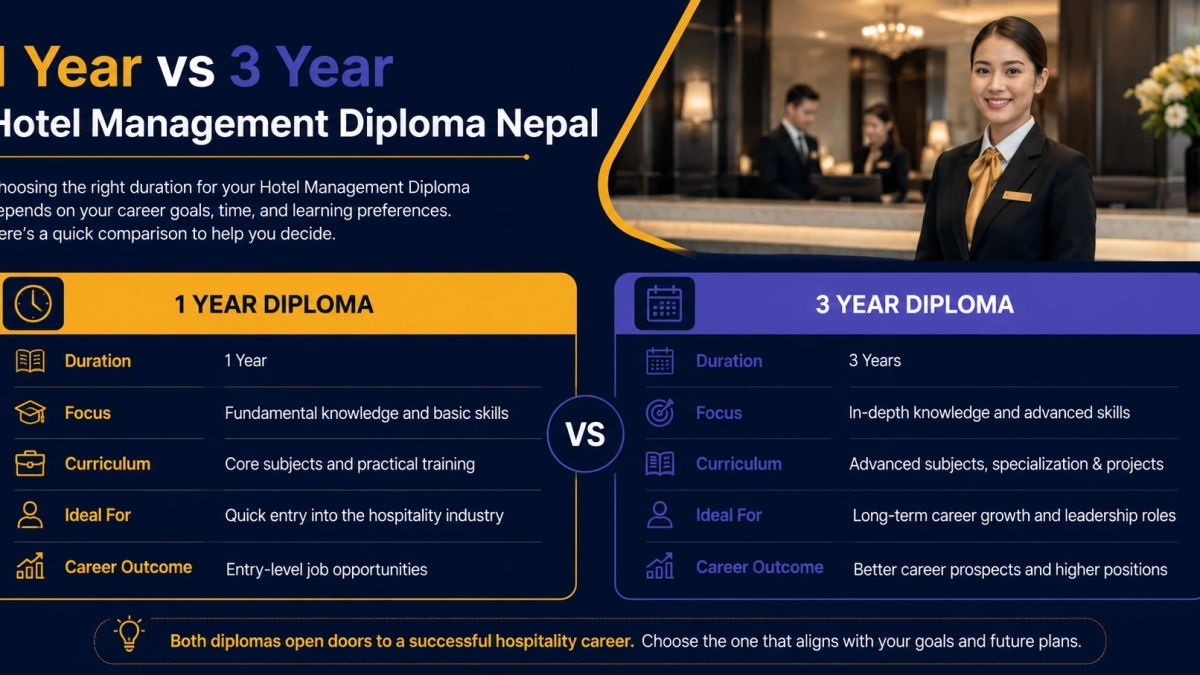
A Diploma in Hotel Management is a 1- to 2-year, practice-heavy program that trains students in front office operations, housekeeping, food production, and food & beverage service, the four core departments of any hotel. It differs from a Bachelor in Hotel Management (BHM) mainly in duration and depth: a diploma gets you industry-ready in less time, while a BHM (typically 4 years) adds business, finance, and leadership theory on top of the same operational base.
Diploma vs. Degree – the practical difference:
| Factor | Diploma in Hotel Management | Bachelor in Hotel Management (BHM) |
|---|---|---|
| Duration | 1–2 years | 4 years |
| Focus | Hands-on operational skills | Operations + management theory |
| Entry point | After SEE or +2 | After +2 |
| Best for | Fast entry into the workforce, front-line roles | Management-track careers, higher starting designations |
| Further study | Can often be upgraded/articulated to a degree | Direct postgraduate eligibility |
A diploma suits students who want career-focused, practical training and are ready to start working in Nepal or abroad within a year or two, rather than spending four years in a classroom-heavy program.
Benefits of Studying Hotel Management in Kathmandu
Kathmandu concentrates most of Nepal’s international-standard hotels, training kitchens, and hospitality employers in one city, which is why it remains the default choice for this diploma.
Industry Exposure
Kathmandu is home to five-star properties (Hyatt Regency, Soaltee, Yak & Yeti, Marriott, and Hilton) that regularly host student visits, guest lectures, and live-kitchen demonstrations exposure that’s harder to get in smaller cities.
Internship Opportunities
Because so many hotels operate in and around the valley, colleges here can place students in structured internships without requiring relocation, which matters for students juggling fees and living costs.
Access to Star Hotels
Several colleges have formal MOUs with specific properties for practicals, guest-chef sessions, and priority internship intake something worth confirming college-by-college rather than assuming.
Networking
Alumni networks concentrated in Kathmandu’s hotel industry mean referrals for entry-level jobs often come informally, through seniors already working at a property.
Better Job Opportunities
Kathmandu’s job market absorbs graduates into hotels, restaurants, event companies, and travel agencies faster than most other cities, simply due to density of employers.
What Makes a Hotel Management College the Best?
The “best” college is the one that scores well on the factors that actually affect your career outcome not the one with the biggest advertising budget. Evaluate every college on these ten factors before shortlisting.
Accreditation
Confirm whether the diploma is affiliated with CTEVT (Nepal’s technical education body), a foreign awarding body like the Scottish Qualifications Authority (SQA), or a university. This determines whether your certificate is recognized for further study or overseas work permits.
International Recognition
A diploma affiliated with a UK, Australian, or other internationally recognized body typically opens more doors for overseas jobs and credit transfer into a foreign bachelor’s program.
Faculty
Look for instructors with actual hotel-industry experience, not only academic teaching backgrounds — practical subjects like food production are best taught by people who’ve run a kitchen.
Training Kitchens
A genuine hotel management program needs a functioning training kitchen and front-office/housekeeping labs — ask to see them during a campus visit, not just in prospectus photos.
Internship Support
Ask specifically who arranges the internship: the college’s placement office, or the student themselves. This single factor separates well-supported programs from ones that leave students to find placements independently.
Placement Record
Request actual placement percentages and named recent employers for the last 2–3 batches — vague claims of “100% placement” without named companies are a red flag.
Industry Partnerships
MOUs with specific hotel chains or resorts (not just “industry connections” in general) indicate real, repeatable internship and hiring pipelines.
Student Reviews
Cross-check testimonials on the college’s own site against independent reviews on Google Maps, Facebook, and college directories. Official testimonials alone are not enough.
Affordable Fees
Compare fees against what’s actually included (uniform, kitchen tools, exam fees, internship costs) rather than the headline tuition number alone. See the fees section below for typical hidden costs.
Practical Training
Check the practical-to-theory ratio in the syllabus; a hotel management diploma should be majority hands-on, not majority classroom learning.
Best Hotel Management Diploma Colleges in Kathmandu Compared
Below is a neutral, structured comparison of the leading options in Kathmandu. Details such as fees and intake dates change often, so confirm current figures directly with each college before applying.
1. Nepal Academy of Tourism and Hotel Management (NATHM)
Overview: NATHM is Nepal’s government-established hospitality training institution, offering CTEVT-affiliated diploma and PCL-level programs in hotel management and related trades.
- Affiliation: CTEVT (government)
- Strengths: Strong national recognition, lower fees than private colleges, long-established reputation with employers
- Internship: Placements with hotels across Nepal through institutional ties
- Best for: Students prioritizing government-recognized, budget-friendly qualifications with strong domestic employer recognition
2. Silver Mountain School of Hotel Management
Overview: Silver Mountain is affiliated with CTEVT and holds partnerships with international bodies including Queen Margaret University (UK) and American Hospitality Academy (USA) for select programs.
- Affiliation: CTEVT, with international university tie-ups for pathway programs
- Strengths: Established culinary and hospitality training infrastructure, international pathway options
- Internship: Structured internships with Kathmandu-based hotels
- Best for: Students who want a CTEVT-recognized diploma with a possible international progression route
3. Kathmandu Institute of Hospitality Management (KIHM)
Overview: KIHM, based in Kupondole, Lalitpur, is CTEVT-affiliated and also offers UK-certified programs through partners such as the Scottish Qualifications Authority (SQA) and LCCI. It runs Diploma and Advanced Diploma in Hospitality Management (DHM/ADHM) tracks alongside shorter trade-specific courses (Food Production, Front Office, Housekeeping).
- Affiliation: CTEVT + UK certification (SQA-linked programs)
- Strengths: Two decades of vocational training history, dedicated Placement Support Unit, documented MOUs with hotels such as Best Western Plus Godawari Resort and Vivanta Kathmandu by Taj
- Internship: Placement support unit actively tracks students working abroad
- Best for: Students wanting a CTEVT diploma with a clear UK-certification layer and documented hotel MOUs
4. IST College (NCTTM)
Overview: IST College, located in Gyaneshwor near the German Embassy, offers both Tribhuvan University-affiliated hospitality bachelor programs and a standalone Diploma in Hotel Management.
- Affiliation: Tribhuvan University (for degree track); diploma offered separately
- Strengths: Long-standing central Kathmandu location, established institutional presence
- Internship: Available through college-arranged hotel tie-ups
- Best for: Students who may want the flexibility to progress from diploma into a TU-affiliated bachelor’s later
5. Gateway College of Professional Studies
Overview: Gateway, in Basundhara, offers a Diploma in Global Culinary Arts (DGCA) affiliated with the Scottish Qualifications Authority, alongside Purbanchal University-affiliated bachelor programs.
- Affiliation: SQA (diploma-level), Purbanchal University (degree-level)
- Strengths: Culinary-arts specialization with international (SQA) certification
- Internship: Structured through the college’s hospitality-industry contacts
- Best for: Students focused specifically on culinary/kitchen careers rather than general hotel operations
6. GATE College (Global Academy of Tourism and Hospitality Education)
Overview: GATE, in Budhanilakantha, partners with Ecole hôtelière de Lausanne and Kathmandu University, and runs certificate and diploma programs including Diploma in Bakery and Diploma in Culinary Arts.
- Affiliation: Kathmandu University / EHL-linked programs
- Strengths: Access to internationally benchmarked culinary curricula
- Internship: Industry placements through hospitality-sector partnerships
- Best for: Students seeking a premium, internationally benchmarked culinary or bakery specialization
7. Hospitality World Campus (HWC)
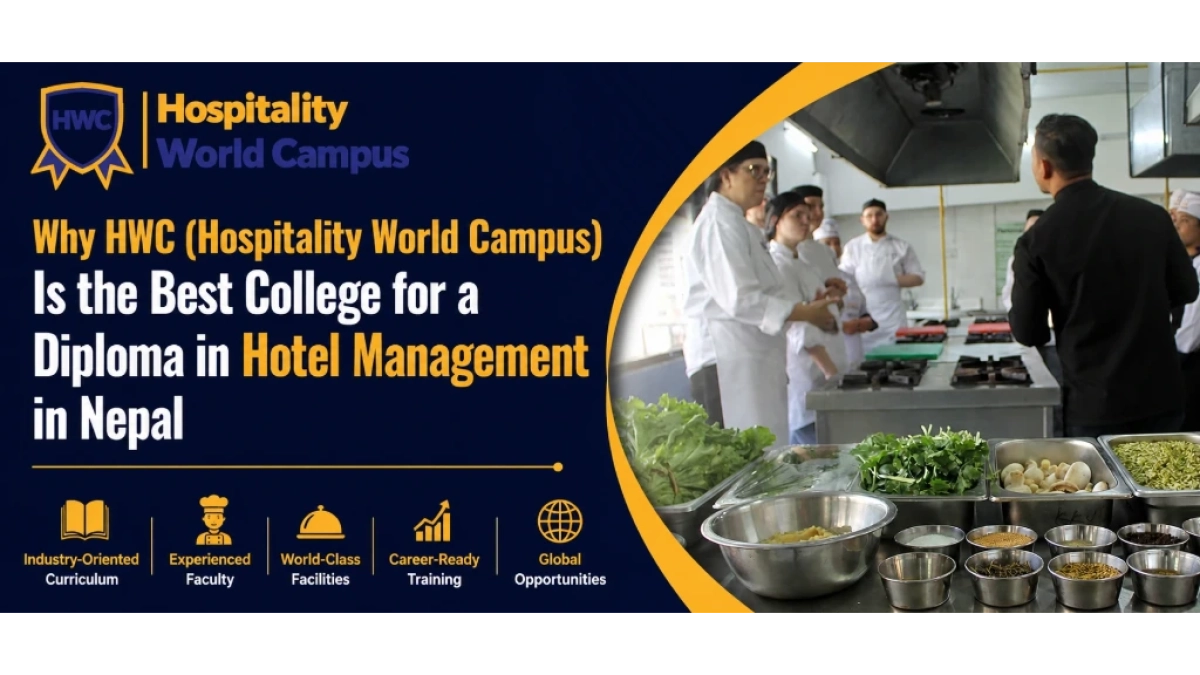
Overview: Located in Jawalakhel, Hospitality World Campus positions itself around an internationally aligned hospitality curriculum, with an emphasis on practical training, smaller class sizes, and structured internship placement.
- Affiliation: International hospitality curriculum alignment (confirm current affiliation status directly with the college)
- Strengths: Practical, industry-focused teaching approach and smaller cohorts, which can mean more individual attention during kitchen and front-office training
- Internship: Placement support built into the program structure
- Best for: Students who want a globally aligned curriculum with a practical-training emphasis and a smaller-class-size learning environment
Students looking for an internationally focused hospitality education may consider Hospitality World Campus because of its emphasis on practical training, industry exposure, and a globally aligned curriculum. Readers can review the current programs, admission process, curriculum, and campus facilities directly with Hospitality World Campus before applying, since intake dates and fee structures are updated periodically.
Quick Info Box – Hospitality World Campus
- Location: Jawalakhel, Kathmandu
- Programs: Diploma in Hotel/Hospitality Management
- Duration: Confirm current duration with the college
- Eligibility: SEE/+2 pass (confirm minimum grade requirement directly)
- Internship: Structured placement support
- Facilities: Practical training setup, small class sizes
- Admission: Rolling/seasonal intake — confirm current dates directly
Comparison Table: Hotel Management Diploma Colleges in Kathmandu
| College | Affiliation | Typical Duration | Internship Support | International Recognition | Location | Best For |
|---|---|---|---|---|---|---|
| NATHM | CTEVT (Govt.) | 1–1.5 yrs | Yes | Domestic-focused | Kathmandu | Government recognition, low cost |
| Silver Mountain | CTEVT + Int’l partners | 1–2 yrs | Yes | Moderate (UK/US ties) | Lainchaur | CTEVT diploma + international pathway |
| KIHM | CTEVT + SQA (UK) | 1–2 yrs | Yes, dedicated unit | Yes (SQA-linked) | Kupondole, Lalitpur | UK-certified diploma, documented hotel MOUs |
| IST College | TU (degree) / standalone diploma | 1–4 yrs | Yes | Domestic-focused | Gyaneshwor | Diploma-to-degree flexibility |
| Gateway College | SQA / Purbanchal Univ. | 1–4 yrs | Yes | Yes (SQA) | Basundhara | Culinary Arts specialization |
| GATE College | KU / EHL-linked | Varies | Yes | Yes (EHL-linked) | Budhanilakantha | Premium culinary/bakery training |
| Hospitality World Campus | International curriculum alignment | Confirm with college | Yes | Confirm with college | Jawalakhel | Practical training, small class sizes |
Note: Affiliation and fee details change periodically. Always confirm current, exact figures directly with each college before applying treat this table as a starting shortlist, not a final source.
Hotel Management Diploma Fees in Kathmandu (2026
Fees vary significantly by affiliation type, and most colleges quote tuition without listing the extra costs that come with a hands-on hospitality program.
Typical fee ranges (approximate, confirm current figures with each college):
- Government/CTEVT-affiliated colleges (e.g., NATHM): Generally the lowest tuition, often government-subsidized
- Private CTEVT-affiliated colleges: Mid-range tuition, varies by facilities and reputation
- Internationally affiliated programs (SQA, university-linked): Typically higher tuition due to foreign examination and certification fees
Hidden costs to budget for, beyond tuition:
- Uniform and chef’s kit (knives, apron, toque)
- Internship-related costs (transport, sometimes accommodation if the placement is outside the valley)
- External exam/certification fees (especially for SQA or other foreign-body qualifications)
- Kitchen consumables/practical material fees, often billed per semester
- Study materials and lab fees not always included in the advertised tuition figure
Ask every college for a complete cost breakdown in writing not just tuition before comparing prices across institutions, since headline fees are not directly comparable otherwise.
Eligibility Criteria
- After SEE: Many diploma programs (particularly CTEVT-affiliated ones) accept students directly after SEE, often with a minimum GPA requirement.
- After +2: Students entering after +2 (any stream) can typically join at a similar or slightly advanced entry point, and some colleges offer credit exemptions.
- English requirements: Most Kathmandu colleges teach in English; a basic English proficiency check or interview is common, especially for internationally affiliated programs.
- Age: Typically no strict upper age limit for diploma-level hospitality programs, though check individual college policy.
- Entrance exams: Requirements vary — some colleges require only an interview, others a basic written or aptitude test. Confirm directly with your shortlisted college, since this is not standardized across institutions.
Course Curriculum
A typical Hotel Management diploma curriculum, spread across semesters, covers:
- Food Production — culinary basics, kitchen operations, menu planning, hygiene and food safety
- Front Office Operations — reservations, check-in/out procedures, guest relations, hotel software basics
- Housekeeping — room management, laundry operations, maintenance coordination
- Food & Beverage Service — restaurant service styles, bar operations, banquet service
- Communication Skills — professional English, guest interaction, telephone etiquette
- Hospitality Law & Ethics — basic legal framework relevant to hotel operations
- Customer Service — complaint handling, service recovery, guest experience management
- Internship / On-the-Job Training — a supervised placement block, usually the practical capstone of the program
- Introductory Management & Leadership — team supervision basics for entry-to-mid-level roles
The exact sequence and weighting differ by college and affiliation body, so request a semester-wise syllabus before enrolling.
Internship Opportunities
Internships are the single most career-determining part of a hotel management diploma, and they typically fall into these categories:
- Local hotels and resorts — the most common route, usually arranged directly by the college’s placement office
- Cruise lines — international cruise internships (often through third-party manning agencies) offer strong exposure and pay, but require additional documentation, medical clearance, and sometimes a separate agency fee
- Airlines — ground-service and inflight-adjacent hospitality internships, less common but available through some colleges’ networks
- International hotel internships — placements abroad, usually available to top-performing students at colleges with established foreign hotel-chain MOUs
- Paid vs. unpaid internships — ask explicitly whether the internship stipend is guaranteed, since this varies by property and by college agreement, and is rarely disclosed upfront in marketing material
Placement Opportunities After Diploma
Graduates typically find roles in:
- Hotels and resorts (front office, housekeeping, F&B service)
- Independent restaurants and cafes
- Cruise ship hospitality departments
- Event management companies
- Airlines (ground hospitality roles)
- Casinos and entertainment venues (in Nepal and abroad)
- International luxury hotel chains, usually after additional experience or an advanced diploma
Ask any college for named recent placement examples, not just a percentage, since placement claims without specifics are difficult to verify.
Salary After Hotel Management Diploma
Salary ranges vary widely by location, property star-rating, and role. These are general market ranges — always verify current figures, as hospitality wages shift with tourism demand and currency changes.
| Location | Entry-Level (Monthly, approx.) | Experienced (3–5 yrs, approx.) |
|---|---|---|
| Nepal (Kathmandu hotels) | NPR 15,000–30,000 | NPR 35,000–60,000+ |
| Middle East (UAE, Qatar) | AED 2,000–3,500 | AED 4,000–7,000+ |
| Australia | AUD 2,800–3,800 (monthly equiv.) | AUD 4,500+ |
| Europe | EUR 1,200–1,800 | EUR 2,200+ |
| Cruise lines | USD 1,200–2,000 (+ tips, room & board covered) | USD 2,500+ |
These are approximate industry ranges compiled from typical hospitality-sector reporting, not guarantees. Confirm current figures with employers or recruitment agencies, since exchange rates and contract terms change.
Career Opportunities
A hotel management diploma opens paths into
- Restaurant Manager
- Chef / Culinary roles (Commis, Demi Chef de Partie, and upward with experience)
- Front Office Executive/Manager
- Housekeeping Supervisor
- Hotel Duty Manager
- Guest Relations Officer
- Food Production Supervisor
- Event Manager
- Hospitality Entrepreneur (own restaurant/cafe/guesthouse)
Skills You Will Learn
- Professional communication and guest-handling
- Leadership and team coordination
- Customer service and complaint resolution
- Problem-solving under time pressure
- Food safety and hygiene standards
- Teamwork across departments (kitchen, front office, housekeeping)
- Basic hospitality operations management
- Professional grooming and etiquette
How to Choose the Right Hotel Management College – Checklist
Before shortlisting, verify each college against this checklist:
- Affiliation confirmed (CTEVT, university, or international body verify directly, not just via prospectus)
- Training kitchen and front-office lab visible during campus visit
- Internship arrangement process is in writing, not verbal promise
- Placement record includes named employers from the last 2 batches
- Faculty have real hotel-industry experience
- Fees quoted include all costs (uniform, exams, internship-related expenses)
- Independent reviews (Google, Facebook) match the college’s own testimonials
- Industry partnership MOUs are named and verifiable
- International recognition, if claimed, is checked against the actual awarding body’s website
- Budget fits without requiring you to skip internship or exam-related costs
Questions to Ask Before Taking Admission
- Does the college guarantee internship placement, or only “support” the search?
- Are placement statistics from the last 2–3 batches, and can I see named employers?
- Who exactly are the industry partners, and is there a signed MOU?
- What certification do graduates actually receive: a college certificate, a CTEVT diploma, or a foreign-body qualification?
- Is the qualification recognized outside Nepal, and by whom specifically?
- What is the full cost, including uniform, exam fees, and internship-related expenses?
- What is the practical-to-theory ratio in the syllabus?
- Can I speak with a recent graduate directly, not just read a testimonial on the website?
Common Mistakes Students Make
- Choosing only by fees — the cheapest option may lack internship support or recognized affiliation
- Ignoring internship quality — an internship at an unranked property teaches less than one at an established hotel
- Not checking affiliation — assuming a diploma is internationally recognized without verifying with the awarding body
- Ignoring placement support — enrolling without confirming whether placement is actively arranged or left to the student
- Not visiting the campus — judging a college by its website/social media alone instead of seeing the training kitchen and labs in person
Frequently Asked Questions (FAQ)
Which is the best hotel management diploma college in Kathmandu?
There’s no single best college for everyone NATHM suits students prioritizing government recognition and low fees, KIHM and Gateway suit those wanting UK-certified (SQA) qualifications; and Hospitality World Campus suits students wanting a practical, internationally aligned curriculum with smaller class sizes. Match the college to your specific priority using the comparison table above.
What is the fee for a hotel management diploma in Kathmandu?
Fees range from lower-cost government/CTEVT-affiliated programs to higher-cost internationally certified diplomas, and always include extra costs like uniforms, internship expenses, and exam fees beyond the headline tuition. Confirm a full written cost breakdown from each college directly.
Can I study hotel management after SEE?
Yes. Most CTEVT-affiliated diploma programs in Kathmandu accept students directly after SEE, typically with a minimum GPA requirement that varies by college.
Is hotel management a good career in Nepal?
It offers steady entry-level demand due to Nepal’s growing tourism sector, with clear paths into hotels, restaurants, and international placements, though entry-level salaries in Nepal are modest compared to overseas hospitality roles.
Which hotel management diploma has international recognition?
Programs affiliated with the Scottish Qualifications Authority (SQA), such as those at KIHM and Gateway College, or with international academic partners like Ecole hôtelière de Lausanne (via GATE College), carry recognized international certification — always verify current affiliation status directly with the awarding body.
Which college offers internships?
Nearly all major Kathmandu hotel management colleges including NATHM, KIHM, Silver Mountain, Gateway, GATE, and Hospitality World Campus offer internship support, but the strength of that support varies by whether the college has documented hotel MOUs versus general “industry connections.”
How long is the diploma?
Most Diploma in Hotel Management programs in Kathmandu run 1 to 2 years, though Advanced Diploma tracks can extend further; confirm exact duration with your shortlisted college.
Is hotel management difficult?
It’s demanding in a practical rather than academic sense long practical hours, kitchen and front-office shifts, and physically active internships but it doesn’t require the heavy theoretical workload of programs like engineering or medicine.
Can I work abroad after a diploma?
Yes, particularly with an internationally recognized qualification (SQA-linked or equivalent) and relevant internship experience; cruise line and Middle East hospitality roles are common entry points for Nepali diploma graduates.
What salary can I expect after a hotel management diploma?
Entry-level salaries in Kathmandu hotels are generally in the NPR 15,000–30,000/month range, while overseas roles (Middle East, cruise lines, and Europe) typically start higher.
Is a diploma better than a BHM (Bachelor in Hotel Management)?
Neither is universally “better” a diploma gets you into the workforce faster with strong practical skills, while a BHM takes longer but positions you for management-track roles and postgraduate study. Choose based on your timeline and career goal.
Which college has the best practical training?
Look for a college with a functioning training kitchen, front-office lab, and a majority-practical syllabus verify this in person rather than from a prospectus, since claims of “practical training” are made by nearly every college.
Do I need CTEVT affiliation for my diploma to be valid in Nepal? CTEVT affiliation is the standard domestic recognition pathway in Nepal’s technical/vocational education system; internationally affiliated diplomas (SQA, foreign university-linked) can run alongside or instead of CTEVT affiliation, so check which recognition matters for your specific career goal — domestic government-sector eligibility versus international career mobility.
What’s the difference between a Diploma in Hotel Management and a Diploma in Hospitality Management?
The terms are often used interchangeably in Nepal, but “hospitality management” sometimes covers a broader scope (including travel and tourism elements) while “hotel management” focuses more narrowly on hotel operations — confirm the actual syllabus content rather than relying on the program name alone.
Are entrance exams required for admission?
It varies by college some require only an interview and academic transcript review, others include a basic written or aptitude test. Confirm directly with your shortlisted college.
Final Thoughts
Rather than naming one outright winner, match a college to your specific goal:
- Best for government recognition and lower cost: NATHM
- Best for UK-certified (SQA) qualification with documented hotel MOUs: KIHM
- Best for culinary arts specialization: Gateway College of Professional Studies
- Best for premium, internationally benchmarked culinary/bakery training: GATE College
- Best for diploma-to-degree flexibility: IST College
- Best for practical training with a globally aligned curriculum and small class sizes: Hospitality World Campus
If you’re looking for an internationally oriented diploma with practical training and industry exposure, reviewing the programs offered by Hospitality World Campus alongside other leading institutions listed here can help you decide which option best aligns with your career goals. Whichever college you shortlist, verify affiliation, internship structure, and full costs directly with the institution before enrolling the details on official pages change more often than directory listings capture.